
The Social Security Break-Even Age Is the Wrong Question
Most retirees decide when to claim Social Security by finding their break-even age. It's the wrong question — here's the lens that actually protects your retirement and your spouse.

Ask most people how they decided when to claim Social Security, and you’ll hear some version of the same answer: they found their break-even age. Claim at 62 and you get smaller checks starting sooner. Wait until 70 and you get much bigger checks starting later. Somewhere out in your early eighties, the delayed path finally catches up and passes the early one. That crossover is the break-even age, and for a lot of retirees it is the decision.
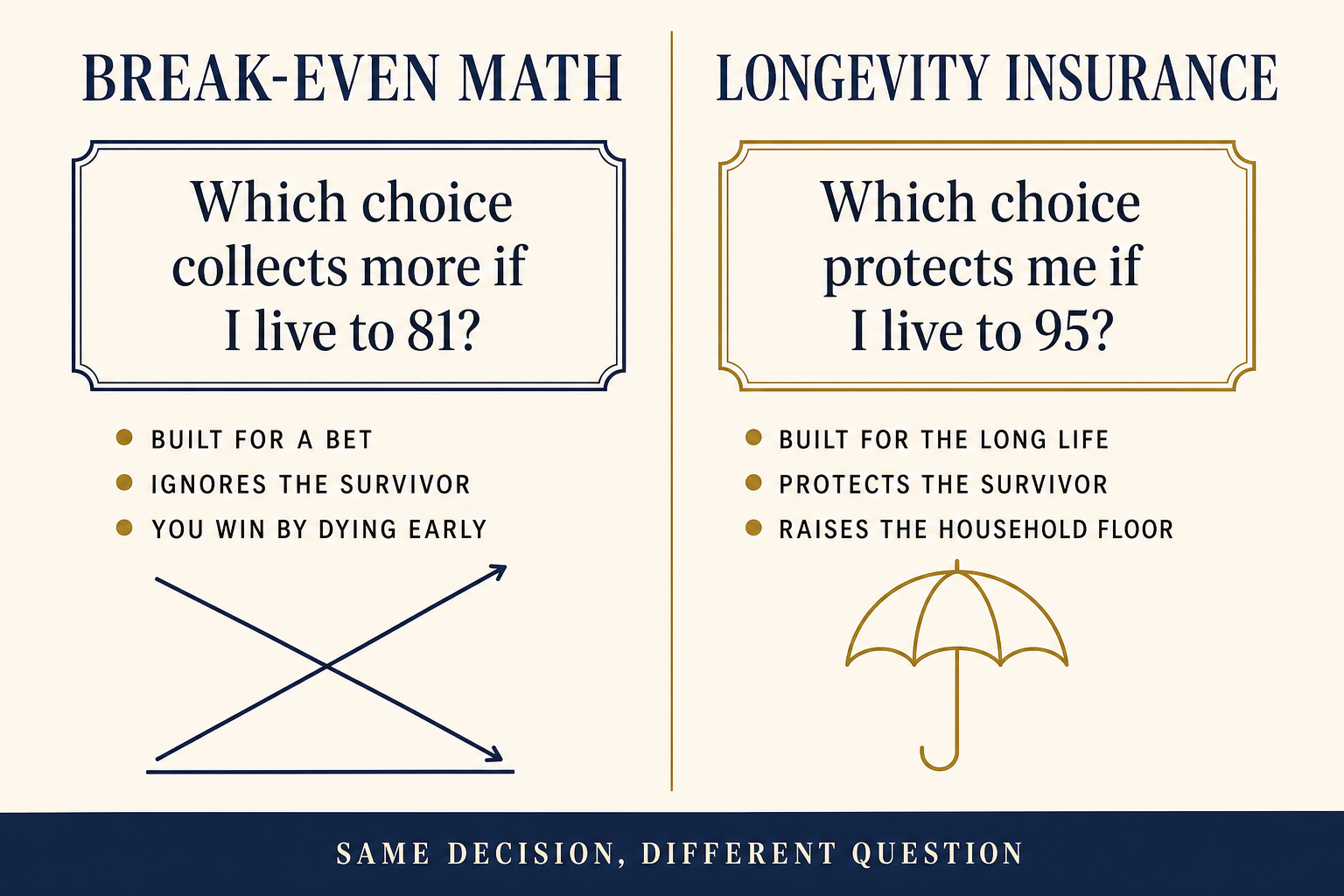
I want to make the case that it’s the wrong question — not a little off, but pointed at the wrong thing entirely. The break-even age answers “which choice collects more total dollars if I live to exactly age X.” That’s a fine question for an investment. Social Security isn’t an investment. It’s insurance against the one financial risk you can’t diversify away: living a long time.
The break-even question everyone starts with
The math behind break-even is real, so let’s give it its due. For anyone born in 1960 or later, full retirement age is 67. Claim at 62 and your benefit is reduced by as much as 30% — you collect 70% of your full benefit for life. Wait past your full retirement age and you earn delayed retirement credits worth 8% a year until they stop at 70, where your check lands at 124% of the full amount. Put the two ends together and the benefit at 70 is roughly 77% larger than the benefit at 62 (124% of your full benefit versus 70%). The reduction and credit schedule is set in statute, so this isn’t a projection — it’s arithmetic.
Run that arithmetic and the early checks are ahead for a long time, because the person who claimed at 62 has a head start of eight years of payments. The delayed check is bigger every month, but it has to claw back all those missed years before it pulls ahead. For most people the crossover lands somewhere around age 81. Live past that, waiting “won.” Die before it, claiming early “won.”
That framing feels rigorous. It produces a specific number. And it quietly smuggles in an assumption that falls apart the moment you say it out loud.
Why break-even is the wrong lens
Here’s the assumption: that the goal is to collect the most total dollars from the program. Think about what it actually means to “win” a break-even bet. You win by dying before the crossover. You collect your bigger pile of early checks and then you’re gone. Nobody plans their retirement around the scenario where the good outcome is an early death.
Insurance runs on the opposite logic, and Social Security is insurance. You don’t buy homeowner’s coverage hoping your house burns down so you can “break even” on the premiums. You buy it so that the one catastrophe you can’t absorb doesn’t wipe you out. The catastrophe Social Security protects against isn’t dying early — your problem is solved if you die early. It’s living to 95 with your portfolio drawn down and your other income sources exhausted. Against that risk, the larger lifetime check isn’t a bet that paid off. It’s the coverage doing its job.
Once you see it that way, the break-even age stops being the answer and becomes a footnote. You’re no longer asking “which choice wins if I live to 81.” You’re asking “which choice protects me if I live to 95 — the outcome I actually have to survive.”
The two questions that actually decide it
Replace the break-even question with two better ones. The first: which claiming age best protects you against outliving your money? Delaying converts a portion of your longevity risk into a guaranteed, inflation-adjusted income stream you cannot outlive. Every future cost-of-living adjustment then compounds on the larger base, so the gap between the early and late check doesn’t just persist — it widens for the rest of your life. If the risk you lie awake over is running out at 90, the bigger check is the most direct hedge you can buy, and it’s typically cheaper than buying the same guarantee from a commercial annuity.
The second question matters even more for married couples, and the break-even calculators almost always miss it: which claiming age best protects the surviving spouse? When one spouse dies, the household keeps the larger of the two Social Security checks and loses the smaller one. That survivor benefit is locked to what the higher earner was receiving. So when the higher earner delays, they aren’t just growing their own check — they’re setting the income floor for whichever spouse lives longest, potentially for decades of widowhood. That’s not a bet on one person’s lifespan. It’s insurance on the household’s longest life, and it’s the single most overlooked reason to delay. I’ve written more on the timing move most widows miss and on how spousal benefits work while both spouses are alive, because the household lens changes the answer more than any break-even chart.
A hypothetical: Howard and Nancy
Consider a hypothetical couple: Howard and Nancy, both 64, recently retired outside Winston-Salem. Howard was the higher earner, with a full benefit of $2,900 a month at 67. Nancy’s own full benefit is $1,300. They ran a break-even calculator, saw the crossover for Howard land around age 81, and Howard — who feels healthy but watched his father die at 74 — leaned toward claiming early to “not leave money on the table.”
Watch what the two lenses do to the same decision. If Howard claims at 62, his check is about $2,030. If he waits to 70, it’s about $3,596. The break-even lens says: bet on your own longevity, and if you’re right you come out ahead around 81. But shift to the survivor lens. Howard is statistically likely to die first. Whenever he does, Nancy’s own $1,300 stops and she steps up to a survivor benefit equal to Howard’s check. Claim early, and Nancy’s floor for the rest of her life is $2,030. Delay to 70, and it’s $3,596 — more than $1,500 a month, every month, for as long as she lives, with COLAs stacked on top.
Howard’s early death, the scenario that “wins” the break-even bet, is exactly the scenario where delaying pays Nancy the most. The break-even chart treated his shorter life expectancy as a reason to claim early. The insurance lens treats it as the strongest reason to delay. Same numbers, opposite conclusion — because one of them was asking the right question.
When claiming early is genuinely the right call
None of this makes delaying automatic. There are honest reasons to claim early, and pretending otherwise would be its own kind of dishonesty. If you have a serious health condition and a genuinely shortened life expectancy — and no spouse whose survivor benefit you’re protecting — the longevity insurance is worth less to you, and claiming early can be the sound choice. If you’re single with no survivor to shield, the household argument simply doesn’t apply. And if claiming early is the difference between covering your groceries and selling investments at a loss in a down market, the income you need today beats the larger check you might collect at 90.
The point isn’t that everyone should wait until 70. It’s that “when do I break even” is the wrong tool for making the call. The right inputs are your health, your marital situation, whether you have other assets to bridge the gap, and how much you fear outliving your money — not the age at which two lines cross on a chart. For those who do want to wait, a change of heart isn’t always final; there are ways to suspend and re-earn credits after full retirement age.
This is really a question about your income floor
Regulars here know where this lands. In the Now, Soon, Later bucket framework, Social Security is the anchor of the Soon bucket — the guaranteed income floor that covers your essential bills no matter what the market does. Delaying isn’t about maximizing a number. It’s about building the highest, most durable floor your household can get, so the Later bucket can stay invested and a bad market never touches your grocery money.
Seen from the floor, the claiming decision is really a floor-sizing decision. The bigger your Social Security check, the smaller the gap your savings and any income-focused annuity have to fill, and the less of your longevity risk you’re carrying yourself. That’s why I treat the years between retirement and a delayed claim as a planning problem worth solving on purpose — I’ve walked through the mechanics in the bridge years problem and in how to size your income floor target. The break-even age has nothing to say about any of that, because it was never asking about your floor. It was asking about a bet.
So before you claim, throw out the break-even chart — or at least demote it to the footnote it deserves to be. Ask instead which choice protects you if you live longer than you expect, and which choice protects the person who outlives you. Those are the questions Social Security was built to answer. Answer them, and the claiming age mostly picks itself.
If you want to see how the two paths compare for your own numbers — including the survivor floor most calculators leave out — you can run your situation through our Social Security calculator and look at the decision through the lens that actually matters.
Key takeaways
- The break-even age answers “which choice collects more dollars if I live to age X” — a good question for an investment, the wrong one for insurance.
- You “win” a break-even bet by dying before the crossover. Social Security exists to protect the opposite risk: living a long time.
- Delaying converts longevity risk into a larger, COLA-adjusted, guaranteed check you can’t outlive — typically cheaper than buying the same guarantee commercially.
- For married couples, the higher earner’s claiming age sets the survivor’s floor for life. Delaying protects the household’s longest life, not just the claimant’s.
- Claiming early can be right — shortened life expectancy with no spouse to protect, no survivor to shield, or a real need for income today. Just decide it on those inputs, not on where two lines cross.
This article is published by Confluence Media Group LLC, an independent publisher of educational financial content. Thomas Clark is a Series 65 Investment Advisor Representative. The information provided is for educational and informational purposes only and is not personalized financial, tax, or legal advice. Past performance does not guarantee future results. All investing involves risk, including potential loss of principal. Consult a qualified professional before making financial decisions.
Confluence Media Group LLC is a separate entity from Confluence Capital Management, the investment advisory practice through which Thomas Clark provides advisory services. Advisory services are not offered through this publishing platform.
About Thomas Clark
Thomas Clark is the founder of Confluence Media Group LLC and a Series 65 Investment Advisor Representative. He has spent nearly two decades working with families on retirement planning, with a focus on Social Security optimization, retirement income coordination, and the bucket planning approach to building a guaranteed income floor.
Thomas writes and publishes at thomasclarkadvisor.com and is the author of The Just in Case Binder — a 148-page printable family financial organizer for households who want to make sure the people they love know where everything is.
He lives in North Carolina with his family.
Subscribe to the weekly newsletter · Get the Just in Case Binder

Thomas Clark is a Series 65 licensed investment advisor and experienced trader. He specializes in investing, retirement planning, and market analysis, helping individuals build wealth and make informed financial decisions.
