
Social Security Spousal Benefits: How the 50% Rule Works
A spousal Social Security benefit tops out at 50% of your spouse's full benefit — and unlike your own, it stops growing at full retirement age. Here's how the 50% rule works.

The spousal Social Security benefit is the most misunderstood check in the whole system. I see two beliefs about it again and again, and both of them cost couples real money.
The first is that waiting past full retirement age makes a spousal benefit grow, the way delaying your own retirement benefit does. It doesn’t. The second is that the spousal benefit is calculated from whatever your higher-earning spouse actually collects, including any delay bonus they earned. It isn’t. The spousal benefit answers to its own set of rules, and once you understand them, the right claiming move usually gets a lot clearer.
Here is how the spousal benefit actually works, what sets its ceiling, and where it fits in a retirement income plan.
What the spousal benefit actually is
A spousal benefit lets a husband or wife claim Social Security on the other spouse’s work record. The maximum is 50% of the higher earner’s primary insurance amount — the benefit that worker would receive at their own full retirement age. Social Security calls that figure the PIA, and it is the number everything here hinges on.
You don’t get your own benefit and a full 50% on top of it. Social Security pays the larger of the two, then tops up the difference. If your own retirement benefit is smaller than half of your spouse’s PIA, you receive your own amount plus a spousal “excess” that brings you up to the 50% figure. If your own benefit is already larger than half your spouse’s PIA, the spousal benefit gives you nothing — your own record wins.
That is why the spousal benefit matters most for the lower-earning spouse in a household where the two earnings records are lopsided: the stay-at-home parent, the spouse who worked part-time for two decades, the one whose career paid far less. For two high earners with similar records, the spousal benefit rarely comes into play at all.
The ceiling is set at full retirement age — and delaying past it does nothing
This is the point that trips up the most people, so I’ll state it plainly. Spousal benefits do not earn delayed retirement credits. Your own retirement benefit grows by 8% a year for every year you postpone it past full retirement age, up to age 70. A spousal benefit does not. It tops out at 50% of your spouse’s PIA at your full retirement age, and waiting until 68, 69, or 70 to claim it adds exactly zero.
So if your retirement income is going to lean on a spousal benefit, there is no reason to delay it past your full retirement age. Claiming it then is the right move, not a missed opportunity.
There’s a second, related surprise. The 50% is based on your spouse’s PIA — their full-retirement-age figure — not on the larger check they collect if they delayed to 70. Your higher-earning spouse delaying their own benefit is one of the best moves a household can make, but understand what it does and doesn’t do. It grows their own monthly check, and it permanently raises the survivor benefit the surviving spouse will eventually receive. It does not raise the spousal benefit you collect while you’re both alive. That stays anchored to the PIA.
Thomas’s Take: A higher earner delaying to 70 is really buying two things — a bigger check for themselves now and a bigger survivor benefit for whoever outlives the other. The spousal benefit while both are living isn’t part of that trade. Once you separate those three numbers, the claiming decision stops feeling like a guess.
Claiming early shrinks it — down to about 32.5%
If 50% is the ceiling at full retirement age, claiming earlier brings it down. A spouse can start a spousal benefit as early as 62 (earlier if they’re caring for the worker’s child who is under 16 or disabled), but the reduction for going early is steep.
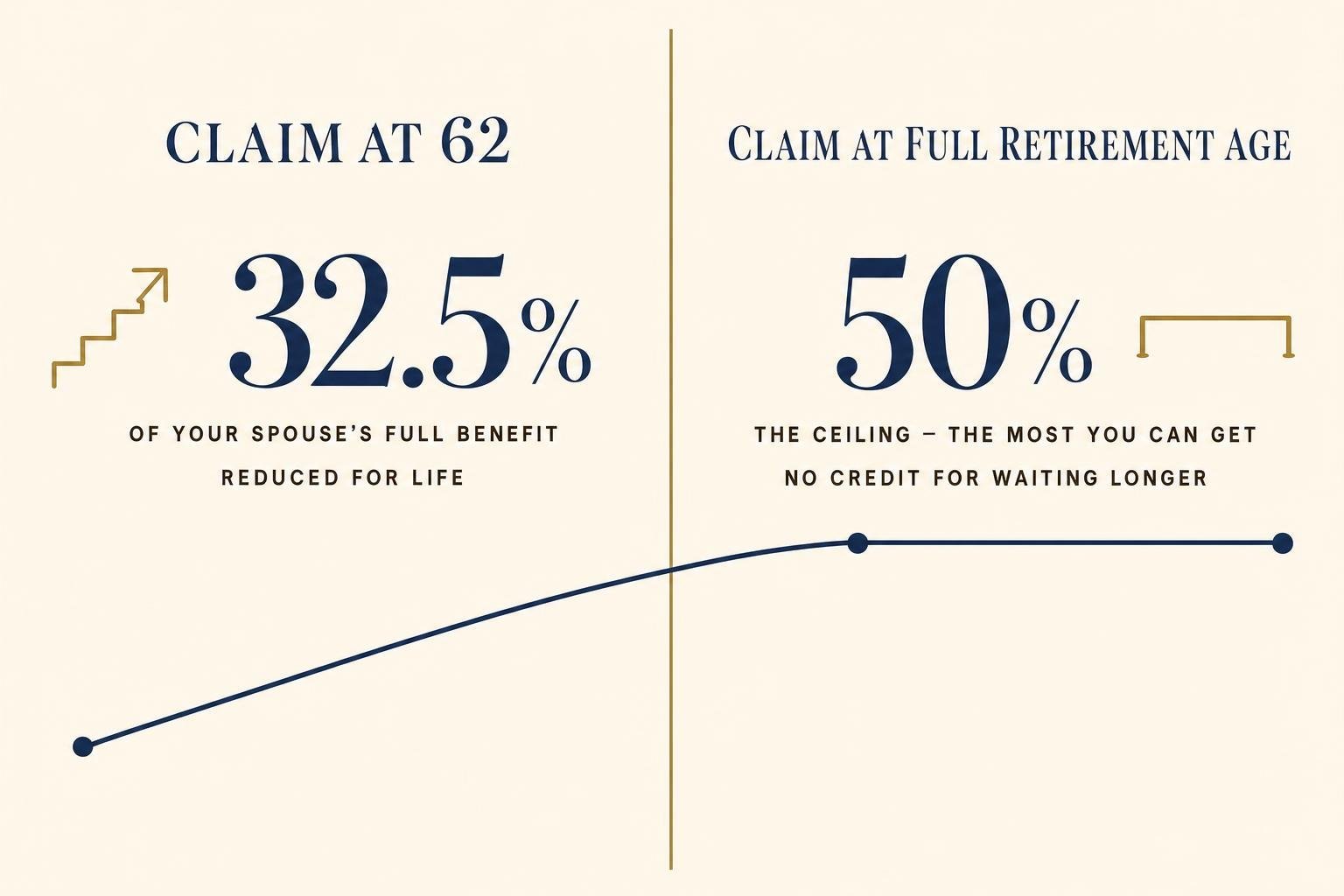
For someone whose full retirement age is 67, claiming a spousal benefit at 62 drops it to roughly 32.5% of the worker’s PIA instead of the full 50%. Social Security reduces the spousal amount by 25/36 of 1% for each of the first 36 months you claim early, then 5/12 of 1% for each additional month. Over the full five years, that’s a 35% haircut on the spousal portion. You can see the exact reduction table on the SSA’s benefits-for-spouses page.
So the entire claiming “curve” for a pure spousal benefit runs from 32.5% at 62 up to 50% at full retirement age — and then it’s flat. Knowing the line stops climbing at FRA is what keeps people from leaving the benefit unclaimed for years, believing it’s still growing.
You can’t claim a spousal benefit until your spouse has filed
One requirement catches couples off guard during the planning conversation: you generally cannot collect a spousal benefit until the worker whose record you’re claiming on has filed for their own benefit. Your eligibility is tied to their claim.
There used to be a workaround called “file and suspend,” where the higher earner filed to unlock the spousal benefit and then immediately suspended their own to keep earning delayed credits. That door closed in April 2016. Today, if your higher-earning spouse suspends their benefit, any spousal benefit on their record suspends right along with it. I walked through the mechanics of that in the post on when Social Security suspension still makes sense.
The practical effect is that the two claims have to be coordinated. If the plan is for the higher earner to delay to 70 for the bigger check and survivor benefit, the lower earner usually can’t begin a spousal benefit until that point — which is one more reason to bridge those years deliberately rather than letting the timing default to itself.
Deemed filing closed the old “restricted application” trick
If you were born on January 2, 1954 or later — which now covers essentially everyone reaching retirement age — a rule called deemed filing applies. When you file for either your own retirement benefit or a spousal benefit, Social Security treats you as having filed for both, and pays you the higher of the two. You can no longer file a “restricted application” to collect only the spousal benefit while letting your own retirement benefit grow to 70. The Bipartisan Budget Act of 2015 phased that strategy out. The SSA’s filing-rules page spells out exactly how deemed filing works.
One important exception worth knowing: deemed filing applies to retirement and spousal benefits, but not to survivor benefits. A surviving spouse can still choose to take a survivor benefit first and switch to their own later, or vice versa. That distinction is the whole reason survivor-benefit timing is a separate conversation from spousal timing — I covered it in the post on the restricted application and survivor benefits.
A hypothetical to put the numbers together
Consider a hypothetical couple: Ray and Donna, both 63, living outside Charlotte. Ray was the primary earner, with a PIA of $2,800 at his full retirement age of 67. Donna raised their kids and worked part-time for years; her own retirement benefit comes to about $900 at her full retirement age.
Donna’s spousal maximum is 50% of Ray’s PIA — $1,400 a month. Because her own benefit ($900) is smaller, Social Security would pay her the $900 from her own record plus a $500 spousal excess to reach $1,400, once she’s at full retirement age and Ray has filed.
Now watch what doesn’t change. Ray decides to delay his own benefit to 70, growing his check to roughly $3,470. That’s a smart move — it lifts his monthly income and locks in a larger survivor benefit for Donna if he dies first. But Donna’s spousal benefit stays at $1,400, because it’s tied to Ray’s $2,800 PIA, not his delayed $3,470. And if Donna had claimed that spousal benefit early at 62, it would have shrunk to roughly $910 a month — and stayed there for life.
Three timing decisions are hiding inside one household here: Ray’s own claim, Donna’s own claim, and the survivor benefit. The spousal benefit sits across all three, capped and unmoving — and planning around it means knowing which levers actually move it.
Where the spousal benefit fits in a retirement income plan
In bucket planning, guaranteed lifetime income belongs in the Soon bucket — the layer that covers your essential bills no matter what the market does. A spousal benefit is exactly that kind of income: guaranteed, inflation-adjusted, and paid for life. The job in planning is to know its real size so you don’t over- or under-build the rest of the floor around it.
That’s where the mistakes I opened with get expensive. A couple who assumes the spousal benefit keeps growing past full retirement age might delay it for years and forfeit the income. A couple who assumes it scales with the higher earner’s delayed check might size their income floor on a number that never arrives. Getting the spousal figure right is what lets you build the rest of the plan on solid ground.
You can check your spouse’s benefit estimate in your my Social Security account, and to see how the spousal benefit and the two own-benefit claims interact for your own numbers, the Social Security calculator on the site lets you test different claiming ages side by side before you commit to anything.
Key takeaways
- The ceiling is 50% of the PIA. A spousal benefit tops out at half your spouse’s full-retirement-age benefit — not their delayed, age-70 check.
- Delaying a spousal benefit past full retirement age does nothing. Spousal benefits earn no delayed retirement credits, so there’s no reason to wait past your FRA to claim one.
- Claiming early shrinks it permanently. At 62 with an FRA of 67, the spousal benefit falls to about 32.5% of the worker’s PIA.
- Your spouse has to file first. You generally can’t collect a spousal benefit until the worker on whose record you’re claiming has filed for their own.
- Deemed filing closed the restricted-application loophole for anyone born in 1954 or later — but it doesn’t apply to survivor benefits.
Frequently asked questions
Can I collect a spousal benefit and my own retirement benefit at the same time?
Not as two separate checks. Social Security pays your own benefit first and adds a spousal “excess” only if half your spouse’s PIA is larger. The result is a single combined payment equal to the higher of the two amounts.
Does my claiming a spousal benefit reduce what my spouse receives?
No. A spousal benefit paid on your spouse’s record has no effect on the worker’s own benefit. The household just collects more in total. (A separate rule, the family maximum, can cap total benefits paid on one record when several people claim on it — I covered that in the post on the Social Security family maximum.)
How long do we have to be married for me to qualify?
Generally one year of marriage before you can claim a spousal benefit on a current spouse’s record. Divorced-spouse benefits follow different rules, including a ten-year marriage requirement.
The spousal benefit isn’t complicated once you stop expecting it to behave like your own retirement benefit. It caps at half the PIA, it stops growing at full retirement age, and it depends on your spouse having filed. Know those three things, and you can size it correctly and claim it at the right time — which, for a benefit this many couples misread, is most of the battle.
This article is published by Confluence Media Group LLC, an independent publisher of educational financial content. Thomas Clark is a Series 65 Investment Advisor Representative. The information provided is for educational and informational purposes only and is not personalized financial, tax, or legal advice. Past performance does not guarantee future results. All investing involves risk, including potential loss of principal. Consult a qualified professional before making financial decisions.
Confluence Media Group LLC is a separate entity from Confluence Capital Management, the investment advisory practice through which Thomas Clark provides advisory services. Advisory services are not offered through this publishing platform.
About Thomas Clark
Thomas Clark is the founder of Confluence Media Group LLC and a Series 65 Investment Advisor Representative. He has spent nearly two decades working with families on retirement planning, with a focus on Social Security optimization, retirement income coordination, and the bucket planning approach to building a guaranteed income floor.
Thomas writes and publishes at thomasclarkadvisor.com and is the author of The Just in Case Binder — a 148-page printable family financial organizer for households who want to make sure the people they love know where everything is.
He lives in North Carolina with his family.
Subscribe to the weekly newsletter · Get the Just in Case Binder

Thomas Clark is a Series 65 licensed investment advisor and experienced trader. He specializes in investing, retirement planning, and market analysis, helping individuals build wealth and make informed financial decisions.
