
Bucket Planning and Social Security Delay: The Bridge Years Problem
The decision to delay Social Security to 70 isn't really about Social Security — it's about how to fund the bridge years in between. Here's how bucket planning solves the bridge problem, where the bridge money comes from, and the four questions that decide whether delay is your move.

The hardest stretch of a retirement plan isn’t year 20 or year 30. It’s the first few years — the window between when the paycheck stops and when the largest guaranteed income source finally turns on.
For most retirees without a pension, that source is Social Security. And the version of Social Security that makes the rest of the plan work is the one that arrives at 70, not the one that’s available at 62. The benefit at 70 is roughly 76% higher than the benefit at 62, per the Social Security Administration’s delayed retirement credit schedule, and that larger number then carries every future cost-of-living adjustment on top of it.
The catch is structural. The decision to delay is not really a decision about Social Security. It’s a decision about how to fund the bridge years in between — and that’s a bucket planning problem, not a Social Security problem. Most retirement content gets that backwards.
Why the bridge years are the hardest stretch of retirement
The bridge years are the gap between when essential expenses start and when the full Soon-bucket income floor — Social Security at the optimal claim age, any pension, any deferred annuity income rider — turns on. For a household retiring at 62 and planning to claim Social Security at 70, that gap is eight years. For someone retiring at 65 who plans to claim at 70, it’s five.
Three things make this stretch difficult. First, every dollar spent during the bridge comes from the portfolio, which means a bad sequence of returns lands on a smaller-than-target Soon bucket. Second, the discipline to actually delay tends to crack in the second or third year, especially during a market drawdown, when the larger check at 70 feels far away and the smaller one available now feels real. Third, taxes during these years are often as favorable as they’ll ever be — earned income has stopped, Social Security hasn’t started, and Required Minimum Distributions are still a decade out. That’s a window worth using, not a stretch to white-knuckle through.
None of these problems are unique to delaying Social Security. They’re the structural problems of early retirement. But the decision to delay forces a household to confront them earlier and more sharply than the alternative does.
The 76% reason most pre-retirees should at least consider delay
Between age 62 and full retirement age (67 for anyone born in 1960 or later), the Social Security benefit grows by roughly 6.5% to 8% a year — depending on how close to FRA the claim falls. Between FRA and 70, delayed retirement credits add another 8% per year for a total lift of 32% over those three years. Stack the two stretches together and the difference between the 62 check and the 70 check is around 76%.
For a household whose Primary Insurance Amount at FRA is $2,800, that means a 62 benefit of roughly $1,960 versus a 70 benefit of roughly $3,472. Across a 25-year retirement the lifetime difference runs into six figures — and the surviving spouse, if there is one, inherits the larger number for life under the Social Security survivor rules.
That last detail matters more than most pre-retirees realize. The household claim at 70 isn’t just optimizing for one life. It’s setting the inflation-adjusted floor that the longer-lived spouse will live on after the first death — often the financially harder half of the retirement.
The bridge problem, reframed as a bucket problem
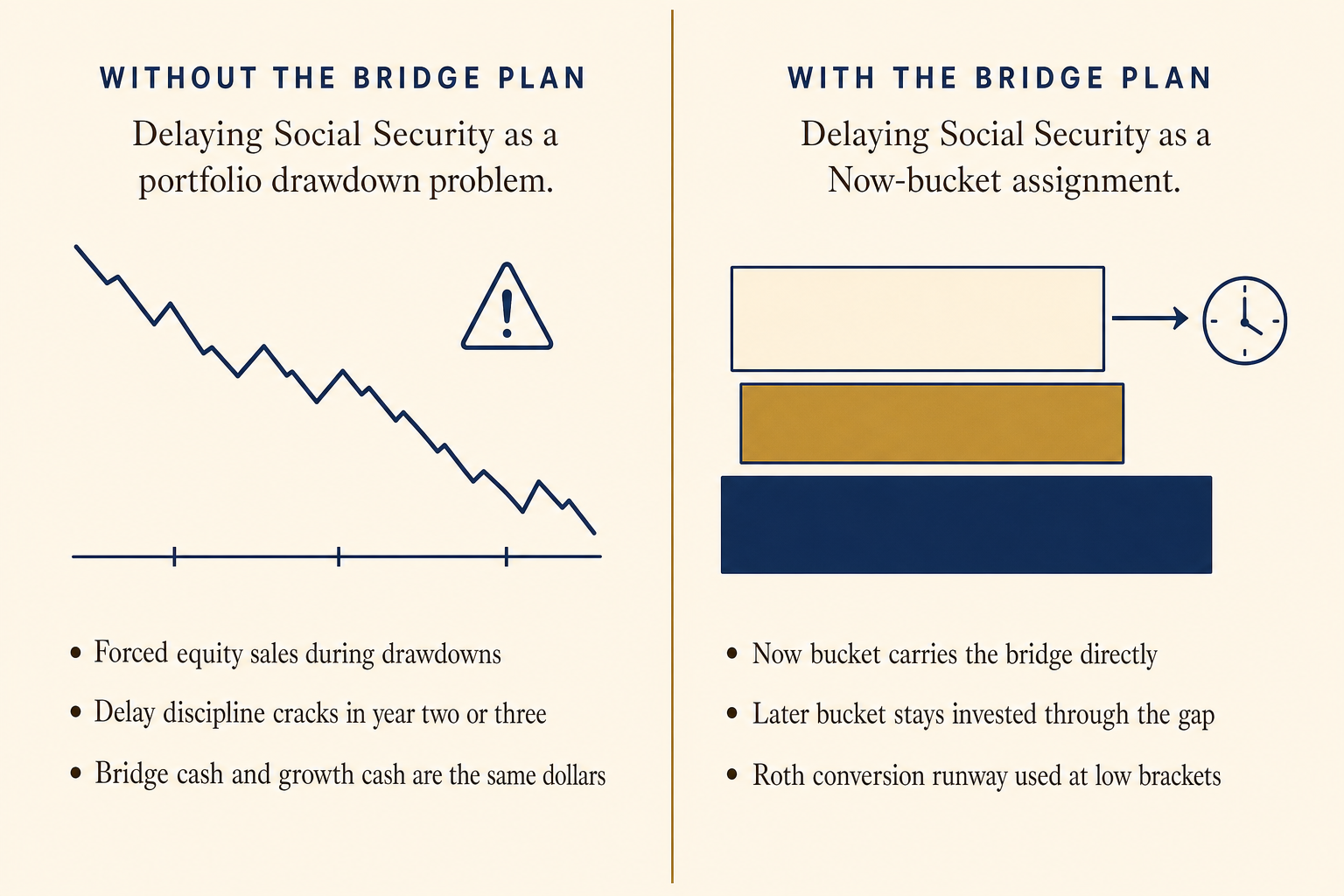
Here’s where most articles about delaying Social Security go wrong. They frame the bridge years as a portfolio drawdown problem: “you’ll have to live off your investments for X years, and here’s the withdrawal rate that makes it work.” That framing accepts the wrong premise. It treats the bridge as a stress test the portfolio has to survive.
The bucket planning version flips the question. The bridge is not a stress test. It’s a planned use of the Now bucket — exactly what the Now bucket exists to do. The Now bucket is short-term cash, money markets, and short-duration Treasurys held specifically so that essential spending in the next several years does not depend on the market.
For a household with a pension or an early Social Security claim, the Now bucket carries 12 to 24 months of expenses, because guaranteed income is already arriving. For a household delaying Social Security, the Now bucket carries the bridge — five years, sometimes more, of essentials. That’s a different size, but it’s the same structure. The discipline holds because the bridge cash is already segregated from the market exposure that has to grow.
The Later bucket, meanwhile, does its job exactly as designed: it stays invested for long-term growth, and it ignores the bridge years entirely. The mistake is to drain the Later bucket each month during the bridge to “fund retirement.” That’s the systematic withdrawal trap. The bucket version doesn’t draw from the Later bucket during the bridge at all — except as part of a deliberate refill of the Now bucket in strong market years, which is a different mechanic with different rules.
Where the bridge money comes from — and where it shouldn’t
The materials that build a clean bridge are not exotic. They are, in rough priority order: a pre-funded Now bucket; cash or money-market balances already sitting in taxable accounts; short-duration Treasurys laddered to mature during the bridge; and Traditional IRA distributions sized to fit inside a low tax bracket. The last source is also the Roth conversion window — the bridge years are when many households can move pre-tax dollars to Roth at unusually low rates, which compounds for the rest of the plan.
What the bridge should not come from: forced equity sales during a drawdown, credit lines tied to home equity that get called when rates move, or partial Social Security claims that lock in a permanently smaller check. The whole point of building the bridge in advance is to take the option to sell at the bottom off the table.
A reasonable tool to model the trade-off — bridge size, sequence-of-returns sensitivity, Roth conversion bracket fits, and the lift from a delayed claim — is ProjectionLab, which handles guaranteed-income inputs better than most consumer planning tools. (ProjectionLab affiliate disclosure: I may earn a commission if you subscribe through that link. The recommendation is editorial — I use it because the delayed-claim and FIA scenarios actually model correctly.)
A hypothetical case: bridging four years for an 8% annual lift
Consider a hypothetical case. Eleanor and James, 63 and 62, live in suburban Charlotte. James just retired from a 35-year career as a mechanical engineer; Eleanor stopped consulting two years ago. They have $850,000 in pre-tax accounts, $140,000 in a Roth, and $90,000 in a taxable money market. The house is paid off. Essential expenses run about $5,400 a month. Neither has a pension.
James’s Primary Insurance Amount at his FRA of 67 is $3,050 a month; Eleanor’s is $1,950. If James claims at 70 instead of 67, his benefit grows to roughly $3,782 — a 24% lift on his own check and, because the household-claim arithmetic also raises the survivor benefit, a permanent increase in the inflation-adjusted floor for whichever of them lives longer.
The bridge year structure looks like this. James plans to claim at 70, four years out. Eleanor plans to claim at her FRA of 67, five years out. Across those four years of full bridge, the household needs roughly $260,000 of guaranteed-floor spending covered before either Social Security check arrives. The Now bucket is sized to carry $130,000 of that directly — the existing $90,000 taxable balance plus a deliberate top-up from the pre-tax accounts during the first low-bracket year of retirement. The remaining $130,000 is funded year by year from carefully sized Traditional IRA distributions sized to fit inside the 12% bracket, which doubles as a Roth conversion runway in the years where headroom exists.
The Later bucket — the remaining $720,000 or so of equity and balanced exposure — stays invested. It is not the source of monthly spending during the bridge. It is the source of the refill mechanic in good market years, and the long-term growth engine for the post-70 decades. That separation is what makes the delay durable. If markets fall in years two and three of the bridge, the household does not have to sell into the drawdown — the Now bucket is already covering the rent.
The four questions that decide whether delay is your move
Delaying Social Security is the highest-leverage decision most pre-retirees will ever make, but it is not universal. Four questions decide whether the math actually works for a given household.
What is the essential expense number, and what fraction of it does Social Security at 70 cover? If a delayed claim closes most of the gap, the delay is worth engineering for. If it only closes a small slice, the delay matters less and the construction work tilts toward other materials.
Is there a longevity reason to favor the earlier check? Specific medical history, both-spouse health context, family longevity patterns — these change the break-even math. Delay is not the right call for every household. It is the right default for many.
How big is the bridge, and is the Now bucket sized to carry it? A four-year bridge for a household with $400,000 of essentials in mostly tax-deferred form is structurally different from an eight-year bridge for a household with the same expenses. Both can work, but the construction order changes.
What is the tax picture across the bridge years? Households with large pre-tax balances often have a once-in-a-lifetime Roth conversion runway during the bridge. Delaying Social Security extends that runway. That’s a side benefit of the delay that compounds for decades.
What the bucket framework gives back, in all four cases, is the same thing it always gives back: a structure that separates the “what to spend” question from the “what to sell” question. The bridge years are the test of that separation. Building it in advance is the work. Living through it without panic is the payoff.
Key Takeaways
- The bridge years between retirement and the optimal Social Security claim age are the structural problem behind any delay decision — they’re funded out of the Now bucket, not the Later bucket.
- The 76% lift between a 62 claim and a 70 claim also permanently raises the survivor benefit, which is often the financially harder half of the retirement to plan for.
- Bridge funding comes from cash, short-duration Treasurys, and bracket-sized Traditional IRA distributions — not from forced equity sales during a drawdown.
- The bridge years are usually the lowest-tax stretch of retirement, which makes them the natural Roth conversion runway.
- Delay is the right default for many households, not all. Four questions — essentials gap, longevity, bridge size, and tax picture — decide whether it’s the right call for yours.
Frequently Asked Questions
Q: If I delay Social Security, am I betting on living past the break-even age?
The break-even-age framing misses the survivor mechanic. A delay raises not only the claimant’s own check but the inflation-adjusted floor that the surviving spouse inherits. Even households where the higher-earning spouse dies before break-even often come out ahead at the household level because the survivor lives on the larger number for the rest of their life. The bet is about household longevity, not individual longevity.
Q: What if markets drop badly during my bridge years?
That’s exactly the scenario the Now bucket exists to absorb. If the bucket is sized to carry the bridge directly, equity sales during a drawdown are not required. The Later bucket recovers without being touched, and the post-70 Social Security floor turns on at full strength. A guaranteed income floor is the only durable defense against sequence-of-returns risk, and a delayed claim builds a larger version of that floor.
Q: Doesn’t a partial claim — say, at 65 instead of 62 or 70 — split the difference?
It can, but it splits the difference in a specific way: a permanently smaller check, plus the same bridge problem on a shorter timeline. Households without enough portfolio assets to carry a full delay sometimes do exactly this, and it’s a reasonable middle path. But the bridge problem doesn’t disappear at 65 — it just shrinks. The structural work of building the Now bucket and protecting the Later bucket is the same.
Q: I have a small pension. Does that change the bridge math?
A partial pension shortens the bridge by whatever fraction of the essentials it already covers. A $1,500 monthly pension that arrives at 65 doesn’t eliminate the bridge, but it reduces the amount the Now bucket has to carry across the bridge years. Bucket planning with a pension covers the math for that case in detail — the structural logic is the same, the materials list is shorter.
This article is published by Confluence Media Group LLC, an independent publisher of educational financial content. Thomas Clark is a Series 65 Investment Advisor Representative. The information provided is for educational and informational purposes only and is not personalized financial, tax, or legal advice. Past performance does not guarantee future results. All investing involves risk, including potential loss of principal. Consult a qualified professional before making financial decisions.
Confluence Media Group LLC is a separate entity from Confluence Capital Management, the investment advisory practice through which Thomas Clark provides advisory services. Advisory services are not offered through this publishing platform.
About Thomas Clark
Thomas Clark is the founder of Confluence Media Group LLC and a Series 65 Investment Advisor Representative. He has spent nearly two decades working with families on retirement planning, with a focus on Social Security optimization, retirement income coordination, and the bucket planning approach to building a guaranteed income floor.
Thomas writes and publishes at thomasclarkadvisor.com and is the author of The Just in Case Binder — a 148-page printable family financial organizer for households who want to make sure the people they love know where everything is.
He lives in North Carolina with his family.
Subscribe to the weekly newsletter · Get the Just in Case Binder

Thomas Clark is a Series 65 licensed investment advisor and experienced trader. He specializes in investing, retirement planning, and market analysis, helping individuals build wealth and make informed financial decisions.
