
Delaying Social Security Doesn’t Delay Medicare
Waiting until 70 to claim Social Security is a smart move — but Medicare enrollment at 65 is a completely separate deadline. Miss your Initial Enrollment Period and the Part B late penalty follows you for the rest of your life.

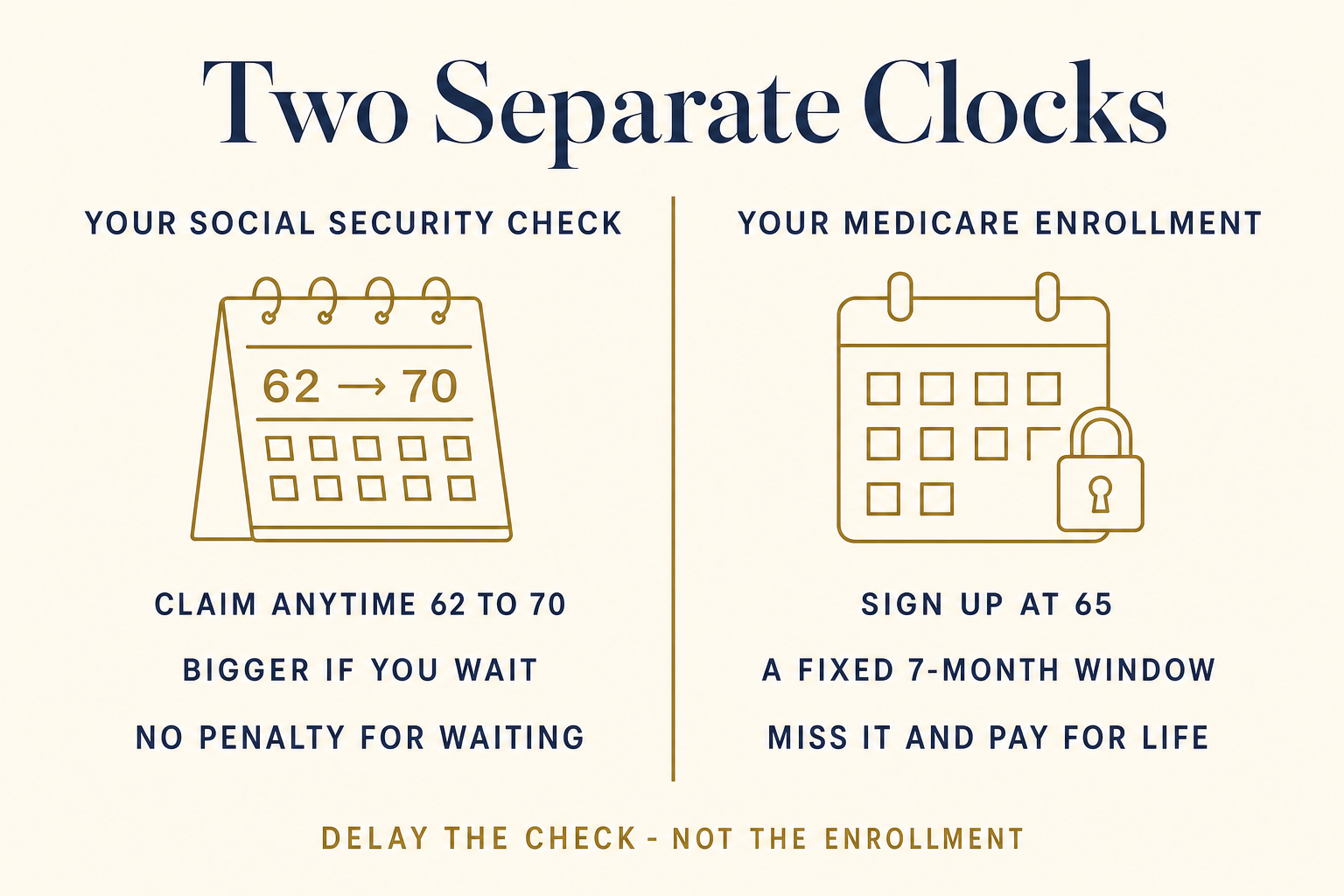
Waiting until 70 to claim Social Security is one of the best moves a healthy pre-retiree can make. I say so often, and the math backs it up. But there’s a quiet catch buried inside that advice, and it costs people real money every year: your Social Security check and your Medicare coverage run on two separate clocks. Delay the check, and Medicare does not politely wait for you. Miss its deadline at 65, and you can be paying a penalty on your health coverage for the rest of your life.
This is one of the most common — and most expensive — planning mistakes I see, and it comes from a reasonable assumption: that these two government programs move together. They used to. For a growing number of retirees, they no longer do.
The two systems used to move together — and now they don’t
For decades, most people claimed Social Security at or before 65. So Medicare enrollment felt automatic, because it was. The day you turned 65, you were already collecting a Social Security check, and the Social Security Administration simply signed you up for Medicare Parts A and B and mailed you your card. Nothing to do.
That automatic enrollment still happens — but only if you’re already receiving Social Security benefits before you turn 65. As delaying to full retirement age or 70 has become mainstream advice, a growing share of 65-year-olds aren’t collecting anything yet. For them, nothing is automatic. No card shows up in the mail. You have to enroll yourself — and if you miss the window, Medicare treats it as a decision you made.
That’s the whole trap in one sentence: the better you are about delaying your Social Security benefit, the more likely you are to sleepwalk past your Medicare deadline.
Your Initial Enrollment Period is a seven-month window
Medicare gives you an Initial Enrollment Period built around your 65th birthday: the three months before your birthday month, the birthday month itself, and the three months after — seven months total. Sign up in the first three months and your coverage starts the first day of your birthday month. Wait until the back half of the window and your coverage start date can be pushed out.
Here’s the part people miss: you enroll through Social Security — at ssa.gov — even if you are not claiming your retirement benefit yet. You’re applying for “Medicare only.” Two pieces to understand:
- Part A (hospital insurance) is premium-free for most people who’ve worked 40 quarters. There’s rarely a reason not to take it at 65.
- Part B (doctor and outpatient coverage) carries a monthly premium — $202.90 in 2026 — and it’s the one that carries the lifetime penalty risk if you’re late.
The penalty that never goes away
This is where the real money is. The Part B late enrollment penalty adds 10% to your Part B premium for each full 12-month period you could have had Part B but didn’t sign up. And it’s not a one-time late fee — it’s permanent. You pay it for as long as you have Medicare, and because it’s calculated as a percentage of the current premium, it climbs every single time the base premium rises.
Two years late? That’s a 20% surcharge on your premium, for life. Part D prescription drug coverage has its own version: 1% of the national base premium for every month you went without creditable drug coverage — also permanent. Neither penalty ever expires, forgives, or resets.
Thomas’ Take: Most “mistakes” in retirement planning cost you once. This one bills you every month for the rest of your life, and the bill grows with inflation. That’s what makes it worth an afternoon of attention now.
The one exception — and the trap hiding inside it
There is a legitimate way to delay Part B without penalty: if you (or your spouse) are still working and covered by a group health plan through that current employer, and the employer has 20 or more employees. In that case you can wait, and when the job or the coverage ends you get an eight-month Special Enrollment Period to sign up — no penalty.
But here’s the trap that catches people: COBRA and retiree coverage do not count as coverage based on current employment. Neither does an ACA marketplace plan. If you retire at 65, go on COBRA, and figure you’ll pick up Medicare when COBRA runs out, your eight-month clock started the day your employment ended — not the day COBRA ends. By the time COBRA lapses at 18 months, the Medicare window has already closed behind you, and the penalty is waiting.
One more wrinkle: if your employer has fewer than 20 employees, Medicare is usually the primary payer once you turn 65, so you generally need to enroll even if you’re keeping the job. When in doubt, ask your benefits administrator in writing which coverage is primary.
How you pay Part B before your Social Security starts
Normally, your Part B premium is quietly deducted from your monthly Social Security check — which is exactly why so many people assume “it just comes out of my check.” But if you’ve delayed Social Security to 70, there is no check yet to deduct from.
So Medicare bills you directly, usually quarterly, or monthly if you set up Medicare Easy Pay for automatic withdrawal. Once your Social Security benefit finally begins, the premium flips over to automatic deduction. It’s a small logistical thing, but it catches people off guard — and it belongs in your Now bucket as a real, recurring expense from 65 on. Higher-income households should also budget for IRMAA surcharges layered on top of the base premium, and remember that once you’re collecting, the premium comes straight out of your Social Security check before the COLA even reaches you.
What this looks like in a real plan
Consider a hypothetical case: Gary, 64, a self-employed consultant near Greensboro, plans to delay his Social Security until 70. It’s a smart plan — it locks in the largest possible benefit and, just as important, the biggest survivor benefit for his wife Denise. Exactly the kind of delay decision I’d generally endorse.
But Gary assumed Medicare would “kick in automatically at 65,” the way it did for his father — who was already collecting Social Security at the time. It won’t. Gary has to enroll himself during the seven months around his 65th birthday. If he doesn’t catch it until he’s shopping for coverage at 67, he’s signed up two full years late. A 20% penalty on a $202.90 premium is about $40 a month — roughly $487 a year — and it rises every time the premium does, for the rest of his life. The delay-to-70 decision was worth tens of thousands of dollars in lifetime benefits. The missed Medicare deadline would quietly claw a piece of it right back.
That’s the whole point. Delaying your Social Security check is one of the highest-return, lowest-risk moves in retirement planning. Delaying your Medicare enrollment is one of the most expensive unforced errors. Do the first. Never do the second. Healthcare is a permanent line item in your Now bucket — it never drops to zero, and for early retirees it starts well before Medicare even begins — so protecting it from an avoidable, compounding penalty protects the entire plan.
Frequently asked questions
If I’m delaying Social Security, will Medicare enroll me automatically at 65?
No. Automatic enrollment only happens if you’re already receiving Social Security benefits before 65. If you’ve delayed, you have to sign up yourself through Social Security during your Initial Enrollment Period.
I’m still working at 65 with employer insurance — do I have to take Medicare?
If your employer has 20 or more employees and the coverage is through current employment, you can delay Part B penalty-free and use the eight-month Special Enrollment Period when the job ends. With fewer than 20 employees, Medicare is usually primary and you generally should enroll. Most people still take premium-free Part A at 65 either way.
Does COBRA count as coverage that lets me delay Part B?
No. COBRA and retiree health plans are not considered current-employment coverage. Your Special Enrollment window starts when the job ends, not when COBRA ends — a common and costly misunderstanding.
How do I pay for Part B if I’m not collecting Social Security yet?
Medicare bills you directly — quarterly, or monthly through Medicare Easy Pay. Once your Social Security benefit starts, the premium is deducted from it automatically.
Put the date on the calendar now
If you’re still weighing when to claim Social Security — the very decision that creates this Medicare timing question — it’s worth seeing the actual numbers for your own record before you commit. Our free Social Security calculator lets you compare claiming ages side by side. And whatever you decide about the check, do one thing today: mark your 65th birthday window on the calendar as a Medicare enrollment deadline. The check can wait. Medicare can’t.
This article is published by Confluence Media Group LLC, an independent publisher of educational financial content. Thomas Clark is a Series 65 Investment Advisor Representative. The information provided is for educational and informational purposes only and is not personalized financial, tax, or legal advice. Past performance does not guarantee future results. All investing involves risk, including potential loss of principal. Consult a qualified professional before making financial decisions.
Confluence Media Group LLC is a separate entity from Confluence Capital Management, the investment advisory practice through which Thomas Clark provides advisory services. Advisory services are not offered through this publishing platform.
About Thomas Clark
Thomas Clark is the founder of Confluence Media Group LLC and a Series 65 Investment Advisor Representative. He has spent nearly two decades working with families on retirement planning, with a focus on Social Security optimization, retirement income coordination, and the bucket planning approach to building a guaranteed income floor.
Thomas writes and publishes at thomasclarkadvisor.com and is the author of The Just in Case Binder — a 148-page printable family financial organizer for households who want to make sure the people they love know where everything is.
He lives in North Carolina with his family.
Subscribe to the weekly newsletter · Get the Just in Case Binder

Thomas Clark is a Series 65 licensed investment advisor and experienced trader. He specializes in investing, retirement planning, and market analysis, helping individuals build wealth and make informed financial decisions.
