
Claimed Social Security Too Early? You May Have a Do-Over
Claiming Social Security feels like a one-way door, but it often isn't. Here are the two legitimate ways to undo an early claim, and who each one fits.

Most people treat the day they claim Social Security like a door that only swings one way. You file, the first deposit lands, and that number — reduced because you claimed early, or not — feels locked in for the rest of your life.
For a lot of retirees, it isn’t.
There are two legitimate ways to walk part of that decision back, plus a third quirk that quietly fixes itself. None of them is a loophole. They are all written into the rules, and Social Security will tell you about them if you ask the right question. Most people never ask, because they don’t know the levers exist.
Why the claiming decision feels permanent
People claim early for understandable reasons. A layoff at 62. A health scare. Or just the quiet pull of “take it while it’s there.” The trouble is that the trade-off sounds final. Claim at 62 with a full retirement age of 67, and your monthly benefit is cut by about 30% — permanently, in most people’s minds. That reduction is real (the Social Security Administration spells out the exact percentages by claiming age).
Then life moves. The person goes back to work. A spouse’s benefit turns out to be larger. The market recovers and the money wasn’t needed after all. Regret sets in, and almost everyone assumes they’re stuck with the smaller check forever.
They’re often not. The rules give you two ways out, and which one you can use depends entirely on when you’re standing there wishing you’d done it differently.
Option one: the 12-month do-over
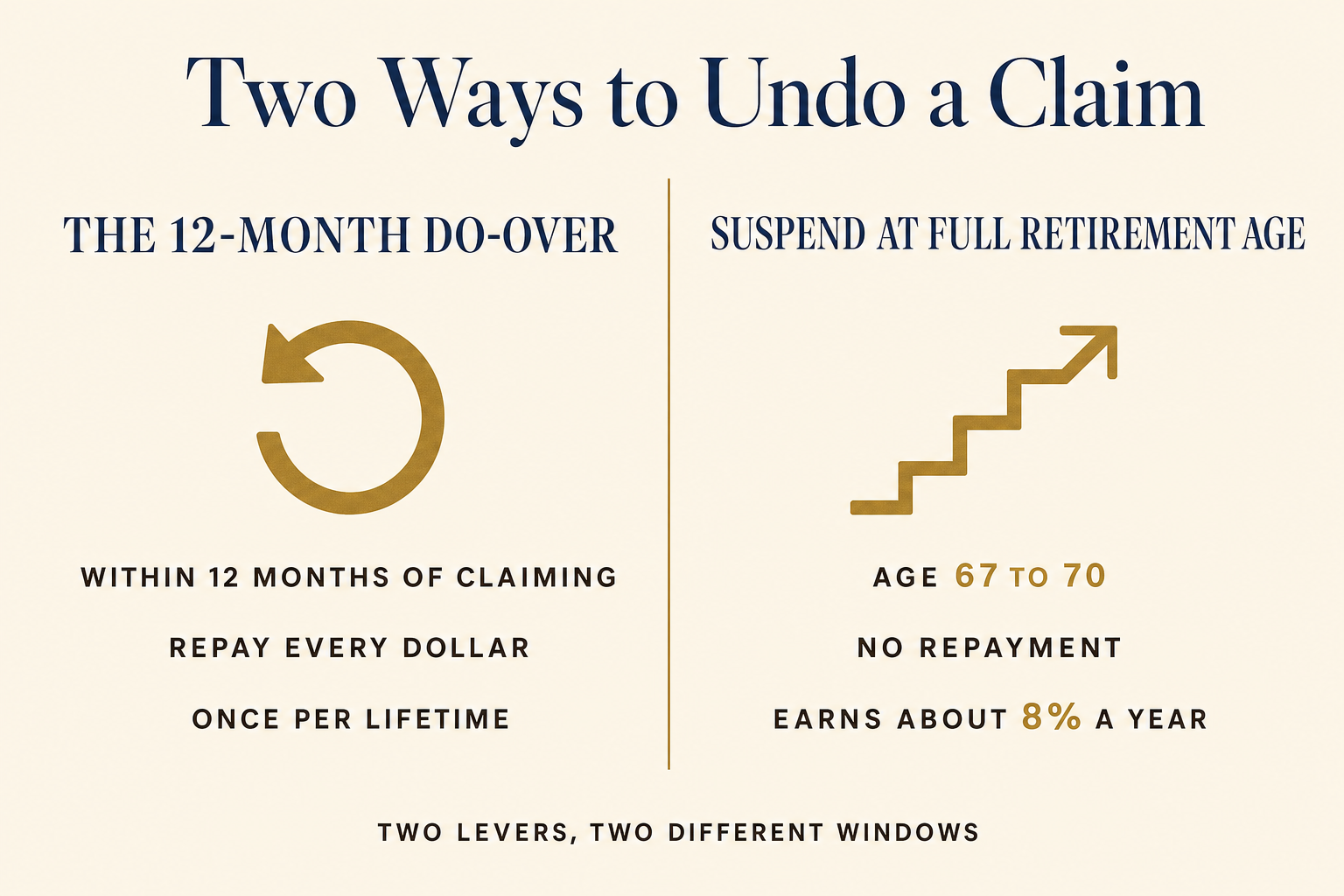
If you claimed within the last 12 months, you can undo it completely. The tool is Form SSA-521, a “Request for Withdrawal of Application.” File it, give a reason, and Social Security treats your claim as if it never happened. You go back to square one and can claim again later at an older age — and a larger, permanent benefit.
The catch is the price of admission: you repay every dollar. That means the benefits you received, plus anything paid to family members on your record, plus any Medicare premiums, income-tax withholding, or garnishments that came out of those payments. The SSA’s own guidance is blunt about this.
Two more rules matter. You get this once in your lifetime — there’s no second withdrawal. And anyone else drawing a benefit on your record, such as a spouse, has to consent in writing before you can pull the application, because your withdrawal stops their check too.
So who should actually do it? Someone who claimed recently, regrets it, and can genuinely repay the money — which in practice usually means the benefits are still sitting in the bank rather than already spent. That last part is where a cash cushion quietly earns its keep.
Option two: suspend at full retirement age
Miss the 12-month window? There’s a second lever, but it doesn’t open until full retirement age.
Once you reach full retirement age — 67 for anyone born in 1960 or later — you can voluntarily suspend your benefit. You stop the checks, and for every month you stay suspended between full retirement age and 70, you earn delayed retirement credits: about two-thirds of 1% a month, which works out to roughly 8% a year added to your future benefit.
The important difference from the do-over: no repayment. This isn’t a reset. It’s a pause that grows the check waiting on the other side. The SSA’s suspension rules let you restart whenever you want, and if you do nothing, benefits switch back on automatically at 70 — there’s no reason to suspend past that point, because the credits stop.
There is one trade-off to know. While you’re suspended, benefits other people collect on your record — a current spouse’s spousal benefit, for instance — pause along with yours. A divorced ex-spouse’s benefit is the exception; that keeps paying.
The third lever: the earnings test isn’t a penalty
Here’s the situation that trips up the most people. You claimed early, then went back to work. If you’re under full retirement age and earn above the annual limit, Social Security withholds part of your benefit. It feels like a fine for having the nerve to keep working.
It isn’t. Those withheld dollars are not gone. When you reach full retirement age, Social Security recalculates your benefit and effectively hands them back by raising your monthly payment for the rest of your life. The earnings test doesn’t shrink your lifetime benefit — it just shifts some of it later.
That single fact changes a lot of claiming decisions. Working while collecting early does not permanently torch your benefit the way many people fear, and understanding that removes a needless source of panic.
A hypothetical: same regret, two different tools
Consider a hypothetical case. Diane, 62, claimed Social Security the month she was laid off from her hospital-administration job outside Charlotte. Eight months later she landed a new role paying nearly what she made before, and suddenly she didn’t need the check she’d started. Because she’s still inside the 12-month window and the money is sitting untouched in savings, Diane files Form SSA-521, repays what she received, and resets the clock. She’ll claim again years from now at a higher age and lock in a bigger benefit for life.
Now consider Frank, 68. He claimed at 66, has been collecting for two years, and just sold a small business — he no longer needs the income. His do-over window closed long ago. But Frank is past full retirement age, so he suspends instead. For the next two years, until he turns 70, his future benefit grows by roughly 8% a year. He repays nothing; he simply switches the checks back on at 70, larger than before.
Same regret, two different tools — because the window each of them was standing in was different. (Both figures here are round numbers for illustration, not a projection of anyone’s actual benefit.)
Where this fits in a real plan
Both levers share one requirement: you have to be able to live without the check while you fix the decision. A do-over means repaying a year of benefits. A suspension means going without income you’d been counting on. Neither is possible unless the money is coming from somewhere else in the meantime.
That “somewhere else” is exactly what the Now and Soon buckets are built to be. In the bucket planning framework, a cash cushion (the Now bucket) and a guaranteed income floor (the Soon bucket — Social Security, a pension, or an income-focused annuity that covers your essentials) mean no single claiming decision has to be perfect. If the floor is covering the bills, you have the room to reset or pause a benefit without scrambling.
That’s the real point. The reversibility is a safety net, not a strategy. The better move is still to get the claiming decision right the first time — the same reason it’s worth understanding how your benefit is actually calculated and how a deliberate delay can work in your favor. But knowing the net is there takes some of the fear out of a choice too many people rush.
Thomas’ Take: The biggest cost of a Social Security mistake usually isn’t the mistake itself — it’s believing you can’t fix it. I’ve seen people carry a permanently reduced check for twenty years, convinced they had no choice, when for the first year they absolutely did. Learn the levers before you file, not after.
Before you touch a form, run the numbers
If you’re still weighing when to claim — or wondering whether an early claim you already made is worth undoing — the math is worth running before you fill out anything. Our free Social Security Calculator lets you compare claiming ages side by side and see what waiting, or resetting, would actually buy you.
The claiming decision deserves that much attention. It’s one of the highest-leverage financial choices you’ll ever make — and, far more often than people realize, one you get a second shot at.
Key takeaways
- Within 12 months of claiming, Form SSA-521 lets you withdraw your application and reset entirely — but you repay every dollar received, and you only get one do-over in your lifetime.
- Past that window, suspending your benefit at full retirement age (67 to 70) grows your future check by about 8% a year, with no repayment required.
- Benefits withheld under the earnings test aren’t lost — they’re restored as a higher monthly payment once you reach full retirement age.
- Any do-over only works if you can replace the income while you reset, which is precisely what a cash cushion and a guaranteed income floor are for.
This article is published by Confluence Media Group LLC, an independent publisher of educational financial content. Thomas Clark is a Series 65 Investment Advisor Representative. The information provided is for educational and informational purposes only and is not personalized financial, tax, or legal advice. Past performance does not guarantee future results. All investing involves risk, including potential loss of principal. Consult a qualified professional before making financial decisions.
Confluence Media Group LLC is a separate entity from Confluence Capital Management, the investment advisory practice through which Thomas Clark provides advisory services. Advisory services are not offered through this publishing platform.
About Thomas Clark
Thomas Clark is the founder of Confluence Media Group LLC and a Series 65 Investment Advisor Representative. He has spent nearly two decades working with families on retirement planning, with a focus on Social Security optimization, retirement income coordination, and the bucket planning approach to building a guaranteed income floor.
Thomas writes and publishes at thomasclarkadvisor.com and is the author of The Just in Case Binder — a 148-page printable family financial organizer for households who want to make sure the people they love know where everything is.
He lives in North Carolina with his family.
Subscribe to the weekly newsletter · Get the Just in Case Binder

Thomas Clark is a Series 65 licensed investment advisor and experienced trader. He specializes in investing, retirement planning, and market analysis, helping individuals build wealth and make informed financial decisions.
