
How to Audit Your Social Security Earnings Record — The 30 Minutes Most Retirees Skip
Social Security benefits are calculated from an earnings record almost nobody verifies. A thirty-minute audit can catch errors that quietly compound for the rest of your retirement.

Most retirement plans treat the Social Security estimate as the truth.
The plan opens with the SSA portal, copies the projected benefit at full retirement age, and builds everything else around that number. The income floor, the bucket math, the bridge years if delaying to 70 — all of it rests on a benefit estimate that was generated automatically from an earnings record nobody verified.
That earnings record is often wrong.
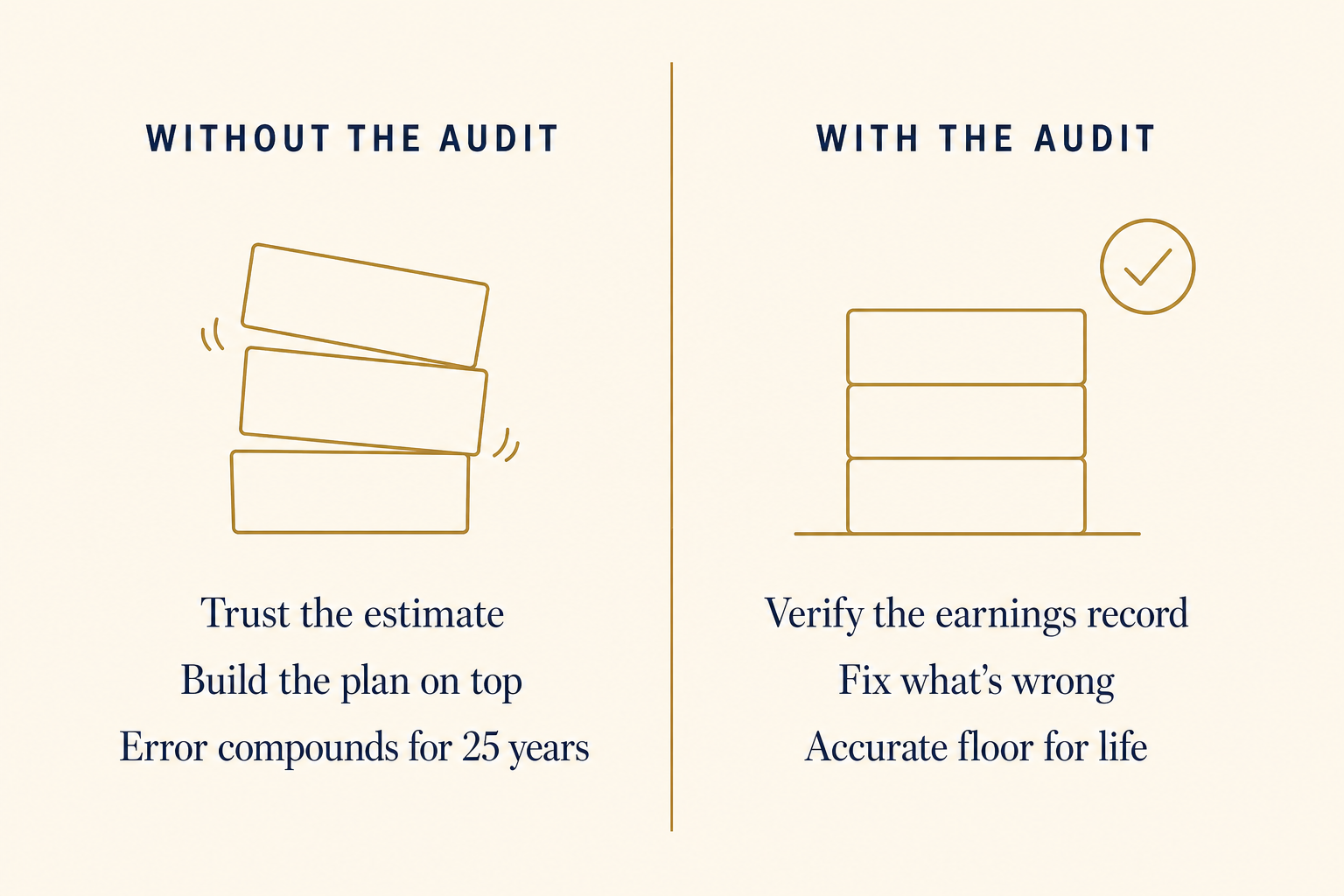
Not catastrophically wrong in most cases. A missing year here, a misreported employer there, a name change that scrambled the W-2 match. Small errors. But Social Security benefits are calculated against a 35-year average, indexed for wage growth, and run through a bend-point formula — and that means a small error in the earnings record compounds into a permanent error in monthly benefits, every month, for the rest of your retirement.
The audit is thirty minutes. Most retirees skip it. This piece is why you shouldn’t.
What the earnings record actually shows
Pull up your my Social Security account (the SSA’s modernized portal — Login.gov verification required if you haven’t logged in since 2024) and the earnings record is the long table on the left side of your statement. It shows every year from your first W-2 to last year, broken into two columns: Social Security taxed earnings and Medicare taxed earnings.
What it doesn’t show clearly is the assumption baked into the benefit estimate at the top of the page. SSA assumes you continue earning at your current rate until full retirement age — every year between today and your FRA gets imputed at your most recent earnings number. If you plan to stop working at 60, your estimated benefit at 67 is probably overstated.
That’s an assumption error, not a recording error. The recording errors are the ones worth fixing.
The four common errors
A missing year is the most damaging. If your 2014 W-2 never made it from the employer to SSA — payroll error, employer bankruptcy, name mismatch — that year reads as zero in your earnings record. Because the SSA’s benefit formula averages your highest 35 years (after dropping the lowest), a missing high-earnings year quietly pulls every future month’s benefit down.
A wrong amount is the next most common. A W-2 for $58,000 showing up as $58 on the earnings record — the digit transposition, or a wage-base capping error in the other direction. The difference at full retirement age might be $40 a month. Over a 25-year retirement, that’s $12,000 — for an error that took twenty minutes to fix.
A name change creates a third pattern. If you got married in 1998 and didn’t update your name with SSA promptly, the W-2 records from your prior name might be sitting in a separate file linked to your SSN by a fuzzy-match algorithm that has since been tightened. The earnings are real, the record is real — but the system is showing you the post-change file only, with a partial-year gap around the transition.
The fourth pattern is self-employment income that was reported to the IRS but never reached SSA. Schedule SE income usually flows through correctly, but if you filed late, filed under an LLC EIN that didn’t credit your personal SSN, or had a payroll provider that mishandled the quarterly 941 filings, the gap can show up here.
The 30-minute audit
Pull your old tax returns. You don’t need every year — you need the years where the earnings record looks suspicious.
Compare line-by-line. The Social Security taxed earnings column should match either Box 3 of your W-2 (Social Security wages) or Schedule SE Line 6 for self-employment income — not Line 1 of the 1040, which is gross income before any pre-tax deductions. This is the most common audit mistake people make on themselves: they compare the earnings record to gross income and panic at a “missing” $5,000 that was actually a legitimate 401(k) contribution. Pre-tax 401(k) money still counts for Social Security wages on the W-2 in Box 3 — it’s only the income-tax line that’s reduced.
Flag any year where:
- The earnings record shows $0 but you know you worked.
- The earnings record shows substantially less than W-2 Box 3 or Schedule SE Line 6.
- A high-earnings year (above the wage base) shows below the wage base for that year — the wage base in 2014 was $117,000, in 2024 was $168,600, in 2026 is $176,100, so a year capped at the wage base should match exactly.
- A name change year shows a partial-year gap.
Then run your own benefit estimate one more time, this time using the SSA’s Quick Calculator with your actual planned retirement age and zero assumed future earnings if you’ve stopped working. The number that comes out should be inside about 5 percent of what your statement shows. If the gap is larger than that, the earnings record probably has an error.
How to fix what you find
The SSA accepts corrections two ways. The first is online through the my Social Security portal — the modernized 2025 release added a “Report a missing year” workflow that handles routine corrections without paperwork. The second is Form SSA-7008, the Request for Correction of Earnings Record, mailed or hand-delivered to your local SSA field office with supporting documents (W-2, tax return, pay stubs — whatever proves the correct number).
The deadline is the part most retirees don’t know about. Under 20 CFR § 404.822, corrections must be requested within three years, three months, and fifteen days after the end of the taxable year in question. For 2022 wages, that deadline lands on April 15, 2026. After that, corrections are still possible but require stronger documentation — the burden of proof shifts to you, and the SSA can refuse a correction based on its judgment about the evidence.
Processing usually takes 10 to 90 days. The fix flows back into your earnings record retroactively, which means your benefit estimate updates the next time SSA recalculates (typically annually in October).
Thomas’ Take
The cheapest thirty minutes in retirement planning is the audit of an earnings record nobody else is going to do for you. The SSA doesn’t audit your record proactively — it processes what employers file and assumes the record is right. Your CPA doesn’t audit it either, because it’s not part of a tax engagement. Your retirement plan, your bucket math, your Social Security claiming strategy — all of it is built on a number that exists somewhere between “probably correct” and “actually correct,” and the difference is yours to verify.
Where it lands in the bucket plan
For households running Now/Soon/Later bucket planning, the Social Security benefit is the structural anchor of the Soon bucket. The whole point of the Soon bucket is a guaranteed income floor sized to essential expenses — and if the Social Security estimate is overstated by 3 percent because of an earnings record error, the Soon bucket is undersized by exactly that much for the next twenty-five years. The error compounds twice: once at the bend-point math, again every year through COLA on a smaller base.
Consider a hypothetical case. Margaret is 60 and in suburban Charlotte, working as a private-duty nurse after fifteen years in school nursing. She runs the audit one Saturday morning. Two years from her school-district career show earnings about $4,200 lower than her W-2s say — a payroll provider that re-filed quarterly numbers and inadvertently created duplicates that SSA reconciled by lowering both. She fixes it online in twenty minutes. Her benefit estimate at FRA goes from $2,310 to $2,372. Over a 25-year claim window with 2.5 percent average COLA, the lifetime difference is illustrative but real — for thirty minutes of work she almost didn’t do.
The hypothetical numbers are illustrative, not predictive. The point is structural: the earnings record is a foundation, and foundations get audited before everything else gets built on top of them. The same logic that applies to household claiming under the Family Maximum cap applies here — the household income plan can only be as accurate as the underlying numbers it draws from.
Run the audit before the year locks in
The natural moment to do this is now, in mid-summer. The SSA has finished posting prior-year earnings data by August, the deadlines for older years are still within the three-year-three-month-fifteen-day window, and you’re far enough from filing season that the tax returns and W-2s are findable but not stale in your memory.
The audit doesn’t get easier by waiting, and the deadlines don’t reset. Two years from now is two years past several recoverable corrections.
If you want help running your own claiming-age math after the audit lands, the free TCA Social Security Calculator walks the FRA-versus-62-versus-70 trade-off using your actual benefit number, not the imputed estimate. That’s the number that should show up on your corrected earnings record.
This article is published by Confluence Media Group LLC, an independent publisher of educational financial content. Thomas Clark is a Series 65 Investment Advisor Representative. The information provided is for educational and informational purposes only and is not personalized financial, tax, or legal advice. Past performance does not guarantee future results. All investing involves risk, including potential loss of principal. Consult a qualified professional before making financial decisions.
Confluence Media Group LLC is a separate entity from Confluence Capital Management, the investment advisory practice through which Thomas Clark provides advisory services. Advisory services are not offered through this publishing platform.
About Thomas Clark
Thomas Clark is the founder of Confluence Media Group LLC and a Series 65 Investment Advisor Representative. He has spent nearly two decades working with families on retirement planning, with a focus on Social Security optimization, retirement income coordination, and the bucket planning approach to building a guaranteed income floor.
Thomas writes and publishes at thomasclarkadvisor.com and is the author of The Just in Case Binder — a 148-page printable family financial organizer for households who want to make sure the people they love know where everything is.
He lives in North Carolina with his family.
Subscribe to the weekly newsletter · Get the Just in Case Binder

Thomas Clark is a Series 65 licensed investment advisor and experienced trader. He specializes in investing, retirement planning, and market analysis, helping individuals build wealth and make informed financial decisions.
