
Inflation Risk in Retirement: How Rising Prices Erode Your Purchasing Power

Key Takeaways
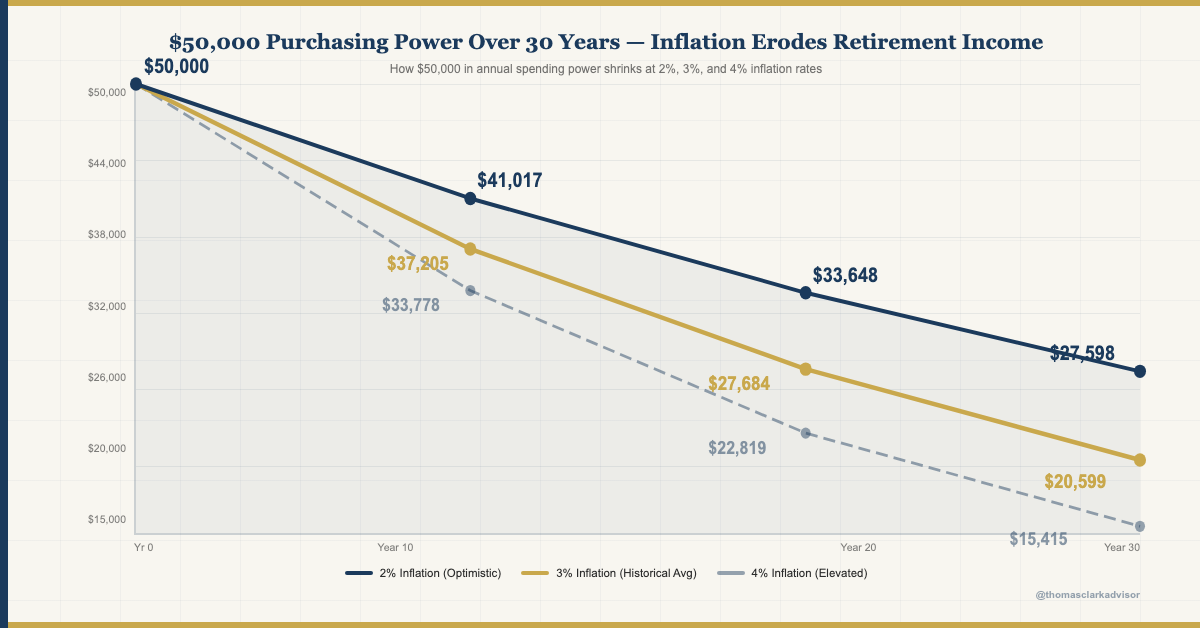
- Inflation is the silent threat to retirement income — at just 3% annual inflation, your purchasing power drops by roughly 26% in 10 years and nearly 60% over 30 years.
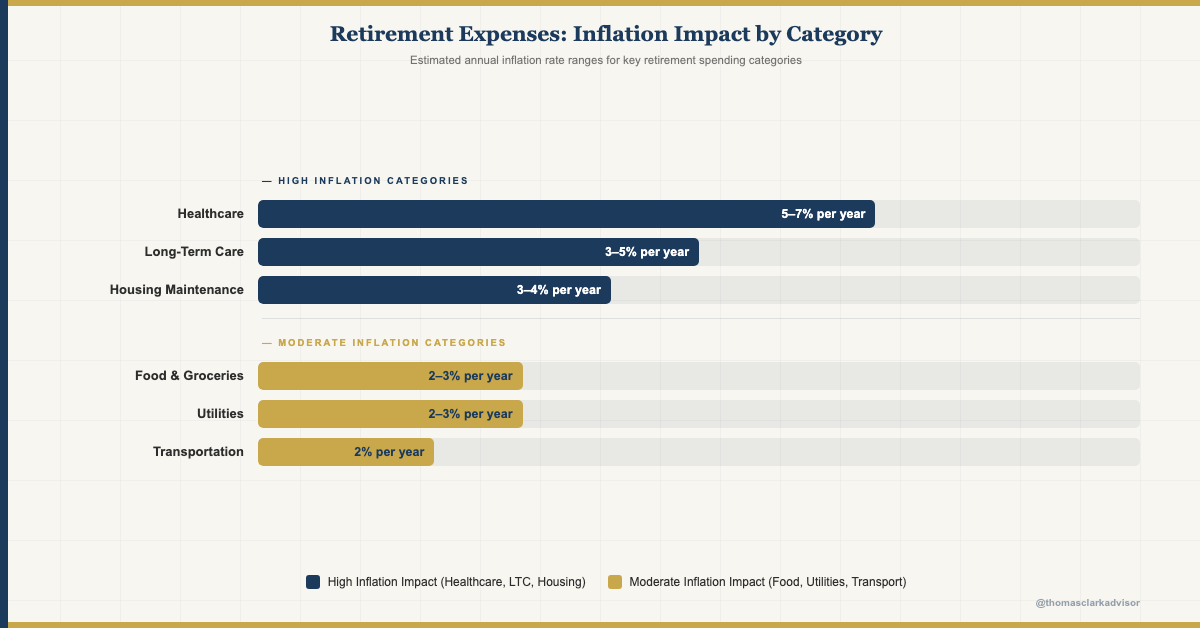
- Healthcare costs inflate faster than the general economy — medical expenses have historically grown at 5-7% annually, outpacing the general CPI by 2-3 percentage points.
- Social Security’s COLA provides partial protection but doesn’t fully cover retiree-specific inflation — the COLA is tied to CPI-W (urban wage earners), not the experimental CPI-E (elderly), which runs about 0.2-0.3 percentage points higher.
- A portfolio that doesn’t grow faster than inflation is actually losing money in real terms — keeping everything in cash or low-yield bonds feels safe but guarantees purchasing power erosion.
- Strategic asset allocation, TIPS, and income sources with built-in inflation adjustments are your primary defenses — the goal isn’t to beat the market, it’s to keep your spending power intact.
Table of Contents
- The Math That Should Keep Every Retiree Up at Night
- Why Retirees Feel Inflation More Than Workers
- The Healthcare Inflation Multiplier
- How Social Security’s COLA Actually Works
- The Cash Trap: When “Safe” Investments Lose Money
- Seven Strategies to Protect Your Purchasing Power
- Building an Inflation-Aware Retirement Budget
- Hypothetical: What Inflation Does to a 30-Year Retirement
- FAQ
The Math That Should Keep Every Retiree Up at Night
Here’s a number that changed how I think about retirement planning: at a modest 3% annual inflation rate, a retiree who needs $50,000 per year in today’s dollars will need roughly $67,000 in year 10, $90,000 in year 20, and over $121,000 in year 30 — just to maintain the same standard of living.
That’s not a typo. Your expenses don’t stay flat in retirement. They compound upward, year after year, whether you notice it or not.
According to a 2024 Department of Labor report to Congress, inflation’s impact on retirement savings is one of the most significant risks facing American retirees — and one of the most underestimated. Most retirement calculators use a flat-spending assumption that ignores the compounding nature of rising prices. In reality, a retiree with $500,000 in savings would need approximately $672,000 after just 10 years at 3% inflation to maintain the same purchasing power.
The challenge is that inflation doesn’t feel dramatic on any given day. Gas costs a few cents more. Groceries creep up 3-4% per year. Your property taxes rise. None of it feels catastrophic in isolation. But compounded over a 20- or 30-year retirement, the cumulative effect is devastating to a fixed budget.
Why Retirees Feel Inflation More Than Workers
When you’re working, inflation is painful but manageable — wages tend to rise with prices (eventually), and you can adjust by working more hours, pursuing raises, or switching jobs. Retirees don’t have those levers.
Retirees are more vulnerable to inflation for several specific reasons:
Fixed income sources don’t always keep pace. Pensions rarely include inflation adjustments. Annuity payments are fixed unless you purchased an inflation rider (which most people don’t). Bond interest payments stay flat for the life of the bond. Only Social Security has a built-in annual adjustment, and as I’ll explain below, even that doesn’t fully cover the inflation retirees actually experience.
Retirees spend more on categories with above-average inflation. The Bureau of Labor Statistics tracks spending patterns by age group, and the data is clear: retirees allocate a larger percentage of their budget to healthcare, housing maintenance, utilities, and food — categories that have consistently inflated faster than the general CPI basket.
Retirees have less flexibility to cut spending. You can skip a vacation or delay buying a new car. You can’t skip your medications, reduce your electricity usage below a minimum threshold, or stop eating. The essential expenses that dominate retiree budgets are also the least discretionary.
The retirement timeline is longer than people realize. A 65-year-old couple today has approximately a 50% chance that at least one spouse will live to age 90 — a 25-year retirement. A meaningful number will live past 95. That’s enough time for 3% inflation to cut purchasing power in half.
The Healthcare Inflation Multiplier
If general inflation is the silent threat, healthcare inflation is the loud one that people still manage to ignore.
According to the Centers for Medicare and Medicaid Services, national health expenditures have grown at an average annual rate of 5-7% over the past two decades — roughly double the general inflation rate. For retirees, healthcare represents an increasingly large share of their budget as they age.
Consider how this compounds: if healthcare costs grow at 6% annually while Social Security’s COLA averages 2.5%, the gap between your healthcare expenses and your inflation-adjusted income widens every single year. By year 15 of retirement, healthcare might consume 25-30% of your budget rather than the 15% you planned for.
Specific areas of healthcare inflation that hit retirees hardest:
- Medicare Part B premiums — the standard monthly premium has increased from $104.90 in 2015 to $185.00 in 2026, a 76% increase in 11 years
- Prescription drug costs — even with Medicare Part D, out-of-pocket costs for brand-name drugs have risen faster than general inflation
- Long-term care costs — assisted living and nursing home costs have inflated at 3-5% annually, with the national median for a private nursing home room now exceeding $120,000 per year
- Dental and vision care — not covered by Original Medicare, and costs have risen steadily
Pro Tip: When building your retirement budget, Many financial planners inflate the healthcare line item at 5-6% annually — separate from your 2.5-3% general inflation assumption for other expenses. This “two-rate” approach produces a much more realistic projection of future spending needs.
How Social Security’s COLA Actually Works
Social Security includes an annual Cost-of-Living Adjustment, and it’s one of the most valuable inflation-protection features in any retirement income source. But it’s not a perfect hedge.
The COLA is based on the Consumer Price Index for Urban Wage Earners and Clerical Workers (CPI-W) — not the Consumer Price Index for the Elderly (CPI-E), which the Bureau of Labor Statistics calculates experimentally. The CPI-E tends to run about 0.2-0.3 percentage points higher than CPI-W because it weights healthcare and housing more heavily — exactly the categories where retirees spend more.
Over a 25-year retirement, that small annual shortfall compounds. A retiree whose COLA increases lag true elderly inflation by just 0.25% per year would see approximately a 6% cumulative shortfall in purchasing power over 25 years — money that slowly disappears from their standard of living.
That said, Social Security’s COLA is still enormously valuable compared to fixed income sources with zero inflation adjustment. Recent COLA history shows the system responding to actual inflation:
| Year | COLA Adjustment |
|---|---|
| 2022 | 5.9% |
| 2023 | 8.7% |
| 2024 | 3.2% |
| 2025 | 2.5% |
| 2026 | 2.5% |
Someone receiving $2,000 monthly at the start of 2023 now receives approximately $2,350 monthly — a meaningful increase driven entirely by COLA adjustments. The system isn’t perfect, but it’s working.
The Cash Trap: When “Safe” Investments Lose Money
I understand the instinct to move everything into cash, CDs, or short-term bonds when you retire. The stock market feels risky, and the idea of watching your portfolio drop 20% in a single quarter is genuinely terrifying when you’re drawing income from it.
But here’s the uncomfortable truth: if your portfolio doesn’t grow faster than inflation, you’re losing money in real terms — even if your account balance stays the same or grows slightly.
Let’s say you park $400,000 in a money market fund earning 4% annually. After taxes (let’s assume a 22% federal bracket), your after-tax return is 3.12%. If inflation runs at 3%, your real return is 0.12% — essentially zero. Your money isn’t growing; it’s treading water. And if inflation ticks up to 3.5% or 4%, you’re actively losing purchasing power while feeling safe.
This is what I call the “cash trap.” The emotional safety of guaranteed returns masks the mathematical reality of purchasing power erosion. According to BlackRock’s retirement research, retirees who maintain overly conservative portfolios face a meaningful risk of outliving their assets — not because of market losses, but because of inflation’s relentless compounding.
The right balance isn’t all stocks or all cash. It’s a portfolio that generates enough real return (after inflation and taxes) to sustain withdrawals over your full retirement timeline.
Seven Strategies to Protect Your Purchasing Power
1. Maintain equity exposure appropriate to your timeline. A 65-year-old with a potential 30-year retirement still has a long time horizon for a portion of their portfolio. Maintaining some equity exposure — sized to your personal risk tolerance, time horizon, and guaranteed income floor — has historically been one of the most reliable defenses against inflation over rolling 10-year periods. I’m not suggesting an aggressive portfolio — I’m suggesting that avoiding stocks entirely creates a different and equally dangerous risk. (This is general educational information, not a recommendation for any specific allocation.)
2. Consider Treasury Inflation-Protected Securities (TIPS). TIPS are U.S. government bonds whose principal value adjusts with CPI. They provide a guaranteed real return above inflation — one of the only investments that directly hedges inflation risk. The tradeoff: TIPS yields are modest, and they can lose value if interest rates rise sharply.
3. Delay Social Security if possible. Each year you delay claiming past your full retirement age (up to 70), your benefit grows by 8% — and that larger base amount receives the annual COLA adjustment. A $3,000/month benefit at 67 becomes $3,720/month at 70, and all future COLAs are calculated on the higher base. Over a long retirement, this compounds significantly. Learn more about the claiming decision framework.
4. Build inflation escalators into your withdrawal strategy. Instead of withdrawing a flat dollar amount, build annual increases into your withdrawal plan. The guardrails strategy adjusts withdrawals based on portfolio performance, allowing increases when markets are strong and calling for modest reductions when they’re not.
5. Consider assets with inflation-linked income. Real estate (or REITs), dividend-paying stocks with a history of dividend growth, and inflation-adjusted annuities all provide income streams that can rise over time. No single asset class is perfect, but diversification across inflation-sensitive categories creates multiple hedges.
6. Minimize fixed-payment exposure. The more of your income that comes from fixed sources with no inflation adjustment (fixed annuities, most pensions, bond coupons), the more vulnerable you are. Where possible, structure your income with growth potential or built-in adjustments.
7. Revisit your budget annually. Inflation doesn’t hit every category equally. Track your actual spending and compare it to CPI data for the categories you spend on most. Your personal inflation rate may be higher or lower than the national average — and your strategy should reflect your reality, not a headline number.
Building an Inflation-Aware Retirement Budget
Most retirement budgets I see assume flat spending — “$60,000 per year for 30 years” — and it’s one of the most dangerous oversimplifications in financial planning.
A more realistic approach uses what I call a “dual-inflation” model:
Essential expenses (healthcare, housing, food, utilities): Inflate at 3.5-5% annually. These categories historically outpace general CPI, and retirees can’t easily reduce them.
Discretionary expenses (travel, dining out, entertainment, gifts): Inflate at 2-3% annually, with the understanding that these categories naturally decline as retirees age. Research consistently shows that retiree spending follows a “smile” pattern — higher in early retirement (the “go-go” years), lower in the middle (the “slow-go” years), and higher again at the end due to healthcare costs (the “no-go” years).
Tax obligations: Inflate based on your specific situation. Tax brackets are inflation-adjusted annually by the IRS, but other tax impacts (IRMAA, Social Security taxation thresholds, capital gains) may not keep pace.
This dual-inflation approach typically shows a 15-25% higher lifetime spending need than flat-budget models — a significant gap that catches unprepared retirees off guard.
Hypothetical: What Inflation Does to a 30-Year Retirement
Note: This scenario is entirely hypothetical and for educational purposes only.
Consider a hypothetical retiree — let’s call her Janet — who retires at 65 with $600,000 in savings and $2,200/month in Social Security benefits. Her annual spending need is $55,000, of which Social Security covers $26,400, leaving $28,600 to come from portfolio withdrawals.
In a zero-inflation world: Janet needs $28,600 per year from her portfolio. At a 4.8% withdrawal rate, her $600,000 covers this comfortably for about 25 years.
At 3% inflation: By year 10, Janet needs $37,000 from her portfolio (not $28,600), even though Social Security’s COLA has partially kept pace. By year 20, she needs over $50,000 annually. Her portfolio, which needs to grow to support rising withdrawals, faces a dramatically different demand than a flat-spending model suggests.
At 4% inflation: The picture worsens. By year 15, Janet’s portfolio withdrawal need has nearly doubled. Without sufficient growth in her investments, her savings are depleted years earlier than projected.
The lesson: inflation doesn’t just reduce what your money buys — it accelerates the rate at which you draw down your savings. The combination of rising expenses and portfolio withdrawals creates a compounding drain that flat-budget projections dangerously underestimate.
FAQ
What is a “safe” inflation assumption for retirement planning? Many planners use 3% as a baseline for general expenses and 5-6% for healthcare costs. While long-term historical inflation has averaged about 3.2% in the U.S. since 1926, recent decades have seen more volatility. Using 3% gives you a realistic middle ground — conservative enough to be responsible, but not so low that it creates a false sense of security.
Does Social Security fully protect against inflation? Social Security’s annual COLA provides substantial protection but doesn’t perfectly match retiree-specific inflation. The COLA is tied to CPI-W (wage earners), while the experimental CPI-E (elderly) runs slightly higher because retirees spend more on healthcare and housing. Over a long retirement, this small gap compounds. Social Security remains one of the best inflation hedges available, but it shouldn’t be your only one.
Should I buy I Bonds or TIPS for inflation protection? Both are valuable tools. I Bonds (limited to $10,000 per person per year in direct purchases) offer a fixed rate plus an inflation-adjusted variable rate, with no risk of losing principal. TIPS trade on the open market, can be purchased in larger amounts, and adjust both principal and interest payments with CPI. For most retirees, a combination of both — along with a diversified portfolio — provides the strongest inflation defense.
How does inflation affect Required Minimum Distributions? The IRS adjusts the Uniform Lifetime Table periodically, but your RMD is calculated based on your account balance divided by a life expectancy factor. If inflation forces you to withdraw more than your RMD for living expenses, you’ll deplete your tax-deferred accounts faster. Conversely, if your investments keep pace with inflation, your account balances (and thus RMDs) will be higher — creating potential tax bracket and IRMAA implications.
What’s the biggest mistake retirees make regarding inflation? Ignoring it entirely. Many retirees assume their expenses will stay flat or decrease. While discretionary spending often does decline in mid-retirement, essential expenses — especially healthcare — typically increase faster than general inflation. The compounding effect over a 25-30 year retirement can easily consume an additional $200,000-$400,000 in purchasing power compared to flat-budget projections.
The Bottom Line
The single greatest predictor of retirement happiness isn’t net worth — it’s the gap between essential expenses and inflation-adjusted guaranteed income. Close that gap, and inflation becomes an ordinary planning input rather than a slow-motion threat.
Build the floor first. Build the growth on top of it second. Run the numbers in real (inflation-adjusted) dollars, not nominal ones, and the order of operations stops being a debate.
This article is published by Confluence Media Group LLC, an independent publisher of educational financial content. Thomas Clark is a Series 65 Investment Advisor Representative. The information provided is for educational and informational purposes only and is not personalized financial, tax, or legal advice. Past performance does not guarantee future results. All investing involves risk, including potential loss of principal. Consult a qualified professional before making financial decisions.
Confluence Media Group LLC is a separate entity from Confluence Capital Management, the investment advisory practice through which Thomas Clark provides advisory services. Advisory services are not offered through this publishing platform.

Thomas Clark is a Series 65 licensed investment advisor and experienced trader. He specializes in investing, retirement planning, and market analysis, helping individuals build wealth and make informed financial decisions.
