
Paying Off the Mortgage in Retirement: The Real Math
Should you pay off the mortgage before retirement? The rate-vs-return spreadsheet is the smallest piece. Cash flow, sequence-of-returns risk, and the inflation hedge usually decide it.

If you’re staring at a mortgage balance and a retirement date in the same five-year window, you’ve probably heard both sides of the argument. One camp says pay it off — debt-free retirement, peace of mind, done. The other camp pulls up a spreadsheet and says your 5.5% mortgage is being beaten by your 7% expected portfolio return, so keep the mortgage, invest the difference.
Both answers are usually wrong.
Not because the math is wrong — it isn’t. But because the rate-versus-return spreadsheet is the smallest piece of the decision, and the bigger pieces — cash flow, tax behavior after the 2017 standard deduction doubling, sequence-of-returns risk, and the part of your retirement that inflation actually eats — almost never make it into the calculation.
Where the standard spreadsheet falls apart
The default math goes like this. Your mortgage rate is 5.5%. Your portfolio’s expected long-run return is somewhere around 7% real or 9% nominal. Therefore, keep the mortgage, invest the cash, and you come out ahead.
That math is right on the rate. It’s wrong on almost everything else.
It assumes the 7% return is delivered on a calm even line every year, which is the assumption that sequence-of-returns risk specifically punishes in retirement. It assumes the mortgage interest is still tax-deductible, which after the 2017 standard deduction doubling it usually isn’t. It ignores that the 5.5% you pay on the mortgage is a guaranteed real return — not a market estimate, not a probability — and a guaranteed 5.5% is a respectable bond-like return that almost no fixed-income instrument matches today.
And the spreadsheet entirely ignores the inflation behavior of the underlying expense, which is where the decision actually lives.
The tax piece is smaller than it used to be
For decades the mortgage paydown question was answered by the deduction. Mortgage interest was deductible. You ran the math at your after-tax rate. A 5.5% mortgage at a 24% marginal rate was effectively 4.2% after the deduction, and that’s the number that went into the comparison.
That changed in 2017. The Tax Cuts and Jobs Act roughly doubled the standard deduction, and the share of households actually itemizing dropped from around 30 percent to under 10 percent. The mortgage interest itself is still deductible per IRS Publication 936, but for most retirees that’s an academic point — they’re taking the standard deduction either way, and the mortgage just sits there as a non-deductible expense.
The 2026 standard deduction is $30,000 for married filing jointly and $15,000 for single filers per IRS Rev. Proc. 2025-19. Add the over-65 additional amount and most retired couples are sitting at a $33,200 floor before they itemize anything. A typical retiree with $9,000 of mortgage interest, $7,000 of state-and-local-tax (capped at $10,000), and $3,000 of charitable giving lands at $19,000 of itemized deductions — well under the standard. The mortgage doesn’t help at tax time at all.
Which means your effective mortgage rate, for most retirees, is the stated rate. If you’re paying 5.5%, that’s a 5.5% guaranteed return on principal, not a 4.2% one. The math gets less interesting in favor of holding the mortgage, not more.
What actually shifts: cash flow and the income floor
The piece the spreadsheet always misses is what happens to your monthly cash requirement when the mortgage payment stops.
Take a $250,000 balance at 5.5% on a 30-year fixed. The principal-and-interest payment is roughly $1,420 a month, or $17,000 a year. Property tax and insurance — separately escrowed — don’t change either way. That $17,000 is the actual question.
In accumulation, $17,000 a year is a line item. In distribution, it’s a different conversation. That’s $17,000 you need to pull out of your portfolio every year for 30 years, increased by zero (the payment is fixed) but funded by a portfolio that has to weather sequence-of-returns risk, inflation, and your own withdrawal discipline. For a retiree who would otherwise need to withdraw $48,000 to cover essentials, killing the mortgage drops that to $31,000 — and the withdrawal-rate math at $31,000 against a portfolio is dramatically more durable than the same math at $48,000.
This is the piece bucket planning specifically pre-answers. If you’re thinking in Now/Soon/Later terms, eliminating a $17,000 fixed essential expense shrinks the size of the Soon bucket you have to build. Less guaranteed income needed means less Social Security delay required to cover it, smaller fixed-index-annuity sizing, more Later-bucket dollars left to grow.
The inflation hedge nobody calls a hedge
A fixed-rate mortgage is one of the largest inflation hedges a household owns, and almost nobody calls it that. When the inflation piece ran on this site last week, the contrarian frame at the end was that mortgage paydown isn’t really a math move — it’s an inflation move. Worth unpacking that here.
A 30-year fixed payment doesn’t rise. Twenty years from now, the same nominal dollar amount comes out of your account, but in real terms it’s a fraction of what it is today. If inflation averages 3% over twenty years, a $1,420 monthly payment in 2026 dollars is roughly $785 a month in today’s purchasing power by 2046.
That cuts both ways. If you keep the mortgage and inflation runs warm, you’re paying back fixed dollars with cheaper dollars — a real win. If you pay it off and inflation runs warm, you’ve consumed today’s harder dollars to retire an obligation that would have shrunk in real terms anyway.
This is the strongest argument the keep-the-mortgage camp actually has, and it’s better than the rate-versus-return one. A fixed-rate mortgage is a short position against inflation. In a moderate or high inflation environment, holding that short is valuable.
What about the sequence-of-returns piece
The flip side: a fixed mortgage payment in a bad market sequence is brutal. If you retire into a 30% drawdown in years one and two and you’re funding mortgage payments from a portfolio that just fell 30%, you’re forced to sell more shares at lower prices to cover a fixed obligation that doesn’t care about market conditions. That’s the failure mode the bucket framework defends against, and the mortgage payment is one of the cleanest things you can move out of the line of fire.
Paying off the mortgage doesn’t eliminate sequence risk — your other expenses still have to be funded — but it shrinks the fixed-obligation portion that has to be covered in a bad year. Smaller required withdrawals during a downturn equals more shares preserved equals more upside captured on the recovery. The math compounds in your favor for decades.
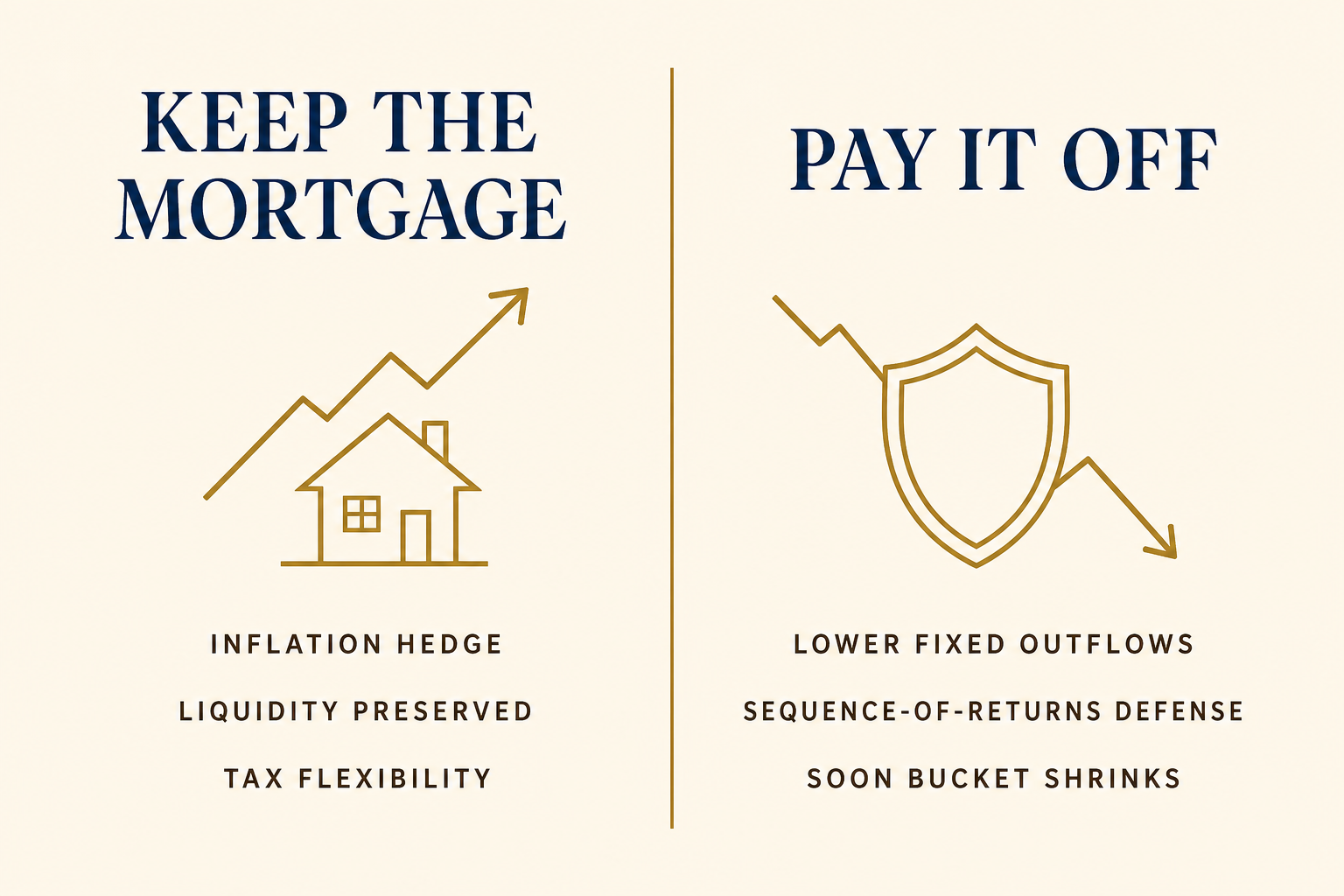
So: the inflation argument favors keeping the mortgage. The sequence-of-returns argument favors paying it off. Which one wins depends entirely on what the next ten years look like — and you don’t know.
The piece that decides it: where the cash actually comes from
Here’s where most paydown analyses fall over completely. The question isn’t really “should I pay off the mortgage.” The question is “where does the $250,000 come from.”
If it comes from a taxable brokerage account at a 15% long-term capital gains rate, you’re paying real tax to unlock the cash, but the tax is bounded and you only do it once. If it comes from a Traditional IRA, you’re triggering ordinary income on the entire withdrawal — at 24% federal plus state, a $250,000 lump sum could cost $70,000 in taxes plus an IRMAA surcharge two years later. If it comes from a Roth, you’re spending the most tax-advantaged dollars you’ll ever have access to, which is almost always the wrong move.
The account-ordering decision matters more than the paydown decision itself. A retiree paying off a mortgage from a taxable brokerage account is making a very different bet than one paying it off from a Traditional IRA. The first is mostly a clean cash-flow trade. The second is a single-year tax disaster that probably erases the value of the paydown entirely.
If the answer is “I can pay it off from cash or taxable holdings without triggering a bracket bump or an IRMAA shock,” the paydown question is suddenly much simpler. If the answer is “I’d have to take a $250,000 distribution from a Traditional IRA in a single tax year,” the right answer is almost always no — or at least, spread it over three to four years of bracket-fill withdrawals during the low-bracket window between retirement and Social Security.
A hypothetical to make this concrete
Consider a hypothetical case. Robert and Janet, both 62, in suburban Charlotte. They plan to retire next year. They have $250,000 left on a 30-year fixed at 5.5%, refinanced in 2023, with about 27 years to run. The principal-and-interest payment is $1,420 a month. Their portfolio: $620,000 in his Traditional IRA, $180,000 in her Roth, and $50,000 in a taxable brokerage account. Their essential expenses run $48,000 a year, of which the mortgage P&I is $17,000.
The naive spreadsheet says: 5.5% mortgage, 7% expected return, keep the mortgage and invest. Done.
The actual math is uglier and better. They take the standard deduction either way — no tax benefit from the mortgage interest. Paying it off would require either a $250,000 Traditional IRA distribution that pushes them into the 32% bracket for that year and triggers an IRMAA surcharge in 2027, or a four-year bracket-fill withdrawal at $62,500 a year during their 63–66 low-bracket window before Social Security, which is much smarter but slower. Using the Roth is off the table — those dollars compound tax-free forever and shouldn’t be touched for this.
The bucket planning piece changes the answer. If the mortgage is paid off by age 66, their essential expenses drop from $48,000 to $31,000. Their Soon-bucket guaranteed-income target drops by $17,000 a year, which means delaying Social Security to 70 alone covers a much larger share of essentials. The Later bucket gets to stay invested for growth instead of being slowly drained to fund a fixed obligation. They sleep at night.
So the answer for Robert and Janet probably is to pay it off — but spread over four bracket-fill years, not in a single tax-disaster year. That nuance is the whole game, and it never shows up in a rate-versus-return spreadsheet.
The five questions that decide it
If you’re staring at this same decision, the math comes down to five questions, in this order:
One. Where does the cash come from? Taxable and cash holdings make this easy. Traditional IRA-only makes it hard. Roth is almost never the right source.
Two. Do you itemize? If you’re taking the standard deduction, the mortgage interest isn’t doing anything for you, and the effective rate is the stated rate.
Three. What does eliminating the payment do to your required annual withdrawal? If it drops you from a fragile 5% withdrawal rate to a sustainable 3.5%, that’s a much bigger deal than the rate-versus-return question.
Four. How would you feel about a fixed $1,400 payment during a 30% drawdown in year one of retirement? Some households are temperamentally fine. Others would sell at the bottom to make the payment, which is the failure mode bucket planning is built to prevent.
Five. What’s your view on inflation over the next twenty years? Holding a fixed-rate mortgage is a real short position against inflation. If you think inflation runs hotter than the consensus, that argues for keeping the mortgage. If you think it runs cooler, the keep-it case weakens.
If you want to run the full multi-year tax-and-cash-flow scenario rather than guess, ProjectionLab is the planning tool I use to model this kind of question. It handles the bracket-fill year-by-year math, the Soon-bucket sizing implications, and the sequence-of-returns scenarios in a single view, which is exactly the framing this decision needs.
Disclosure: ProjectionLab is a paid retirement planning tool I recommend as an affiliate partner. If you sign up through this link, I receive a small referral fee at no additional cost to you. I only recommend tools I’d use myself.
The Thomas Take
The rate-versus-return spreadsheet is a fine first pass, but it’s never been the right way to make this decision. The actual question is what eliminating a fixed essential expense does to the shape of your retirement — to your required withdrawal rate, to your Soon-bucket sizing, to your behavior in a drawdown, to your peace of mind on a Tuesday morning in year three of retirement when the market is down 22%.
For most retirees with the cash to do it without a tax disaster, paying off the mortgage by retirement — or within the first few low-bracket years after — is the cleaner architecture. Not because the math forces it, but because the math becomes secondary to the structural shift in how the rest of the plan has to work. A retirement plan with no mortgage is a fundamentally easier plan to run than one with a $1,400 monthly obligation that has to be covered through every kind of market.
For households who’d have to drain a Traditional IRA in a single tax year to do it, the answer is usually no — or yes, but spread carefully across the bracket-fill years between retirement and Social Security claim age. That’s a planning project, not a check-writing exercise.
The spreadsheet camp is right about one thing: the math matters. But the math that matters isn’t 5.5% versus 7%. It’s the math of how much your retirement plan has to do every year, and that’s the math the mortgage payment quietly drives.
This article is published by Confluence Media Group LLC, an independent publisher of educational financial content. Thomas Clark is a Series 65 Investment Advisor Representative. The information provided is for educational and informational purposes only and is not personalized financial, tax, or legal advice. Past performance does not guarantee future results. All investing involves risk, including potential loss of principal. Consult a qualified professional before making financial decisions.
Confluence Media Group LLC is a separate entity from Confluence Capital Management, the investment advisory practice through which Thomas Clark provides advisory services. Advisory services are not offered through this publishing platform.
About Thomas Clark
Thomas Clark is the founder of Confluence Media Group LLC and a Series 65 Investment Advisor Representative. He has spent nearly two decades working with families on retirement planning, with a focus on Social Security optimization, retirement income coordination, and the bucket planning approach to building a guaranteed income floor.
Thomas writes and publishes at thomasclarkadvisor.com and is the author of The Just in Case Binder — a 148-page printable family financial organizer for households who want to make sure the people they love know where everything is.
He lives in North Carolina with his family.
Subscribe to the weekly newsletter · Get the Just in Case Binder

Thomas Clark is a Series 65 licensed investment advisor and experienced trader. He specializes in investing, retirement planning, and market analysis, helping individuals build wealth and make informed financial decisions.
