
Retirement Spending Isn’t a Flat Line: Plan the Curve
Retirement spending isn't a flat line — it runs high early, dips in the middle, and climbs again late in life. Here's how to plan your Now, Soon, and Later buckets around the go-go, slow-go, and no-go years instead of a straight-line spreadsheet.

Most retirement plans are built on a straight line. You pick a number — say $70,000 a year — add an inflation bump every year, and run it out to age 95. Clean, simple, and wrong.
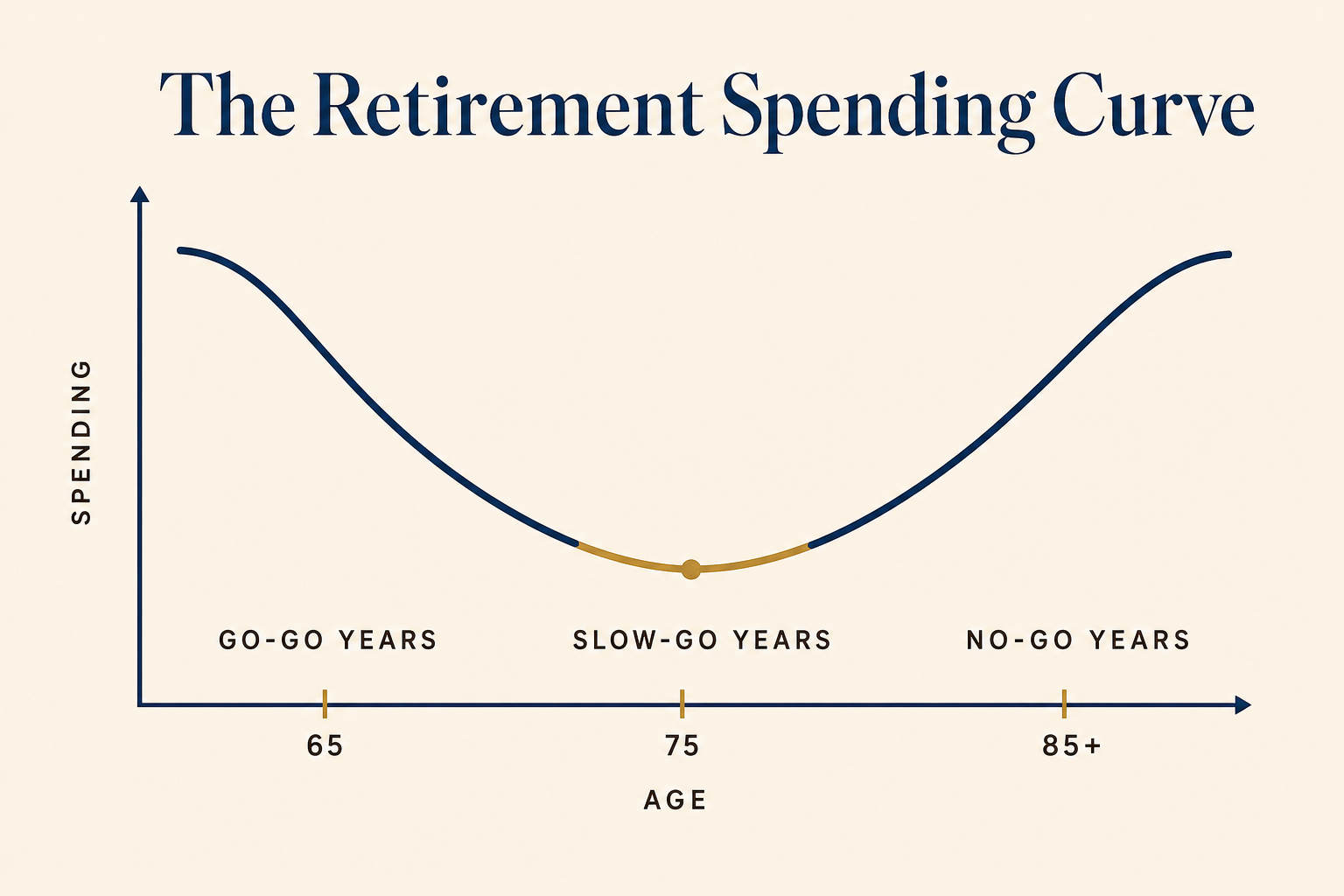
Real retirement spending doesn’t move in a straight line. It moves in a curve. People spend more in the early years, ease off through the middle, and then face a second climb late in life. If your plan assumes a flat line, you’re either scaring yourself out of spending money you could enjoy, or quietly underfunding the one stretch that tends to cost the most. Here’s what the curve actually looks like, and how to build your buckets around it.
The flat line quietly breaks good plans
The flat-spending assumption is baked into almost every retirement calculator. It’s not a conspiracy — it’s just easier math. Pick a spending number, index it to inflation, and the spreadsheet does the rest. The problem is that no one actually lives that way.
The government has been tracking this for decades. The Bureau of Labor Statistics Consumer Expenditure Survey shows household spending peaking in the mid-50s and declining steadily through the 60s, 70s, and 80s. Households headed by someone 75 or older spend meaningfully less than households in their early 60s — not because they ran out of money, but because they slowed down.
Researcher David Blanchett put numbers on the shape. In his widely-cited work on what advisors now call the “retirement spending smile,” inflation-adjusted spending tends to decline gradually — very roughly 1% or so a year in real terms through much of retirement, before turning back up late in life. Averaged out, real spending can fall by roughly a quarter from the start of retirement to the mid-80s trough. That’s not a rounding error. That’s a fundamentally different shape than the line in your calculator.
The three phases: go-go, slow-go, no-go
The clearest way I’ve found to talk about this is the language a lot of retirees already use for themselves: the go-go years, the slow-go years, and the no-go years.
The go-go years are early retirement — roughly your 60s into early 70s. You’re newly free, still healthy, and you have a list. Travel, the second home, the kitchen remodel, spoiling the grandkids, the thing you put off for thirty years. This is when discretionary spending is highest, and it should be. You didn’t save for four decades to sit in the house.
The slow-go years follow — think mid-70s into the early 80s. The passport gets used less. The big trips become smaller trips, then visits closer to home. Spending drifts down, not because of a budget crisis but because energy and appetite for big-ticket activity naturally taper. This is the middle of the smile, and it’s usually the cheapest stretch of the whole retirement.
The no-go years are late life. Discretionary spending is low — but health and care costs can climb, sometimes sharply. This is the right side of the smile turning back up. The money isn’t going to Italy anymore; it’s going to help around the house, higher medical costs, and possibly long-term care.
The part nobody warns you about: the curve climbs back up
Plenty of advisors will happily tell you the good news half of this story — that you’ll probably spend less as you age, so maybe you need less than you feared. That’s true, and it’s a relief for a lot of people. But it’s only half the picture, and the half that gets left out is the half that hurts.
The smile has a right side. Late-life health and long-term-care costs are the single biggest reason the curve stops falling and starts rising again. And here’s the trap: the go-go and slow-go savings are gradual and comfortable, while the no-go climb can be lumpy and sudden. One health event can move a household’s spending more in a single year than the previous decade of gentle decline saved.
Thomas’ Take: The flat-line plan and the “you’ll spend less, don’t worry” plan make the same mistake from opposite directions. One overfunds the boring middle; the other underfunds the expensive end. The goal isn’t to guess the average — it’s to build a structure that can bend with the curve.
A hypothetical: Ray and Diane, both 64
Consider a hypothetical case. Ray and Diane are both 64, just retired, with about $900,000 in retirement accounts, a paid-off house, and Social Security waiting in the wings. Their planner ran a flat $72,000-a-year projection, inflation-adjusted, out to 95. On paper it works.
But look at what a flat line does to their actual life. It tells them to spend the same $72,000 in the year they want to take the kids and grandkids to the coast as it does in a quiet year at 82 when they barely leave the county. In the go-go years, that flat number feels stingy — they’re holding back on the trips they’re healthy enough to take right now. In the slow-go years, they’re “spending” a budget they don’t have the appetite to use. And the flat line makes no explicit room for a care event at 86 that could dwarf a normal year.
A curve-aware version of Ray and Diane’s plan does three things the flat line can’t: it front-loads discretionary spending into the go-go years while they can enjoy it, it lets the middle years run lean without guilt, and it reserves capacity — not a vague hope — for the no-go climb. Same money. Completely different retirement.
How buckets bend with the curve
This is exactly the problem the Now, Soon, and Later bucket framework is built to solve. A flat-line withdrawal strategy pulls the same slice from the same accounts every year regardless of what life is actually doing. Buckets let you match the money to the phase.
The Now bucket — cash and short-term reserves — does its heaviest lifting in the go-go years. This is what funds the front-loaded travel and the big early purchases without forcing you to sell investments in a down market to do it. It’s also the reserve you don’t want to have raided when a no-go surprise shows up.
The Soon bucket is the one that quietly wins the whole game: your guaranteed income floor. Social Security is the backbone here, and it’s uniquely suited to a curve that runs for decades because it’s inflation-adjusted for life — it keeps paying at 92 the same as it did at 67. Layered with a pension or an income-focused Fixed Index Annuity, the Soon bucket’s job is to cover your essential bills through every phase, so the ups and downs of the curve land on discretionary money, not the light bill. When your groceries don’t depend on the market or on how long you live, the spending curve stops being a threat and becomes a set of choices.
The Later bucket — your growth money — is what you’re protecting for the right side of the smile. It’s the capacity you leave invested through the lean middle years specifically so it’s there for the late-life climb, or for legacy if the climb never comes. A flat plan tends to draw this down evenly; a curve-aware plan treats it as the reserve for the phase that costs the most.
If you want to see your own curve instead of trusting a straight line, this is worth modeling against your real numbers rather than eyeballing. A planning tool like ProjectionLab lets you set different spending in the go-go, slow-go, and no-go years — and add a late-life care shock — then watch whether your income floor and reserves actually hold. (ProjectionLab is a paid tool; the link is an affiliate link, which means I may earn a small commission at no extra cost to you. I only recommend tools I’d use myself.)
What to actually do with this
You don’t need to predict your spending curve to the dollar. You need to stop planning as if it doesn’t exist. Three moves cover most of it.
First, give yourself explicit permission to spend more in the go-go years, funded from the Now bucket, without treating it as blowing the plan — because it isn’t. This is the same reason a rigid 4% rule can quietly shortchange your best years. Second, build the Soon bucket to cover essentials for life, so the middle years can run lean without fear and the market’s mood never touches your grocery money — the same reason the order of your returns matters so much early on. Third, name the no-go climb out loud in your plan and reserve capacity for it, rather than hoping the flat line’s “extra” happens to still be there.
The straight line was never real. It was just easy. Your retirement will have a shape — a rise, a long dip, and a climb at the end. Plan for the shape, and the money you worked for lands where your life actually needs it.
This article is published by Confluence Media Group LLC, an independent publisher of educational financial content. Thomas Clark is a Series 65 Investment Advisor Representative. The information provided is for educational and informational purposes only and is not personalized financial, tax, or legal advice. Past performance does not guarantee future results. All investing involves risk, including potential loss of principal. Consult a qualified professional before making financial decisions.
Confluence Media Group LLC is a separate entity from Confluence Capital Management, the investment advisory practice through which Thomas Clark provides advisory services. Advisory services are not offered through this publishing platform.
About Thomas Clark
Thomas Clark is the founder of Confluence Media Group LLC and a Series 65 Investment Advisor Representative. He has spent nearly two decades working with families on retirement planning, with a focus on Social Security optimization, retirement income coordination, and the bucket planning approach to building a guaranteed income floor.
Thomas writes and publishes at thomasclarkadvisor.com and is the author of The Just in Case Binder — a 148-page printable family financial organizer for households who want to make sure the people they love know where everything is.
He lives in North Carolina with his family.
Subscribe to the weekly newsletter · Get the Just in Case Binder

Thomas Clark is a Series 65 licensed investment advisor and experienced trader. He specializes in investing, retirement planning, and market analysis, helping individuals build wealth and make informed financial decisions.
