
Sequence-of-Returns Risk: Why Order Beats Average
Two retirees can earn the identical average return and end up in completely different places. The reason is sequence-of-returns risk - and bucket planning is the structural defense.

Two people retire on the same day with the same million dollars, the same withdrawal plan, and — over the next 30 years — the exact same set of annual market returns. One of them dies with money to spare. The other runs short in their eighties. Nothing separates them except the order those returns happened to arrive in.
That is sequence-of-returns risk, and it is the single most under-appreciated danger in retirement. It is also the reason the number most people plan around — their “average return” — quietly lies to them the moment they stop saving and start spending.
The number that lies to you in retirement
While you are working and contributing, average return is a mostly honest number. A bad year early doesn’t hurt much, because you have little saved and years of buying ahead of you. In fact, a downturn in your 30s is a gift — you’re buying shares on sale. The order of returns barely matters. What matters is the average, compounded over time.
Retirement flips that logic on its head. Now you’re withdrawing instead of contributing, and every dollar you pull out of a falling portfolio is a dollar that can never recover. A 6% average return means nothing if the losses show up first and your withdrawals lock them in. Two retirees can earn the identical long-run average and end up in completely different places. Average return describes the destination; sequence risk is about the road.
What sequence-of-returns risk actually is
Sequence-of-returns risk is the danger that a stretch of poor returns early in retirement — combined with the withdrawals you’re taking to live on — permanently shrinks your portfolio before it ever gets the chance to recover.
The mechanism is simple and unforgiving. When you sell assets to fund your spending in a down year, you sell more shares to raise the same amount of cash. Those extra shares are gone. When the market rebounds — as it historically has, though never on a schedule anyone can promise — you own fewer shares to rebound with. You’ve converted a temporary paper loss into a permanent one. Do that in the first few years of retirement, and the damage compounds for decades.
Meet Karen and Diane
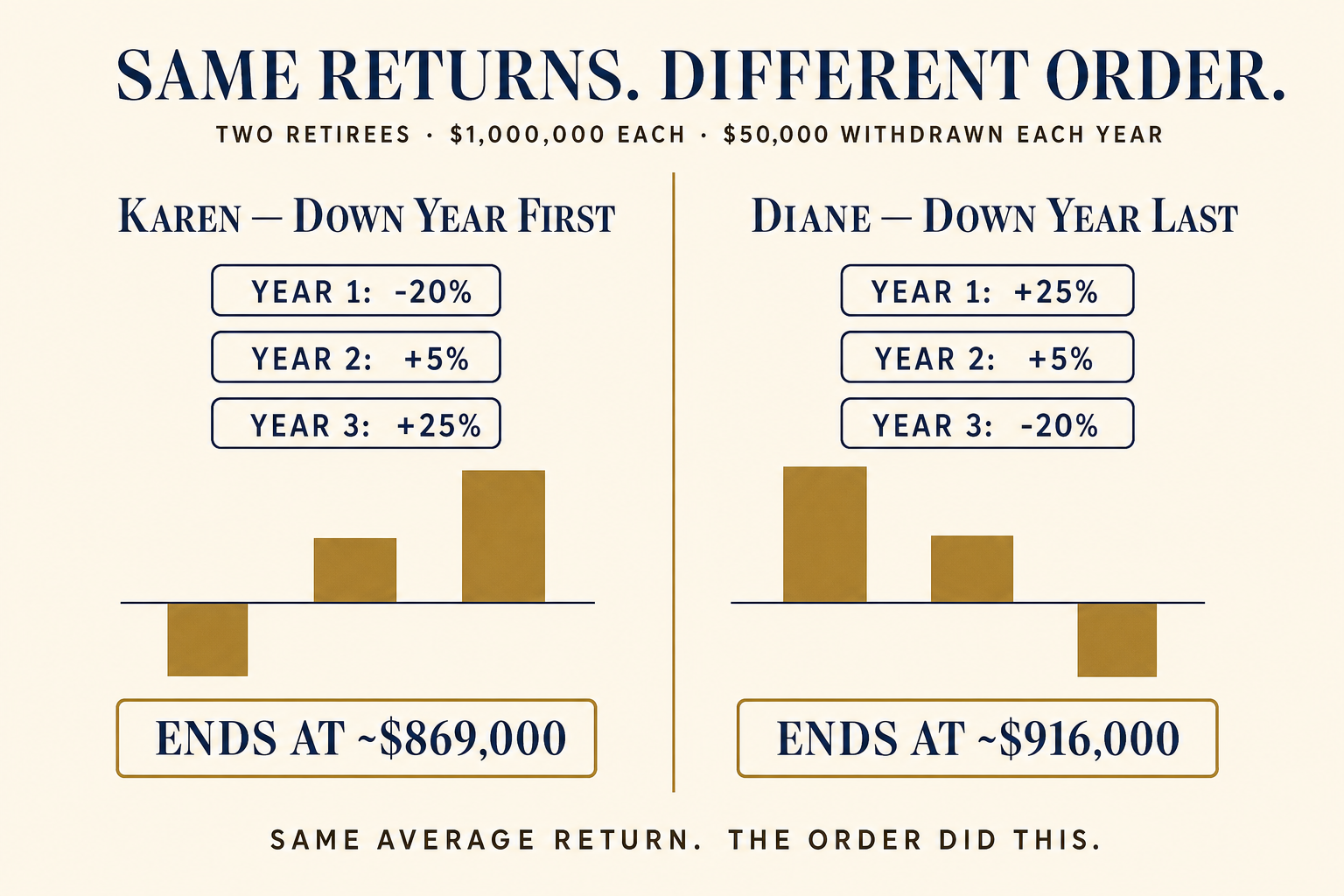
Consider two hypothetical retirees, Karen and Diane. (These are illustrations, not real people, and the figures are round on purpose.) Each retires at 65 with $1,000,000. Each withdraws $50,000 at the start of every year to live on. And each earns the same three returns in their first three years: one year of −20%, one year of +5%, and one year of +25%. Same average. Same withdrawals. The only difference is the order.
Karen gets the bad year first: −20%, then +5%, then +25%. After withdrawing her $50,000 each year, she ends year three with about $869,000.
Diane gets the same returns in reverse — the good years first, the −20% last: +25%, +5%, −20%. Same withdrawals, same average return. She ends year three with about $916,000.
A gap of roughly $47,000 opened up in just three years, between two people who earned identical average returns and spent identical amounts. This is not a projection of anyone’s actual results — it’s a demonstration of a mechanism. Now stretch it across a full 30-year retirement with real market volatility, and that early gap doesn’t stay small. In widely cited long-horizon illustrations, two retirees running the same average return but opposite sequences can finish decades apart — one comfortably ahead, the other having run out years early. The order did that. Only the order.
Why the first years carry the most weight
Sequence risk isn’t evenly spread across retirement. It’s front-loaded. The years right around your retirement date — often called the “red zone,” roughly the five years before and after you stop working — carry outsized power over how the whole plan turns out. A crash at 66 does far more lasting damage than the same crash at 82, because at 66 you have the most money exposed and the most withdrawals still ahead of it.
Retirement researcher Wade Pfau has shown that a strikingly large share of a portfolio’s final outcome traces back to the returns of just the first decade of retirement. That’s a sobering thought, because you don’t get to choose which decade you retire into. You can’t control whether your first five years look like a bull market or a bear market. What you can control is whether a bad first five years forces you to sell.
This is a distribution problem, not an investing problem
Here’s where most retirement advice goes wrong. Faced with sequence risk, the instinct is to reach for a better investment answer — a smarter fund, a tactical manager, a way to see the downturn coming and step aside. That’s the accumulation-era brain talking, and it’s the wrong tool.
You cannot out-invest sequence risk. You can’t reliably predict which years will be the bad ones, and trying to time your way around them usually makes things worse. The problem was never which assets you own. The problem is being forced to sell them at the wrong time. That’s a structural problem, and it has a structural solution: arrange your money so that a bad market never lands on the assets you’re about to spend.
This is the mindset shift the transition from saving to spending demands, and in my experience it’s where the standard “just stay diversified and ride it out” advice fails retirees most. Riding it out is easy to say when you’re contributing. It’s a lot harder when the market you’re supposed to ride out is the one funding your grocery bill.
How bucket planning defuses it
This is exactly the job the Now, Soon, and Later bucket framework is built to do. Not to earn a higher return — to make sure a bad sequence never touches the money you need soon.
The Now bucket holds cash and short-term reserves — typically a year or two of spending. When the market drops, this is what you live on, so you’re not selling anything at a loss. How much that bucket should hold is a real decision, but the principle is fixed: near-term spending never comes from a falling market.
The Soon bucket is your guaranteed income floor — Social Security, any pension, and income-focused instruments like fixed index annuities used specifically for the income they throw off, not for growth. The more of your essential expenses this floor covers, the less you ever need to sell to eat. A guaranteed check doesn’t care what the market did this morning.
The Later bucket is your growth — equities that you leave alone precisely because the first two buckets mean you don’t have to touch them in a downturn. You give them the one thing sequence risk tries to steal: time to recover.
Thomas’ Take: Bucket planning looks conservative on the surface, and people sometimes dismiss it as leaving return on the table. But its real purpose isn’t caution — it’s control. It converts the single most dangerous moment in retirement, being forced to sell into a crash, into a non-event. You get to be the retiree who simply doesn’t sell, because a down market lands on the bucket you weren’t going to spend for fifteen years anyway.
What sequence risk is not
It is not an argument for hiding in cash. A retiree with everything in the Now bucket has traded sequence risk for a slow-motion certainty of running out — inflation and longevity will win that fight. The point of the buckets isn’t to avoid the market; it’s to stay invested in growth without being hostage to its timing.
It’s also not something you defeat with a good forecast. If you take one idea from this, let it be that the fix is structural, not predictive. You don’t need to know when the next bad stretch is coming. You need to have already arranged your money so that when it comes — early, late, or never — you’re not the one who has to sell into it. For a fuller picture of how this plays out when the timing goes against you, the case of retiring straight into a down market and the rule for when not to refill your Now bucket both show the same principle in action.
Key takeaways
- Average return is an accumulation-phase number. Once you’re withdrawing, the order of returns can matter more than the average.
- Down years early in retirement do lasting damage because withdrawals turn temporary losses into permanent ones. The first decade carries outsized weight.
- You can’t out-invest or out-predict sequence risk. It’s a structural problem, so it needs a structural fix.
- The fix is to never be forced to sell. A cash Now bucket and a guaranteed Soon-bucket income floor let your growth assets ride out a downturn instead of funding your groceries.
Frequently asked questions
Does sequence risk go away later in retirement? It fades. Once you’re 15 or 20 years in, a bad year has fewer remaining withdrawals to compound against and less time-horizon riding on it. The danger is concentrated in the years right around your retirement date.
Isn’t a big cash cushion just a drag on my returns? On paper, over a calm market, yes. Its value shows up in the bad years — it’s what lets you avoid selling growth assets at the bottom. Think of it less as an investment and more as the thing that protects your investments from your own spending needs.
How many years of spending should be protected from the market? There’s no single number, but the goal is to cover your near-term spending from cash and your essential ongoing expenses from guaranteed income, so the market only ever funds discretionary and long-dated needs. That’s the sizing question the bucket framework is built to answer.
The bottom line
You don’t get to pick the market you retire into. That’s the uncomfortable truth underneath sequence-of-returns risk — the thing that most determines your outcome is partly a matter of timing you can’t control. But the conclusion isn’t to worry harder or forecast better. It’s to build a plan that makes the timing irrelevant, so that whether your first five years are kind or brutal, you’re never the retiree who has to sell into the storm.
If you want to see how a bad early stretch would actually play out against your own numbers, this is worth modeling rather than eyeballing. A planning tool like ProjectionLab lets you stress-test your plan against a rough sequence in your first years of retirement and see whether your income floor and cash reserves hold — instead of guessing. (ProjectionLab is a paid tool; the link is an affiliate link, which means I may earn a small commission at no extra cost to you. I only recommend tools I’d use myself.)
And if the deeper worry underneath all of this is simply lasting — making sure the money outlives you rather than the other way around — that’s longevity risk, and it’s the companion problem sequence planning is designed to solve alongside.
This article is published by Confluence Media Group LLC, an independent publisher of educational financial content. Thomas Clark is a Series 65 Investment Advisor Representative. The information provided is for educational and informational purposes only and is not personalized financial, tax, or legal advice. Past performance does not guarantee future results. All investing involves risk, including potential loss of principal. Consult a qualified professional before making financial decisions.
Confluence Media Group LLC is a separate entity from Confluence Capital Management, the investment advisory practice through which Thomas Clark provides advisory services. Advisory services are not offered through this publishing platform.
About Thomas Clark
Thomas Clark is the founder of Confluence Media Group LLC and a Series 65 Investment Advisor Representative. He has spent nearly two decades working with families on retirement planning, with a focus on Social Security optimization, retirement income coordination, and the bucket planning approach to building a guaranteed income floor.
Thomas writes and publishes at thomasclarkadvisor.com and is the author of The Just in Case Binder — a 148-page printable family financial organizer for households who want to make sure the people they love know where everything is.
He lives in North Carolina with his family.
Subscribe to the weekly newsletter · Get the Just in Case Binder

Thomas Clark is a Series 65 licensed investment advisor and experienced trader. He specializes in investing, retirement planning, and market analysis, helping individuals build wealth and make informed financial decisions.
