
When Not to Refill Your Now Bucket in a Downturn
Most retirees refill the Now bucket on a calendar. In a down market, that habit forces you to sell growth assets at a loss — here's the rule that prevents it.

Every retirement plan has a maintenance chore nobody warns you about: refilling the cash bucket. You spend down the money you set aside for living expenses, and at some point you top it back up by selling something. Most people put that chore on a calendar — once a year, every January, like changing the smoke-detector batteries.
That works fine in a good year. In a bad one, refilling on schedule is one of the most expensive mistakes a retiree can make. A calendar does not know what the market is doing. When you refill your Now bucket on autopilot during a downturn, you convert a paper loss into a permanent one — which is the exact outcome bucket planning was built to prevent.
This is the part of the Now, Soon, and Later bucket framework that gets skipped. People learn how to build the buckets and never learn the one rule that governs when not to refill them.
The refill habit that quietly breaks the strategy
Quick refresher on the architecture. The Now bucket holds one to three years of spending money in cash and short-term instruments. The Soon bucket is your guaranteed income floor — Social Security, any pension, and income-focused Fixed Index Annuities — covering most or all of your essential bills. The Later bucket is the growth engine: equities and longer-term holdings doing the work of outpacing inflation over time.
The Now bucket exists for one reason: so you never have to sell from the Later bucket at a bad price. It is a shock absorber. As you spend it down, the standard advice is to refill it periodically from the Later bucket’s gains. In most years, that is exactly right — and I’ve written before about the mechanics of when and how often to refill.
But “refill it periodically” turns into “refill it every January no matter what.” And that small drift — from a deliberate decision into a recurring calendar event — is what quietly breaks the whole strategy. The shock absorber only works if you let it absorb the shock.
Why a down year changes the math entirely
Here is the mechanism, because it matters. When the Later bucket is down 20% and you sell shares to refill the Now bucket, you are not “rebalancing.” You are locking in the loss. The shares you sell at the bottom are gone — they cannot participate in any eventual recovery. A temporary decline on a statement becomes a permanent reduction in your portfolio.
This is the same engine behind sequence-of-returns risk — the well-documented reality that the order of your returns matters enormously once you’re withdrawing money. The Financial Industry Regulatory Authority has written about why recent retirees are especially exposed to a bad early stretch. Forced selling in a downturn is how that risk does its damage. A calendar-driven refill is forced selling with extra steps.
The whole point of carrying a Now bucket is to give the Later bucket time to recover. Mechanically refilling in a down year throws away that time on purpose.
The rule: refill from strength, not from the calendar
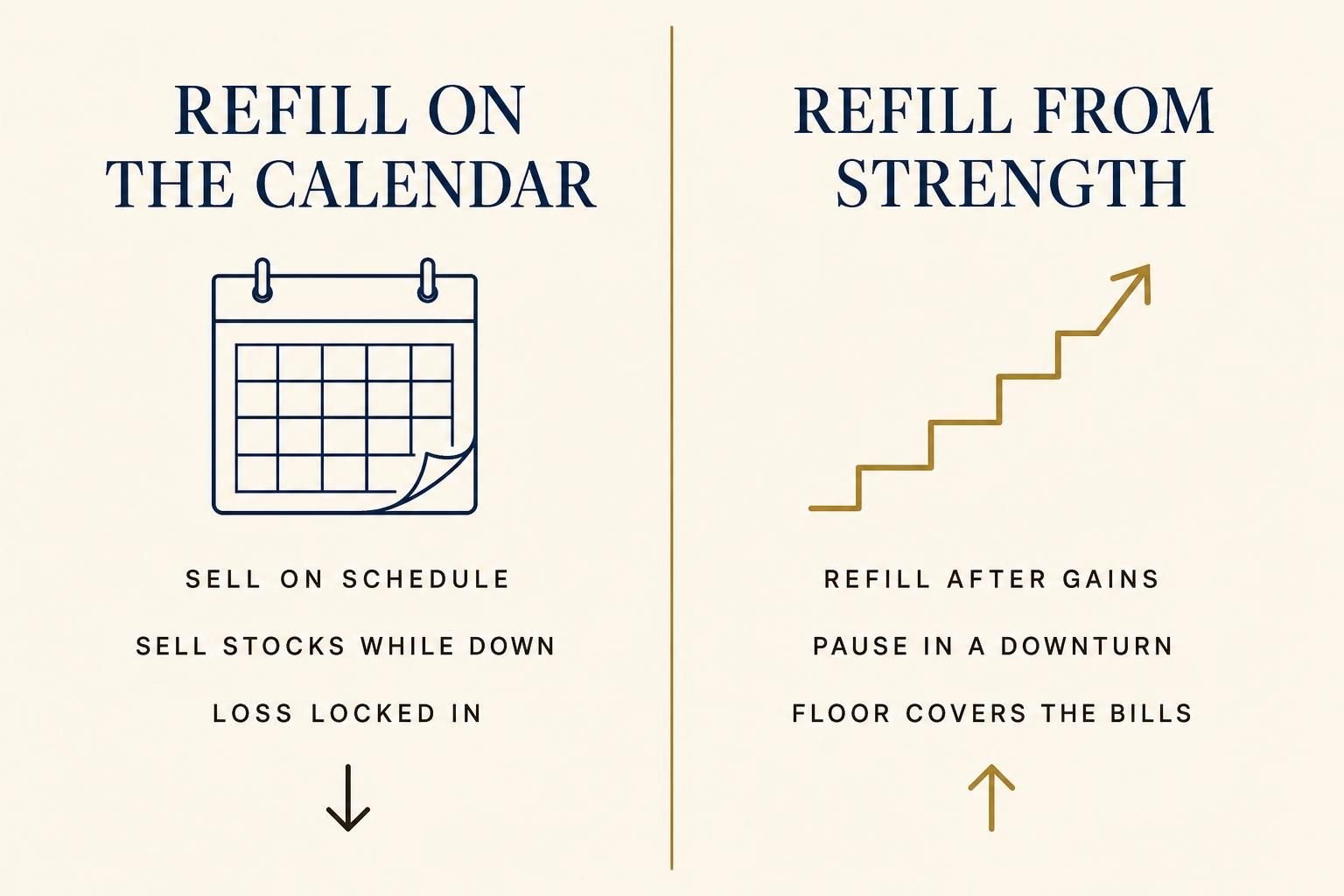
So here’s the rule I’d write on the inside cover of any bucket plan: refill from strength, not on a schedule. You top up the Now bucket when the Later bucket has had a good run and you’re trimming winners anyway. You pause the refill when the Later bucket is down and selling would mean realizing a loss.
This is not market timing. You are not predicting anything. You are simply refusing to sell low when you don’t have to — and the reason you don’t have to is that you built a guaranteed income floor and a multi-year cash cushion precisely so you’d have that option. The structure gives you permission to wait.
In practice, the trigger is simple. Before any refill, ask one question: is the Later bucket above or below where it was the last time I refilled? If it’s up, refill. If it’s down, don’t — spend the Now bucket down further, lean on the income floor, and revisit in a few months. The cushion is there to be used. A down year is the year it earns its keep.
Where the money comes from when you don’t refill
“Don’t refill” raises an obvious question: then what do I live on? This is where the architecture does its job.
Your essential bills — housing, food, utilities, insurance, healthcare — are already covered by the Soon bucket’s guaranteed income. Social Security doesn’t fall in a bear market; its annual cost-of-living adjustment only moves up. A pension doesn’t fall. An FIA income rider pays its contractual amount regardless of what stocks did this quarter. That floor is the reason you can stop selling growth assets and nothing bad happens to your grocery budget.
What you pause is the discretionary layer — the travel, the projects, the extras the Now bucket was funding on top of essentials. You let the Now bucket draw down toward its lower limit instead of topping it back up. If it’s getting thin, you trim discretionary spending for a year. Interest from the cash itself, and any dividends or bond interest thrown off by the Later bucket, can also flow into Now without selling a single share. This is, incidentally, one more reason the right amount of cash — not too little, not too much — gives you room to maneuver exactly when you need it.
A hypothetical: Carol in a down year
Consider a hypothetical case. Carol, 68, retired two years ago and lives outside Columbus, Ohio. Her essentials run about $4,000 a month, and her Soon bucket covers all of it: roughly $2,900 from Social Security, a $600 monthly pension from her years as a county administrator, and $500 from an FIA income rider she activated at 67. Her Now bucket started the year at about $90,000 — a little over two years of the $36,000 she pulls annually for travel and the discretionary spending on top of essentials. Her Later bucket holds about $820,000.
Then the market drops, and her Later bucket falls roughly 22% on paper. Her old plan said: every January, sell enough to put the Now bucket back to $90,000. That would mean selling about $36,000 of stock — at a 22% discount.
Under the refill-from-strength rule, Carol does nothing of the kind. Her essentials are still fully covered by guaranteed income that didn’t move. She lets the Now bucket fall toward $60,000 — still well over a year of cushion — trims one of the two trips she’d planned, and lets her Later bucket’s dividends trickle into cash. She doesn’t sell a share at the bottom. When the market recovers, she refills then, from strength. The shares she didn’t sell are what carry her through the next decade.
The numbers here are illustrative, not a forecast. But the shape of the decision is the lesson: the plan held because she let the buckets do their job.
When you should still refill in a down year
I won’t pretend the rule is absolute, because a few real situations override it. If your Now bucket is genuinely running dry — down to a few months — and the Soon bucket doesn’t cover a true essential, you may have to raise cash even in a poor market. Survival beats optimization. That’s usually a sign the Now bucket was sized too small to begin with, which is a planning problem to fix on the other side, not a reason to feel bad about selling.
A down market can also be a legitimate rebalancing moment — but that’s the opposite trade. Rebalancing back to your target allocation in a downturn usually means buying more of what fell, not selling it to raise cash. A deep-loss year can also open the door to a Roth conversion or tax-loss harvesting, where realizing the loss is the point. None of those is the same thing as topping up your checking account because the calendar said so.
Set the rule before you need it
The hard part is that you have to decide this in advance. In the middle of a 20% decline, every instinct says “do something,” and selling to refill the cash account feels responsible. It isn’t. The retiree who thrives in a bad market is the one who already wrote down what they’d do — and then did nothing extra.
So write it down now, while markets are calm. Size your Now bucket to carry you through a long flat stretch — two to three years, not eighteen months — and size your Soon bucket so the floor genuinely covers essentials. Then add the one sentence most plans are missing: we refill from strength, and in a down year we wait. That sentence is the difference between a plan that survives its first real bear market and one that quietly sells itself to death.
If you want to see how a paused refill plays out across different market sequences in your own numbers, modeling tools like ProjectionLab let you stress-test a down year against a guaranteed income floor before you’re living through one. (ProjectionLab is an affiliate partner; if you subscribe through that link, Confluence Media Group may earn a commission at no additional cost to you. I only point readers toward tools I’d actually use.)
Key takeaways
- Refilling your Now bucket on a fixed calendar means selling growth assets even when they’re down — turning a temporary loss into a permanent one.
- Refill from strength: top up the cash bucket after the Later bucket has gained, and pause refills when it’s down.
- In a down year, your guaranteed income floor (Social Security, pension, FIA income rider) keeps covering essentials, so you can stop selling stocks without missing a bill.
- Real exceptions exist — a nearly empty Now bucket, deliberate rebalancing, or a tax-driven Roth conversion — but none of them is a routine calendar refill.
- Decide the rule in advance. In the middle of a downturn, the calm decision feels like inaction, and that’s exactly why it works.
Frequently asked questions
How big should my Now bucket be so I can ride out a downturn?
Enough to cover the gap between your guaranteed income and your total spending for a meaningful stretch — generally two to three years, longer in the first decade of retirement when sequence risk bites hardest. The bigger your guaranteed floor, the smaller the gap the Now bucket has to fill, which is why it pays to start by sizing the income floor first.
What if the downturn lasts longer than my Now bucket?
That’s the scenario the Soon bucket is built for. Once essentials are covered by guaranteed income, a long bear market becomes a discretionary-spending problem, not a survival problem — you trim the extras and wait it out.
Isn’t pausing the refill just market timing?
No. Market timing is predicting direction. This is reacting to a fact already on your statement — the Later bucket is down — and declining to sell at that price when your structure means you don’t have to. You’re not forecasting a recovery; you’re refusing to lock in a loss you can afford to wait out.
This article is published by Confluence Media Group LLC, an independent publisher of educational financial content. Thomas Clark is a Series 65 Investment Advisor Representative. The information provided is for educational and informational purposes only and is not personalized financial, tax, or legal advice. Past performance does not guarantee future results. All investing involves risk, including potential loss of principal. Consult a qualified professional before making financial decisions.
Confluence Media Group LLC is a separate entity from Confluence Capital Management, the investment advisory practice through which Thomas Clark provides advisory services. Advisory services are not offered through this publishing platform.
About Thomas Clark
Thomas Clark is the founder of Confluence Media Group LLC and a Series 65 Investment Advisor Representative. He has spent nearly two decades working with families on retirement planning, with a focus on Social Security optimization, retirement income coordination, and the bucket planning approach to building a guaranteed income floor.
Thomas writes and publishes at thomasclarkadvisor.com and is the author of The Just in Case Binder — a 148-page printable family financial organizer for households who want to make sure the people they love know where everything is.
He lives in North Carolina with his family.
Subscribe to the weekly newsletter · Get the Just in Case Binder

Thomas Clark is a Series 65 licensed investment advisor and experienced trader. He specializes in investing, retirement planning, and market analysis, helping individuals build wealth and make informed financial decisions.
