
The Hidden Cost of Holding Too Much Cash in Retirement
Cash feels safe. The wrong amount of it has a real cost retirees rarely measure — the inflation drag and the opportunity cost over a 20-year retirement. Here is what 'safe' actually trades away, and how the Now bucket has a right size.

“Just keep more in cash.” It’s the most common piece of retirement advice that almost nobody questions. And it’s where I spend more of my time pushing back than on almost any other single topic.
Cash feels safe. It doesn’t drop on a bad market day. The balance is the same Monday as it was Friday. For a generation that watched 2008 swallow forty percent of their portfolios, the appeal is obvious.
But cash isn’t safe. Cash is liquid. Those aren’t the same word, and confusing them costs retirees more than most ever realize. The retiree who held an extra $200,000 in cash from age sixty to eighty didn’t stay safe — they quietly lost roughly $33,000 of real purchasing power, plus whatever the same money would have produced sitting inside the right bucket.
This piece is about what cash is actually for, what it isn’t, and how to tell when “playing it safe” has crossed into something more expensive.
Where the “more cash is safer” instinct comes from
The instinct isn’t irrational. Three real things drive it.
Pattern memory. Retirees who lived through 2000–2002, 2008, and the 2020 flash crash remember what an equity drop felt like at exactly the wrong time. The aversion is earned. The reflex is to never feel that again.
Sequence-of-returns risk. A thirty-percent drop in year one of retirement is not the same event as a thirty-percent drop in year twenty — I covered why at length in the sequence-of-returns piece. Cash is one defense against it, and an early-retirement reader is right to take the risk seriously.
The advice ecosystem. Most retirement guidance — books, columns, brokerage marketing — tells retirees to hold “five to seven years of expenses in cash and short bonds.” It’s repeated so often it sounds like a law of physics.
The first two are valid concerns. The third is a heuristic that mistakes “more cash” for “more defense” — and in practice, the two aren’t the same. The defense is structural, not quantitative. You don’t out-cash sequence risk. You out-architect it.
The slow leak — what cash actually costs over twenty years
Here’s the part most retirees never run the numbers on.
Over the last two decades, short-term Treasury and money-market rates averaged in the low single digits — roughly 1.5 to 2.0 percent in good years and close to zero in many years between. Inflation, measured by the Consumer Price Index, averaged around 2.7 percent over that same window.
The arithmetic of those two numbers is unforgiving. A retiree who held $200,000 in cash from sixty to eighty, earning 1.8 percent nominal against 2.7 percent inflation, did not end the period with $200,000 of real purchasing power. They ended it with about $167,000 — a quiet $33,000 leak, with no statement entry ever recording the loss.
That’s the direct cost. The opportunity cost is larger. The same $200,000, held in a moderate balanced portfolio earning a real return of even four percent over the same window, would have grown to roughly $438,000 in real terms. The difference between sitting in cash and sitting in the right bucket is more than a quarter-million dollars of real purchasing power over a twenty-year retirement.
None of that means cash is wrong. It means too much cash, held for the wrong reason, is a tax retirees levy on themselves.
The right size for the Now bucket — and what overflowing it costs
The Now/Soon/Later framework has an opinion about cash. A strong one.
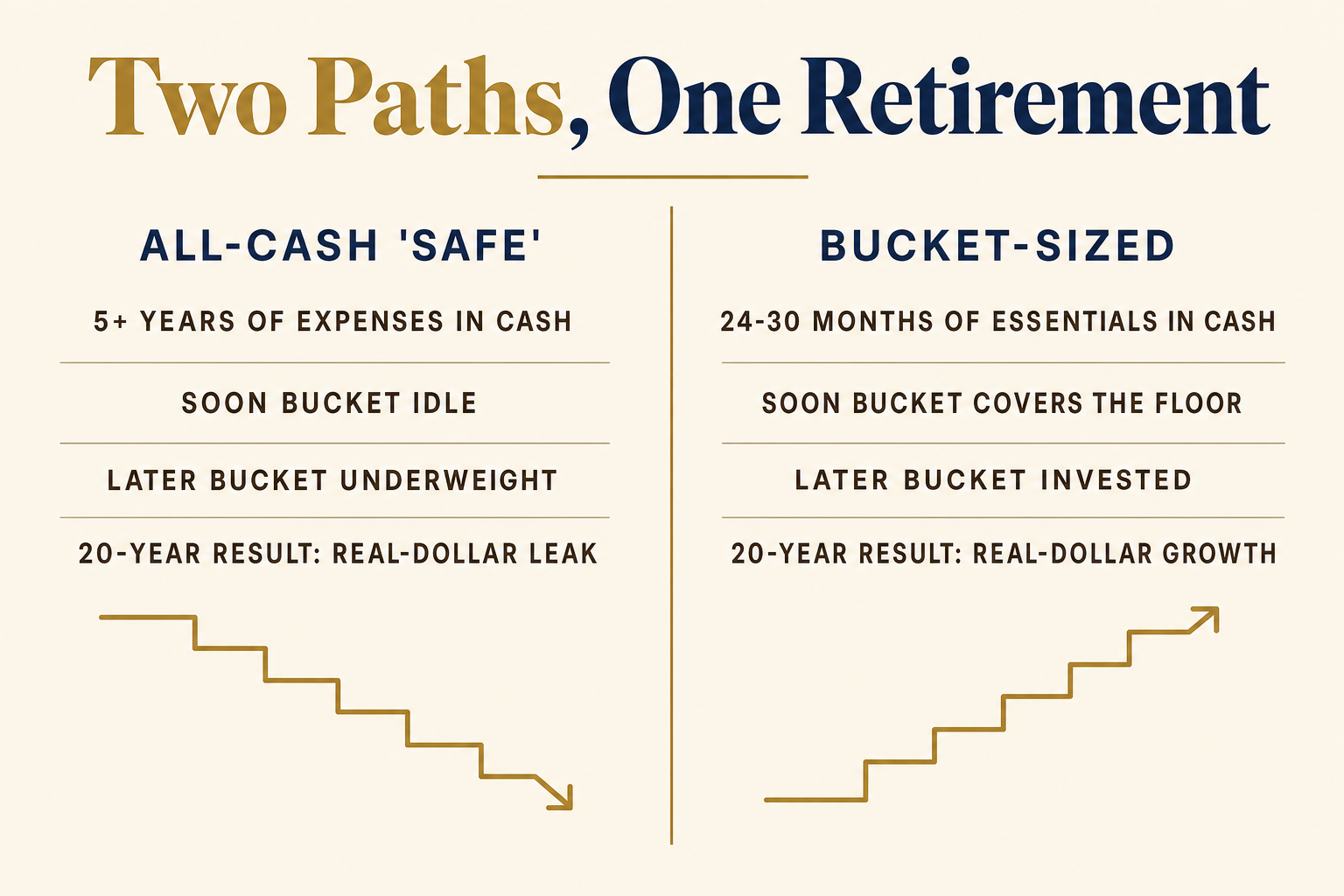
The Now bucket is for short-horizon money — usually twelve to twenty-four months of essential expenses, sometimes extended to twenty-four to thirty months inside the retirement red zone. That’s it. Its job is to absorb the next bad market year so the Later bucket doesn’t have to be sold under duress.
The Soon bucket is the income floor — Social Security, pensions, and where appropriate, a Fixed Index Annuity with an income rider. The Soon bucket is what actually makes the rest of the architecture work. It’s not cash that keeps the lights on during a downturn. It’s the guaranteed monthly check.
The Later bucket is for growth — equities, balanced portfolios, the long-horizon money that has decades to weather drawdowns because the first two buckets are doing the defensive work.
When a retiree holds five-plus years of expenses in cash, they’re not making the Now bucket bigger. They’re stuffing money into it that belongs in the Later bucket — and giving up the real return that bucket exists to capture. The defense was already in place. The extra cash is overinsurance, paid for in real terms every year.
Sizing the Soon bucket correctly is the move that lets the Now bucket be small without feeling small. Once the income floor covers essentials, two years of cash is plenty.
The inflation half of the equation
I wrote the recent inflation piece partly because retirees consistently underestimate the cumulative effect of even moderate inflation on cash holdings.
At a 2.7 percent average inflation rate, $1.00 becomes about $0.59 of real purchasing power over twenty years. Cash that earns less than inflation is not preserving value. It’s erosion in slow motion. Social Security has a partial defense in its annual cost-of-living adjustment. Cash doesn’t.
This is why a deliberately oversized Now bucket is so costly. The longer the money sits, the larger the gap between what it should buy and what it actually buys. The five-year cash cushion that felt like a safety blanket at sixty-five buys meaningfully less at seventy-five, and substantially less at eighty-five.
The behavioral cost — cash is almost never the temporary move
This is the part I think advisors most underweight.
Cash has gravitational pull. Most retirees who park “just a little extra” in cash during a scary moment don’t redeploy it once the moment passes. The S&P recovers, the news cycle moves on, the cash stays. By the time anyone notices, three years have gone by and the “temporary” cash position has become a permanent allocation drag.
I’ve watched this pattern often enough that I now treat it as a structural reality rather than a behavioral exception. If you’re going to oversize cash, assume the oversize is permanent — and price the opportunity cost accordingly.
A hypothetical — David and Linda, both 62
Consider a hypothetical: David and Linda, both sixty-two, retiring this year in suburban Charlotte. Their numbers:
- Combined portfolio: $850,000 (mostly in tax-deferred accounts)
- Paid-off house
- Essential monthly expenses: $5,400
- David’s Social Security at full retirement age (sixty-seven): $3,200/month, $3,968/month if he delays to seventy
- Linda’s Social Security at her FRA: $1,950/month
- A small state pension of $1,100/month starting at sixty-five
The retirement-planning podcast they listened to last week said “keep at least five years of expenses in cash.” Five years of essentials is $324,000 — close to forty percent of their portfolio. They are about to make that move.
Here’s the bucket-planning view of the same situation.
The Soon bucket is largely already built. Once David claims at seventy and Linda claims at her FRA, household guaranteed income lands around $7,000 a month — enough to cover all $5,400 of essentials with a roughly $1,600 monthly buffer. The pension at sixty-five closes part of the gap earlier.
The Now bucket needs to carry the household through the bridge years before Social Security claims and through the retirement red zone — about twenty-four to thirty months of essentials, or $130,000 to $160,000. Not $324,000.
The $160,000 difference is the cost of overinsurance. Held in a moderate portfolio earning four percent real over twenty years, that money grows to roughly $350,000 in real terms. Held in cash earning negative real return, it shrinks toward $130,000.
The “safe” advice quietly costs them about $220,000 of real purchasing power over their retirement — money that doesn’t disappear loudly, just disappears.
Three signals you’re holding too much cash
You don’t need a spreadsheet to spot this. Three checks usually surface the problem.
1. Your cash position exceeds twenty-four to thirty months of essential expenses. If it does, the surplus probably belongs in the Later bucket. The retirement red zone is the one window where the upper end of that range is defensible.
2. Your Soon-bucket income floor already covers essentials. If Social Security, pensions, and any income-rider FIA together exceed your essential monthly outflow, cash beyond the Now bucket isn’t doing defensive work — it’s drag.
3. The cash position was supposed to be temporary, and isn’t. If you parked extra cash during a scary news cycle and haven’t redeployed it within a year, it’s no longer a tactical decision. It’s an allocation.
If any of those three signal yes, run the opportunity cost. Tools like ProjectionLab let you model what an extra five years of cash actually costs your plan in real-dollar terms over the rest of your retirement, side by side with the same money in a properly sized Later bucket. The number is almost always larger than people expect.
Disclosure: ProjectionLab is an affiliate partner. If you sign up through that link, I earn a small commission at no additional cost to you. I use the platform myself because it does this kind of modeling cleanly.
What cash is for, and what it isn’t
Cash is for known short-term outflows: the next twelve to twenty-four months of essentials, an upcoming major expense, a planned bucket-refill window. It buys liquidity, and liquidity is the thing it’s actually good at.
Cash isn’t for safety in the deep sense. Safety in retirement is structural — it comes from a Soon bucket sized to cover essentials, a Now bucket sized to absorb the next bad year, and a Later bucket left alone to do its job. Stuff extra money into the Now bucket and you don’t get extra safety. You get extra erosion.
The retiree who builds the income floor, sizes the Now bucket properly, and leaves the Later bucket invested isn’t taking more risk than the cash-heavy retiree. They’re taking different risk — and the math over twenty years tells you which one quietly compounds in the wrong direction.
Cash feels safe. The wrong amount of it isn’t.
This article is published by Confluence Media Group LLC, an independent publisher of educational financial content. Thomas Clark is a Series 65 Investment Advisor Representative. The information provided is for educational and informational purposes only and is not personalized financial, tax, or legal advice. Past performance does not guarantee future results. All investing involves risk, including potential loss of principal. Consult a qualified professional before making financial decisions.
Confluence Media Group LLC is a separate entity from Confluence Capital Management, the investment advisory practice through which Thomas Clark provides advisory services. Advisory services are not offered through this publishing platform.

Thomas Clark is a Series 65 licensed investment advisor and experienced trader. He specializes in investing, retirement planning, and market analysis, helping individuals build wealth and make informed financial decisions.
