
The Retirement Red Zone: The Decade That Decides How Your Plan Actually Holds
The decade around your retirement date — five years before and five years after — is the window where the math of your retirement gets locked in. Here is what the retirement red zone actually is, why a 2008 in year one is structurally different from a 2008 in year twenty, and the three real defenses that don't require you to time the market or get conservative at the wrong moment.

The decade around your retirement date is not like any other decade in your financial life. The five years before you stop working and the five years after — what advisors call the retirement red zone — are when the math of your entire retirement gets locked in. A bad outcome here doesn’t average out over time. It compounds in a direction you can’t reverse.
I’ve been writing about sequence-of-returns risk for a while now, because it’s the single most underrated risk in retirement planning. But the red zone is the version of that risk you can actually plan around — because you know roughly when it starts and roughly when it ends. The five years in front of you and the five years behind your retirement date form a ten-year window where structural decisions matter more than tactical ones.
This post is about what that window actually is, why it’s different from any other stretch of your investing life, and the three real defenses against it that don’t require you to time the market or get conservative at the wrong moment.
What the red zone actually is — and why it sits where it does
The retirement red zone is the roughly ten-year window centered on your retirement date. Call it five years before and five years after, give or take. The exact boundaries are less important than the structure: it’s the period when your portfolio is largest, your time-to-recovery is shortest, and the first big withdrawals are being taken from accounts that were built to compound, not to distribute.
This combination is what makes the window dangerous. Earlier in your career, a 30% market drop is painful but recoverable — your portfolio is smaller, you’re still contributing, and time is on your side. Later in retirement, a 30% drop is unpleasant but the bucket structure has done its job for a decade and your guaranteed income has had time to compound. The red zone sits between those two cushions, with neither of them fully built yet.
This is also the window where most “I have plenty saved” plans quietly stop working. The headline number looks the same on January 1st of each year. What changes is how that number behaves when you actually start drawing from it.
The math: why a 2008 in year one is different from a 2008 in year twenty
Sequence-of-returns risk is just a mathematical observation: when you’re taking withdrawals, the order in which returns arrive changes the outcome, even if the average return is identical. FINRA describes this as the reason why “the timing of returns matters as much as the returns themselves” for anyone in distribution. The textbook example is two retirees with the same starting balance, the same average return, the same withdrawal rate — but opposite return sequences. The one whose worst years come early can run out of money. The one whose worst years come late can finish with more than they started.
The red zone is where this matters most because it’s where the worst-case sequence does the most damage. Consider what a 30% drawdown looks like in year one of retirement versus year twenty:
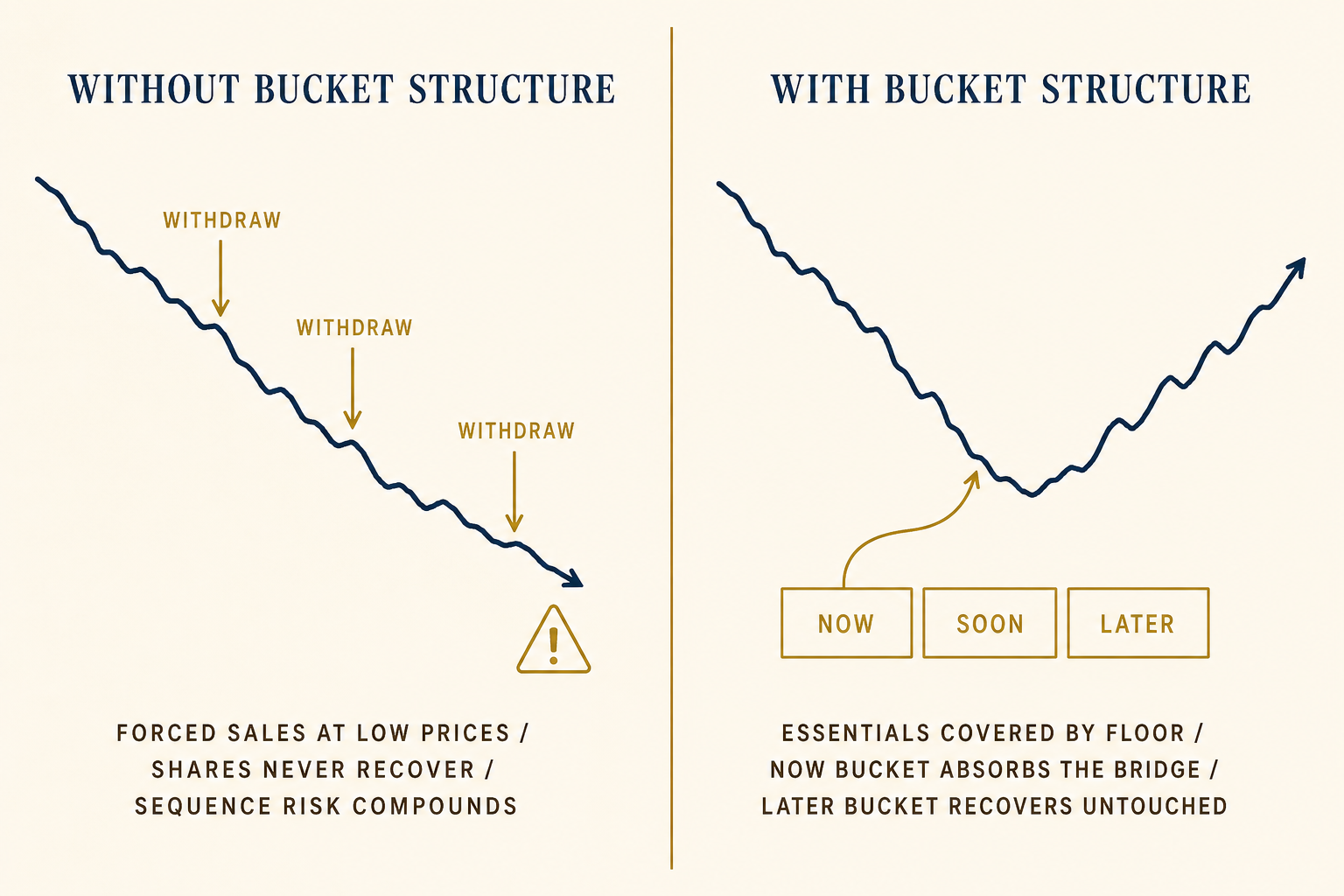
- Year one of retirement: $1,000,000 portfolio drops to $700,000. The retiree pulls $50,000 to live on. The portfolio finishes the year at roughly $650,000. To recover to the original $1,000,000 even ignoring future withdrawals, the remaining money has to grow more than 53%. With ongoing withdrawals, it has to grow much more than that — and it has to do it before the next drawdown arrives.
- Year twenty of retirement: The same $1,000,000 portfolio, after twenty years of returns and withdrawals, is some lower or higher number depending on the path. A 30% drop in year twenty is real money. But by then, the retiree has been taking guaranteed income for two decades, the Soon bucket is mature, and time has done a lot of the work the early years couldn’t.
Here is the part most people miss: the damage is not just about percentages. It’s about forced selling. A retiree drawing from a portfolio in a drawdown is selling units when they’re cheap. Every dollar pulled at the trough is a dollar that never participates in the recovery. That’s the structural mechanism. A bear market in your fifties is a paper loss you can wait out. A bear market in your sixties, with checks going out the door every month, is a permanent transfer of shares from your future self to your present self.
The three real defenses (none of them is “get conservative”)
The conventional advice for the red zone is some version of “dial back the risk.” That advice is half-right and entirely insufficient. The Bureau of Labor Statistics’ running CPI release is a useful reminder of why a portfolio that gets too conservative too early — and then has to fund 25 or 30 years of inflation-eroded essentials — has a different failure mode, not a smaller one. Reducing equity exposure in the red zone protects you from the drawdown, but it also removes the only mechanism by which the portfolio could grow into a thirty-year retirement. Trading sequence risk for longevity risk is a trade, not a solution.
The real defenses are structural and they’re the ones the Now/Soon/Later bucket framework exists to build:
Defense one: a guaranteed income floor sized to your essentials. Social Security, pensions, and income-focused Fixed Index Annuities together cover the bills that have to get paid every month no matter what the market does. The mechanism that defeats sequence risk isn’t a conservative allocation — it’s removing the forced sale. If the essentials are covered, you don’t have to sell into a drawdown. The portfolio gets to behave the way portfolios are supposed to behave over decades. The delayed retirement credits on Social Security — the 76% lift between claiming at 62 and at 70 — exist precisely to give households a way to build that floor.
Defense two: a Now bucket oversized for the red zone specifically. Outside the red zone, eighteen months of cash and short-duration bonds is usually plenty. Inside the red zone — especially the first five years — that buffer needs to stretch. Two years on the conservative side, three years if you’re entering the window with a portfolio already at all-time highs. The Now bucket is the inventory that lets you ride out a bad sequence without selling the Later bucket at the wrong price. When and how to refill it is its own decision, but the size of it during the red zone is the lever that matters most.
Defense three: the Later bucket stays invested. This is the part the “get conservative” advice quietly destroys. Once defenses one and two are in place, the Later bucket has been freed up to do its actual job — multi-decade growth that the household will need in years fifteen, twenty, and twenty-five of retirement. Pulling it out of equities to feel safer in year three is the same mistake an accumulator makes when they sell after a 20% drop. The structural defense is what lets you keep the long-term allocation pointed at long-term goals.
You will notice none of these defenses involves predicting market direction, rotating sectors, hedging with options, or any of the tactical noise that fills financial media. The red zone is solved structurally or it isn’t solved at all.
A hypothetical: David and Linda, 62 and 60
Consider a hypothetical case. David is 62 and planning to retire at 65. His wife Linda is 60 and plans to retire at the same time. They live outside Charlotte, North Carolina. Their household balance sheet looks roughly like this: $980,000 across a 401(k), a Roth IRA, and a small taxable account. A paid-off house. About $5,400 a month of essential expenses (mortgage gone, but property tax, insurance, healthcare, food, utilities, transportation). David’s Social Security benefit at full retirement age is about $3,200; Linda’s is about $1,950. No pension.
They are sitting at the front edge of their red zone. The next ten years will decide most of what their retirement actually looks like.
Here is what the structural defenses might mean for them in practice. They plan to delay David’s claim to 70, which lifts his benefit to roughly $3,968 and adds a survivor floor for Linda if she outlives him. Linda claims at her own FRA. By age 70, their household guaranteed income — Social Security plus a small income-rider Fixed Index Annuity sized to fill the essentials gap — covers something close to their entire $5,400 essentials number. From that point forward, the Later bucket can ride through any drawdown without selling at the wrong price.
Between 65 and 70, they have to bridge. The Now bucket carries that gap — roughly $130,000 in cash and short-duration Treasurys at retirement, deliberately oversized because they are entering the red zone — together with bracket-fitted distributions from the Traditional IRA that double as Roth conversion runway. The Later bucket — about $700,000 by their retirement date — stays invested through the whole bridge. If a 2008 happens in 2027, the Now bucket carries them. They are not forced sellers. The Later bucket gets to recover on its own clock.
If you want to see how the bridge math, the conversion ladder, and the income floor interact under different sequences for your own numbers, ProjectionLab is the tool I use to model the red-zone decade specifically. (Affiliate disclosure: I receive a small commission if you sign up through that link. It costs you nothing extra. I use it because it’s the planning software I trust for this kind of multi-account, multi-bucket modeling.)
What the red zone should change about how you plan right now
If you are anywhere inside the window — say, age 55 to 70 — the red zone changes what kind of decisions deserve your attention. The interesting questions are no longer “what’s the right stock-to-bond ratio?” or “what’s the right withdrawal rate?” The interesting questions are structural:
- Is the essentials gap covered by guaranteed income, or is it still riding on portfolio withdrawals? If it’s still riding on withdrawals, that’s the project. Sizing the Soon bucket is the upstream decision.
- Is the Now bucket sized for the red zone, not for normal retirement? Two to three years of essentials is the calibration. One year is fine outside the window. Inside the window, one year is a structural mistake.
- Is the Social Security claim date a household decision, not an individual one? In a two-earner household, the higher earner delaying to 70 is usually the single highest-leverage decision available. The math is in the bridge years problem.
- Is the Later bucket allocation pointed at the next twenty-five years, not the next five? This is the discipline that the structural defenses make possible. Without them, you’ll be tempted to defang the long-term portfolio at exactly the wrong moment.
The red zone is unforgiving in one direction: a plan that wasn’t built before you arrive in it is much harder to build once you’re already inside it. The plan that was built before, on the other hand, mostly just runs. Defenses one, two, and three do their jobs. The window closes. The next thirty years get to be what they were supposed to be.
That’s the work the red zone asks for. It’s quiet, structural, and it doesn’t make for a headline. But it is the entire game.
This article is published by Confluence Media Group LLC, an independent publisher of educational financial content. Thomas Clark is a Series 65 Investment Advisor Representative. The information provided is for educational and informational purposes only and is not personalized financial, tax, or legal advice. Past performance does not guarantee future results. All investing involves risk, including potential loss of principal. Consult a qualified professional before making financial decisions.
Confluence Media Group LLC is a separate entity from Confluence Capital Management, the investment advisory practice through which Thomas Clark provides advisory services. Advisory services are not offered through this publishing platform.
About Thomas Clark
Thomas Clark is the founder of Confluence Media Group LLC and a Series 65 Investment Advisor Representative. He has spent nearly two decades working with families on retirement planning, with a focus on Social Security optimization, retirement income coordination, and the bucket planning approach to building a guaranteed income floor.
Thomas writes and publishes at thomasclarkadvisor.com and is the author of The Just in Case Binder — a 148-page printable family financial organizer for households who want to make sure the people they love know where everything is.
He lives in North Carolina with his family.
Subscribe to the weekly newsletter · Get the Just in Case Binder

Thomas Clark is a Series 65 licensed investment advisor and experienced trader. He specializes in investing, retirement planning, and market analysis, helping individuals build wealth and make informed financial decisions.
