
The Longevity Risk Most Retirement Plans Ignore
Most retirement plans are quietly built to last only to life expectancy, a median, which means a coin-flip chance of outliving your money. Here's why guaranteed lifetime income, not a bigger portfolio, is the only real hedge against a long life.

Ask a retirement calculator how long your money needs to last and it will quietly assume an answer: about age 85. That’s roughly life expectancy for someone retiring today, and it feels reasonable. It’s also the single most dangerous number in your plan.
Life expectancy is a median, not a deadline. Half of people live longer than it, sometimes much longer. So a plan built to last exactly that long is, by definition, a plan with a coin-flip chance of running out while you’re still here to notice. That’s longevity risk, and after nearly two decades of doing this work, I’ve found it’s the risk people prepare for least and worry about most.
Here’s the good news: it’s also the one big retirement risk you can almost completely eliminate. You just can’t do it with a bigger pile of savings. Let me explain.
The age you’re planning to is a coin flip
When financial planners say “life expectancy,” they mean the median, the age by which half of a group has died and half is still living. For a 65-year-old today, that’s somewhere around 84 to 87, depending on the table. Build your plan to that age and you’ve quietly accepted a 50% chance of outliving it.
And that’s just for one person. For a healthy 65-year-old couple, the odds that at least one of them reaches 90 are better than even, and a meaningful share will see 95. You can check the raw numbers yourself in the Social Security Administration’s actuarial life tables. The takeaway is simple: planning your money to “last to life expectancy” is planning for the exact middle of a range that runs a decade or more past it.
Why longevity risk is the one that makes every other risk worse
Longevity risk is sneaky because it doesn’t show up as its own line item. Instead, it multiplies every other risk you’re already trying to manage.
The longer you live, the more chances a bad run of markets has to catch you at the wrong time. The sequence-of-returns risk I’ve written about doesn’t disappear at 75. The longer you live, the more inflation compounds against a fixed pot of money. The longer you live, the more likely you are to face the big late-life healthcare and long-term-care costs that arrive in your 80s and 90s. Time is the amplifier on all of it.
And here’s the part that makes longevity risk genuinely different: you can’t diversify it away. You can spread investments across assets to manage market risk. There is no asset that hedges the length of your own life, because you don’t get to live an average life — you live your actual one. A portfolio can be engineered to last “on average.” You are not average. You are one specific person who will live one specific, unknown number of years.
The one asset that doesn’t care how long you live
If a bigger portfolio can’t solve longevity risk — and it can’t, because any pot of money can be drawn down to zero — then what does? Guaranteed income that pays for as long as you live, no matter how long that is.
There are three sources of it, and they’re the core of what I call the Soon bucket in bucket planning:
- Social Security. You literally cannot outlive it, it rises with inflation through annual cost-of-living adjustments, and every year you delay claiming toward 70 permanently raises the check. That combination (lifetime, inflation-adjusted, and enlargeable) makes delayed Social Security the cheapest longevity insurance most people will ever have access to.
- A pension with a lifetime payout, ideally with a joint-and-survivor election so it keeps paying a surviving spouse.
- An income-focused fixed index annuity with a lifetime income rider. This is the private-market tool for the job: it converts a portion of savings into a contractual check that keeps coming even if you live to 100 and the account value is long gone. Its purpose isn’t to beat the market. Its purpose is to cover your essential bills for life.
Notice what all three have in common. None of them can be exhausted by a long life. That’s the whole point, and it’s exactly why a market portfolio, however large, can’t fully replace them. A portfolio has a balance that can hit zero. A lifetime income doesn’t. (For the same reason, I don’t build income floors out of variable annuities: layering market risk onto the one part of the plan that’s supposed to be certain defeats the purpose.)
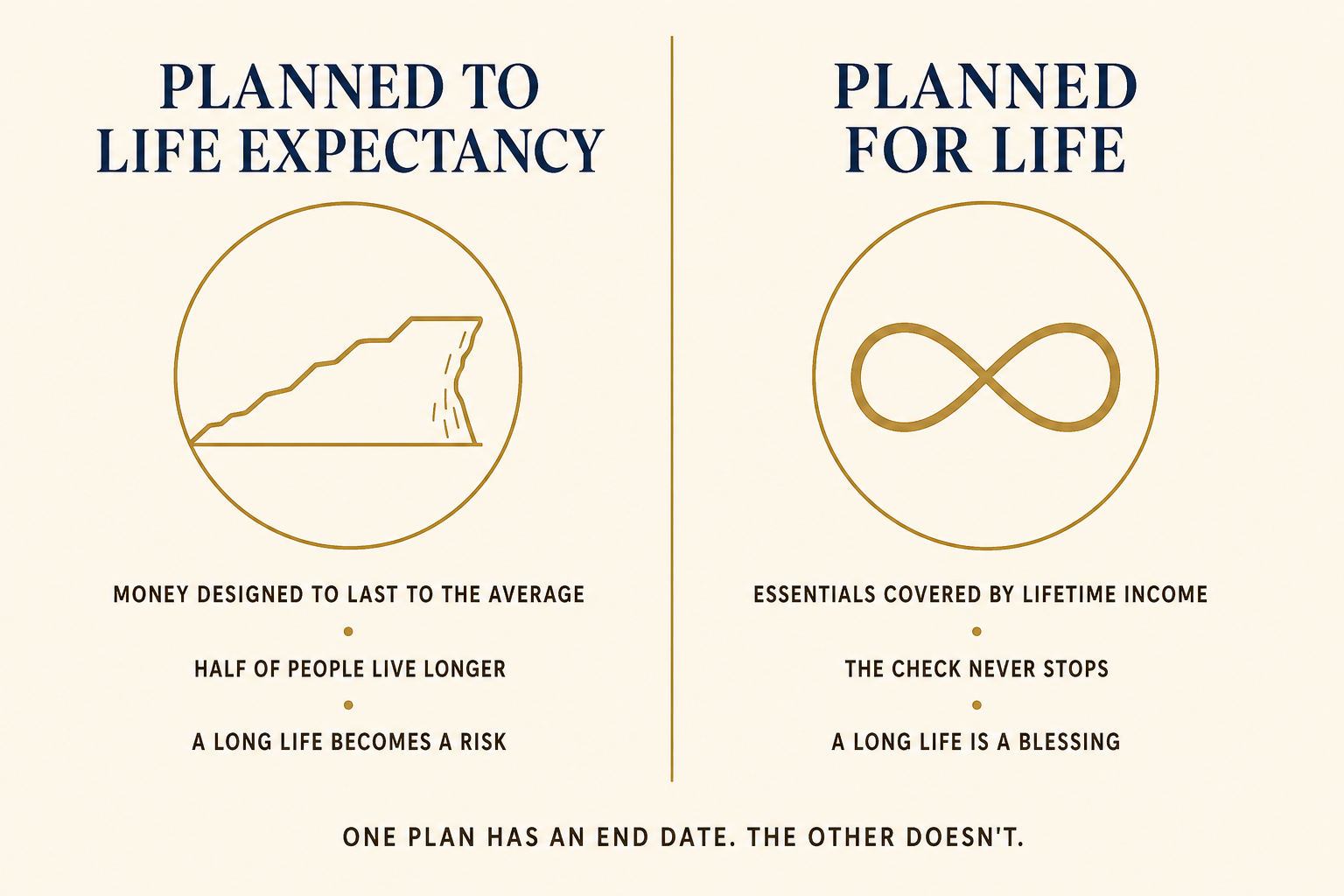
A hypothetical: two healthy 65-year-olds, two different plans
Consider a hypothetical case. Ellen and Ray are both 65, both healthy, both with a family history of living into their 90s. Each has $850,000 saved and expects the same Social Security. On the calculator, they look identical. What differs is how they built the plan.
Ray built his to life expectancy. He set up a withdrawal schedule designed to make $850,000 plus Social Security last comfortably to about 86, which the software called a success. It works beautifully — until he’s 92, the portfolio is nearly drained, and he’s living on Social Security alone in the years he least expected to still be here. His plan didn’t fail because the strategy was wrong. It failed because it had an end date and he outlived it.
Ellen built hers for life. She delayed Social Security to 70 to enlarge that lifetime, inflation-adjusted check, and used a portion of her savings to add a lifetime income annuity so that her essential bills are fully covered by guaranteed income that never stops. The rest of her portfolio is her Later bucket: travel, grandchildren, the late-life care fund. When Ellen turns 92, the length of her life has changed her travel budget, not whether the lights stay on. (These figures are illustrative and hypothetical; annuity income is guaranteed only to the terms of the actual contract.)
Same age, same health, same savings. One plan ran out of runway. The other never needed any.
How to build a plan that doesn’t care how long you live
You don’t need to predict your lifespan. You need to build so the prediction doesn’t matter:
- Plan to a long age, not the average. Run your plan to 95, or simply to “for life.” If it only survives to 85, that’s not a finished plan — it’s a plan with a hidden expiration date.
- Cover your essentials with lifetime-guaranteed income. Add up your non-negotiable bills and make sure they’re met by sources that can’t run out. Social Security timing is the highest-leverage move here, and it costs nothing but patience.
- Let the portfolio carry the discretionary and legacy layer. Once essentials are guaranteed for life, running low on the investment side means fewer trips, not missed rent. That’s a survivable problem.
- Consider a lifetime income annuity to fill the gap. If Social Security and any pension don’t fully cover essentials, an income-focused annuity can close the difference with a check that lasts as long as you do.
This is worth modeling with your real numbers before you commit to anything, and worth stress-testing against a long life specifically. A planning tool like ProjectionLab lets you run your plan out to 95 or 100, watch what happens to the portfolio in the tail, and see how much steadier the picture gets when guaranteed income covers your essentials. (ProjectionLab is a paid tool; the link is an affiliate link, which means I may earn a small commission at no extra cost to you. I only recommend tools I’d use myself.)
A long life should be a blessing, not a budget problem
The goal was never to guess your expiration date. It’s to build a plan where the guess doesn’t matter — where living to 95 is a gift you get to enjoy rather than a scenario your money can’t survive.
Thomas’ Take: People think a guaranteed income floor is only about surviving market crashes. It’s also the answer to the quietest question in retirement: “what if I live a long time?” When your essential income is guaranteed for life, a long life stops being a risk you have to survive and becomes exactly what it should be: more years to enjoy.
Key takeaways
- Retirement calculators quietly plan to life expectancy — a median, which means a coin-flip chance you’ll outlive the plan.
- Longevity risk can’t be diversified away and it magnifies every other risk: markets, inflation, and late-life healthcare all get worse the longer you live.
- The only real hedge is guaranteed lifetime income — Social Security, a pension, or an income-focused annuity — because none of them can be exhausted by a long life.
- Cover essentials with lifetime income and let the portfolio carry the extras, and the length of your life stops deciding whether your bills get paid.
Frequently asked questions
Isn’t planning to 95 just leaving a huge pile of money unspent?
Not if your essentials are covered by lifetime income. The point isn’t to hoard a bigger portfolio “just in case.” It’s to guarantee the floor so you can actually spend the rest — including in your 60s and 70s — without the nagging fear of the tail. Guaranteed income is what gives you permission to enjoy the money.
What actually counts as lifetime income?
Sources that pay for as long as you live and can’t be drawn to zero: Social Security, most pensions, and the contractual income from an income-focused annuity with a lifetime rider. Portfolio withdrawals and dividends don’t count — they can stop, however steady they’ve looked. All investing carries risk, which is why the essential floor is the wrong place to take it.
Do I need an annuity to solve this?
Not necessarily. For many people, delaying Social Security and coordinating a pension covers most or all of their essential bills — no annuity required. An income-focused annuity is a tool for closing whatever gap remains between guaranteed income and essential expenses, not a mandatory purchase. You can read FINRA’s overview of how annuities work before you ever talk to anyone about one, and start by figuring out how much of your spending your guaranteed income already covers.
If this is the kind of planning you want to get right, the weekly newsletter works through one retirement-income idea like this at a time.
This article is published by Confluence Media Group LLC, an independent publisher of educational financial content. Thomas Clark is a Series 65 Investment Advisor Representative. The information provided is for educational and informational purposes only and is not personalized financial, tax, or legal advice. Past performance does not guarantee future results. All investing involves risk, including potential loss of principal. Consult a qualified professional before making financial decisions.
Confluence Media Group LLC is a separate entity from Confluence Capital Management, the investment advisory practice through which Thomas Clark provides advisory services. Advisory services are not offered through this publishing platform.
About Thomas Clark
Thomas Clark is the founder of Confluence Media Group LLC and a Series 65 Investment Advisor Representative. He has spent nearly two decades working with families on retirement planning, with a focus on Social Security optimization, retirement income coordination, and the bucket planning approach to building a guaranteed income floor.
Thomas writes and publishes at thomasclarkadvisor.com and is the author of The Just in Case Binder — a 148-page printable family financial organizer for households who want to make sure the people they love know where everything is.
He lives in North Carolina with his family.
Subscribe to the weekly newsletter · Get the Just in Case Binder

Thomas Clark is a Series 65 licensed investment advisor and experienced trader. He specializes in investing, retirement planning, and market analysis, helping individuals build wealth and make informed financial decisions.
