
How Much Do You Really Need to Retire?
The retirement “number” — a million dollars, or 25x your expenses — is answering the wrong question. Here’s the coverage question that actually tells you whether you can retire.

“How much do I need to retire?” is the first question almost everyone asks. And the answer that usually comes back — a million dollars, or twenty-five times your annual expenses — feels precise, official, and more than a little terrifying.
Here’s what I’ve learned after nearly two decades of these conversations: that number is answering the wrong question. Two people can hit the exact same target and be in completely different shape. One sleeps fine. The other lies awake every time the market dips. The size of the pile isn’t what separates them.
So before you chase a figure that may not even apply to you, let’s replace the question with a better one — the one that actually tells you whether you can retire.
Where the “magic number” comes from
The famous number traces back to the 4% rule. The idea, from research first published in the 1990s, is that a retiree could withdraw 4% of their portfolio in the first year, adjust that dollar amount for inflation each year after, and have the money historically last about 30 years across most market periods. Flip 4% on its head and you get the shorthand version: you need roughly 25 times your annual spending. Spend $60,000 a year, and the rule of thumb says you need $1.5 million.
Give it genuine credit — as a back-of-the-envelope sanity check, it’s useful, and it’s a reasonable starting point. Regulators like FINRA point out that no single withdrawal rule fits every retiree, and this one is no exception. It was never meant to be a personalized readiness test. It assumes a fixed withdrawal, a specific time horizon, a particular portfolio mix, and — this is the part that trips people up — that every dollar of your spending has to come out of your investments. For most retirees, that last assumption is simply false. (I’ve written a fuller breakdown of what the 4% rule actually says and what to use instead if you want to go deeper.)
Why one number can’t tell you if you’re ready
The thing that decides whether you can retire isn’t the size of your savings. It’s the gap between your essential expenses and your guaranteed income.
Picture two people who both have $700,000 saved. The first already has Social Security and a small pension covering the bills — the mortgage is gone, the essentials are met by income that arrives every month no matter what. The second has the same $700,000 but has to pull $3,000 a month out of the market just to eat. Same number. Completely different retirement. The first person owns a cushion. The second person owns a problem.
That’s why a single target is so misleading. It measures the pile and ignores the only thing that makes the pile feel safe or scary — how much work it actually has to do.
The better question: start with the gap, not the pile
Instead of asking “what’s my number,” work through three steps in order:
1. What do your essentials actually cost? Housing, food, utilities, insurance, healthcare, transportation — the bills that don’t stop if the market has a bad year. This is a smaller figure than your total budget, and it’s the one that matters most.
2. How much of that is covered by guaranteed income you can’t outlive? Social Security, a pension, any lifetime annuity income. These are the sources that keep paying whether the S&P is up 20% or down 20%.
3. The gap between those two is what your savings actually has to produce — and only for as long as you live. That gap, not the headline total, is your real number.
This is the whole logic behind the Now, Soon, Later bucket framework: cover the essentials with a guaranteed floor first, and the rest of the money is free to do a different job. Once you see retirement this way, “how much do I need” turns into something you can actually calculate: how big a gap must my portfolio bridge, and for how long?
The three inputs that actually move your number
Your essential spending — not your total spending. According to the U.S. Bureau of Labor Statistics’ Consumer Expenditure Survey, the average household headed by someone 65 or older spends roughly $60,000 a year — but a meaningful slice of that is discretionary: travel, dining out, gifts, hobbies. Those are the dollars you can flex in a rough year. The essentials are the floor you have to defend. Sizing your plan around essentials rather than your peak-spending budget can change your number dramatically.
Your guaranteed income floor. Every dollar of guaranteed income is a dollar your portfolio doesn’t have to produce. And this is the input you have the most control over. Delaying Social Security raises your monthly check for life, which shrinks the gap your savings has to fill — the Social Security Administration increases your benefit for each year you wait past full retirement age, up to age 70. Sizing that floor deliberately is the heart of setting your income floor target.
Longevity and the timing of returns. Two people with the identical number can end up in very different places depending on when a bad market shows up. A big drop in the first few years of retirement, while you’re selling to cover that spending gap, does lasting damage — the risk known as sequence of returns risk. A covered essential doesn’t care what the market did this year. A gap you’re funding by selling shares cares a great deal.
Thomas’ Take: There are two levers that shrink the number you need, and neither one involves saving more. The first is delaying Social Security — the cheapest inflation-adjusted lifetime income most people will ever have access to. The second is separating your essentials from your wants. A plan that can pause the travel budget in a down year needs a much smaller portfolio than one where every dollar is a fixed obligation.
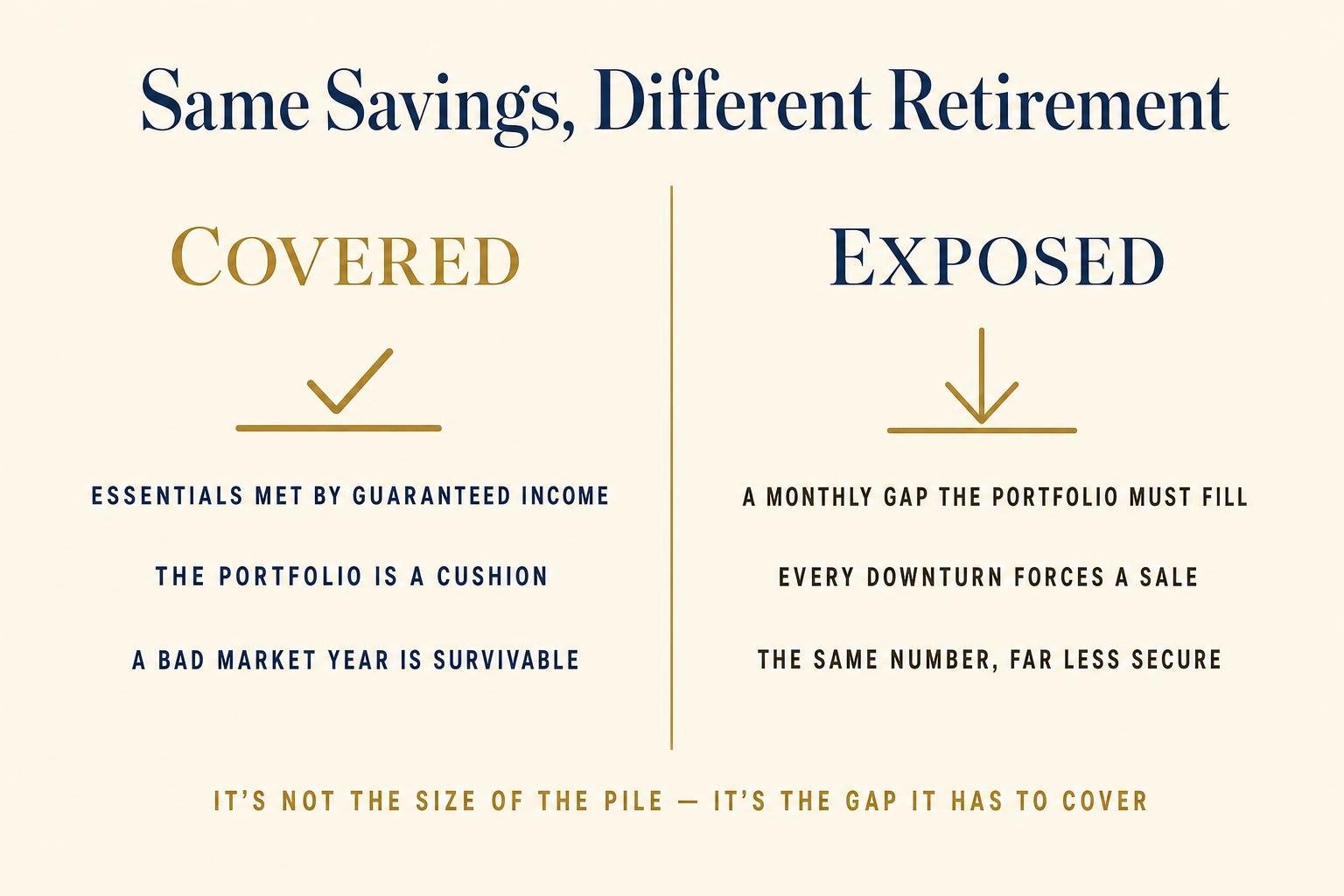
Same number, two very different retirements
Consider two hypothetical couples, both 64, both with $700,000 saved and a paid-off house.
Elena and Marcus keep their essentials to about $4,000 a month. Between Social Security and a small pension, roughly $4,300 a month arrives guaranteed. Their floor already covers the bills. The $700,000 isn’t what keeps the lights on — it’s a cushion for travel, home repairs, and the occasional bad year. A 25% market drop is uncomfortable for them, but it’s not dangerous, because nothing they need to live on depends on selling at the bottom.
Gwen and Roy are the same age with the same $700,000, but they spend about $6,500 a month and expect $3,500 from Social Security with no pension. Their portfolio has to cover a $3,000 monthly gap — roughly $36,000 a year, more than 5% of the balance, and climbing with inflation. For them, a 25% drop early in retirement isn’t uncomfortable; it’s a forced sale at the worst possible time, locking in losses on the money they need for groceries.
Same number. One couple is comfortably retired. The other is exposed. The difference was never the $700,000 — it was the gap that $700,000 had to cover.
This is exactly the kind of thing worth modeling before you set a date. A planning tool like ProjectionLab lets you enter your real spending, your Social Security estimate, and different claiming ages, then watch how the gap — and the number you actually need — moves as you change the inputs. (ProjectionLab is a paid tool; the link is an affiliate link, which means I may earn a small commission at no extra cost to you. I only recommend tools I’d use myself.)
So how much do you really need?
The honest answer is that it’s not a finish line you cross at a million dollars. It’s a coverage question. When your guaranteed income covers the bills that don’t stop, the pile behind it can be smaller than you feared — and a rough market stops being a threat to your grocery budget. Build the floor first, size the gap honestly, and the number stops being a source of dread and starts being something you can plan around.
That’s the whole shift. Stop asking how big the pile is. Start asking how much of your life it actually has to pay for.
Frequently asked questions
Is the $1 million retirement rule real?
It’s shorthand from the 4% rule — 25 times your annual spending. It’s a useful sanity check, but it’s a generic rule of thumb, not a personalized answer. Your real number depends on your essential spending and how much of it your guaranteed income already covers.
How much do I need to retire if I have a pension?
Often meaningfully less than a rule of thumb suggests. A pension is guaranteed income that covers part — sometimes all — of your essential spending, which shrinks the gap your savings has to fill. The bigger your guaranteed floor, the smaller the pile behind it needs to be.
Does delaying Social Security really lower the number I need?
Yes. A larger guaranteed check covers more of your essential bills for life, so your portfolio has a smaller gap to bridge. For many people, delaying is the single most effective way to reduce the amount of savings the plan actually requires.
This article is published by Confluence Media Group LLC, an independent publisher of educational financial content. Thomas Clark is a Series 65 Investment Advisor Representative. The information provided is for educational and informational purposes only and is not personalized financial, tax, or legal advice. Past performance does not guarantee future results. All investing involves risk, including potential loss of principal. Consult a qualified professional before making financial decisions.
Confluence Media Group LLC is a separate entity from Confluence Capital Management, the investment advisory practice through which Thomas Clark provides advisory services. Advisory services are not offered through this publishing platform.
About Thomas Clark
Thomas Clark is the founder of Confluence Media Group LLC and a Series 65 Investment Advisor Representative. He has spent nearly two decades working with families on retirement planning, with a focus on Social Security optimization, retirement income coordination, and the bucket planning approach to building a guaranteed income floor.
Thomas writes and publishes at thomasclarkadvisor.com and is the author of The Just in Case Binder — a 148-page printable family financial organizer for households who want to make sure the people they love know where everything is.
He lives in North Carolina with his family.
Subscribe to the weekly newsletter · Get the Just in Case Binder

Thomas Clark is a Series 65 licensed investment advisor and experienced trader. He specializes in investing, retirement planning, and market analysis, helping individuals build wealth and make informed financial decisions.
