
How to Actually Set Up Your Retirement Buckets
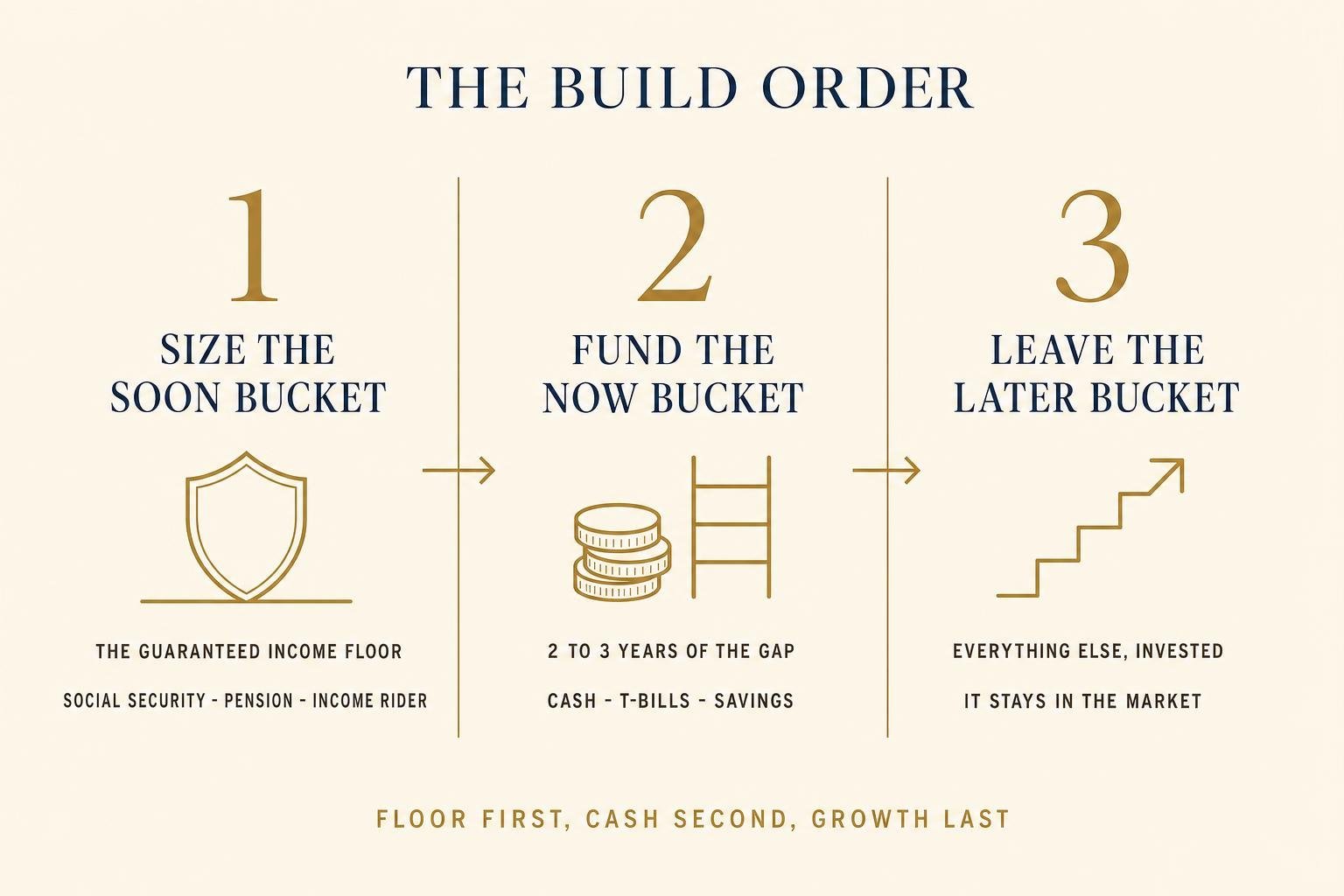
Bucket planning isn't about opening new accounts — it's about doing three jobs in the right order. Here's the step-by-step setup: size the guaranteed income floor first, fund two to three years of cash, then let everything else grow.

You’ve decided to use bucket planning. Good. Now comes the question the framework posts never quite get around to answering: what do you actually do on Monday morning?
Here’s the part that surprises people. Setting up your Now, Soon, and Later buckets is not a matter of opening five new accounts and shuffling everything around. Most of the work is deciding what job each dollar you already own is supposed to do — and doing those jobs in the right order. The order matters more than almost anything else, and most people do it backwards.
This is the step-by-step version. By the end you’ll know exactly what to size first, where the money comes from, and why the whole thing takes an afternoon to set up and about twenty minutes a year to maintain.
First, understand what you’re actually building
A bucket is not an account. Say it out loud, because it fixes half the confusion right away. A bucket is a job — and the three jobs are simple: cover the near term, guarantee the middle, grow the long term.
You already own the raw material. A checking account, a savings account, a 401(k) or two, maybe an IRA and a Roth, a brokerage account, Social Security you haven’t claimed yet. Bucket planning is a layer of jobs you lay over the accounts you already have. You’re not liquidating your life and starting fresh at a new custodian. You’re assigning roles.
That reframe is what makes the setup manageable. You’re not building three buckets from zero. You’re sorting what you’ve got into three piles and filling the gaps.
Start with one number: your essential expenses
You cannot size a single bucket until you know your floor — the annual cost of the life you’re not willing to cut. Housing, utilities, food, insurance, healthcare, transportation, the minimum version of your actual life. Add it up for a year.
Then, separately, add up the discretionary layer: travel, dining out, gifts, the golf membership, the grandkids. That’s the money that’s nice to have and survivable to pause.
Write both numbers down. The essentials number is the single most important figure in your entire plan, because everything downstream is sized against it. Skip this step and every bucket you build afterward is a guess wearing a costume.
Step 1: Size the Soon bucket first — the guaranteed income floor
Here’s where most people go wrong. They start with cash, because cash feels like the beginning. It isn’t. The first thing you build is the Soon bucket — your guaranteed income floor — because it determines how much work the other two buckets have to do.
The Soon bucket’s job is to cover your essential expenses with income that shows up whether the market is up, down, or closed. Three sources fill it:
- Social Security. This is the foundation, and it’s the cheapest guaranteed income most people will ever buy. Every year you delay claiming past your full retirement age adds roughly 8% to your benefit until age 70, and that larger amount is inflation-adjusted for life (Social Security Administration). For a married couple it also locks in a bigger survivor benefit. Deciding when the higher earner claims is a Soon-bucket decision, not a side issue.
- A pension, if you have one. The monthly check, and the single-life-versus-joint-and-survivor election that comes with it.
- An income-focused Fixed Index Annuity, if there’s still a gap. When Social Security and a pension don’t fully cover essentials, a Fixed Index Annuity with an income rider can fill the rest — a private pension you build yourself (the SEC’s investor.gov has a plain-English primer on how annuities work). Used this way, it’s an income tool for the Soon bucket, not a growth play, and not a substitute for the Later bucket.
Add those guaranteed sources up. If they cover your essentials, your floor is built and the market can do whatever it wants to the rest of your money without touching your grocery budget. If there’s a shortfall, that gap becomes a job for the Now bucket — which is the next step, and the reason we sized this one first.
Step 2: Fund the Now bucket — two to three years of the gap
The Now bucket is your spending cash and your shock absorber. Its job is to hold enough safe, liquid money that you never have to sell a growth investment in a bad year to pay for a good life.
How much? Enough to cover the gap between your guaranteed floor and your total spending for two to three years. If Social Security and a pension already cover essentials, the Now bucket only has to carry your discretionary spending plus a cushion — which is often smaller than people expect. If there’s an essentials shortfall or you’re bridging a few years until you claim Social Security at 70, the Now bucket carries more.
This money lives in genuinely safe, genuinely liquid places — a high-yield savings account, a government money market fund, or a short ladder of Treasury bills and CDs. The good news, for the first time in fifteen years, is that this cash is finally paying you something while it sits there. Don’t reach for yield here. The Now bucket’s job is to be boring and available, not to earn.
Step 3: Everything else is the Later bucket — and it stays invested
Whatever is left after you’ve built the floor and funded the Now bucket is the Later bucket. This is your growth engine, and it can hold exactly the kind of diversified, long-horizon portfolio you’d want in your accumulation years — a broad mix of stocks and bonds aligned with your risk tolerance (FINRA).
The reason the Later bucket can stay invested through a downturn is that the first two buckets already removed the thing that forces retirees to sell at the bottom. That forced sale — pulling income out of a falling portfolio early in retirement — is sequence-of-returns risk, and it’s the single failure mode bucket planning exists to prevent. Build the floor and the cash cushion, and the Later bucket gets to do the one thing it’s good at: grow, on its own schedule, without you flinching.
Resist the urge to over-engineer this bucket into three more. If you’ve sized the first two correctly, you almost certainly don’t need more than three buckets.
The step nobody mentions: you’re labeling accounts, not opening them
Now the piece that makes all of this practical. You don’t need a “Now account,” a “Soon account,” and a “Later account.” You need to know which of your existing accounts is doing which job.
Your checking and savings and a T-bill ladder are the Now bucket. Social Security and a pension and an income rider are the Soon bucket. Your IRA, 401(k), Roth, and taxable brokerage — invested for growth — are the Later bucket. The buckets are a map you draw over accounts you already hold.
There is one refinement worth making while you’re drawing that map: which type of account funds which job has real tax consequences. Cash for the Now bucket ideally comes from taxable savings, not a big taxable IRA withdrawal. Roth dollars are the most valuable and usually belong in the Later bucket, spent last. That’s the tax-aware layer of bucket planning, and it’s the difference between two retirees running the identical structure and paying wildly different lifetime tax. You don’t have to get it perfect on day one. You do have to know it’s the next thing to tune.
A hypothetical build, start to finish
Consider a hypothetical case: Warren and Paula, both 63, just outside Greensboro, North Carolina. They’ve got a paid-off house, $850,000 spread across a 401(k), two IRAs, a Roth, and a taxable brokerage account, and Social Security neither of them has claimed. Their essentials run about $5,000 a month; with travel and the grandkids, total spending is closer to $6,500.
They set it up in an afternoon. First, the floor: Warren is the higher earner, so they plan to have him delay Social Security toward 70 to maximize both his check and Paula’s eventual survivor benefit, while Paula claims a few years earlier. Between the two checks at their planned ages plus a modest income rider they’d already been considering, they can cover roughly $5,000 of guaranteed monthly income — their essentials, handled.
Second, the Now bucket. Until Warren claims, there’s a bridge to fund, plus the discretionary layer. They carve out about two and a half years of that gap — call it $150,000 — into a high-yield savings account and a short T-bill ladder. Nothing fancy. It just sits there, available.
Third, the Later bucket. The remaining roughly $700,000 stays invested in their existing diversified mix. They didn’t open a single new account. They labeled the ones they had, funded the gap, and decided a claiming strategy. The afternoon’s work was the plan; the accounts were already sitting there.
Now when the market drops 25% in some future year — and it will, in some year — Warren and Paula don’t sell anything. Their groceries come from the floor. Their trips come from cash. The Later bucket recovers on its own time.
Thomas’ Take: The setup is the easy part — it’s an afternoon, and most of it is arithmetic and one big Social Security decision. What actually makes bucket planning work is the discipline afterward: not refilling the Now bucket from the Later bucket in the middle of a downturn, and not tinkering with a structure that’s doing its job. Build it once, correctly, and then mostly leave it alone.
Where to start this week
You don’t need a spreadsheet with forty tabs. You need three numbers and one decision: your annual essentials, your total spending, your guaranteed income at different claiming ages, and when the higher earner claims. Everything else is downstream of those.
Before you lock in a claiming age or a Now-bucket size, this is exactly the kind of thing worth modeling against your real numbers. A tool like ProjectionLab lets you run your own plan — different claiming ages, cash cushions, and withdrawal orders — and watch how your “will I run out” risk actually moves as you change the inputs. (ProjectionLab is an affiliate partner; if you subscribe through that link, Confluence Media Group may earn a commission at no additional cost to you.)
The three-bucket structure isn’t complicated. It just has to be built in the right order — floor first, cash second, growth last — using the accounts you already own. Do that, and you’ve turned a pile of accounts into a plan that knows what to do on the day the headlines get ugly. That’s the whole point.
This article is published by Confluence Media Group LLC, an independent publisher of educational financial content. Thomas Clark is a Series 65 Investment Advisor Representative. The information provided is for educational and informational purposes only and is not personalized financial, tax, or legal advice. Past performance does not guarantee future results. All investing involves risk, including potential loss of principal. Consult a qualified professional before making financial decisions.
Confluence Media Group LLC is a separate entity from Confluence Capital Management, the investment advisory practice through which Thomas Clark provides advisory services. Advisory services are not offered through this publishing platform.
About Thomas Clark
Thomas Clark is the founder of Confluence Media Group LLC and a Series 65 Investment Advisor Representative. He has spent nearly two decades working with families on retirement planning, with a focus on Social Security optimization, retirement income coordination, and the bucket planning approach to building a guaranteed income floor.
Thomas writes and publishes at thomasclarkadvisor.com and is the author of The Just in Case Binder — a 148-page printable family financial organizer for households who want to make sure the people they love know where everything is.
He lives in North Carolina with his family.
Subscribe to the weekly newsletter · Get the Just in Case Binder

Thomas Clark is a Series 65 licensed investment advisor and experienced trader. He specializes in investing, retirement planning, and market analysis, helping individuals build wealth and make informed financial decisions.
