
How Many Retirement Buckets Do You Actually Need?
Five buckets, seven buckets, one for every decade — more feels safer, but it rarely is. Here's why three retirement buckets is almost always the right number, and the one real case for a fourth.

The bucket idea has spread fast — and somewhere along the way it turned into a numbers contest. I’ve seen retirement plans built around five buckets, seven buckets, even a separate bucket for every stretch of years. More buckets feel more careful. They feel like precision. Most of the time, they’re just more moving parts.
The whole point of bucket planning is to make retirement simpler to live, not harder to manage. So the honest answer to “how many buckets do I need” is three — Now, Soon, and Later — and it takes a genuinely different job to justify a fourth. Here’s how to tell the difference between a bucket that’s doing real work and one that’s just adding maintenance.
A bucket is a job, not a jar
The mistake underneath most over-engineered bucket plans is treating a bucket like an account. It isn’t. A bucket is a job you’ve assigned to a pile of money.
There are only three jobs your retirement savings actually has to do: cover what you spend now, guarantee what you’ll spend soon, and grow what you’ll spend later. That’s the Now, Soon, and Later framework in one sentence — and it’s three buckets because there are three jobs, not because three is a tidy number.
- Now bucket — cash and near-cash for current living expenses, so a market drop never touches this month’s grocery money.
- Soon bucket — a guaranteed income floor from Social Security, a pension, or an income-focused fixed index annuity, sized to cover your essential bills.
- Later bucket — the growth engine, invested for the years and decades still ahead.
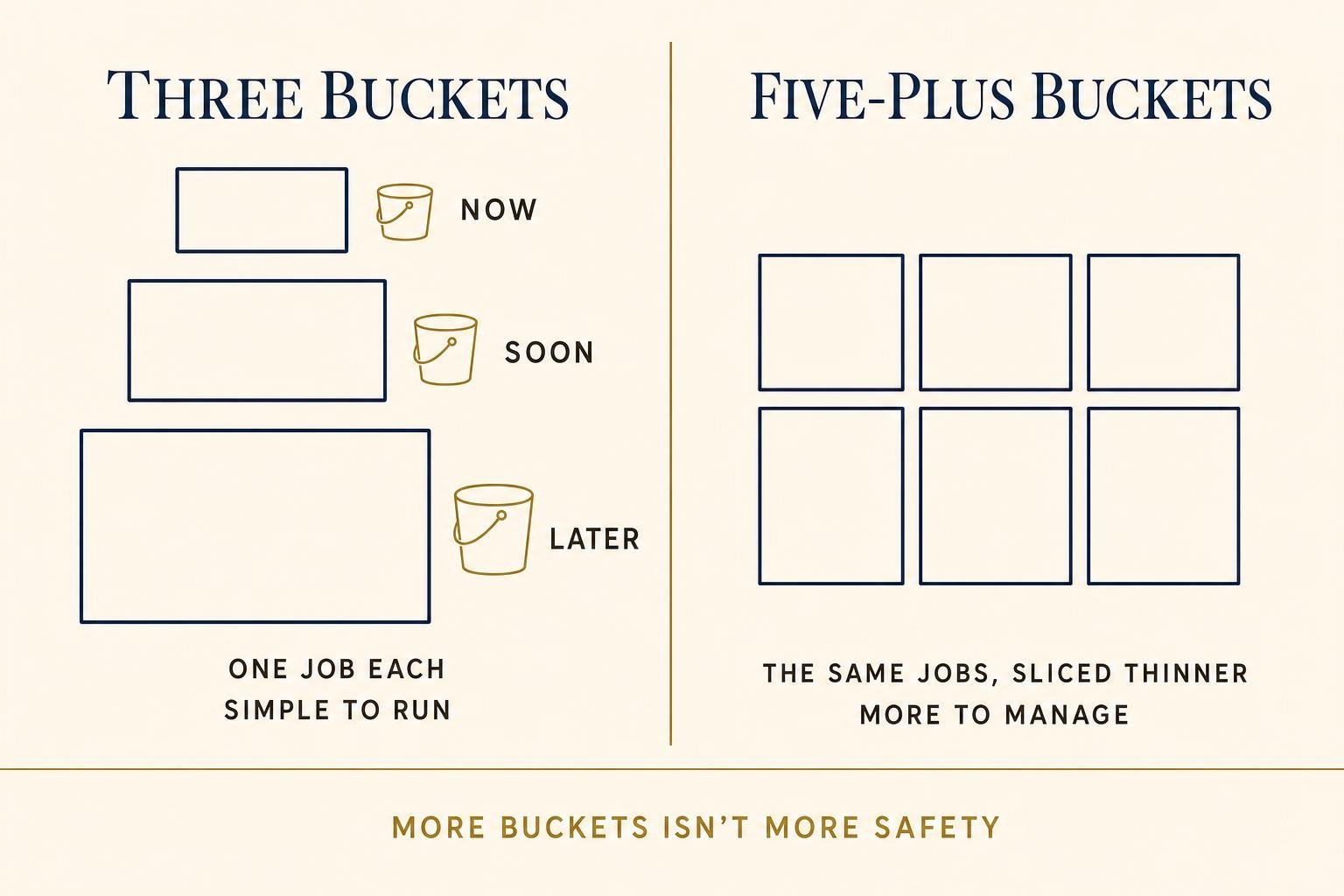
Once you see the buckets as jobs, the “how many” question mostly answers itself. You don’t need a fifth bucket unless you’ve found a fifth job. And most of the extra buckets people are sold aren’t new jobs — they’re the same three jobs sliced thinner.
Where the extra buckets come from
Two ideas drive the bucket count up, and both sound reasonable until you look closely.
The first is time-segmentation — a bucket for years 1–5, another for years 6–10, another for 11–20, and so on. The logic is that money you won’t touch for fifteen years can take more risk than money you’ll spend in three. That part is true. But you don’t need a separate bucket for each five-year block to act on it. “Long-horizon money can hold more equities” is a sentence about how you invest the Later bucket — it isn’t a reason to build four more buckets around it.
The second is the more-is-safer instinct — the feeling that a finer breakdown gives you more control. It’s the same instinct that makes people build a forty-line monthly budget they abandon by March. Granularity feels like rigor. In practice, it usually just raises the number of decisions you have to get right.
Why more buckets usually make the plan worse
Every bucket you add has a cost, and the costs are easy to miss because they show up as work, not as a number on a statement.
More buckets mean more rebalancing decisions. Three buckets have a clean flow: the Later bucket refills the Now bucket when it’s ahead, and the Soon bucket quietly pays the floor. Add four more and you’ve built a web of “which bucket refills which, and when” that you have to manage every single year — the exact overhead bucket planning was supposed to remove.
More buckets create false precision. A five-bucket, decade-by-decade plan quietly assumes you know what your spending looks like in year twelve versus year fourteen. You don’t. Nobody does. Building structure around a forecast that fine is engineering around noise.
And more buckets give you more to tinker with. Every bucket is another dial, and every dial is another chance to react to a headline, second-guess an allocation, or “adjust” at exactly the wrong moment. A plan you fiddle with is a plan you’re likely to break.
Thomas’ Take: The best retirement plan isn’t the most detailed one — it’s the one you’ll still be running the same way in year eight, when you’re tired, distracted, or grieving, and the last thing you want is a spreadsheet with seven tabs. Simple survives. Complicated gets abandoned.
The one case for a fourth bucket
Here’s the honest exception. A fourth bucket earns its place when it holds a genuinely different job — with its own time horizon and its own rules — not a thinner slice of a job you already have.
The clearest example is an earmarked reserve for a large, lumpy, someday expense that doesn’t belong in your regular income plan: a long-term-care self-funding pool, a legacy gift you intend to leave untouched, or a known one-time cost like helping a child with a down payment. That money has a different job (it isn’t funding your monthly life), a different horizon (it may never be spent, or spent all at once), and often a different tax treatment and home across your accounts.
The test is simple: does this bucket answer a new question, or just re-answer an old one with more decimal places? A long-term-care reserve answers a new question — “how do I handle a risk my income floor isn’t built to absorb?” A “years 11–15” bucket just re-answers “how should my growth money be invested?” One earns its keep. The other is clutter wearing the costume of prudence.
A hypothetical: same retiree, two plans
Consider a hypothetical case: Frank, 66, just retired outside Charlotte with $850,000 saved, a paid-off house, and about $5,200 a month in essential expenses. His Social Security and a small pension cover roughly $4,300 of that; the remaining $900 comes from savings.
An advisor pitches Frank a five-bucket plan: a cash bucket, a “years 1–5” bond bucket, a “years 6–10” balanced bucket, a “years 11–20” growth bucket, and a “legacy” bucket. It looks impressive on paper. It also means Frank now has five allocations to monitor, four refill rules to remember, and five sleeves to reconcile every quarter — and he still has to decide, in a down year, which bucket to sell from.
The three-bucket version does the same work with far less to break. Frank keeps two to three years of that $900 monthly gap in the Now bucket as cash. He shores up the Soon bucket so his guaranteed income covers the essentials floor. Everything else sits in the Later bucket, invested for growth he won’t touch for years. When the market falls 25%, Frank sells nothing — his floor still pays the bills and his cash still fills the gap. The plan that protected him wasn’t the one with the most buckets. It was the one he could actually run.
(Frank is a hypothetical used to illustrate the point; his figures are round numbers, not a projection.)
How to know your three buckets are sized right
The number of buckets matters far less than whether the three you have are sized correctly. Three quick checks:
- Does your Soon bucket cover your essential bills? If your guaranteed income leaves a gap, that’s the first thing to close — and often where an income-focused annuity does its job.
- Do you have two to three years of spending in the Now bucket, in cash? That’s the buffer that lets you ignore a bad market instead of selling into it.
- Is everything else in the Later bucket, invested for a horizon you can actually leave alone?
If you can answer yes to all three, adding a fourth or fifth bucket won’t make you safer — it’ll just make you busier. If you can’t, the fix is sizing the three you have, not multiplying them. This is exactly the kind of trade-off worth modeling before you lock it in. A tool like ProjectionLab lets you run your own numbers — different cash cushions, claiming ages, and withdrawal orders — and watch how your “do I run out” risk actually moves. (ProjectionLab is an affiliate partner; if you subscribe through that link, Confluence Media Group may earn a commission at no additional cost to you.)
The number was never the point
Bucket planning didn’t catch on because three is a magic number. It caught on because it answers the one question that actually decides how retirement feels: when you need to spend a dollar, do you have to sell something at a loss to get it?
Three buckets answer that question completely. A fourth is worth adding only when you’ve found a job the first three don’t do. Everything past that is precision you’ll pay for in maintenance and never get back in security. Build three buckets well, size them honestly, and then — this is the hard part — leave them alone.
Key takeaways
- Bucket planning works because it assigns money three jobs — spend now, guarantee soon, grow later — not because three is a tidy number.
- Five- and seven-bucket systems usually slice the same three jobs thinner, adding maintenance and false precision without adding safety.
- A fourth bucket is justified only when it holds a genuinely different job — like a long-term-care or legacy reserve — with its own horizon and rules.
- Sizing your three buckets correctly matters far more than how many buckets you have.
Frequently asked questions
Isn’t a bucket for each decade of retirement more accurate?
It’s more detailed, not more accurate. A decade-by-decade plan assumes you can forecast your spending fifteen years out, which nobody can. “Long-horizon money can hold more risk” is a rule for how you invest the Later bucket — it doesn’t require building extra buckets to act on.
When does a fourth bucket actually make sense?
When it holds a job the first three don’t — most often an earmarked reserve for long-term care, a legacy gift, or a known one-time expense. The test: does it answer a new question, or just re-answer “how should my growth money be invested?”
Where does a fixed index annuity fit in the three buckets?
In the Soon bucket, as a tool for guaranteed income — not growth. Its job is to help cover your essential bills so a market drop never reaches them.
This article is published by Confluence Media Group LLC, an independent publisher of educational financial content. Thomas Clark is a Series 65 Investment Advisor Representative. The information provided is for educational and informational purposes only and is not personalized financial, tax, or legal advice. Past performance does not guarantee future results. All investing involves risk, including potential loss of principal. Consult a qualified professional before making financial decisions.
Confluence Media Group LLC is a separate entity from Confluence Capital Management, the investment advisory practice through which Thomas Clark provides advisory services. Advisory services are not offered through this publishing platform.
About Thomas Clark
Thomas Clark is the founder of Confluence Media Group LLC and a Series 65 Investment Advisor Representative. He has spent nearly two decades working with families on retirement planning, with a focus on Social Security optimization, retirement income coordination, and the bucket planning approach to building a guaranteed income floor.
Thomas writes and publishes at thomasclarkadvisor.com and is the author of The Just in Case Binder — a 148-page printable family financial organizer for households who want to make sure the people they love know where everything is.
He lives in North Carolina with his family.
Subscribe to the weekly newsletter · Get the Just in Case Binder

Thomas Clark is a Series 65 licensed investment advisor and experienced trader. He specializes in investing, retirement planning, and market analysis, helping individuals build wealth and make informed financial decisions.
