
Cash Is Finally Paying — What That Means for Your Now Bucket
For fifteen years the safe money in a retirement plan earned almost nothing. That changed in 2026. Here's how to run the Now bucket now that short-term cash pays close to 4% — and the reinvestment trap to avoid.

For most of the last fifteen years, the safest money in your retirement plan earned almost nothing. Savings accounts paid a few hundredths of a percent. A money market fund was somewhere to park cash, not a place it grew. Holding “safe” money meant accepting that it would quietly lose ground to inflation every year — that was the price of not being in the market.
That has changed, and most retirees haven’t adjusted to it. As of this writing in July 2026, short-term Treasurys and money market funds are paying in the neighborhood of 4%. The Federal Reserve has held its policy rate at 3.50% to 3.75% for four straight meetings and signaled it’s in no hurry to cut — a few officials think the next move could even be a hike. Whatever that means for stocks, it means something specific and useful for the least glamorous money you own: the cash in your Now bucket is finally being paid properly.
This isn’t a case for holding more cash — I’ve made the opposite argument about the hidden cost of holding too much of it. It’s about running the cash you should hold well, in an environment that finally rewards you for it. That means knowing where it lives, and understanding the one catch nobody mentions.
What the Now bucket is actually for
In the Now / Soon / Later framework, the Now bucket holds the money you’ll spend in the near term — typically one to three years of living expenses, sitting in cash and cash-like instruments. Its job is not to grow. Its job is to be there, in full, on the day you need it, no matter what the market did that week.
That’s the whole point of separating it out. When your next two years of spending sits in something stable, a bad stretch in stocks becomes a headline instead of an emergency. You’re not forced to sell growth assets at a loss to cover groceries, because the groceries are already funded. The Now bucket is the shock absorber that lets the rest of the plan work.
For years that shock absorber came at a real cost: the cash earned nothing while inflation nibbled at it. You held it anyway, because the protection was worth more than the lost yield. The news in 2026 is that you no longer have to choose. The protection is still there — and now the cash pays you close to 4% for providing it. The only question is whether your cash is actually collecting that, or sitting in an account that never got the memo.
Where your Now-bucket cash should actually live
Here’s the mistake I see most often: a retiree keeps the Now bucket in a big-bank checking or savings account earning 0.01%, while the bank itself quietly earns 4% on those deposits. The money is safe, but it’s being paid nothing for it. Fixing that doesn’t require taking on risk — it requires moving the cash somewhere that passes the yield through to you.
A high-yield savings account at an online bank is the simplest option. It’s FDIC-insured up to the limits, fully liquid, and pays a rate that tracks short-term interest rates instead of ignoring them. The federal insurance means the safety is identical to the big bank down the street; only the yield is different.
A money market fund is the next step — a mutual fund that holds very short-term, high-quality debt like Treasury bills and repurchase agreements. A government money market fund holds essentially the safest paper there is. It isn’t FDIC-insured; it’s a registered investment product that aims to hold a stable $1 share price. But a government money fund is about as close to cash as an investment gets, and its yield moves up with rates in real time.
Treasury bills bought directly — through TreasuryDirect or a brokerage account — let you lock a known yield for a set term of a few weeks to a year, backed by the full faith and credit of the U.S. government. And short-term CDs, FDIC-insured at a bank or bought as brokered CDs through an investment account, do much the same thing with a bank as the backer. All of these are appropriate homes for Now-bucket money. None of them asks you to take market risk to collect today’s rates.
The catch nobody mentions: today’s yield doesn’t come with a lock
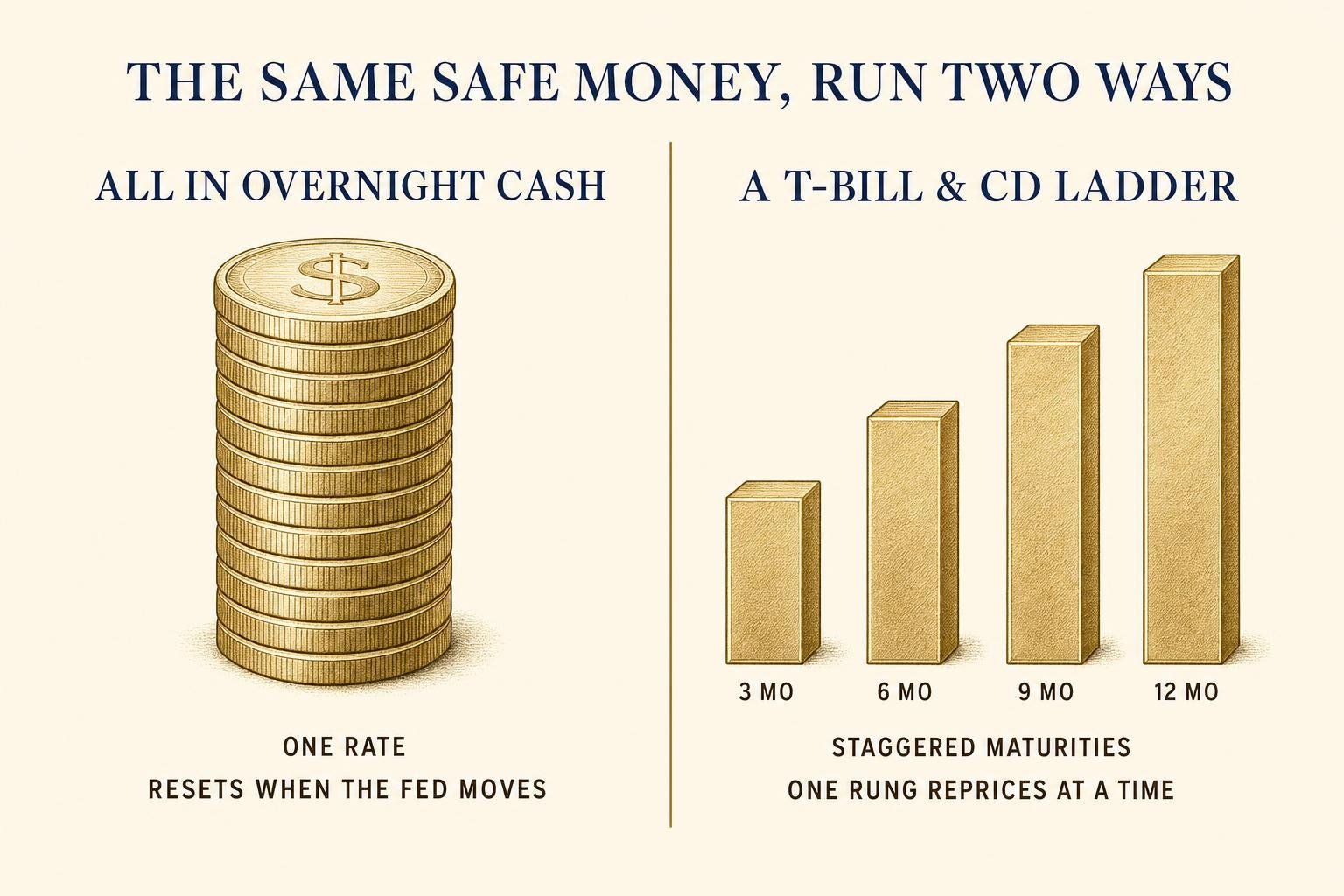
Here’s the part the “high-yield savings is a no-brainer” crowd skips. The 4% your money market fund pays today is not a rate you’re promised for the next decade. Money fund and savings yields float — they reset as the Fed moves. The day the Fed starts cutting, that yield starts falling, and it can fall quickly.
Right now the Fed is holding, and a few of its own members think the next move could be up rather than down. But policy turns eventually, and when it does, a retiree with the entire Now bucket sitting in overnight cash watches the whole thing reprice at once. This is reinvestment risk — the risk that when your money comes due, the only rates available to reinvest at are lower ones. High rates today don’t remove that risk. They just make it easy to forget.
The defense is old and boring and it works: a ladder. Instead of putting the whole Now bucket in one overnight vehicle, or one big lump at a single maturity, you stagger it — some in a T-bill or CD coming due in three months, some in six, some in nine, some in twelve. As each rung matures, you either spend it or roll it out to the far end of the ladder. You’re never forced to reinvest everything at whatever rate happens to exist on one particular day, and you always have a rung coming due soon for near-term spending.
Thomas’ Take: Most of the financial press treats “higher for longer” as bad news. For the safe money in a retirement plan, it’s the best environment in fifteen years. The real risk isn’t that rates are high — it’s leaving your cash in an account earning nothing, or assuming today’s 4% will still be sitting there, untouched, when the Fed changes its mind.
A ladder in practice
Consider a hypothetical case. Ellen, 68, retired last year in Wilmington, North Carolina. She keeps a Now bucket of about $80,000 — roughly two years of the spending her Social Security doesn’t already cover. Until recently it all sat in a savings account paying almost nothing.
Rather than move it all into a single money market fund and hope the rate holds, Ellen splits it into four rungs of $20,000 each, in Treasury bills and CDs maturing in three, six, nine, and twelve months. She keeps a small extra cushion in a plain high-yield savings account for anything unexpected. As the three-month rung matures, she uses part of it for the quarter’s expenses and rolls the rest into a new twelve-month rung at the back of the ladder.
The specific rates aren’t the point, and I’m not going to pretend to know what they’ll be — they’ll move. What the ladder buys her is that no single Fed decision resets her entire income cushion at once, and there’s always cash coming available within ninety days. If rates keep climbing, each maturing rung reinvests higher. If the Fed cuts, only one rung at a time reprices while the others keep paying their locked rate. She isn’t predicting anything. She’s just refusing to bet the whole bucket on one day’s interest rate.
Don’t reach for yield — cash has a job, and it isn’t growth
The flip side of finally getting paid on cash is the temptation to chase a little more. When a savings account pays 4%, a product advertising 7% “with cash-like access” starts to look reasonable. It usually isn’t. If something pays materially more than a Treasury bill of the same term, it is taking on risk you aren’t being told about clearly — credit risk, liquidity risk, or fine print about how available your money really is. That may be a fine trade somewhere else in your plan. It has no place in the Now bucket, whose entire job is to be safe and available.
Two related temptations are worth naming. The first is letting a good cash yield pull money that belongs in the Later bucket out of the market — trading a shot at long-term growth for a rate that will fall when the Fed turns. The second is the mirror image: deciding how much of your plan belongs in cash versus working in the market by feel rather than by math. That trade-off (how large a cash cushion and income floor you actually need, and what it costs you in long-run growth) is exactly the kind of thing worth modeling before you commit. A tool like ProjectionLab lets you run your own plan against different cash levels, withdrawal orders, and rate scenarios and see how the “do I run out” risk actually moves. (ProjectionLab is an affiliate partner; if you subscribe through that link, Confluence Media Group may earn a commission at no additional cost to you. I only point readers toward tools I’d actually use.)
And high short-term rates quietly help one more part of the plan. When you go to build the guaranteed Soon-bucket income floor — from delayed Social Security, and for some retirees an income-focused fixed index annuity — a higher-rate environment generally means more guaranteed income per dollar than a low-rate one did. It’s one more reason “higher for longer” is friendlier to a retirement plan than the headlines suggest. For more on the rate backdrop itself, see what the Fed’s decisions mean for retirement income and how to read the bond market.
The boring money finally pays
For the first time in a generation, the conservative side of a retirement plan is being paid properly. That’s genuinely good news, and it deserves a response beyond leaving the money exactly where it’s always been. Move Now-bucket cash somewhere that actually passes today’s rate through to you. Ladder it so a change in Fed policy can’t reset the whole thing at once. And don’t let the good yield tempt you into a “cash” product that isn’t cash, or out of the growth money you’ll need in fifteen years.
The market will do what it does; the record highs and the scary days will keep trading places. None of it changes the job of the Now bucket. That job just got easier to do — because the safest money you own is finally earning its keep, as long as you’ve put it somewhere that lets it.
This article is published by Confluence Media Group LLC, an independent publisher of educational financial content. Thomas Clark is a Series 65 Investment Advisor Representative. The information provided is for educational and informational purposes only and is not personalized financial, tax, or legal advice. Past performance does not guarantee future results. All investing involves risk, including potential loss of principal. Consult a qualified professional before making financial decisions.
Confluence Media Group LLC is a separate entity from Confluence Capital Management, the investment advisory practice through which Thomas Clark provides advisory services. Advisory services are not offered through this publishing platform.
About Thomas Clark
Thomas Clark is the founder of Confluence Media Group LLC and a Series 65 Investment Advisor Representative. He has spent nearly two decades working with families on retirement planning, with a focus on Social Security optimization, retirement income coordination, and the bucket planning approach to building a guaranteed income floor.
Thomas writes and publishes at thomasclarkadvisor.com and is the author of The Just in Case Binder — a 148-page printable family financial organizer for households who want to make sure the people they love know where everything is.
He lives in North Carolina with his family.
Subscribe to the weekly newsletter · Get the Just in Case Binder

Thomas Clark is a Series 65 licensed investment advisor and experienced trader. He specializes in investing, retirement planning, and market analysis, helping individuals build wealth and make informed financial decisions.
