
How Much Cash Should Your ‘Now’ Bucket Really Hold?
The 'Now' bucket is the cash layer most people size by feel — and get wrong in both directions. Here's how to size it to the gap your guaranteed income doesn't cover.

Ask ten retirees how much cash they keep on hand and you’ll get ten different answers, most of them guesses. Some are sitting on three years of living expenses in a savings account, watching inflation nibble it down every month. Others have barely a month’s worth and are one bad quarter away from selling stocks at exactly the wrong time.
The “Now” bucket — the cash layer that funds your near-term spending — is the part of a bucket plan people size by feel. That’s a mistake in both directions. Hold too little and a market drop forces you to sell your growth investments to buy groceries. Hold too much and the drag quietly costs you more than the crash you were trying to avoid. There is a right size for your Now bucket, and it isn’t a gut number. It’s a calculation, and it starts with a question most cash-cushion advice skips entirely.
What the Now bucket is actually for
In the bucket approach, your money lives in three layers. The Now bucket holds cash and cash-equivalents for near-term spending. The Soon bucket builds a guaranteed income floor from Social Security, pensions, and income-focused annuities. The Later bucket stays invested for growth. Each has one job, and the Now bucket’s job is narrower than people think.
It is not your emergency fund from your working years, and it is not your entire safety net. Its single purpose is to let you leave the Later bucket alone when markets fall. If you can cover your spending from cash for a year or two, you never have to sell equities into a decline — you wait for the recovery instead of funding your retirement out of it.
That matters because of sequence-of-returns risk: the same average return delivered in a different order can leave you far worse off if the bad years hit early and you’re selling into them. The Now bucket is the buffer that keeps a bad first few years from doing permanent damage. Everything about how you size it flows from that one job. And because retirement spending isn’t flat, the number isn’t static either.
The two ways people get the size wrong
Too small is the obvious danger. If your cash runs out mid-downturn, you’re forced to sell your Later bucket at depressed prices to cover the mortgage. That’s the exact move the bucket structure exists to prevent, and it’s how a temporary paper loss becomes a permanent one.
Too big is the quieter danger, and it’s the one I see more often. Cash that sits far beyond what you’ll spend in the next couple of years doesn’t protect you — it slowly loses to inflation. When consumer prices rise even 3% a year, a pile of “safe” cash loses roughly a quarter of its purchasing power over a decade. That’s not safety. That’s a slow, guaranteed loss dressed up as caution. There’s also a practical ceiling worth remembering: FDIC insurance covers $250,000 per depositor, per bank, per ownership category, so oversized cash stacks create their own housekeeping.
The good news is that cash finally earns something again, which changes the math on how much you can comfortably hold — I covered that in why cash is finally paying its way in your Now bucket. But a decent yield on cash is not a reason to overfund it. It’s a reason to make sure the cash you do hold is working. Sizing comes first.
The real question isn’t “how many months”
The old “three to six months of expenses” rule is an accumulation-phase rule. It’s built for a working household with a paycheck coming in, where the cushion only has to bridge a job loss. In retirement there’s no paycheck to replace, and — if you’ve built your Soon bucket — there’s already guaranteed income arriving every month. Sizing your Now bucket to your total expenses ignores that floor and overfunds cash dramatically.
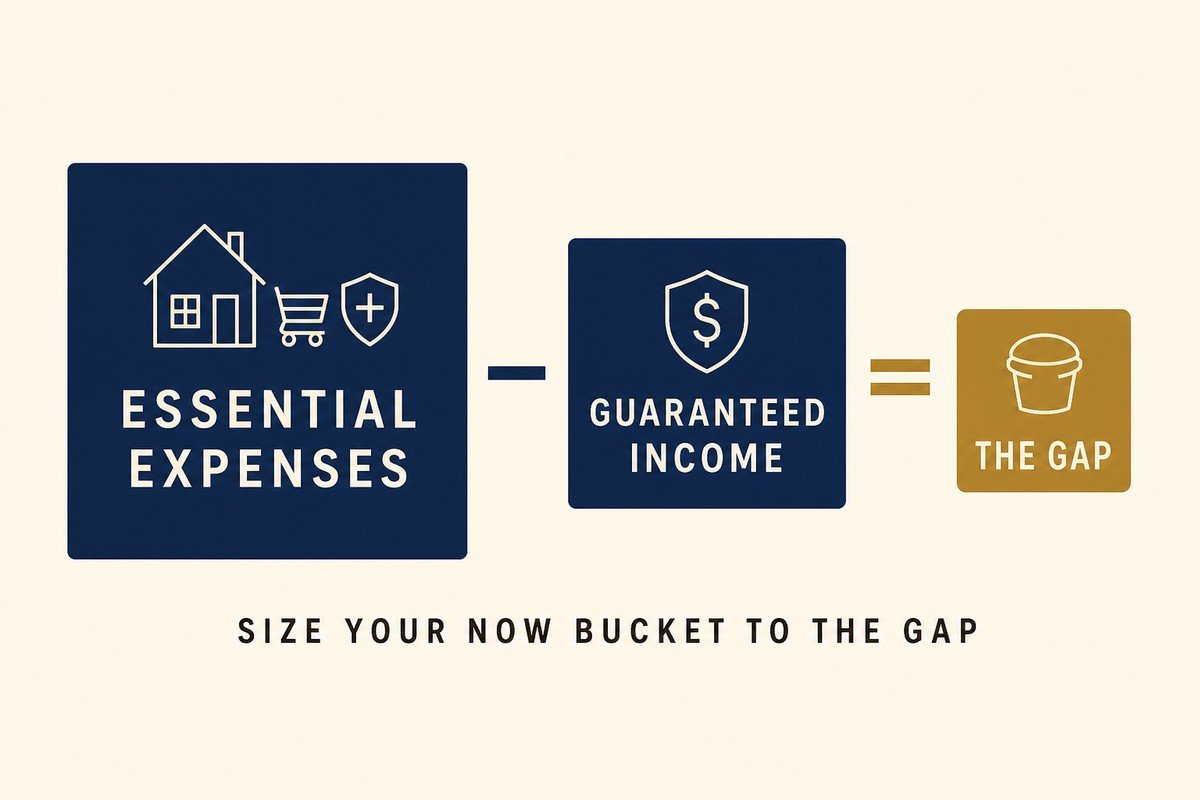
The number that actually matters is the gap between your essential expenses and your guaranteed income. Your Now bucket only has to cover what the guaranteed income doesn’t. That single reframing is the difference between holding $200,000 in cash and holding $35,000 for the same household — and being just as protected with the smaller number.
A hypothetical: Kenji and Mei
Consider a hypothetical couple. Kenji is 66, Mei is 64, both recently retired near Seattle. Their essential, must-pay expenses — housing, food, insurance, utilities, healthcare — run about $70,000 a year. Their guaranteed income floor covers most of it: roughly $46,000 from Social Security plus a small $8,000-a-year pension, for $54,000 of income that shows up no matter what the market does.
Their instinct was to keep three years of full expenses — $210,000 — in cash “just to be safe.” But their gap isn’t $70,000 a year. It’s $70,000 minus their $54,000 floor, or about $16,000 a year that the portfolio actually has to cover. If they want two years of that gap sitting in cash so they can ride out a downturn without touching investments, they need roughly $32,000, plus a modest separate reserve for irregular costs like a roof or a car. That’s a Now bucket of maybe $45,000 — not $210,000. The other $165,000 stays invested in the Later bucket, working, instead of quietly eroding. Same protection, far less drag, all because they sized to the gap and not to the grocery bill.
How to right-size yours
The build sequence is short and it’s the same for everyone, even though the answer is personal:
Start with essential expenses. Add up only the must-pay items — the bills that don’t stop in a bad year. Leave discretionary travel and gifts out of this number; those can flex, and flexible spending doesn’t need a cash guarantee behind it.
Subtract your guaranteed income. Social Security, any pension, and income from an FIA income rider all count. What’s left is the annual gap your portfolio has to fund. If your floor already covers your essentials, your gap is near zero and your Now bucket can be genuinely small.
Multiply the gap by the years of cover you want. One to three years is the usual range. More years buys more calm and costs more drag; fewer years does the opposite. Then add a separate reserve for lumpy, irregular costs — that’s a different job from bridging market weakness, so keep it as its own line rather than inflating the ongoing gap math.
Before you lock in a number, this is exactly the kind of plan worth modeling against your real figures. A tool like ProjectionLab lets you run your own version — different cash cushions, claiming ages, and withdrawal orders — and watch how your “will I run out” risk actually moves as you change the inputs. (ProjectionLab is an affiliate partner; if you subscribe through that link, Confluence Media Group may earn a commission at no additional cost to you.)
When to hold more, when to hold less
Hold toward the larger end early in retirement, when sequence risk is highest and a bad first few years does the most lasting damage. Hold more if your guaranteed income floor is thin, if a big planned expense is coming, or if market swings genuinely keep you up at night — temperament is a real input, not a weakness. Hold toward the smaller end later in retirement, when a strong income floor already covers your essentials, or when you have the stomach and the flexibility to wait out a decline.
Thomas’ Take: The single most effective way to shrink your Now bucket isn’t holding less cash — it’s building a bigger guaranteed income floor. Every dollar of essential spending you move onto Social Security or a pension is a dollar your cash no longer has to defend. Work on the Soon bucket, and the Now bucket takes care of itself.
Notice that this is the opposite of how most cash-cushion advice works. The usual instinct is to stockpile more cash the more nervous you are. The bucket approach says the durable fix is upstream: secure the income floor first, and the amount of cash you need to feel safe drops on its own. That’s why I’d rather see a retiree spend energy optimizing a Social Security claiming decision than pile another year of expenses into a savings account.
Key takeaways
- The Now bucket’s only job is to let you leave your invested Later bucket alone during a downturn — size it for that, not as a general safety net.
- Both errors cost you: too little forces selling into a decline; too much loses ground to inflation year after year.
- Size to the gap between essential expenses and guaranteed income, not to your total spending — the income floor does most of the work.
- A bigger Soon bucket shrinks the Now bucket you need. Building guaranteed income is the highest-leverage move.
Frequently asked questions
Isn’t holding more cash always the safer choice?
Only up to a point. Cash protects you against having to sell investments in a downturn, but beyond a couple of years of your spending gap, extra cash mostly protects you against nothing while losing purchasing power to inflation. Past that line, “more cash” is a slow loss, not added safety.
Where should the Now bucket actually sit?
In genuinely liquid, stable places — a high-yield savings account, a money market fund, or short-term Treasurys. The point is that the money is there and steady when you need it, and today those options actually pay a real yield, which wasn’t true for most of the last decade.
How do I refill the Now bucket after I spend it down?
You top it up from the Later bucket in good years, trimming investments that have grown — which is really just rebalancing with a purpose. In bad years you leave the Later bucket alone and live off the cash, which is the entire reason you sized it deliberately in the first place.
Right-sizing the Now bucket isn’t about finding a magic number of months. It’s about doing one piece of arithmetic honestly: what do your essentials cost, what does your guaranteed income already cover, and how many years of the difference do you want sitting in cash so you never have to sell in a storm. Do that, and you stop guessing. You hold enough to sleep at night and not a dollar more than the job requires — which, in retirement, is exactly how cash is supposed to work.
This article is published by Confluence Media Group LLC, an independent publisher of educational financial content. Thomas Clark is a Series 65 Investment Advisor Representative. The information provided is for educational and informational purposes only and is not personalized financial, tax, or legal advice. Past performance does not guarantee future results. All investing involves risk, including potential loss of principal. Consult a qualified professional before making financial decisions.
Confluence Media Group LLC is a separate entity from Confluence Capital Management, the investment advisory practice through which Thomas Clark provides advisory services. Advisory services are not offered through this publishing platform.
About Thomas Clark
Thomas Clark is the founder of Confluence Media Group LLC and a Series 65 Investment Advisor Representative. He has spent nearly two decades working with families on retirement planning, with a focus on Social Security optimization, retirement income coordination, and the bucket planning approach to building a guaranteed income floor.
Thomas writes and publishes at thomasclarkadvisor.com and is the author of The Just in Case Binder — a 148-page printable family financial organizer for households who want to make sure the people they love know where everything is.
He lives in North Carolina with his family.
Subscribe to the weekly newsletter · Get the Just in Case Binder

Thomas Clark is a Series 65 licensed investment advisor and experienced trader. He specializes in investing, retirement planning, and market analysis, helping individuals build wealth and make informed financial decisions.
