
Rebalancing: Why Selling Your Winners Is the Point
Your portfolio drifts on its own — a strong run for stocks can quietly turn a 60/40 into a 72/28 and hand you more risk than you ever chose. Here's why rebalancing means selling your winners, and how to do it on a rule instead of a guess.

You set your portfolio to 60% stocks and 40% bonds a few years ago. You felt good about it. Then the market did what markets do, stocks ran hard, and you stopped checking. Here’s the part almost nobody looks at: that portfolio isn’t 60/40 anymore. After a strong stretch for stocks, it might be sitting closer to 72/28 — carrying a lot more risk than you ever signed up for, right about the time in life when you can least afford a deep drop.
Rebalancing is the unglamorous habit that fixes that. It’s the periodic act of nudging your portfolio back to the mix you chose on purpose. And it asks you to do the one thing every instinct in your body fights: sell some of what’s been winning.
Most people get this wrong in one of two directions. They never rebalance, and let a portfolio quietly drift into far more risk than they intended. Or they “rebalance” emotionally — piling into whatever’s hot, bailing on whatever’s cold — which is the exact opposite of the job. Let’s fix both.
What rebalancing actually is
Every portfolio has a target mix — a percentage in stocks, a percentage in bonds and cash, maybe a slice in other categories. That mix is really a decision about risk. It says, in effect, “this is how much I’m willing to watch fall in a bad year in exchange for growth in the good ones.” Getting that mix right is one of the most important calls you make as an investor.
The trouble is that the mix won’t stay put. Different assets grow at different speeds, so the winners take up a bigger and bigger share of the pie over time. The SEC’s investor education office describes it plainly: over time some investments grow faster than others, your holdings drift out of line with your goals, and rebalancing brings the portfolio back to its original allocation (Investor.gov).
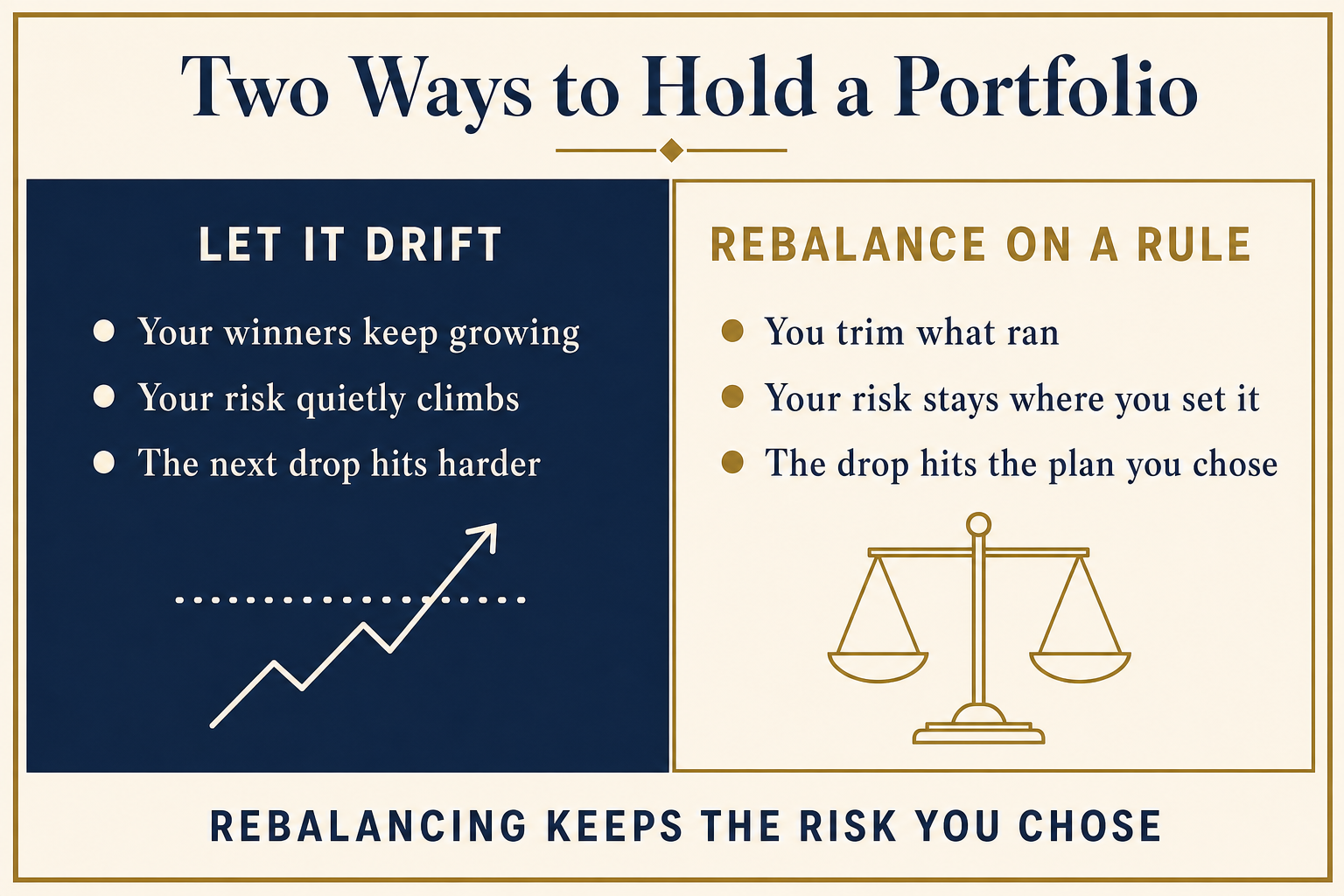
Picture that 60/40 portfolio again. Say stocks return well for three years while bonds mostly tread water. Your stock slice swells and your bond slice shrinks in relative terms. Without you touching a thing, you now own a 70/30 or even 75/25 portfolio. That is not a neutral change. You are now exposed to a much larger loss in the next downturn than the plan you originally agreed to. The drift didn’t just grow your account — it quietly grew your risk.
Why it feels wrong — and why that’s exactly the point
Here’s where rebalancing collides with human nature. To get back to your target, you sell some of the asset that’s been going up and buy more of the asset that’s been lagging. Trim the winners. Add to the laggards. Everything in you says to do the reverse.
But look at what that discipline quietly forces: you sell high and buy low, on a schedule, without needing to predict anything. You’re not calling a market top. You’re just refusing to let one part of your portfolio take over. FINRA makes the same point in its investor guidance — rebalancing is how you keep diversification from eroding as markets move.
This is the reframe that matters: rebalancing is not a trick to boost returns. It’s risk control. In some stretches a disciplined rebalance will modestly help your returns; in others, a runaway winner left alone would have earned more. That’s not the scoreboard to watch. The reason to rebalance is that it keeps the risk in your portfolio where you decided it should be, instead of letting the market vote on it for you. Anyone who promises that rebalancing reliably beats leaving things alone is selling a certainty that doesn’t exist. The honest case is better than that: it stops you from sleepwalking into a portfolio you never chose.
Thomas’ Take: Rebalancing is the closest thing investing has to a free discipline. It builds “sell high, buy low” right into your calendar and takes the forecast — the part everyone gets wrong — completely out of the equation.
The two triggers that beat guessing
“Sell your winners” is fine in theory and paralyzing in practice, because it invites you to guess when. So don’t guess. Pick a rule ahead of time and follow it. Two work well, and you can use either or both.
The calendar trigger. Check your portfolio on a set schedule and rebalance back to target if it has drifted. Many investment professionals suggest doing this every six to twelve months, and the SEC points to that same range (Investor.gov). Once or twice a year is plenty. Rebalancing more often than that just racks up costs and taxes for tiny corrections.
The threshold trigger. Rebalance whenever an asset class drifts more than a set amount from its target — a common band is five percentage points. A 60% stock target then gives you a rebalance signal any time stocks climb above 65% or fall below 55%. The band ignores small wiggles and acts only when the drift is big enough to actually change your risk.
However you trigger it, there are three mechanical ways to do the rebalance itself, and the cheapest one surprises people:
- Sell and buy. Sell some of the overweight asset and use the proceeds to buy the underweight one. Simple, but it can trigger taxes in a taxable account.
- Steer new money. If you’re still contributing, direct fresh dollars toward whatever’s underweight until the mix comes back. No selling, no tax bill.
- Steer withdrawals. If you’re retired and drawing income, take your withdrawals from whatever’s overweight. You rebalance and fund your life in the same move.
One practical note on taxes: do your selling-and-buying inside tax-sheltered accounts like IRAs and 401(k)s whenever you can, because trades there don’t create a tax bill. Save the taxable account for the “steer new money” and “steer withdrawals” methods. It’s the same account-location thinking that decides which investments belong where.
A hypothetical drift — and what it cost
Consider a hypothetical case. Marcus, 58, set his retirement accounts at 65% stocks and 35% bonds — a mix he was comfortable with and that fit his timeline. Then came a long, strong run for stocks. Marcus, understandably, didn’t want to touch a good thing, so he never rebalanced.
Four years later his portfolio had quietly drifted to roughly 78% stocks and 22% bonds. On paper he was thrilled; the account was bigger than ever. But he was now carrying far more market risk than the 65/35 plan he’d chosen, and he was four years closer to retirement, not further away. When a sharp downturn arrived, his portfolio fell much harder than a 65/35 mix would have. That deeper drop wasn’t really the market’s fault. It was the risk he’d let build up without ever deciding to.
Now run the disciplined version. Same Marcus, same market, but this time he rebalances once a year. Each year he trims a little off the stocks that ran and tops up the bonds. His account still grows through the bull market, just a touch less dramatically. And when the downturn hits, he takes the loss he actually signed up for rather than a deeper one — and he has more in bonds to draw on, or to shift into stocks while they’re cheap. Same starting point, same market. The only difference was a boring once-a-year habit. (Marcus is hypothetical, and the figures are round illustrations, not a projection.)
In retirement, rebalancing becomes refilling your buckets
Everything above is the accumulation version. Once you’re actually living off the money, the job shifts — and this is where I lean on bucket planning. In the Now / Soon / Later framework, your growth investments live in the Later bucket. That’s where rebalancing in the classic sense happens.
But your Now bucket (cash for near-term spending) and Soon bucket (a guaranteed income floor from Social Security, a pension, or an income-focused annuity) change the question. You’re no longer just rebalancing to a ratio — you’re deciding which bucket to refill, and from where. In a good market, you trim the Later bucket that’s run and use it to top up the Now bucket you’ve been spending down. In a bad market, your Now and Soon buckets let you leave the Later bucket alone to recover instead of selling stocks at the bottom. That’s the whole purpose of the structure: it’s a rebalancing discipline that also protects you from sequence-of-returns risk, the danger of a bad market early in retirement.
This is the kind of thing worth seeing on paper rather than guessing at. A planning tool like ProjectionLab lets you model how a drifting, un-rebalanced portfolio actually lands on your plan versus a disciplined one — how much deeper the bad year cuts, and how much pressure your income floor takes off — so you can right-size the risk you’re carrying instead of hoping. (ProjectionLab is a paid tool; the link is an affiliate link, which means I may earn a small commission at no extra cost to you. I only recommend tools I’d use myself.)
Key takeaways
- Your portfolio drifts on its own. A bull market can quietly turn a 60/40 into a 72/28, raising your risk without your consent.
- Rebalancing means trimming winners and topping up laggards. It feels backwards, but it builds “sell high, buy low” into a schedule with no forecasting required.
- Rebalancing is risk control, not a return booster. Its real job is keeping your risk where you set it.
- Pick a rule ahead of time: a calendar (every six to twelve months), a threshold (drift of about five percentage points), or both.
- Use new contributions or withdrawals to rebalance when you can, and do your trading inside tax-sheltered accounts to avoid a tax bill.
Frequently asked questions
How often should I rebalance?
For most people, once or twice a year is plenty. Investment professionals commonly suggest checking every six to twelve months and rebalancing if you’ve drifted meaningfully. Rebalancing more often than that usually just adds cost and taxes without changing your risk in any way you’d notice.
Doesn’t selling my winners trigger taxes?
It can, in a taxable account. That’s why the cheaper ways to rebalance are to steer new contributions toward the underweight asset, or — in retirement — to take your withdrawals from the overweight one. When you do need to sell to rebalance, do it inside an IRA or 401(k), where the trade doesn’t create a tax bill.
Should I rebalance during a market crash?
If your rule says it’s time, yes — and that’s exactly when it’s hardest. Rebalancing in a downturn means buying more stocks after they’ve fallen, which is the “buy low” half of the discipline. Setting a rule in a calm moment is what makes it possible to act in a scary one.
The point was never to beat the market
The point of rebalancing was never to outsmart the market. It’s to make sure the market never quietly turns your plan into something riskier than you agreed to. You did the hard part when you chose your mix. Rebalancing is just refusing to let that decision drift away from you.
Set your target. Pick a trigger. Then let a boring, once-a-year habit do the work — including the part that feels wrong. Selling your winners isn’t a mistake. It’s the whole point.
This article is published by Confluence Media Group LLC, an independent publisher of educational financial content. Thomas Clark is a Series 65 Investment Advisor Representative. The information provided is for educational and informational purposes only and is not personalized financial, tax, or legal advice. Past performance does not guarantee future results. All investing involves risk, including potential loss of principal. Consult a qualified professional before making financial decisions.
Confluence Media Group LLC is a separate entity from Confluence Capital Management, the investment advisory practice through which Thomas Clark provides advisory services. Advisory services are not offered through this publishing platform.
About Thomas Clark
Thomas Clark is the founder of Confluence Media Group LLC and a Series 65 Investment Advisor Representative. He has spent nearly two decades working with families on retirement planning, with a focus on Social Security optimization, retirement income coordination, and the bucket planning approach to building a guaranteed income floor.
Thomas writes and publishes at thomasclarkadvisor.com and is the author of The Just in Case Binder — a 148-page printable family financial organizer for households who want to make sure the people they love know where everything is.
He lives in North Carolina with his family.
Subscribe to the weekly newsletter · Get the Just in Case Binder

Thomas Clark is a Series 65 licensed investment advisor and experienced trader. He specializes in investing, retirement planning, and market analysis, helping individuals build wealth and make informed financial decisions.
