
Should You Roll Your 401(k) Into an IRA When You Retire?
Rolling your 401(k) into an IRA at retirement is the industry's default move — but it isn't always the right one. Four questions decide whether to roll it over or leave it in the plan.

The day you retire, the phone calls start. A rep from the firm that holds your 401(k) wants to help you “get your money working for you.” A brokerage you’ve never dealt with offers a cash bonus to move your account over. The message underneath all of it is the same: roll your 401(k) into an IRA, and do it now.
Rolling over is the default answer in this industry, and for a lot of people it’s the right one. But “default” and “automatic” are not the same thing. There are four specific situations where rolling your 401(k) into an IRA quietly costs you something you can’t get back — and nobody on the phone is paid to point them out.
Let me walk through what a rollover actually is, the four questions that should decide it, and how the answer plugs into the rest of your retirement income plan.
What “rolling over” actually means
A rollover moves the money from your employer’s 401(k) into an Individual Retirement Account (IRA) — an account you own directly, outside any employer plan. Done right, it’s not a taxable event. The dollars keep their tax-deferred status; you’ve just changed the container they live in.
There are two ways to do it, and the difference matters. A direct rollover sends the money straight from the plan to the new IRA — the check is made out to the receiving custodian, not to you. An indirect rollover puts the money in your hands first, and you have 60 days to redeposit it. Skip that, and it’s a taxable distribution. Worse, the plan is required to withhold 20% for taxes on an indirect rollover, so you’d have to make up that 20% out of pocket to complete a full rollover. The lesson is simple: if you roll over, always do it directly. The IRS rollover rules spell out both paths.
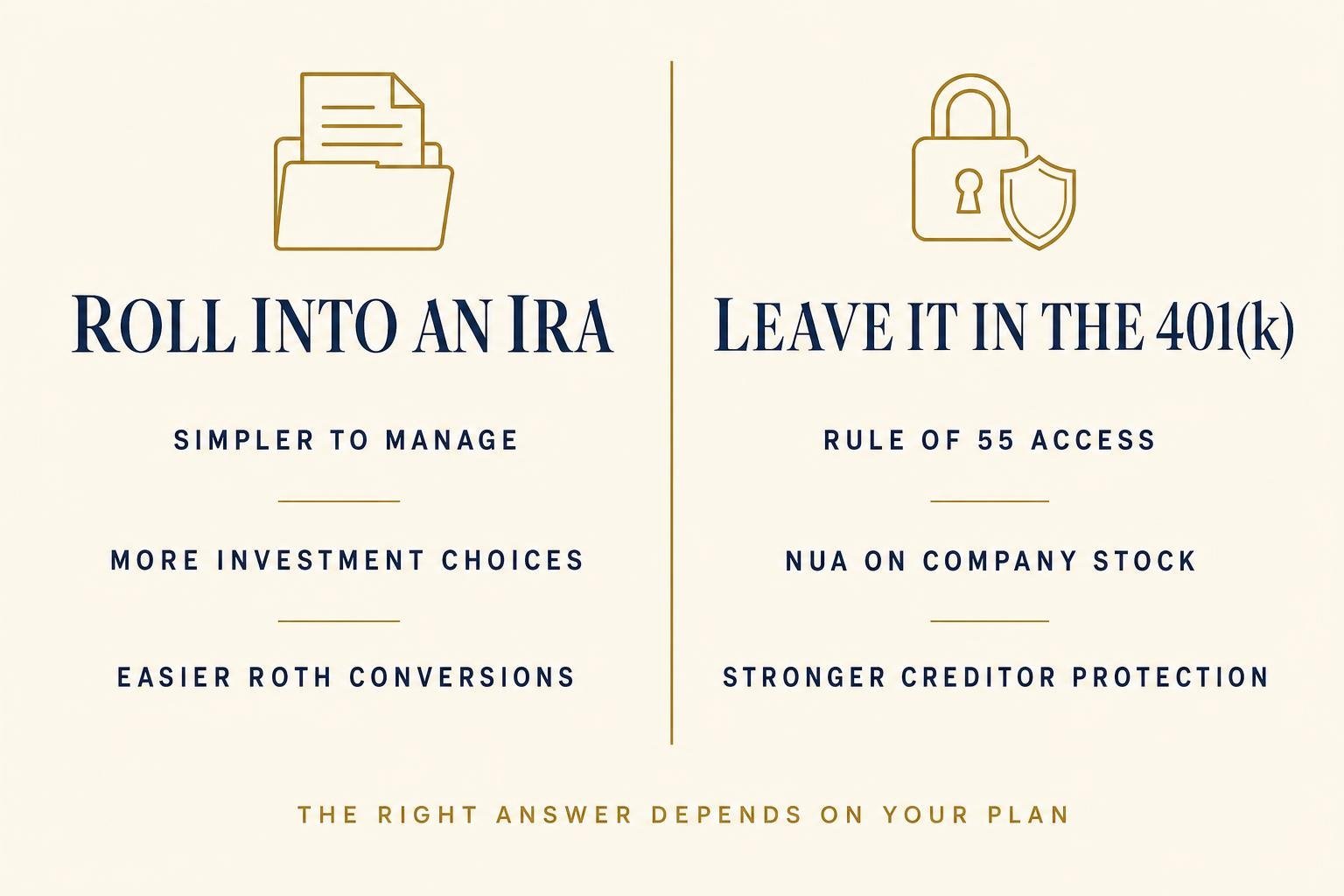
Rolling over has real advantages. You usually get a far wider menu of investments than a 401(k)’s dozen-or-so funds, you can consolidate several old accounts into one, and it’s much easier to run Roth conversions from an IRA. For many retirees, those benefits win. The point isn’t that rolling over is wrong — it’s that you should know what you’re trading away before you sign.
Question 1: Do you hold company stock in the plan?
This is the big one, and it’s the mistake that’s hardest to undo. If your 401(k) holds shares of your employer’s stock that have grown substantially, a blanket rollover can turn a capital-gains bill into an ordinary-income bill — a difference that can run into six figures for long-tenured employees.
The rule is called Net Unrealized Appreciation, or NUA. Under a specific provision of the tax code, you can distribute the employer stock in kind as part of a lump-sum distribution, pay ordinary income tax only on what the shares originally cost, and then pay the lower long-term capital gains rate on all the growth when you eventually sell. Roll those same shares into an IRA instead, and every dollar — cost and growth alike — becomes ordinary income when it comes out. You’d forfeit the preferential treatment entirely.
NUA has strict conditions — a qualifying event, a full lump-sum distribution in a single tax year, and an in-kind transfer of the shares — so it’s worth confirming the details in the IRS guidance on lump-sum distributions before you act. But the headline is this: if you have appreciated company stock, do not roll it over until someone has run the NUA math. Once the shares are in an IRA, that door is closed for good.
Question 2: Might you need the money before 59½?
Most retirement accounts hit you with a 10% penalty for withdrawals before age 59½. But 401(k)s have an escape hatch that IRAs don’t: the Rule of 55.
If you leave your job in or after the calendar year you turn 55, you can take penalty-free withdrawals from that employer’s 401(k) — no waiting until 59½ (the threshold drops to age 50 for qualified public-safety workers). Roll that same money into an IRA, and the Rule of 55 vanishes; you’re back to the 59½ rule and the penalty that comes with jumping early. The IRS early-distribution rules lay out the exceptions.
So if you’re retiring in your late 50s and there’s any chance you’ll need to tap this money before 59½ — to bridge a few years, to cover a gap — leaving it in the plan preserves an option a rollover throws away. There’s a related quirk on the other end, too: if you keep working past 73 and don’t own more than 5% of the company, a current employer’s 401(k) can let you delay Required Minimum Distributions on that account, something an IRA never allows.
Question 3: How much do you value creditor protection?
Money in a 401(k) is protected under federal law (ERISA) from creditors and lawsuits, with no dollar limit. That protection is close to ironclad.
IRAs are protected too, but the shield is different and, in a few respects, weaker. In bankruptcy, federal law caps the IRA protection at $1,711,975 per person for 2025 through early 2028 (the figure is inflation-adjusted every three years). Outside of bankruptcy — an ordinary lawsuit or creditor judgment — IRA protection depends on your state, and states vary widely.
Here’s the reassuring detail most people don’t know: money you roll from a 401(k) into an IRA keeps its full protection and does not count against that bankruptcy cap. So a rollover doesn’t strip the protection off your old plan dollars. But if you’re in a profession with real liability exposure, the belt-and-suspenders certainty of leaving money in the 401(k) is worth weighing.
Question 4: Is your plan actually good — and cheap?
The pitch to roll over usually implies your 401(k) is a cramped little account you’ve outgrown. Sometimes that’s true. Large employer plans, though, often carry institutional-class fund shares priced below anything you can buy retail, and some offer a stable value fund — a low-risk, steady-return option that simply doesn’t exist outside a workplace plan and can be a genuinely useful home for the safe slice of your money.
So before you move, compare honestly. Pull your plan’s fee disclosure and look at the expense ratios. If your 401(k) is a low-cost plan with strong funds and a good stable value option, rolling into a retail IRA could mean higher costs and fewer safe-money choices, not fewer. If the plan is mediocre and expensive — many small-employer plans are — that’s a real point in favor of rolling over. FINRA makes the same point: a rollover is worth comparing on fees and features, not assuming.
A hypothetical: when the default answer is wrong
Consider a hypothetical case: Kenji, 57, just took early retirement from the manufacturer where he spent 28 years, outside Charlotte. His 401(k) holds $900,000 — but $250,000 of that is company stock he bought for about $60,000 over the years. He also thinks he may need to pull $30,000 a year from the account to bridge until Social Security and a small pension start.
The rep who called him recommended rolling the whole thing into an IRA. On its face, tidy. But look at what that one move would cost Kenji. It would bury $190,000 of stock appreciation inside an IRA, where it would eventually come out as ordinary income instead of qualifying for capital-gains treatment through NUA. And because he’s 57 and separated from service, it would trade away his Rule of 55 access — the very feature that lets him take those bridge withdrawals penalty-free.
The better sequence for a situation like Kenji’s is usually the opposite of “roll it all.” Handle the company stock through the NUA process, keep enough in the plan to use the Rule of 55 for the bridge years, and roll the ordinary funds he doesn’t need soon into an IRA where they’re easy to manage and convert. Same accounts, wildly different tax and access outcomes — decided entirely by not treating the rollover as automatic.
Where the money goes once you decide
Rolling over — or not — is only the first decision. The second is what the money is for, and that’s where the Now, Soon, and Later framework does the real work.
Once you know which dollars are staying in the plan and which are moving to an IRA, you assign each pile a job: a couple of years of spending money in the Now bucket, the guaranteed income floor in the Soon bucket, and long-term growth in the Later bucket. The rollover question is really a plumbing question — it decides which pipes the money flows through, not how much market risk you take or when you spend it. The account structure serves the income plan, not the other way around, which is the same logic behind tax-aware bucketing and the order you draw accounts down in retirement.
Because the rollover decision ripples across taxes, penalties, RMDs, and years of withdrawals, it’s genuinely hard to eyeball. A planning tool like ProjectionLab lets you model rolling over versus staying in the plan — including a Roth conversion path and the tax drag of each — and see the multi-year difference before you commit, rather than discovering it on a future tax return.
Disclosure: the ProjectionLab link above is an affiliate link. If you subscribe through it, Confluence Media Group may earn a commission at no additional cost to you. I only point readers to tools I’d use myself.
The bottom line
For most retirees with a straightforward 401(k) and no company stock, rolling into an IRA is a fine, often excellent, move — more choices, easier management, simpler conversions. The problem isn’t rolling over. The problem is rolling over reflexively, because someone with a commission told you to, without checking the four things that can’t be undone: company stock, the Rule of 55, creditor protection, and whether your plan is actually cheaper than what you’d move to.
Ask those four questions first. If the answers all point to an IRA, roll it over with confidence. If even one points the other way, you’ve just saved yourself from an expensive default — and the difference between the two, for a lot of people, is one of the largest single decisions they’ll make in the first year of retirement. (If you’re still sorting out how these accounts differ in the first place, start with the IRA versus 401(k) basics, then come back to the rollover call.)
This article is published by Confluence Media Group LLC, an independent publisher of educational financial content. Thomas Clark is a Series 65 Investment Advisor Representative. The information provided is for educational and informational purposes only and is not personalized financial, tax, or legal advice. Past performance does not guarantee future results. All investing involves risk, including potential loss of principal. Consult a qualified professional before making financial decisions.
Confluence Media Group LLC is a separate entity from Confluence Capital Management, the investment advisory practice through which Thomas Clark provides advisory services. Advisory services are not offered through this publishing platform.
About Thomas Clark
Thomas Clark is the founder of Confluence Media Group LLC and a Series 65 Investment Advisor Representative. He has spent nearly two decades working with families on retirement planning, with a focus on Social Security optimization, retirement income coordination, and the bucket planning approach to building a guaranteed income floor.
Thomas writes and publishes at thomasclarkadvisor.com and is the author of The Just in Case Binder — a 148-page printable family financial organizer for households who want to make sure the people they love know where everything is.
He lives in North Carolina with his family.
Subscribe to the weekly newsletter · Get the Just in Case Binder

Thomas Clark is a Series 65 licensed investment advisor and experienced trader. He specializes in investing, retirement planning, and market analysis, helping individuals build wealth and make informed financial decisions.
