
Your Savings Rate Beats Your Returns (For Now)
Early on, the percentage of your income you save does more to build your future than any fund you pick or dip you time. Here is the math on why your savings rate beats your return — and when that finally flips.

Here is a question that decides more retirement outcomes than almost any other, and almost nobody asks it: what percentage of your income are you actually saving? Not which fund you picked. Not whether you timed the dip. The percentage. In the years when your account is still small, that single number does more to build your future than any investment decision you will make.
This runs against most of what gets written about money. The internet is wall-to-wall with fund comparisons, allocation debates, and takes on whether the market is about to roll over. All of it matters eventually. But early on, it is the wrong obsession. The lever you actually control, the one that moves your outcome the most and depends on no one’s forecast, is how much you put in.
The math nobody wants to hear
Compound growth needs two ingredients: a rate of return and a balance for that return to act on. When you are starting out, the balance is small, so the return has almost nothing to work with. Your contributions are doing the heavy lifting, and it is not close.
Picture the first year of saving. You put in $6,000. A great year in the market might add another few hundred dollars on top of that. A bad year might take a few hundred away. Either way, the money you contributed dwarfs whatever the return did. The return is a rounding error next to the deposit.
That relationship holds for longer than most people expect. For roughly the first decade of serious saving, the size of your contributions matters more than the performance of your investments. The return is real, and it compounds, but it is compounding on a base you are still in the middle of building. You cannot out-earn a small base. You can only out-save it.
A hypothetical worth sitting with
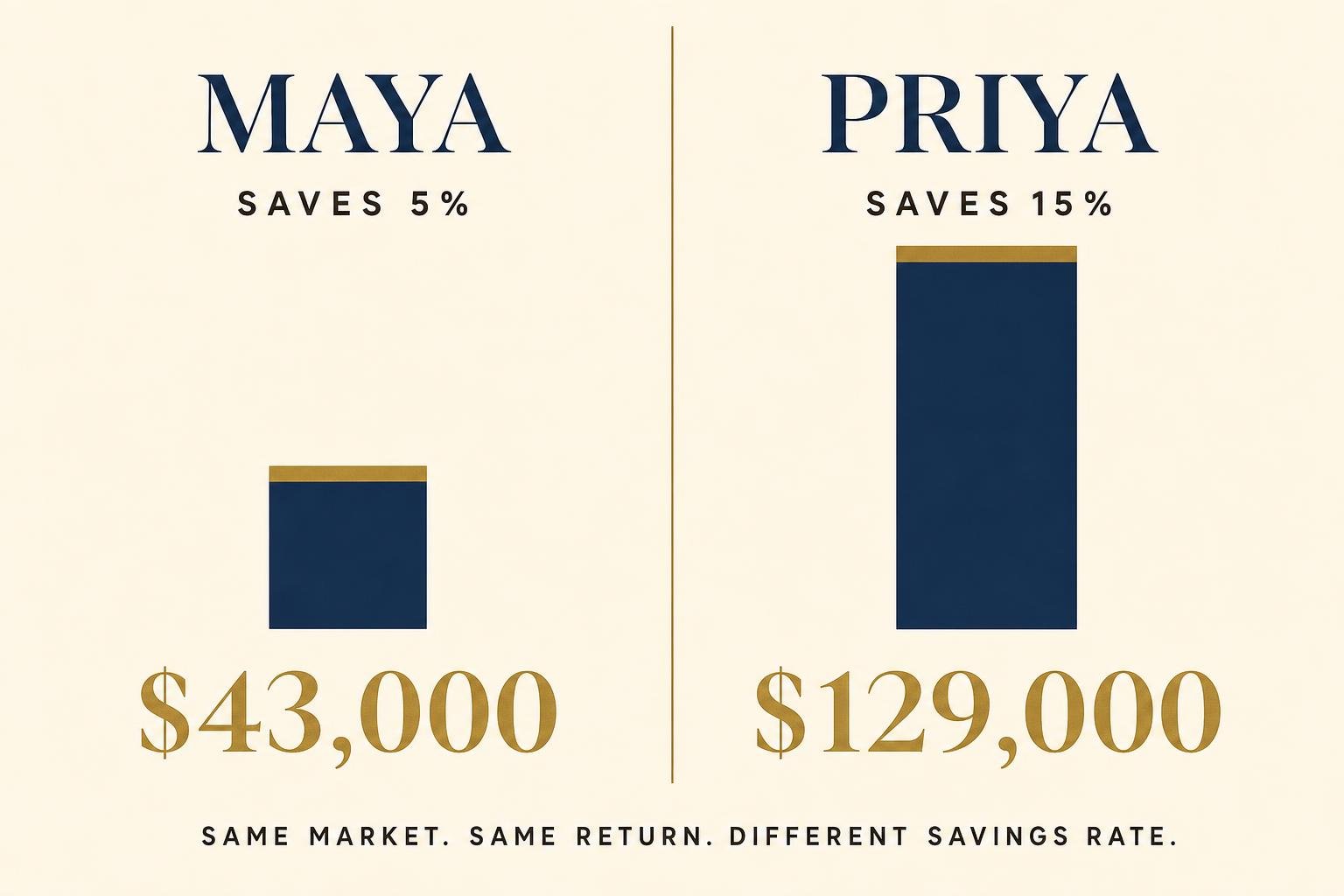
Consider a hypothetical case, with round numbers chosen to illustrate the point rather than predict anyone’s results. Two savers, Maya and Priya, are both 30 and both earn $60,000 a year. Both invest in the same broadly diversified index fund and, for the sake of the illustration, both earn the same assumed 7% annual return. The only difference is the savings rate.
Maya saves 5% of her income, or $250 a month. Priya saves 15%, or $750 a month. Same market, same fund, same returns, same everything except the deposit. After ten years, in this illustration, Maya has built something in the neighborhood of $43,000 and Priya something closer to $129,000. Three times the contribution, roughly three times the balance. The return did identical work for both of them. The savings rate did all the differentiating.
Now flip the variable. Imagine Maya keeps her 5% rate but becomes a brilliant investor and squeezes out 9% instead of 7%, two full percentage points of extra return year after year, which is extraordinarily hard to do. In this hypothetical she still ends up well behind Priya. Two extra points of return on a small balance cannot catch up to three times the contributions. The saver won, not the stock picker.
These figures are illustrative, not a forecast — real markets never hand you a smooth 7%, and some years will be negative. The dollar amounts are not the lesson. The ratio is. Whatever the market does, it does it to everyone in the same fund equally; what separates two savers early on is what they put in.
Why the “pick the right fund” obsession is backwards
Most people entering their saving years pour their energy into the investment decision — researching funds, comparing expense ratios to the third decimal, agonizing over whether to buy now or wait for a pullback. That effort feels productive because it feels like investing. But when your balance is small, the payoff from getting the investment “perfect” is tiny in absolute dollars, while the payoff from raising your savings rate a few points is enormous.
Getting the fund right still matters — a low-cost, broadly diversified index fund will quietly beat a high-fee, concentrated bet over decades, and fees are one more thing you control. But that is a decision you can make once, in an afternoon, and then leave alone. Where those dollars sit — and how that interacts with taxes down the road — is worth understanding too, which I covered in asset location versus asset allocation. The savings rate is a decision you remake every single month, and it is where the real leverage lives in the accumulation phase.
Thomas’ Take: I spent years trading, and the lesson that transferred most cleanly to long-term wealth building was this — you make your money on the things you control and lose it chasing the things you don’t. In trading that meant position sizing and risk management, not predicting the next candle. In saving it means your contribution rate, not your return forecast. The market’s returns are handed to you; your savings rate is authored by you. Spend your energy where the authorship is.
The savings rate is the lever you actually control
There is a quiet freedom in this. You do not need to become a great investor to build real wealth in your working years. You do not need a market call, an edge, or a lucky year. You need to bank a meaningful slice of every paycheck and keep doing it. The return will show up on its own timeline; the contribution is entirely yours.
The practical version of this is boring and it works: raise the rate mechanically instead of waiting to feel ready. Capture the full employer match first — that is an immediate, guaranteed return on your contribution that no investment can match, and skipping it is the one genuinely costly mistake in this whole conversation. That same logic — grab the guaranteed money before the probable money — is the spine of the pay off debt or invest decision. Then push the rate up a percentage point or two whenever your income rises, before the raise gets absorbed into your lifestyle. A saver who banks half of every raise barely feels it and watches their savings rate climb for years without ever going on a budget.
The thing that erodes a savings rate is almost never a bad investment. It is lifestyle creep: every raise quietly becoming spending, so the percentage you save stays flat even as your income doubles. That is the real leak, and it has nothing to do with the market.
When returns finally start to take over
None of this means returns never matter — it means they matter later. As your balance grows, the arithmetic slowly flips. Once you have built a substantial portfolio, a single percentage point of return moves more money than an entire year of contributions ever could. At that point the investment decisions you spent your twenties over-weighting genuinely do become the main event.
There is a rough crossover, usually somewhere in the second decade of consistent saving, where the growth on your existing balance starts to outrun your new deposits. Before that line, you are a saver whose returns are a bonus. After it, you are an investor whose contributions are the bonus, not the engine. Knowing which side of the line you are on tells you where to spend your attention.
This is the same shift that defines the move from accumulation into retirement: the mindset that built the pile is not the mindset that manages it. It is worth seeing where your own crossover sits rather than guessing. A planning tool like ProjectionLab lets you model your actual savings rate against different return assumptions and watch when the growth on your balance overtakes your contributions — so you can see, in your own numbers, exactly how much a few extra points of savings rate is worth today. (ProjectionLab is a paid tool; the link is an affiliate link, which means I may earn a small commission at no extra cost to you. I only recommend tools I’d use myself.)
Key Takeaways
- Early on, your savings rate beats your return. When the balance is small, contributions dwarf whatever the market adds — you cannot out-earn a small base, only out-save it.
- The savings rate is the lever you control. Returns are handed to everyone in the same fund equally; what separates two savers is what they put in.
- Capture the full employer match first. It is an immediate, guaranteed return on your contribution — the one genuinely costly thing to skip.
- Bank your raises before lifestyle absorbs them. Lifestyle creep, not a bad fund, is what quietly flattens a savings rate.
- Returns take over later. Once the portfolio is large, a point of return outweighs a year of saving — that is when the investment decisions become the main event.
Frequently asked questions
What savings rate should I aim for? There is no universal number, and anyone who gives you one without knowing your situation is guessing. The useful move is directional: find your current rate, then raise it. Whatever you are saving now, a few points higher — captured automatically so you never see the money — will do more for your future than any fund switch. It helps to know roughly what you are building toward, which I walked through in how much you really need to retire. Start with the full employer match and build from there.
Does this mean my investment choices don’t matter? They matter, but the order of importance flips over time. In the accumulation years, savings rate leads and low fees and broad diversification are the supporting decisions you set once — including which account holds the money, a choice I broke down in IRA versus 401(k). As your balance grows large, the investment mix moves to the front. It is a question of sequence, not of one mattering and the other not.
I got a late start. Is the savings rate still the main lever? Even more so. With fewer years for compounding to work, the return has less time to build a base for you — which makes the contribution rate the dominant variable, not a secondary one. A higher savings rate is the most reliable lever a late starter has, because it does not depend on the market cooperating.
The takeaway is almost anticlimactic, and that is the point. You do not need to be a great investor to end up in a strong place. You need to save a meaningful percentage of your income and let time and the market do the part you don’t control. Get the savings rate right, and the returns become what they were always meant to be in the early years — a bonus, not the plan.
This article is published by Confluence Media Group LLC, an independent publisher of educational financial content. Thomas Clark is a Series 65 Investment Advisor Representative. The information provided is for educational and informational purposes only and is not personalized financial, tax, or legal advice. Past performance does not guarantee future results. All investing involves risk, including potential loss of principal. Consult a qualified professional before making financial decisions.
Confluence Media Group LLC is a separate entity from Confluence Capital Management, the investment advisory practice through which Thomas Clark provides advisory services. Advisory services are not offered through this publishing platform.
About Thomas Clark
Thomas Clark is the founder of Confluence Media Group LLC and a Series 65 Investment Advisor Representative. He has spent nearly two decades working with families on retirement planning, with a focus on Social Security optimization, retirement income coordination, and the bucket planning approach to building a guaranteed income floor.
Thomas writes and publishes at thomasclarkadvisor.com and is the author of The Just in Case Binder — a 148-page printable family financial organizer for households who want to make sure the people they love know where everything is.
He lives in North Carolina with his family.
Subscribe to the weekly newsletter · Get the Just in Case Binder

Thomas Clark is a Series 65 licensed investment advisor and experienced trader. He specializes in investing, retirement planning, and market analysis, helping individuals build wealth and make informed financial decisions.
