
Pay Off Debt or Invest? The Order That Decides
That extra money each month sparks the same argument: kill the debt or grow the investments? The trick isn't a rate on a spreadsheet — it's knowing which returns are guaranteed and grabbing those first.

You just got a little breathing room. A raise, a bonus, a side gig that finally paid off — call it an extra $500 a month. Two voices show up almost immediately. One says throw every dollar at the debt until it’s gone. The other says the debt can wait, get that money into the market where it can grow.
Both voices are right some of the time and wrong the rest of the time, which is exactly why the question feels so hard. “Should I pay off debt or invest?” gets answered with a spreadsheet — your loan rate versus your expected market return — and the spreadsheet is real. But it’s only half the decision. The other half is about what kind of return you’re actually being offered, and there’s one of them you should never turn down.
Start with the only honest number in the room
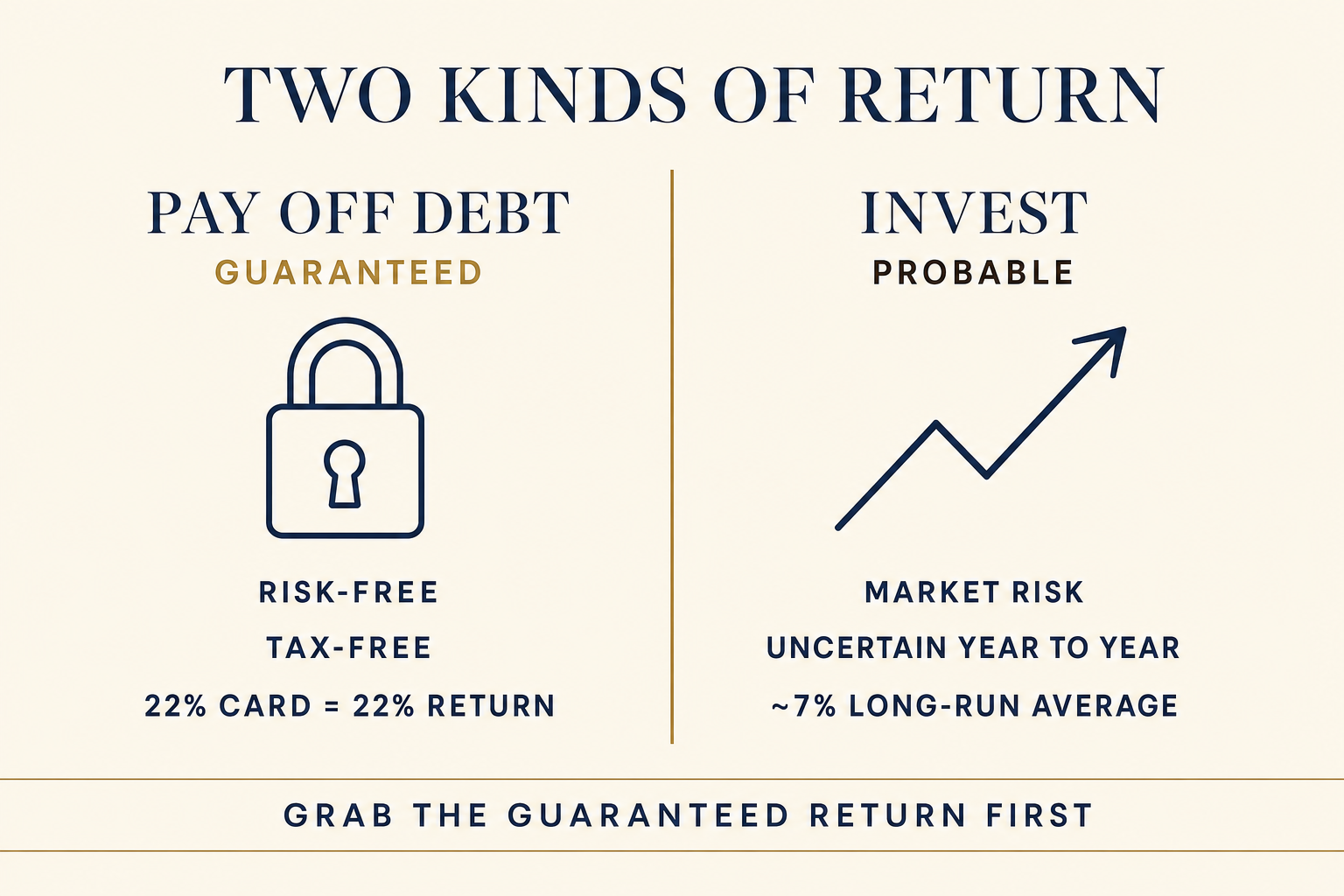
Here’s the distinction that clears up most of the confusion: paying off debt gives you a guaranteed return. Investing gives you a probable one.
When you pay off a loan charging 22% interest, you have just earned 22% — guaranteed, tax-free, and with zero risk. That balance will never charge you another dollar. There is no investment anywhere that promises you 22% with no chance of loss. If someone offers you one, run.
That’s not a small point, because the most common expensive debt Americans carry is exactly that expensive. The average credit card charged about 22% to people carrying a balance in 2026, according to the Federal Reserve. Against a guaranteed 22%, the stock market’s roughly 7% long-run average — which, unlike the 22%, is an average you might not see in any given year — isn’t a real competition. High-interest debt is a five-alarm fire. You put it out first, before you invest a dime beyond the one exception below.
Thomas’s Take: I spent years around trading desks, and a guaranteed, risk-free return with no drawdown is a unicorn — it basically doesn’t exist. Paying off a 22% credit card is that unicorn. You don’t debate a unicorn. You take it.
The one return you never walk past: the employer match
There is exactly one thing that comes before killing even high-interest debt, and it’s the employer match on your workplace retirement plan. If your employer matches, say, 50 cents on the dollar up to 6% of your pay, that match is an instant 50% return on the money you put in — and a dollar-for-dollar match is an instant 100%. Nothing else in this article, or in investing generally, hands you that.
The reason is that the match isn’t a bonus or a perk. It’s part of your compensation that you only receive if you contribute. Skipping it to pay down a 6% student loan is turning down a raise to save 6%. So the rule holds even when you’re in debt: contribute at least enough to capture the full employer match, then attack the debt.
One caveat worth checking: vesting. Some plans make you stay a few years before the match is fully yours. If you’re likely to leave before you vest, the match math changes — but for most people staying put, it’s the highest-return move available, full stop. (If you’re still sorting out which account the money should even go into, that’s a separate question I’ve covered in IRA vs. 401(k).)
The hurdle-rate rule for everything in between
Once the match is captured and any high-interest debt is dead, most people are left staring at middle-of-the-road debt — a car loan, student loans, maybe a HELOC — somewhere in the 4% to 8% range. This is where the spreadsheet finally earns its keep, and the tool is a single idea: your hurdle rate.
Think of your hurdle as the guaranteed return you’d have to beat to make investing the smarter bet. Right now, with safe cash and Treasurys actually paying something again, a reasonable risk-free hurdle sits in the low-to-mid single digits. Debt priced clearly above your hurdle behaves like the credit card — pay it down. Debt priced clearly below it usually loses to investing over a long horizon, because time in the market does the heavy lifting.
| Your debt’s rate | The usual call | Why |
|---|---|---|
| Roughly 8%+ (credit cards, some private loans) | Pay it off | A guaranteed return that beats what the market reliably delivers |
| Roughly 4–8% (car loans, many student loans) | It depends — split the difference | Close enough to your hurdle that temperament and taxes decide |
| Under ~4% (many mortgages, subsidized loans) | Usually invest | A long market horizon has historically outpaced the interest cost |
The table is a starting point, not a verdict. The word “usually” is doing real work in that bottom row, and the middle row is honestly a coin flip you get to weight yourself.
The murky middle is a temperament question, not a math one
When the debt rate and your hurdle are close, the math is close too — close enough that the tie goes to how you’re built. Some people carry a 6% loan without a second thought and happily invest the surplus. Others feel that balance like a pebble in their shoe every single day, and that low-grade stress leaks into worse decisions elsewhere.
If you’re the second kind of person, paying off the “mathematically investable” loan can be the right move even when a calculator disagrees, because the peace of mind is part of the return. There’s no shame in that, and there’s no medal for squeezing out an extra half-percent while feeling miserable. The one thing I’d push back on is doing nothing — sitting on cash because you can’t decide. Splitting the surplus (half to the loan, half invested) is a perfectly good answer that lets you stop agonizing and start moving on both fronts.
What it looks like in practice
Consider a hypothetical — Marcus, 34, an engineer who just freed up $1,000 a month after a promotion. He has a $9,000 credit card balance at 22%, $25,000 in student loans at 6%, and an employer who matches 50% on the first 6% of his pay. His instinct is to throw the whole $1,000 at the student loans because they’re the bigger number. (These figures are an illustration, not a projection.)
The order that actually serves him is different. First, he makes sure he’s contributing enough to grab the full match — that’s free money he was leaving on the table. Next, every remaining dollar goes at the 22% card until it’s gone in a few months, because nothing else he can do with a dollar comes close to a guaranteed 22%. Only then does he reach the 6% student loans, which sit right in the murky middle — so he splits the surplus, sending part to the loans and starting to invest the rest, letting a long horizon go to work. Same $1,000, a very different ten-year outcome.
The part most people miss: paying off debt builds your income floor
Here’s the reframe that ties all of this to the way I think about retirement. Every dollar of debt payment you eliminate permanently lowers the income your future self has to generate. A paid-off car or a killed student loan isn’t just a number that disappears from a statement — it shrinks the “essential expenses” line you’ll one day need guaranteed income to cover.
That’s the same job the Now, Soon, and Later bucket framework does from the other direction. Bucket planning builds up guaranteed income to meet your essential expenses; paying off debt pulls those essential expenses down to meet your income. Both close the same gap. This is also why the mortgage question in retirement is its own animal, with sequence-of-returns risk in the mix — I walked through that specific decision separately.
Before you lock in a plan, it’s worth seeing the two paths on paper rather than guessing. A planning tool like ProjectionLab lets you model directing the same dollars at debt versus investing them — how each path lands on your net worth and your future cash flow over the years ahead — so you’re choosing with numbers instead of arguing with the two voices in your head. (ProjectionLab is a paid tool; the link is an affiliate link, which means I may earn a small commission at no extra cost to you. I only recommend tools I’d use myself.)
Key Takeaways
- Paying off debt is a guaranteed return; investing is a probable one. A 22% credit card paid off is a risk-free 22% you can’t get anywhere in the market.
- Capture the full employer match before anything else. A 50–100% instant return is part of your pay — skipping it to pay down a 6% loan is turning down a raise.
- Use a hurdle rate. Debt clearly above your risk-free hurdle gets paid down; debt clearly below it usually loses to a long investing horizon.
- The murky middle is about temperament. When the rates are close, peace of mind is a legitimate part of the return — and splitting the surplus beats freezing.
- Every payment you eliminate lowers your future income floor. Killing debt and building guaranteed income close the same gap from opposite ends.
Frequently Asked Questions
Should I stop investing entirely until I’m debt-free?
Not before you’ve captured your full employer match — that return is too large to skip, debt or no debt. Beyond the match, pausing other investing to kill high-interest debt is reasonable, since a guaranteed 20%-plus return is worth more than an uncertain market one.
What counts as an emergency fund in all this?
A starter cash cushion comes before you accelerate any debt payoff or extra investing, so a surprise expense doesn’t send you right back to the credit card. I worked through how much you actually need in the emergency fund debate.
Does it matter that mortgage or student loan interest can be tax-deductible?
It can nudge a middle-of-the-road loan toward “invest,” because a deduction lowers your effective interest rate. But since the 2017 standard deduction changes, far fewer households itemize, so many people get no deduction at all — check whether you actually claim it before counting on it.
Isn’t market timing a risk if I invest a lump sum instead of paying debt?
For a long horizon, historically the risk of waiting has outweighed the risk of a bad entry point — the market has been up in most calendar years. You can see how compounding rewards time in the market using the SEC’s free compound interest calculator.
The real answer to “pay off debt or invest” isn’t a rate on a spreadsheet. It’s a ranking. Grab the guaranteed money first — the match, then the high-interest debt — and only then let the probable money compete for what’s left. Do it in that order and you’re never wrong for long, because you took every sure thing before you placed a single bet.
This article is published by Confluence Media Group LLC, an independent publisher of educational financial content. Thomas Clark is a Series 65 Investment Advisor Representative. The information provided is for educational and informational purposes only and is not personalized financial, tax, or legal advice. Past performance does not guarantee future results. All investing involves risk, including potential loss of principal. Consult a qualified professional before making financial decisions.
Confluence Media Group LLC is a separate entity from Confluence Capital Management, the investment advisory practice through which Thomas Clark provides advisory services. Advisory services are not offered through this publishing platform.
About Thomas Clark
Thomas Clark is the founder of Confluence Media Group LLC and a Series 65 Investment Advisor Representative. He has spent nearly two decades working with families on retirement planning, with a focus on Social Security optimization, retirement income coordination, and the bucket planning approach to building a guaranteed income floor.
Thomas writes and publishes at thomasclarkadvisor.com and is the author of The Just in Case Binder — a 148-page printable family financial organizer for households who want to make sure the people they love know where everything is.
He lives in North Carolina with his family.
Subscribe to the weekly newsletter · Get the Just in Case Binder

Thomas Clark is a Series 65 licensed investment advisor and experienced trader. He specializes in investing, retirement planning, and market analysis, helping individuals build wealth and make informed financial decisions.
