
The 401(k) Super Catch-Up Window That Closes at 64
A little-known rule lets workers aged 60 to 63 put up to $35,750 into a 401(k) in 2026 — far more than the standard catch-up. Here's how to use the four-year super catch-up window before it closes at 64.

Most people know that at 50, the IRS lets you put a little extra into your 401(k) — the “catch-up” contribution. Far fewer know that a second, much larger catch-up quietly opened in 2025, and that it’s available for exactly four years of your life.
If you turn 60, 61, 62, or 63 at any point in 2026, you can put $35,750 into your 401(k) this year. Not $24,500. Not $32,500. $35,750. Then, the year you turn 64, the window narrows again. It is the single most generous stretch of tax-advantaged savings most people will ever get — and it lands in precisely the years you can use it best.
What actually changed for 2026
Every year the IRS adjusts how much you can contribute to retirement accounts. For 2026, the base 401(k) employee contribution limit rose to $24,500, up from $23,500. That’s the number for everyone, regardless of age.
On top of that base, there are two different “catch-up” contributions — extra money the law lets older workers add:
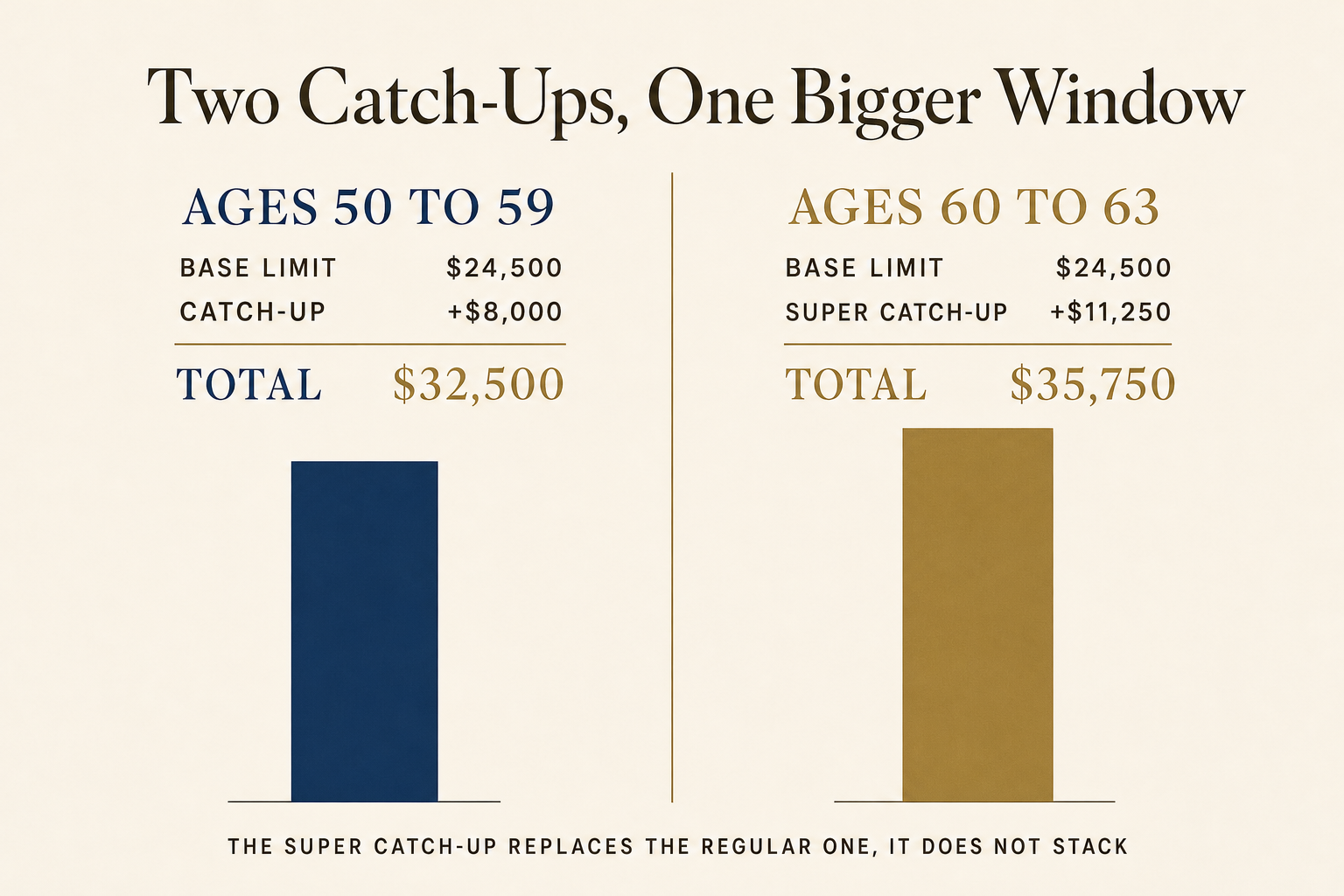
The standard catch-up, for anyone 50 or older, is $8,000 in 2026 (up from $7,500). Add that to the base and a 55-year-old can defer $32,500 into a 401(k) this year.
The super catch-up — the part almost nobody talks about — is $11,250, and it applies only to workers who are 60, 61, 62, or 63 during the calendar year. This came out of the SECURE 2.0 Act and first took effect in 2025. Here’s the detail that trips people up: the super catch-up replaces the standard $8,000 catch-up for those ages. It doesn’t stack on top of it. So the math for a 61-year-old is $24,500 base plus $11,250, which comes to $35,750.
One more layer, because it rounds out the picture. Your IRA is separate from your workplace plan. For 2026 the IRA contribution limit is $7,500, with a $1,100 catch-up once you’re 50 — so $8,600 into an IRA on top of whatever you put in the 401(k). A single 61-year-old with both accounts is looking at a ceiling of roughly $44,350 in tax-advantaged contributions in one year. A married couple who are both in that age band, both still working with plans of their own, can roughly double it.
Why 60 to 63 is the highest-leverage savings window you’ll ever have
Regular readers know I think about retirement money in three buckets: a Now bucket of cash for near-term spending, a Soon bucket that builds a guaranteed income floor, and a Later bucket of growth money for the years further out. The super catch-up is really a story about the Later bucket, and about timing.
These last few working years are when the Later bucket gets its final, biggest deposits. The mortgage is often gone or nearly gone. The kids’ college bills are behind most families. Earnings are usually at their peak. And the paycheck — the thing that makes any of this possible — is still arriving. For a four-year stretch, a lot of households have both the capacity to save a large amount and a tax code that’s unusually willing to let them.
That combination doesn’t last. Once the paychecks stop, you can’t defer salary you’re no longer earning. The super catch-up itself expires the year you turn 64 — you drop back to the standard $8,000 catch-up even though nothing about your situation changed. The IRS is effectively handing pre-retirees a bigger shovel in the exact window when the pile is biggest and the ground is softest. Most people never pick it up, because the rule is new and no one told them it existed.
Thomas’ Take: I’d rather see someone use a known, guaranteed tax benefit in their early 60s than chase a hot investment idea in their 70s. The super catch-up isn’t a bet on the market doing anything in particular — it’s a bigger tax-advantaged container, available on a clock. You either fill it in those four years or the opportunity is gone. That kind of certainty is rare in this business, and it’s worth more attention than it gets.
The wrinkle higher earners need to know about
There’s a change that arrived with the 2026 tax year that higher earners should understand before they set their deferrals. If your wages from your employer in the prior year were above roughly $145,000 — a figure the law adjusts for inflation — your catch-up contributions, including the super catch-up, generally have to go into a Roth account rather than a pre-tax one.
Read that carefully, because it’s easy to misread as bad news. It does not reduce how much you can contribute. The $11,250 is still $11,250. What changes is the tax treatment: instead of getting a deduction now and paying tax on the money in retirement, you pay tax on it now and the growth and withdrawals come out tax-free later. For a lot of people in their early 60s who expect to have meaningful taxable income in retirement, a forced Roth contribution is closer to a gift than a penalty. But it’s a planning detail worth confirming with your plan administrator, because not every plan has its Roth option fully sorted — and if the plan can’t accept Roth catch-ups, affected savers may lose the catch-up entirely for the year.
A hypothetical to make it concrete
Consider a hypothetical case: Steve and Patty, both 61, live outside Greensboro and plan to work three or four more years. Steve earns about $130,000 as an engineer; Patty went to part-time last year and earns around $45,000, and both have a 401(k) through work. Their house is paid off and their kids are launched, so for the first time in decades their expenses are low relative to their income.
This is their super catch-up window — and it’s open for both of them at once, which won’t be true forever. If Steve funds his plan to the ceiling, that’s $35,750 into his 401(k) this year. Patty contributes what her smaller paycheck allows toward her own limit. If they each also fund an IRA, they’re sheltering a substantial share of their income from current taxes in a single year, and they can do it again at 62 and 63.
The specific figure matters less than the shape of the decision. For three or four years, this couple can move a large amount of money into tax-advantaged accounts on a schedule that ends on a known date. (These are round, illustrative figures to show the direction of the math, not a projection, a quote, or a recommendation — your own income, plan rules, and the limits in each future year will differ.) What they decide to do in these years is far more consequential than anything they’ll be able to do about contributions after they retire.
What to actually do before the year ends
A few educational takeaways, not instructions for your specific situation.
First, if you’re 60 to 63 and still working, find out whether your plan supports the super catch-up — most do, but you have to elect it, and your payroll system won’t do it for you. Open enrollment season, which runs through the late fall at many employers, is the natural moment to reset your deferral percentage for next year.
Second, don’t let the big number scare you into doing nothing. You don’t have to hit $35,750 to win. Every dollar you move into a tax-advantaged account during this window is a dollar working under better rules than it will after you stop earning. Raising your deferral by even a few percentage points captures part of the opportunity. This is the flip side of a timing mistake I’ve written about before — that front-loading your 401(k) too fast can cost you part of the employer match — so raise the rate thoughtfully, not blindly.
Third, remember the 401(k) isn’t the only container. The differences between an IRA and a 401(k) matter here, and if you have a high-deductible health plan, the HSA is the most underused retirement account there is. Filling these accounts in your early 60s is the last heavy lift of the accumulation years — the final push to build your buckets before you retire.
The honest way to know what this is worth to you is to put it on your own numbers. Map your income, your current deferral, and how many years you have left in the window, then see what filling it does to your plan. A tool like ProjectionLab lets you model your actual contributions year by year and watch how maxing the super catch-up for a few years changes the shape of your retirement — seeing it on your own plan lands differently than reading someone else’s example.
Disclosure: the ProjectionLab link above is an affiliate link. If you subscribe through it, I may earn a commission at no additional cost to you. I only point to tools I’d actually sit down and use.
Key takeaways
- For 2026 the base 401(k) contribution limit is $24,500; the standard catch-up at 50+ is $8,000, bringing the total to $32,500.
- Workers who are 60, 61, 62, or 63 during the year get a larger “super catch-up” of $11,250, which replaces — not stacks on — the standard catch-up, for a 401(k) total of $35,750.
- The super catch-up window lasts only four years and closes the year you turn 64, so it’s worth using deliberately while you can.
- Higher earners (prior-year wages above roughly $145,000, indexed) generally must make catch-up contributions on a Roth basis beginning in 2026 — a change in tax treatment, not in how much you can save.
- An IRA adds up to $8,600 more at 50+, and an HSA is another tax-advantaged container worth filling in your final working years.
The early 60s are when a lot of people start mentally coasting toward retirement. The tax code is pointing in the opposite direction — telling you that for a short, specific window, you can do more than you ever could before. Use the window while it’s open. It closes on a birthday you can’t move.
This article is published by Confluence Media Group LLC, an independent publisher of educational financial content. Thomas Clark is a Series 65 Investment Advisor Representative. The information provided is for educational and informational purposes only and is not personalized financial, tax, or legal advice. Past performance does not guarantee future results. All investing involves risk, including potential loss of principal. Consult a qualified professional before making financial decisions.
Confluence Media Group LLC is a separate entity from Confluence Capital Management, the investment advisory practice through which Thomas Clark provides advisory services. Advisory services are not offered through this publishing platform.
About Thomas Clark
Thomas Clark is the founder of Confluence Media Group LLC and a Series 65 Investment Advisor Representative. He has spent nearly two decades working with families on retirement planning, with a focus on Social Security optimization, retirement income coordination, and the bucket planning approach to building a guaranteed income floor.
Thomas writes and publishes at thomasclarkadvisor.com and is the author of The Just in Case Binder — a 148-page printable family financial organizer for households who want to make sure the people they love know where everything is.
He lives in North Carolina with his family.
Subscribe to the weekly newsletter · Get the Just in Case Binder

Thomas Clark is a Series 65 licensed investment advisor and experienced trader. He specializes in investing, retirement planning, and market analysis, helping individuals build wealth and make informed financial decisions.
