
How to Build Your Retirement Buckets Before You Retire
Retirement income isn't a switch you flip at 65. Here's how to build your Now, Soon, and Later buckets in the years before you retire — and why the timing protects your first, most vulnerable years.

Most people picture retirement as a single day. You hand in your badge on Friday, and on Monday your paycheck stops and your portfolio quietly becomes your income. One switch, flipped once.
That mental model is where a lot of retirements get off to a rocky start. The people who transition smoothly almost never flip a switch. They spend the last few working years quietly building their income structure piece by piece, so that by the time the paycheck stops, the machine that replaces it is already running. If you organize your money around the Now, Soon, and Later bucket framework, the years before you retire are when the buckets actually get built.
Retirement income isn’t a switch — it’s an on-ramp
Here’s the stance most advisors won’t lead with: the single most vulnerable stretch of your entire retirement is the first few years, and you set yourself up for it — for better or worse — before you ever stop working.
The reason is sequence-of-returns risk. Two retirees can earn the exact same average return over 30 years and end up in completely different places, purely because of the order those returns arrive. A bad market in year one or two — while you’re pulling money out — does damage that a good average can never fully undo. You can’t control when the market cooperates. What you can control is whether you’re forced to sell into a downturn to buy groceries. That single piece of protection is built in the years before retirement, not after.
Fill the Now bucket while you still have a paycheck
Your Now bucket is your cash runway: the money that covers day-to-day living for roughly the first stretch of retirement, held in cash, money market funds, and short-term instruments. It exists so that a market drop is an inconvenience, not an emergency — you spend from cash and give your invested money time to recover.
The mistake is trying to create that cash on day one by selling a chunk of stock the week you retire. If the market happens to be down that week, you’ve locked in the loss to fund years of spending. The better approach is to build the Now bucket gradually from cash flow in your final working years — redirecting raises, bonuses, or the dollars you were sending into your 401(k) toward a plain savings or money market account instead. It helps that safe cash finally earns a real yield again, so the runway isn’t sitting there doing nothing.
How big should that runway be? That depends on the gap between your spending and your guaranteed income, which is worth working out deliberately rather than guessing — I walk through the math in how much cash your Now bucket should hold.
Thomas’ Take: The Now bucket isn’t about earning a return. It’s about buying yourself permission to ignore the headlines for a couple of years. That peace of mind is the return.
Lock in the Soon bucket: decide your income floor early
The Soon bucket is your guaranteed income floor — the dependable money that covers your essential bills no matter what markets do. It’s built from genuinely guaranteed sources: Social Security, any pension, and for some households an income-focused annuity used specifically for lifetime income rather than growth.
The most consequential decision here is when to claim Social Security, and it’s a decision you want to make on purpose, well before you file. For each year you delay past your full retirement age — 67 for anyone born in 1960 or later — your benefit grows through delayed retirement credits of about 8% per year up until age 70. That’s a permanent, inflation-adjusted, guaranteed raise, which is exactly why the claiming age deserves years of thought, not a rushed choice in your last month of work. (You can check your own full retirement age directly on the SSA site.)
If there’s a gap between your essential bills and what Social Security and a pension will cover, the years before retirement are also when you’d evaluate whether a slice of the Soon bucket belongs in an income annuity. Used correctly, these are income tools — you’re buying a paycheck, not chasing a return — and they only make sense once you’ve sized the floor you’re actually trying to fill. That sizing exercise is worth doing carefully; here’s how to size the Soon bucket’s income target.
Give the Later bucket a new job
The Later bucket is your long-term growth money — the part of the portfolio that stays invested for the back half of retirement and any legacy goals. Repositioning it before you retire does not mean selling everything and hiding in cash. That’s the opposite mistake, and over a retirement that may last 30 years, it quietly hands the win to inflation.
Repositioning means changing the bucket’s job. During your working years, the Later bucket’s job was to grow as fast as your risk tolerance allowed. In retirement, its job is to grow while feeding the other two buckets over time without forcing you to sell at the wrong moment. That usually means taking an honest look at your overall mix, trimming the single-stock or over-concentrated positions that were fine in accumulation but too fragile for distribution, and making sure the growth engine matches both your risk tolerance and your timeline.
One more thing to map before you retire: taxes don’t stop when the paychecks do. Traditional 401(k) and IRA balances eventually trigger required minimum distributions, which begin at age 73 today — or age 75 if you were born in 1960 or later. Knowing that number is coming shapes how — and from which accounts — you’ll want to draw in the earlier, more flexible years.
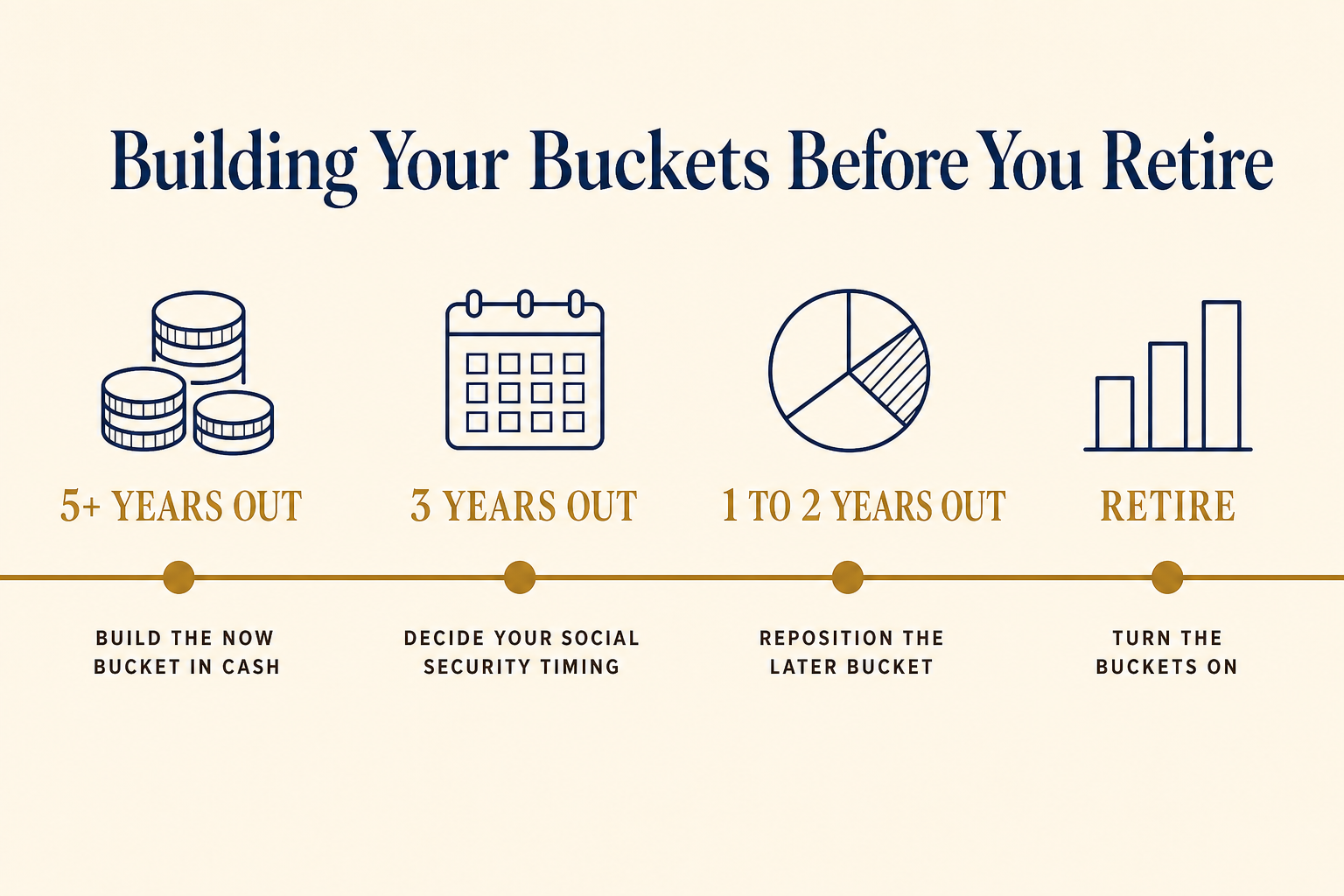
A hypothetical five-year on-ramp
Consider a hypothetical case: Marcus and Dana, both 60, living outside Denver, who want to retire at 65. They have a combined $700,000 across their 401(k)s, no pension, and Social Security benefits that will cover a meaningful share — but not all — of their planned spending. All figures here are round and illustrative, meant to show the shape of a plan, not to predict anyone’s results.
Instead of waiting until 65 to figure it all out, they treat the next five years as an on-ramp. In the first couple of years, they stop increasing their 401(k) contributions beyond the match and steer the extra cash flow into a money market account — deliberately building the Now bucket while they still have earned income to do it with. Around three years out, they map their Social Security strategy, and Dana, the higher earner, plans to delay her benefit toward 70 to lock in the larger guaranteed check for whichever of them lives longer. In the final two years, they review the Later bucket, trim a concentrated position in Marcus’s old company stock, and confirm the growth portion matches their tolerance for a bumpy first few years.
By the time they actually retire, nothing about the transition is a surprise. The paycheck stops, and the buckets they spent five years building simply take over.
What to do, starting this year
You don’t need to do everything at once — that’s the entire point of an on-ramp. But you do need to start from wherever you are:
- Five-plus years out: Get honest about your real spending number, and start redirecting new savings toward cash so the Now bucket is ready without a fire sale.
- Three years out: Nail down your Social Security claiming strategy and decide whether any part of your income floor needs a guaranteed source beyond Social Security.
- One to two years out: Reposition the Later bucket, clean up concentrated holdings, and pressure-test the plan against a bad first year.
- The year you retire: Turn the buckets on and set up your retirement paycheck — a repeatable process for paying yourself from the right bucket each month.
The whole plan gets far easier to trust when you can see it laid out year by year. If you want to model your own on-ramp — test different claiming ages, spending levels, and market scenarios before you commit to any of them — a planning tool like ProjectionLab lets you map your income sources and stress-test the first few years so you’re building on numbers instead of guesses. (ProjectionLab is a paid tool; the link is an affiliate link, which means I may earn a small commission at no extra cost to you. I only recommend tools I’d use myself.)
Retirement doesn’t have to be a leap into the unknown. Build the buckets while you still have a paycheck behind you, and the day you stop working becomes the least dramatic part of the whole thing — which is exactly how it should feel.
Key takeaways
- Retirement income is an on-ramp, not a switch — the smoothest transitions are built in the last few working years, not on the retirement date.
- Your first few years are the most vulnerable to sequence-of-returns risk; a cash-funded Now bucket keeps a down market from forcing you to sell.
- Build the Now bucket from cash flow before you retire, decide your Social Security claiming strategy early, and reposition — don’t liquidate — the Later bucket.
- Delaying Social Security past full retirement age adds roughly 8% per year in guaranteed, inflation-adjusted income up to age 70.
- Map required minimum distributions (which begin at 73, or 75 if you were born in 1960 or later) into your withdrawal plan before they arrive.
Frequently asked questions
How many years before retirement should I start building my buckets?
There’s no hard rule, but five years gives you room to build the Now bucket from cash flow and make your Social Security decision without pressure. Even two or three years of deliberate preparation beats flipping a switch on your last day of work.
Do I have to sell all my investments to create the buckets?
No. The Later bucket stays invested — repositioning means changing its role and cleaning up over-concentrated holdings, not moving everything to cash. Selling out entirely trades market risk for inflation risk over a decades-long retirement.
What if I’m already retired and didn’t do this?
You can still build the structure now; you’ll just do it more carefully, mindful of selling into a down market. Prioritize establishing the Now bucket so you’re not a forced seller, then work on the rest from there.
This article is published by Confluence Media Group LLC, an independent publisher of educational financial content. Thomas Clark is a Series 65 Investment Advisor Representative. The information provided is for educational and informational purposes only and is not personalized financial, tax, or legal advice. Past performance does not guarantee future results. All investing involves risk, including potential loss of principal. Consult a qualified professional before making financial decisions.
Confluence Media Group LLC is a separate entity from Confluence Capital Management, the investment advisory practice through which Thomas Clark provides advisory services. Advisory services are not offered through this publishing platform.
About Thomas Clark
Thomas Clark is the founder of Confluence Media Group LLC and a Series 65 Investment Advisor Representative. He has spent nearly two decades working with families on retirement planning, with a focus on Social Security optimization, retirement income coordination, and the bucket planning approach to building a guaranteed income floor.
Thomas writes and publishes at thomasclarkadvisor.com and is the author of The Just in Case Binder — a 148-page printable family financial organizer for households who want to make sure the people they love know where everything is.
He lives in North Carolina with his family.
Subscribe to the weekly newsletter · Get the Just in Case Binder

Thomas Clark is a Series 65 licensed investment advisor and experienced trader. He specializes in investing, retirement planning, and market analysis, helping individuals build wealth and make informed financial decisions.
