
The Retirement Paycheck: How to Pay Yourself From Your Buckets
For forty years your paycheck arrived on its own. In retirement you have to build it. Here's how to turn your three buckets into one steady monthly deposit.

The hardest part of retiring isn’t the math. It’s the missing deposit. For forty years, a paycheck landed in your account on a schedule you never had to think about. Then it stops, and you’re looking at a pile of accounts — a 401(k), a couple of IRAs, some cash, a brokerage — wondering how any of it turns into groceries next Tuesday.
Bucket planning is good at telling you how to hold your money. Now for today, Soon for the guaranteed years, Later for growth. What it doesn’t do on its own is tell you how to pay yourself from it. That’s the gap almost every new retiree falls into, and it’s the difference between a plan that looks fine in a spreadsheet and one you can actually live on.
The fix is to rebuild the paycheck. You manufacture one predictable monthly deposit so retirement feels the way your working years did — minus the working. Here’s how to do it with the buckets you already have.
Why “just take money out as you need it” quietly fails
The most common advice is also the most dangerous: withdraw money whenever you need it. It sounds flexible. In practice, it turns every purchase into a portfolio decision. Should you sell something to cover the vacation? Is now a bad time? Did the market drop this week? That’s decision fatigue, and it wears people down until they either overspend in good markets or freeze up and underspend out of fear.
A system beats willpower every time. This is the same reason I favor bucket planning over a rigid systematic-withdrawal formula for most retirees: the goal isn’t to optimize every transaction, it’s to build something you’ll actually follow when the market is scary and you’re tired of thinking about it. Even Morningstar’s own review of systematic withdrawal approaches notes that their flexibility cuts both ways — it demands the constant judgment calls a good system is designed to spare you.
Start with the number, not the percentage
Your paycheck is a dollar figure, not a rate. Decide what you need to hit your checking account each month — your essential expenses plus an honest discretionary allowance — and make that the target. A retiree who spends $5,000 a month on essentials and wants another $1,000 for travel and grandkids has a $6,000 paycheck. That’s the number.
Notice what we didn’t do: we didn’t start with “4% of the portfolio” and back into a lifestyle. The percentage is a sanity check, not the plan. Once you know your annual paycheck, confirm the slice coming from investments is sustainable — Morningstar’s research puts a starting rate near 3.9% for a fixed, inflation-adjusted draw over a 30-year retirement. If your portfolio’s share of the paycheck sits comfortably under that, you’re on solid ground. The point of sizing your income floor first is that it shrinks how much the portfolio has to carry.
Assemble the paycheck from three deposits
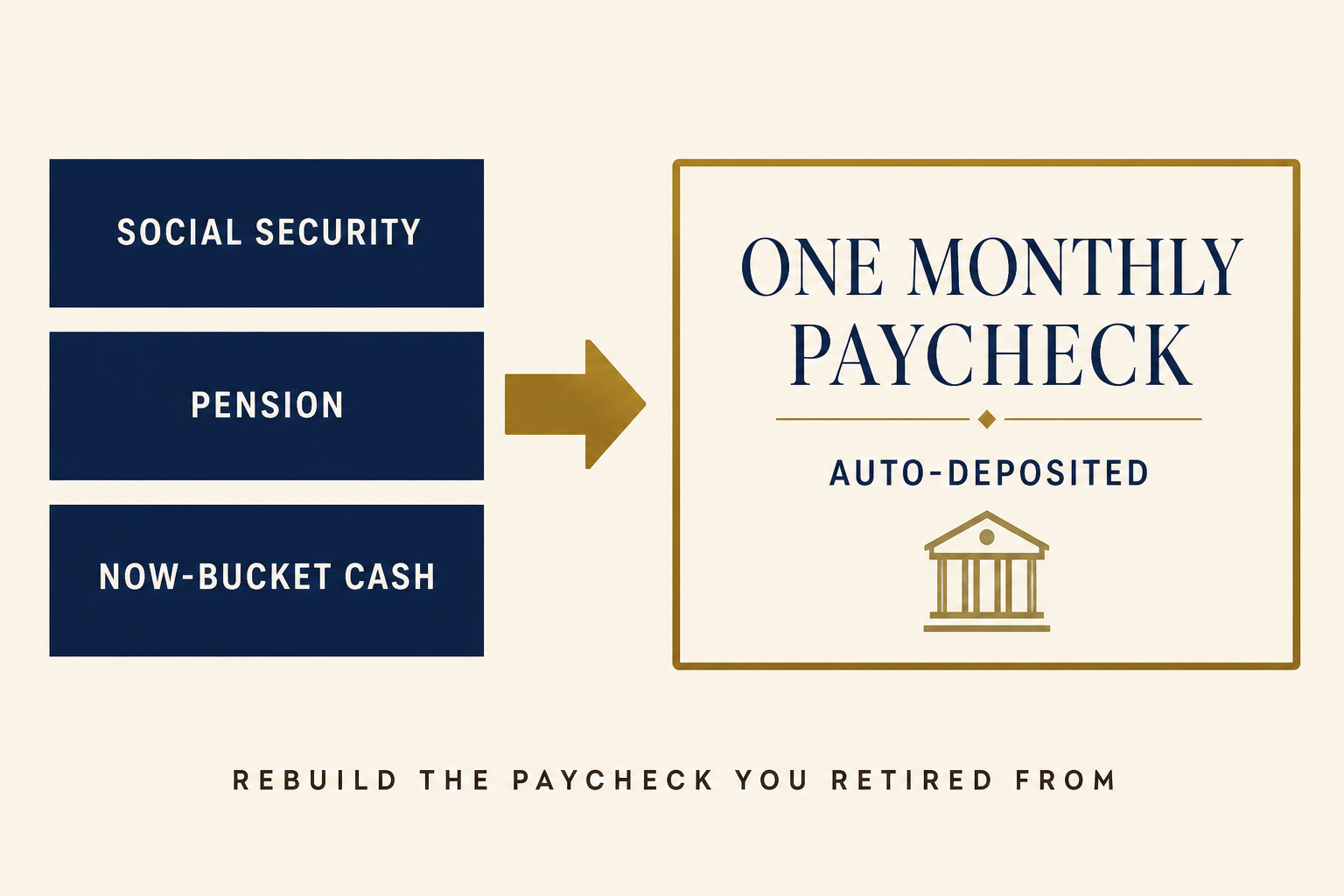
Here’s the part nobody draws out. Your retirement paycheck isn’t one withdrawal — it’s three deposits that arrive as one feeling. Social Security and any pension already land in your account automatically. That’s your Soon bucket, the guaranteed floor, and it does its job without you lifting a finger. For some retirees, part of that floor is an income-focused fixed index annuity with a lifetime income rider, which pays like a private pension — income, not growth.
The rest of the paycheck — the gap between your guaranteed deposits and your target number — comes from the Now bucket. You set up an automatic monthly transfer from that cash (a high-yield savings or money market account) into your checking, timed to land on the same day each month. Stack it on top of the Social Security and pension deposits and you’ve rebuilt a single, predictable paycheck. You’re never logging into a brokerage to “take a withdrawal.” The money just shows up, the way it used to.
Automate it so willpower isn’t involved
Set the transfer to recur, pick a day, and let it run. The entire value of this system is that it removes the monthly decision. You’re not choosing to pay yourself each month; you already decided once, and now it happens on its own.
A predictable deposit does for your spending what a guaranteed floor does for your nerves. It makes the daily “can I really afford this” question disappear, because the answer is already sitting in checking. That behavioral payoff is the underrated half of the whole strategy. Morningstar has been blunt that the bucket approach doesn’t magically raise your returns — its real value is that it keeps you from making the emotional mistakes that actually break retirements. A steady paycheck is that principle in action.
Paying yourself and refilling are two different jobs
This is where people tangle themselves up, so keep the two motions separate. Paying yourself is the monthly transfer from the Now bucket into checking — it runs on a fixed schedule, like clockwork. Refilling is moving money from the Later bucket back into the Now bucket to top up the cash — and that should run on market strength, not the calendar.
You pay yourself every month no matter what the market does. You refill only after good years, and in a bad year you leave the Later bucket alone and let the cash you built up carry the paycheck. Confusing the two is how retirees end up selling stocks at a low just to fund a routine deposit. If you want the full logic on timing, I laid it out in the piece on when not to refill in a downturn. For today, the rule is simpler: the paycheck is automatic; the refill is opportunistic.
A hypothetical: Nathan and Ruth build a $5,000 paycheck
Consider a hypothetical case. Nathan and Ruth, both 67, just retired near Wilmington. They’ve decided their monthly paycheck is $5,000 — enough for essentials and a little room for travel. Between their two Social Security checks and Ruth’s small pension, $3,800 already deposits automatically each month. That leaves a $1,200 gap.
So they set up an automatic transfer of $1,200 from their Now bucket — a money market account holding about $30,000, roughly two years of that gap — into checking on the first of every month. Now $5,000 arrives across three deposits, and neither of them ever touches the $450,000 in their Later bucket to make it happen. When the roof needs replacing, they handle it as a separate one-time transfer, not by permanently giving themselves a raise. Their portfolio is being asked to produce about $14,400 a year against nearly half a million invested and in cash, a draw comfortably inside what’s sustainable, precisely because the guaranteed floor is doing most of the lifting.
The result isn’t just financial. Nathan and Ruth stopped feeling like they were slowly draining a savings account and started feeling like they get paid again. That shift — from portfolio to paycheck — is the one most retirees underestimate.
Thomas’s Take: The number that determines whether retirement feels safe isn’t your net worth. It’s whether a predictable amount lands in your account every month without you having to decide to make it happen. Rebuild the paycheck and most of the anxiety goes with it.
The shift that makes retirement feel safe
You spent a career being paid on a schedule, and that rhythm did more for your peace of mind than you probably realized. Retirement doesn’t have to end it. With a guaranteed floor underneath and an automated transfer on top, you can manufacture the same steady deposit from money you already own — and stop living with one eye on the market.
If you want to see how a given paycheck holds up against your own floor over a long retirement, this is worth modeling rather than guessing, because it depends on how your spending, your guaranteed income, and a string of good and bad years interact. A planning tool like ProjectionLab lets you set a monthly paycheck against your income floor and watch how long the plan lasts before you commit to a number. (ProjectionLab is an affiliate partner; if you subscribe through that link, Confluence Media Group may earn a commission at no additional cost to you. I only point readers toward tools I’d actually use.)
Key takeaways
- The hardest adjustment in retirement is psychological: replacing the steady paycheck you retired from with income you have to manufacture yourself.
- Set your paycheck as a fixed monthly dollar figure built from your actual spending, not as a percentage of the portfolio recalculated every year.
- Your paycheck is three deposits in one: Social Security and pension arrive automatically, and an automated transfer from the Now bucket fills the gap.
- Automating the transfer removes the monthly decision — the same behavioral win that makes bucket planning work in the first place.
- Paying yourself runs on a fixed schedule; refilling the Now bucket runs on market strength. Keep the two separate so a routine deposit never forces a badly timed sale.
Frequently asked questions
How large should the monthly paycheck be?
Build it from your real spending — essential expenses plus a discretionary allowance — then confirm the portion coming from investments is a sustainable share of your portfolio. Anchor the number to your life, and use the withdrawal-rate math only as a guardrail.
Which account should the automated transfer come from?
The Now bucket — cash or near-cash in a high-yield savings or money market account. You want the monthly transfer coming from stable money that isn’t exposed to a market drop, which is exactly what the Now bucket is sized to hold. The growth in your Later bucket funds refills, not the monthly paycheck.
What about big one-time expenses like a new car or roof?
Handle them as separate one-time transfers, not by permanently raising your paycheck. A predictable monthly number is the whole point; fund the occasional big item deliberately, from cash or a planned sale, and leave the recurring deposit steady. It’s the same discipline behind the Now, Soon, and Later framework: decide the job of each dollar before you spend it.
This article is published by Confluence Media Group LLC, an independent publisher of educational financial content. Thomas Clark is a Series 65 Investment Advisor Representative. The information provided is for educational and informational purposes only and is not personalized financial, tax, or legal advice. Past performance does not guarantee future results. All investing involves risk, including potential loss of principal. Consult a qualified professional before making financial decisions.
Confluence Media Group LLC is a separate entity from Confluence Capital Management, the investment advisory practice through which Thomas Clark provides advisory services. Advisory services are not offered through this publishing platform.
About Thomas Clark
Thomas Clark is the founder of Confluence Media Group LLC and a Series 65 Investment Advisor Representative. He has spent nearly two decades working with families on retirement planning, with a focus on Social Security optimization, retirement income coordination, and the bucket planning approach to building a guaranteed income floor.
Thomas writes and publishes at thomasclarkadvisor.com and is the author of The Just in Case Binder — a 148-page printable family financial organizer for households who want to make sure the people they love know where everything is.
He lives in North Carolina with his family.
Subscribe to the weekly newsletter · Get the Just in Case Binder

Thomas Clark is a Series 65 licensed investment advisor and experienced trader. He specializes in investing, retirement planning, and market analysis, helping individuals build wealth and make informed financial decisions.
