
Maxing Out Your 401(k) Early Can Cost You the Match
Maxing out your 401(k) early feels like discipline — but if your plan matches per paycheck with no year-end true-up, finishing early can forfeit months of employer match. Here is the one question to ask HR before you set your contribution rate.

Open enrollment season has a quiet trap built into it. Somewhere between now and the end of the year, your employer will ask you to set next year’s 401(k) contribution rate. The standard advice is “max it out, and do it as fast as you can.” For a lot of savers, that second half is about to cost real money.
Here’s the part nobody mentions at the benefits meeting: if your plan matches your contributions paycheck by paycheck, finishing early can mean the match stops early too. Defer aggressively, hit the annual limit in June, and your employer may simply stop adding money for the rest of the year.
It’s one of the few money mistakes that feels like discipline while you’re making it.
The match is the best deal you’ll get all year
Start with why this matters so much. A 401(k) match is money your employer puts into your account when you contribute. A common formula is 50 cents on the dollar for the first 6% of pay you defer — contribute 6%, and your employer adds another 3% of your salary on top. Some plans go dollar-for-dollar.
That is not an investment return. It’s a term of your compensation, written into your plan document. The dollars are guaranteed by the plan’s formula, not by the market — which makes the match the closest thing to free money most people will ever be offered. Leaving any of it on the table is the rare financial decision that’s simply, unambiguously a loss.
So the goal every year is straightforward: capture the entire match you’re entitled to. The trouble is that how you pace your contributions can quietly decide whether you do.
How saving faster can backfire
The IRS caps what you can personally defer into a 401(k) each year. In 2026 that limit is $24,500, and it adjusts most years for inflation — check IRS.gov for the current figure. If you’re 50 or older you can add a catch-up contribution on top of that.
Now layer in how most employers actually calculate the match. Many do it per pay period: they look at what you contributed this paycheck and match a percentage of it. Contribute 6% this paycheck, you get the match on this paycheck. Contribute nothing, you get nothing.
See the problem? Once you hit the $24,500 ceiling, your contributions stop for the rest of the year. And if the match is keyed to each paycheck, the match stops right along with them. Every paycheck where you defer $0 is a paycheck where the employer adds $0 — even though you never came close to the matching cap. You just got to the contribution cap too fast.
The one word that decides it: “true-up”
This is where plans split into two camps, and where you need to know which one you’re in.
Some plans include a year-end true-up. After the year closes, the plan administrator recalculates the match as if it had been figured on your full-year pay and contributions, compares that to what you actually received paycheck by paycheck, and deposits the difference. A true-up only adds money — it never claws anything back. If your plan has one, front-loading costs you nothing; the shortfall gets fixed in the spring.
Plenty of plans don’t have a true-up. In those plans, a paycheck with no contribution is a match opportunity gone for good. There’s no reconciliation and no makeup deposit. Whether your plan trues up is spelled out in your Summary Plan Description, and it’s the single most important thing to know before you set an aggressive contribution rate.
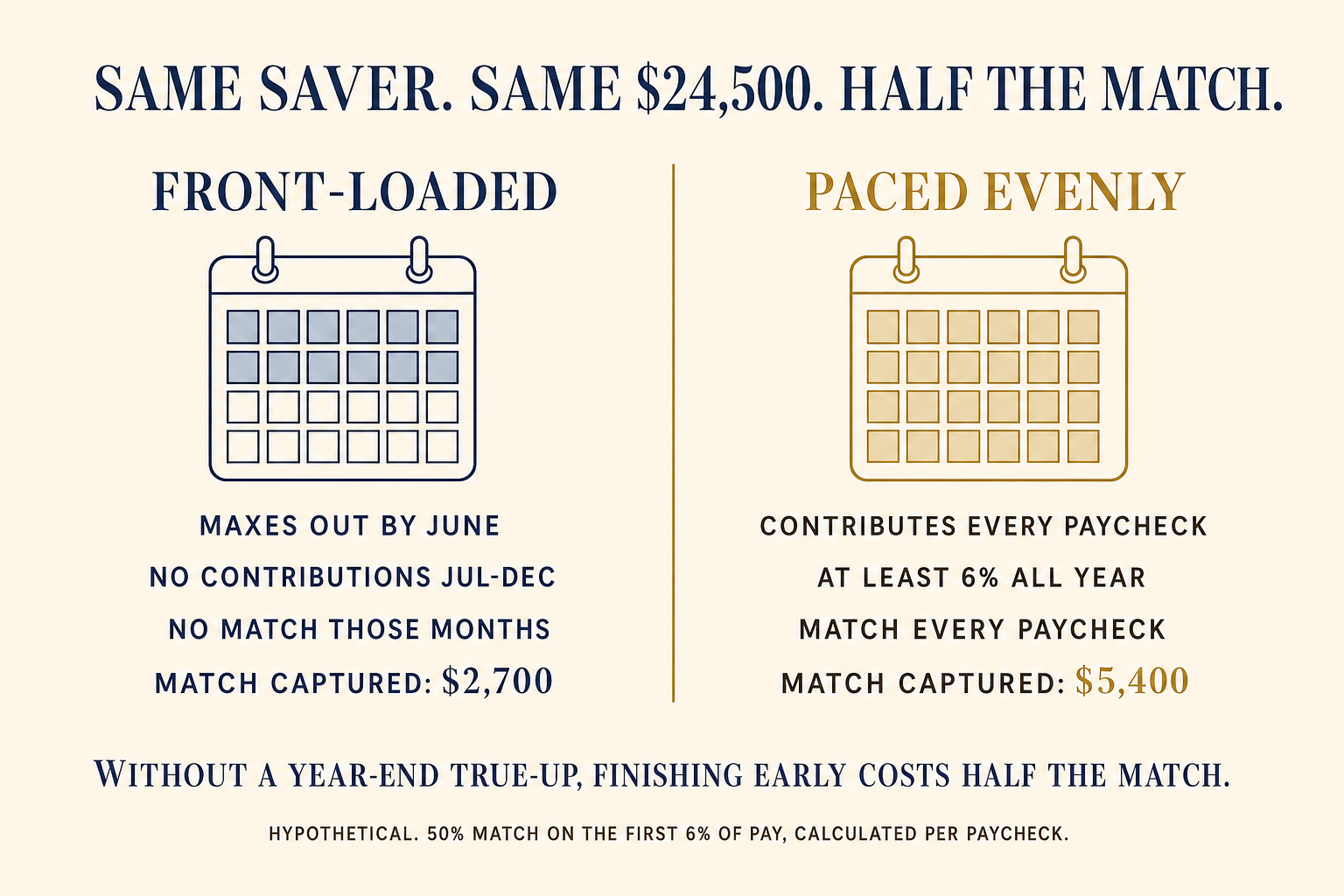
A hypothetical: how Marcus loses half his match
Consider a hypothetical case. Marcus, 48, earns $180,000 and is paid twice a month — 24 paychecks a year. His plan matches 50% of the first 6% of pay he contributes, calculated each paycheck, with no year-end true-up. Fully captured, that match is worth about $5,400 for the year.
Marcus reads that he should max out early, so he sets his deferral high and hits the $24,500 limit by the end of June. From July through December — the back half of the year, twelve paychecks — he contributes nothing, because he’s already capped. With no true-up to catch it, his employer matches nothing for those twelve paychecks.
Marcus ends the year having captured roughly $2,700 of his $5,400 match. He gave away half of it, not by contributing too little, but by finishing too early. (These figures are illustrative, not a projection.)
Had Marcus instead spread the same $24,500 evenly across all 24 paychecks — the exact same total out of his own pocket — he’d have deferred at least 6% every single paycheck and collected the full $5,400. Same saver, same contribution, same tax benefit. The only difference was the calendar.
And the $2,700 he forfeited isn’t really a $2,700 problem. Money that lands in the account in your late 40s has decades to compound before you touch it, which is why a missed match stings far more than the raw number suggests.
Thomas’s Take: The employer match is the one piece of your financial life with a guaranteed, instant payoff defined in writing. Forfeiting even a few months of it to “save faster” is the kind of mistake that wears the costume of discipline. Pace it to the finish line, not the first half of the track.
What to do before you set your contribution rate
You don’t need a spreadsheet to get this right. You need the answer to one question and a little arithmetic.
First, always contribute at least enough to capture the full match — that rule never changes. After a starter emergency fund, the match comes before almost everything else, ahead of paying down low-rate debt or funding other tax-advantaged accounts. If 6% earns the full match, 6% is your floor.
Second, ask HR or your plan administrator a single, specific question: “Does our 401(k) have a year-end true-up, or is the match calculated per paycheck?” If they’re not sure, the answer is in the Summary Plan Description under the matching contribution section.
Third, if there’s no true-up and you still want to max out, don’t sprint. Take the annual limit, divide by your number of paychecks, and set that even amount so you’re still contributing — and still being matched — on the last paycheck of December. On a 24-paycheck schedule, maxing to $24,500 works out to about $1,020 a paycheck.
When front-loading is actually smart
None of this means “never max early.” There are good reasons to front-load, and they all share one feature: no match gets lost in the process.
If your plan has a true-up, load up whenever you like — getting money invested sooner means more time in the market, and the true-up guarantees the match works out either way. If you’re planning to leave a job mid-year, front-loading lets you bank contributions while you still have access to the plan. And if your employer offers no match at all, there’s no match to forfeit, so earlier contributions simply buy you more time invested — a real, if modest, edge.
The point isn’t to slow down your saving — how much you put in does more for your balance right now than anything else. It’s to make sure the calendar doesn’t quietly cancel a benefit you already earned.
Key takeaways
- The match is guaranteed by your plan’s formula, not the market. Capturing all of it is one of the few decisions in investing with no downside.
- Many plans match per paycheck. Hit the annual contribution limit early, and the match can stop for the rest of the year.
- A “true-up” is the deciding factor. With one, front-loading is harmless. Without one, finishing early can forfeit months of match.
- If there’s no true-up, pace evenly. Annual limit divided by number of paychecks keeps you contributing — and matched — through December.
Frequently asked questions
How do I find out whether my plan has a true-up?
Check your Summary Plan Description under the employer-match section, or ask HR or your plan’s recordkeeper directly. The phrase to listen for is “annual true-up” or “match calculated on annual compensation.” If the match is calculated each pay period with no annual reconciliation, there’s no true-up.
I already maxed out early this year. Did I lose the match?
Only if your plan lacks a true-up. If it has one, the shortfall gets corrected after year-end. If it doesn’t, you can’t recover this year’s missed paychecks — but you can set an even contribution rate for next year so it doesn’t repeat.
Should I contribute less so I don’t hit the cap?
No. This is about pacing, not contributing less. You still want to reach the full limit if you can afford to — just spread across the whole year rather than sprinting to the ceiling and coasting.
The 401(k) match is one of the simplest wins in personal finance, and open enrollment is the moment you decide whether you’ll collect all of it. Ask the one question, do the one piece of arithmetic, and let the match run all the way to the last paycheck of the year. The free money is only free if you’re still there to catch it.
This article is published by Confluence Media Group LLC, an independent publisher of educational financial content. Thomas Clark is a Series 65 Investment Advisor Representative. The information provided is for educational and informational purposes only and is not personalized financial, tax, or legal advice. Past performance does not guarantee future results. All investing involves risk, including potential loss of principal. Consult a qualified professional before making financial decisions.
Confluence Media Group LLC is a separate entity from Confluence Capital Management, the investment advisory practice through which Thomas Clark provides advisory services. Advisory services are not offered through this publishing platform.
About Thomas Clark
Thomas Clark is the founder of Confluence Media Group LLC and a Series 65 Investment Advisor Representative. He has spent nearly two decades working with families on retirement planning, with a focus on Social Security optimization, retirement income coordination, and the bucket planning approach to building a guaranteed income floor.
Thomas writes and publishes at thomasclarkadvisor.com and is the author of The Just in Case Binder — a 148-page printable family financial organizer for households who want to make sure the people they love know where everything is.
He lives in North Carolina with his family.
Subscribe to the weekly newsletter · Get the Just in Case Binder

Thomas Clark is a Series 65 licensed investment advisor and experienced trader. He specializes in investing, retirement planning, and market analysis, helping individuals build wealth and make informed financial decisions.
