
Your Emergency Fund Needs Three Layers, Not One
The standard emergency fund advice, three to six months in a savings account, is wrong in two directions. Here is how to build yours in three layers matched to how fast you would actually need the cash.

The standard emergency fund advice is three to six months of expenses in a savings account. Almost everyone has heard it, and it manages to be wrong in two directions at once. For a lot of people the amount is off. For almost everyone, the bigger problem is where the money sits: one undifferentiated pile, usually earning close to nothing, when the same dollars could be working harder without giving up the safety that is the entire point of holding them.
I don’t think of an emergency fund as a number. I think of it as a set of layers, each matched to how fast you would actually need to reach the cash. Once you see it that way, the two hard questions, how much and where, get a lot easier to answer.
The problem with “three to six months in savings”
The rule of thumb survives because it’s simple, and simple is worth something. But it flattens two different questions into one. The first is how much of a cushion your situation calls for. The second is what form that cushion should take. A single savings-account balance answers neither well.
Start with the form. The average savings account in this country pays 0.38%, according to the FDIC’s published national rates. A competitive high-yield savings account right now pays around 4%. On a $30,000 reserve, that gap is roughly $1,100 a year, every year, for money you were going to hold anyway. Nobody hands you a bonus for accepting the lower number. You just have to ask for the higher one.
Now the amount. “Three to six months” treats a tenured government employee with a working spouse the same as a solo commission salesperson with an uneven income. Those are not the same risk. The right size depends on how stable your income is, how many incomes your household runs on, and how quickly you could realistically replace the one that stops. The rule of thumb is a starting point, not the answer.
Think in layers, not a lump sum
Here’s the reframe. An emergency doesn’t announce itself with a category label; it announces itself with a timeline. A flat tire needs cash today. A layoff needs cash over the next several months. A dishwasher that dies falls somewhere in between. If you match the form of your reserve to those timelines, you stop paying for liquidity you don’t need on the money you won’t touch for a while.
Three layers cover almost every case.
Layer one: the buffer (money you can touch today). This is a small cash cushion in your checking account or a linked savings account at the same bank, sized to two to four weeks of expenses. Its only job is to absorb the small, fast, unglamorous stuff, the car repair, the vet bill, the deductible, without triggering an overdraft or a credit card balance you’ll carry. It earns little, and that’s fine. You’re paying for instant access, not yield.
Layer two: the core fund (money you can reach this week). This is the bulk of the reserve, and it belongs in a high-yield savings account or a money market account. Transfers take a day or two, which is fast enough for nearly any real emergency, and the money earns a real return, around 4% at competitive online banks right now, while it waits. This is the layer most people already have; the fix is usually just moving it from a 0.38% account to a 4% one. Same safety, same FDIC insurance, ten times the yield.
Layer three: the deep reserve (money you can reach within a month). If your situation calls for a larger cushion, six months or more because your income is variable or your household runs on one paycheck, the extra doesn’t need same-week access. It can sit in short-term Treasury bills or a Treasury money market fund, or in Series I savings bonds. A four-week T-bill matures fast and is backed by the federal government; you can build a small ladder so something is always coming due. I bonds are worth knowing about here too, with two caveats: you can’t touch them for the first twelve months at all, and if you cash out before five years you forfeit the last three months of interest. That makes them a genuine deep-reserve tool, not a core-fund tool.
The point isn’t to make your emergency fund complicated. Most people live in layers one and two and never need the third. The point is that the layers let you hold more reserve without feeling like you’re burying cash in the backyard, because the money you’re least likely to need is also the money that’s earning the most.
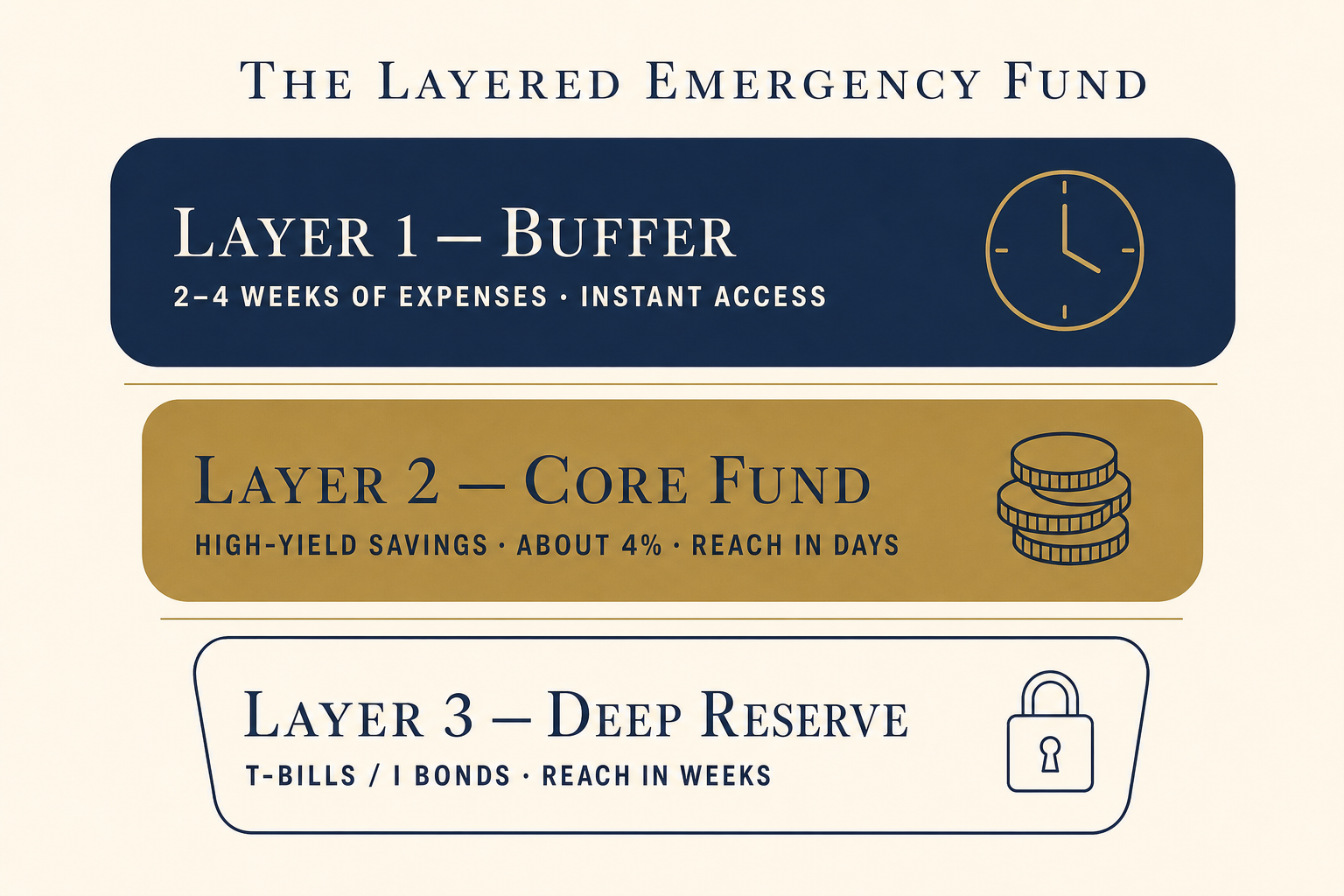
How big should each layer be
Sizing is where the honest work happens, and it comes down to how replaceable your income is.
Two stable incomes in a household is the sturdiest case; if one stops, the other keeps the lights on while you regroup, and three months of total expenses across layers one and two is often enough. A single income, or two incomes in the same industry that could dry up together, argues for more, six months or more, with the overflow in layer three. Self-employment, commission work, or a job in a cyclical field pushes the same direction. The question to sit with isn’t “what’s the rule,” it’s “if my main paycheck stopped tomorrow, how many months would it take me to replace it, and can I cover that stretch without selling investments at a bad time or reaching for a credit card?”
Consider a hypothetical case. Maya, 34, is a marketing manager earning a steady salary; her partner works too. Their monthly expenses run about $5,000. Because they have two stable incomes, they hold a $1,500 buffer in checking (layer one) and $13,500 in a high-yield savings account (layer two), roughly three months combined. They skip layer three entirely, because their income is stable enough that they’d never need to reach past the core fund. If Maya instead freelanced with an income that swung month to month, the same $15,000 might sit in layers one and two while another $15,000 rode in a short T-bill ladder, giving her six months of coverage without leaving all of it in cash.
Those figures are illustrative, not a recommendation for any particular household.
Where to actually keep each layer
The mechanics are simpler than they sound. Layer one stays at your primary bank, because access beats yield for two weeks of expenses. Layer two goes into a high-yield savings or money market account, where roughly 4% is available today and the money is still one transfer away. Layer three, if you need it, is the place for short-term Treasuries, a Treasury money market fund, or I bonds, all of which trade a little liquidity for federal backing and, in the case of Treasuries, exemption from state income tax.
One caution worth stating plainly: yields move. The 4% available today is not a promise about next year. Rates on savings accounts, money market funds, and T-bills all drift with the Fed, and they can fall as easily as they rose. That’s an argument for layering, not against it. When you’re not depending on any single instrument to do everything, a rate change in one place is an adjustment, not a problem.
Thomas’ Take: The emergency fund isn’t really about the number. It’s about matching the speed of your money to the speed of the need. Get that right and you can hold a larger, better-earning reserve while worrying about it less, which is the whole game.
The retirement version of the same idea
If layering sounds familiar to longtime readers, it should. It’s the same logic that runs my Now bucket in retirement: a floor of safe, liquid money so you never have to sell growth assets during a downturn to cover a bill. In your working years, the emergency fund is what protects your long-term investments from being raided by short-term life. In retirement, the Now bucket does the same job under a different name. The instinct behind both, keep the money you might need soon out of the reach of the money that needs decades to grow, is one of the most durable ideas in personal finance. It’s also why your savings rate matters more than your returns while you’re building, and why the order you fund things in is worth getting right.
Key takeaways
- An emergency fund is a set of layers, not a single balance. Match each layer to how fast you’d need the cash.
- Layer one is a two-to-four-week buffer at your primary bank for instant access. Layer two, the core, belongs in a high-yield savings or money market account earning a real return. Layer three, only if your income is variable or single, can sit in short-term Treasuries or I bonds.
- The average savings account pays 0.38%; a competitive high-yield account pays around 4%. Moving your core fund is often the single highest-value hour of financial housekeeping you can do.
- Size the whole thing by how replaceable your income is, not by a fixed rule of thumb.
- Yields change. Layering means no single rate move can undo your plan.
Frequently asked questions
Should I invest my emergency fund to get a better return?
No. The job of this money is to be there, in full, on the day you need it, without depending on what the market did that week. Stocks can be down 20% exactly when you get laid off, which is precisely when both would hit. Keep the emergency fund safe and let your long-term money take the market risk.
If I have a credit card or a home equity line, do I even need an emergency fund?
Those are backups, not a substitute. A credit line can be cut, frozen, or repriced, and it’s often reduced right when the broader economy is stressed and you’re most likely to need it. Borrowed money also comes with interest. Cash you already hold has neither problem.
Are I bonds a good place for an emergency fund?
For the deep-reserve layer, they can be, with eyes open. You cannot redeem an I bond for the first twelve months, and cashing out before five years costs you the last three months of interest. That makes them unsuitable for money you might need this week, but reasonable for the overflow layer you’re unlikely to touch.
The version of an emergency fund most people carry, a single lump sum earning almost nothing, is the version that makes it feel like dead weight. Layered, matched to real timelines, and earning a real return on the part you won’t touch soon, it stops being dead weight and starts being what it was always supposed to be: the thing that lets the rest of your money stay invested and do its work, no matter what the month throws at you.
This article is published by Confluence Media Group LLC, an independent publisher of educational financial content. Thomas Clark is a Series 65 Investment Advisor Representative. The information provided is for educational and informational purposes only and is not personalized financial, tax, or legal advice. Past performance does not guarantee future results. All investing involves risk, including potential loss of principal. Consult a qualified professional before making financial decisions.
Confluence Media Group LLC is a separate entity from Confluence Capital Management, the investment advisory practice through which Thomas Clark provides advisory services. Advisory services are not offered through this publishing platform.
About Thomas Clark
Thomas Clark is the founder of Confluence Media Group LLC and a Series 65 Investment Advisor Representative. He has spent nearly two decades working with families on retirement planning, with a focus on Social Security optimization, retirement income coordination, and the bucket planning approach to building a guaranteed income floor.
Thomas writes and publishes at thomasclarkadvisor.com and is the author of The Just in Case Binder — a 148-page printable family financial organizer for households who want to make sure the people they love know where everything is.
He lives in North Carolina with his family.
Subscribe to the weekly newsletter · Get the Just in Case Binder

Thomas Clark is a Series 65 licensed investment advisor and experienced trader. He specializes in investing, retirement planning, and market analysis, helping individuals build wealth and make informed financial decisions.
