
Annuities, Explained: The Four Types and What Each Is For
“Annuity” isn’t one product — it’s four very different ones, and judging them as a single group is how people end up in the wrong one. Here’s what immediate, fixed, fixed index, and variable annuities each actually do, and the one question that tells you whether any of them belongs in your plan.

You have probably been on both ends of the annuity conversation. Somewhere, in a hotel ballroom over a free steak dinner, someone pitched an annuity as the answer to every retirement worry you have. And somewhere else — a headline, a podcast, a brother-in-law — someone told you annuities are a rip-off you should never touch. Here is the problem: they were talking about completely different products and using the same word.
“Annuity” is not one thing. It is a legal wrapper — a contract with an insurance company — and four very different products hide underneath it. A couple of them are among the most useful tools in retirement. One of them I think most retirees should walk right past. Judging them as a single group is like judging “vehicles”: a bicycle and a dump truck share a category and almost nothing else.
Here are the four types in plain language, what each one is actually built to do, and the single question that tells you whether any annuity belongs in your plan.
First, what an annuity actually is
An annuity is a contract. You hand an insurance company money, and in return it promises to pay money back to you under a defined set of rules. That is the whole idea. Everything else — when it pays, how the money grows in the meantime, what is guaranteed and what is not — depends entirely on which of the four types you are holding.
One thing is true of all of them: the guarantees are only ever as strong as the insurer’s ability to pay its claims. There is no FDIC backstop here. So the financial strength of the company writing the contract matters just as much as the features printed in the brochure. Ratings from firms like AM Best and Standard & Poor’s exist for exactly this reason, and they are worth checking before you sign anything.
Type 1: The immediate annuity — a paycheck for life
An immediate annuity — the industry calls it a SPIA, for single premium immediate annuity — is the oldest and simplest form. You hand over a lump sum, and starting almost right away the insurer sends you a fixed check every month for the rest of your life. Choose the joint version and it pays as long as either you or your spouse is living.
You are not investing here. You are buying longevity insurance — protection against the one risk you genuinely cannot diversify away, which is living a long time and outliving your money. The SEC’s investor education site describes this pooling of longevity risk as the core function of an income annuity, and it is a real one.
The honest tradeoffs: you generally give up access to that lump sum once you annuitize, and a plain-vanilla contract does not adjust for inflation unless you pay for that feature — which lowers your starting check. That is why a SPIA is a tool for a slice of your money, never all of it. It quietly does an important job and pays no one a large commission, which is roughly why you hear about it the least.
Type 2: The fixed annuity — a CD from an insurance company
A fixed annuity — often sold as a multi-year guaranteed annuity, or MYGA — pays a set interest rate for a fixed term of, say, three, five, or seven years. Think of it as a bank CD issued by an insurer instead of a bank, with the added feature that it grows tax-deferred until you withdraw. Simple, predictable, no market exposure.
The tradeoffs are just as simple: your money is locked up for the term, with surrender charges if you need out early, and the rate is whatever it is. A fixed annuity competes directly with CDs, Treasurys, and high-yield savings, so compare it head-to-head on rate, term, and the insurer’s strength. With short-term rates where they have been lately, the gap between a MYGA and a plain T-bill or CD ladder is often narrower than the sales pitch makes it sound.
Type 3: The fixed index annuity — an income tool, not a growth engine
A fixed index annuity (FIA) protects your principal from market losses while crediting a return that is linked to a market index like the S&P 500 — but capped. Through what the contract calls participation rates and rate caps, you get some of the index’s gain in a good year and none of its loss in a bad one. That “upside without the downside” framing sounds like the best of both worlds, and that is precisely how the product gets oversold.
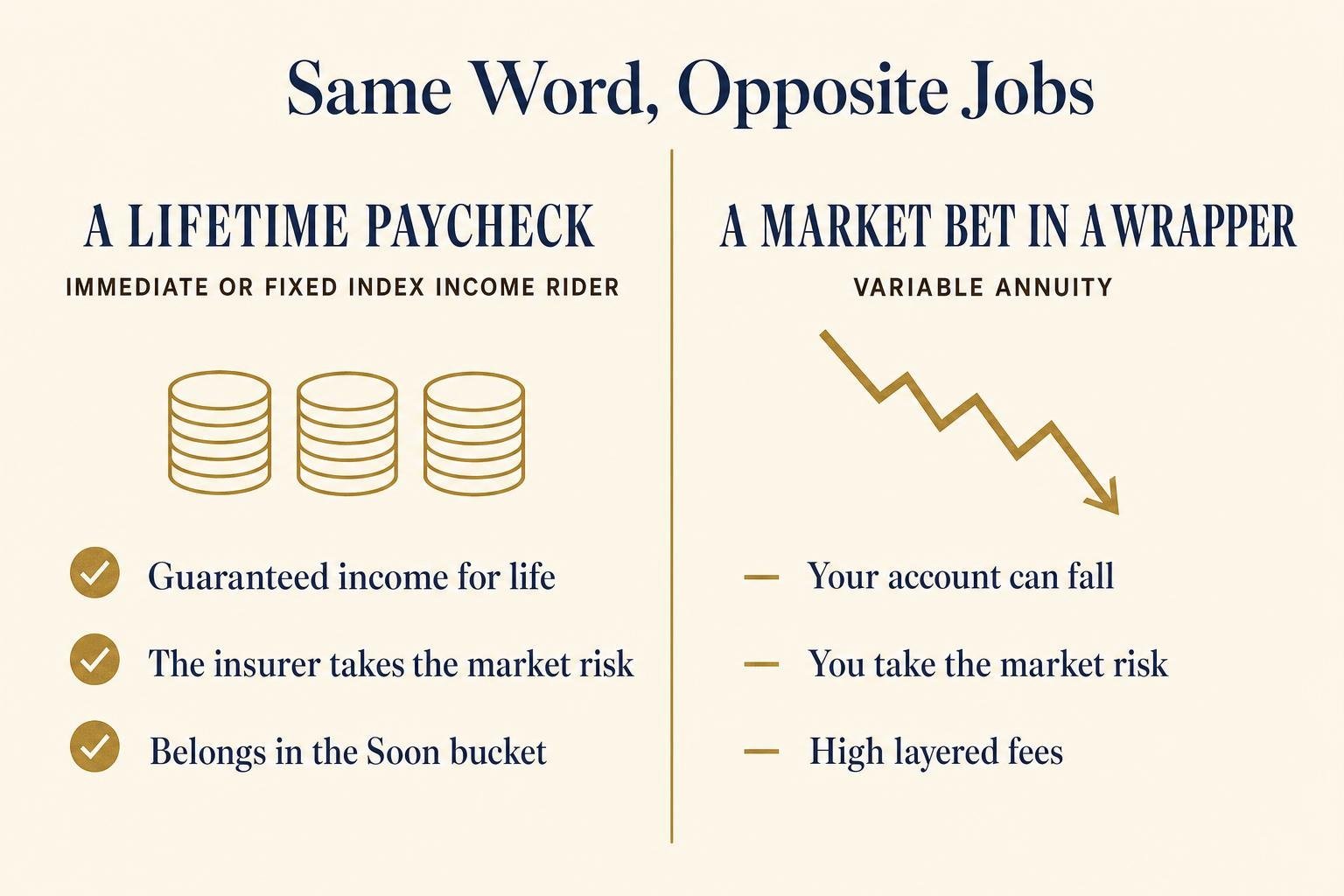
Here is a stance you will not hear from the person selling it: I do not think of a fixed index annuity as a growth investment, and neither should you. The caps are the price you pay for the protection, and over long stretches they cause these contracts to trail a diversified stock portfolio. That is not a flaw — it is the deal. Where an FIA genuinely earns its place is the optional income rider: a feature that guarantees a lifetime income stream you can switch on later, regardless of what the index does, as defined by the contract.
That makes an FIA a Soon-bucket tool — a way to manufacture a private pension when you do not have one — and not a substitute for the growth engine in your portfolio. Judge it entirely on the strength and terms of that income guarantee. Read how the rider actually calculates and pays. And mentally throw the “market upside” brochure language in the trash, because it is not why you would ever want one.
Type 4: The variable annuity — the one I’d walk past
In a variable annuity (VA), your money goes into subaccounts that behave like mutual funds. That means you take real market risk — the account can and does fall — inside an insurance wrapper that layers fees on top: mortality-and-expense charges, administrative fees, the underlying subaccount fund fees, and frequently a rider fee as well. It is common for the all-in cost to run well north of 2% a year, and sometimes past 3%. The FINRA investor education pages spell out these stacked charges in detail, and they add up.
This is the type I think most retirees should walk past. You are paying insurance-level fees for market risk you could take far more cheaply and flexibly in an ordinary brokerage account. The guarantees that are supposed to justify the cost usually attach to a death benefit or to income riders whose fees quietly erode the very account they are meant to protect. A variable annuity tries to be the growth bucket and the safety bucket at the same time, and ends up doing neither job well — which is the opposite of what a plan built to survive a bad market is supposed to do.
If you were sold one years ago — a great many people were — that is a separate and more delicate question. Surrender charges and tax consequences mean unwinding a variable annuity is rarely a snap decision, and it is worth walking through carefully before you touch it, ideally with someone who is not paid a commission on the answer.
The one question that sorts all four
Forget the labels on the brochure. Ask what job the money is doing. In the bucket planning framework, every dollar you own belongs to one of three buckets: Now (cash for near-term spending), Soon (your guaranteed income floor), and Later (long-term market growth). Annuities only ever compete for one of them — the Soon bucket. That single test does most of the work for you:
- Is it creating guaranteed lifetime income — a SPIA, or an FIA with an income rider? Then it is a legitimate Soon-bucket candidate, and you judge it on the income guarantee.
- Is it a place to park safe money for a few years — a fixed MYGA? Then maybe, but only after you have compared it head-to-head with CDs and Treasurys.
- Is it being sold as market growth with a safety net — a variable annuity, or an FIA pitched on its “upside”? Then it is trying to do a Later-bucket job, and an annuity is an expensive, tax-inefficient way to do it.
And before you buy any of them, remember that the best inflation-adjusted lifetime annuity most people will ever have access to is delaying Social Security. It is a guaranteed, government-backed, cost-of-living-adjusted income stream that you “buy” simply by waiting to claim. Fill that floor first. It is almost always the cheapest guaranteed income you will ever find.
A hypothetical to make it concrete
Consider a hypothetical couple: David and Susan, both 66, recently retired outside Charlotte. They have about $800,000 across their retirement accounts, a paid-off house, and roughly $5,200 a month in essential expenses. Once they claim, Social Security will cover about $3,800 of that. An advisor shows them a variable annuity promising “market growth with downside protection” for an all-in cost somewhere north of 3% a year.
Look at the mismatch. David and Susan do not have a growth problem — they have a roughly $1,400 monthly gap between their guaranteed income and their essential bills. The variable annuity’s expensive market bet does nothing for that gap. It simply loads on market risk they do not need to take and charges them handsomely for the privilege. The tool that actually fits their problem is a modest income layer — a slice of the $800,000 converted into guaranteed lifetime income through a SPIA or an FIA income rider, sized to cover that $1,400 — with the rest left invested for growth in the Later bucket. Same word on the brochure, completely different job. The product that fit was cheaper and a lot less exciting than the one being sold.
Sizing that gap is where the real decision lives, and it is easy to get wrong by eyeballing it. A planning tool like ProjectionLab lets you model how much guaranteed income your plan actually needs — and how a small annuity layer, delayed Social Security, and your investment accounts fit together — before you ever hand money to an insurance company.
Disclosure: the ProjectionLab link above is an affiliate link. If you subscribe through it, Confluence Media Group may earn a commission at no additional cost to you. I only point readers to tools I’d use myself.
The bottom line
Annuities are not good or bad. They are specific. One is a straightforward lifetime paycheck. One is a tax-deferred CD. One is an income tool wearing a growth costume. And one is a growth costume wearing an income tool — the one to be most skeptical of. The salesperson wants you to react to the word. Your plan cares only about the job. Get clear on the job first — the gap between your guaranteed income and your essential expenses — and the question of whether you need an annuity at all, and which one, mostly answers itself.
This article is published by Confluence Media Group LLC, an independent publisher of educational financial content. Thomas Clark is a Series 65 Investment Advisor Representative. The information provided is for educational and informational purposes only and is not personalized financial, tax, or legal advice. Past performance does not guarantee future results. All investing involves risk, including potential loss of principal. Consult a qualified professional before making financial decisions.
Confluence Media Group LLC is a separate entity from Confluence Capital Management, the investment advisory practice through which Thomas Clark provides advisory services. Advisory services are not offered through this publishing platform.
About Thomas Clark
Thomas Clark is the founder of Confluence Media Group LLC and a Series 65 Investment Advisor Representative. He has spent nearly two decades working with families on retirement planning, with a focus on Social Security optimization, retirement income coordination, and the bucket planning approach to building a guaranteed income floor.
Thomas writes and publishes at thomasclarkadvisor.com and is the author of The Just in Case Binder — a 148-page printable family financial organizer for households who want to make sure the people they love know where everything is.
He lives in North Carolina with his family.
Subscribe to the weekly newsletter · Get the Just in Case Binder

Thomas Clark is a Series 65 licensed investment advisor and experienced trader. He specializes in investing, retirement planning, and market analysis, helping individuals build wealth and make informed financial decisions.
