
Bond Duration, Explained: Why Rising Rates Hurt Bond Funds
In 2022, “safe” bond funds had their worst year on record, and the reason was one number almost no one checks: duration. Here’s how duration works, why a bond fund isn’t the same as a bond, and how to match it to your buckets so a rate move can never force you to sell at a loss.

In 2022, the safest-sounding part of millions of retirement portfolios had its worst year in the entire history of the index that tracks it. The broad U.S. bond market fell about 13% — a market people had been told for decades was the place you go to be safe. Nobody sold these folks a risky product. They owned a plain-vanilla bond fund. What they didn’t own was an understanding of one number: duration.
That number is printed on a document you can pull up in thirty seconds, yet almost no one looks at it before they buy — and it’s the single best predictor of how much a bond fund can hurt you. Let’s fix that: what duration is, why “safe” bonds fell in 2022, and how to make sure a rate move can never force you to sell your money at a loss.
The seesaw nobody explains when they sell you a bond fund
Start with what a bond actually is. It’s a loan. You hand over your money, you collect a fixed interest payment along the way (the coupon), and you get your principal back on a stated date (maturity). Simple enough.
Here’s the part that trips people up. Once a bond has been issued, its price trades up and down every day — and it moves in the opposite direction of interest rates. When rates rise, the price of existing bonds falls. When rates fall, existing bond prices rise. It’s a seesaw, and it’s mechanical, not emotional.
Why? Imagine you own a bond paying 3% and new bonds start being issued at 5%. Nobody wants your 3% bond at full price, so the only way to sell it is to knock the price down until its yield matches the new 5%. Your income didn’t change; the market value of the loan did. That’s interest rate risk, and it’s baked into every bond and bond fund on the planet.
Duration — the one number that tells you how much it hurts
Duration is the measure of how sensitive a bond, or a bond fund, is to a change in interest rates. You don’t need the underlying math. You need the rule of thumb, and it’s this:
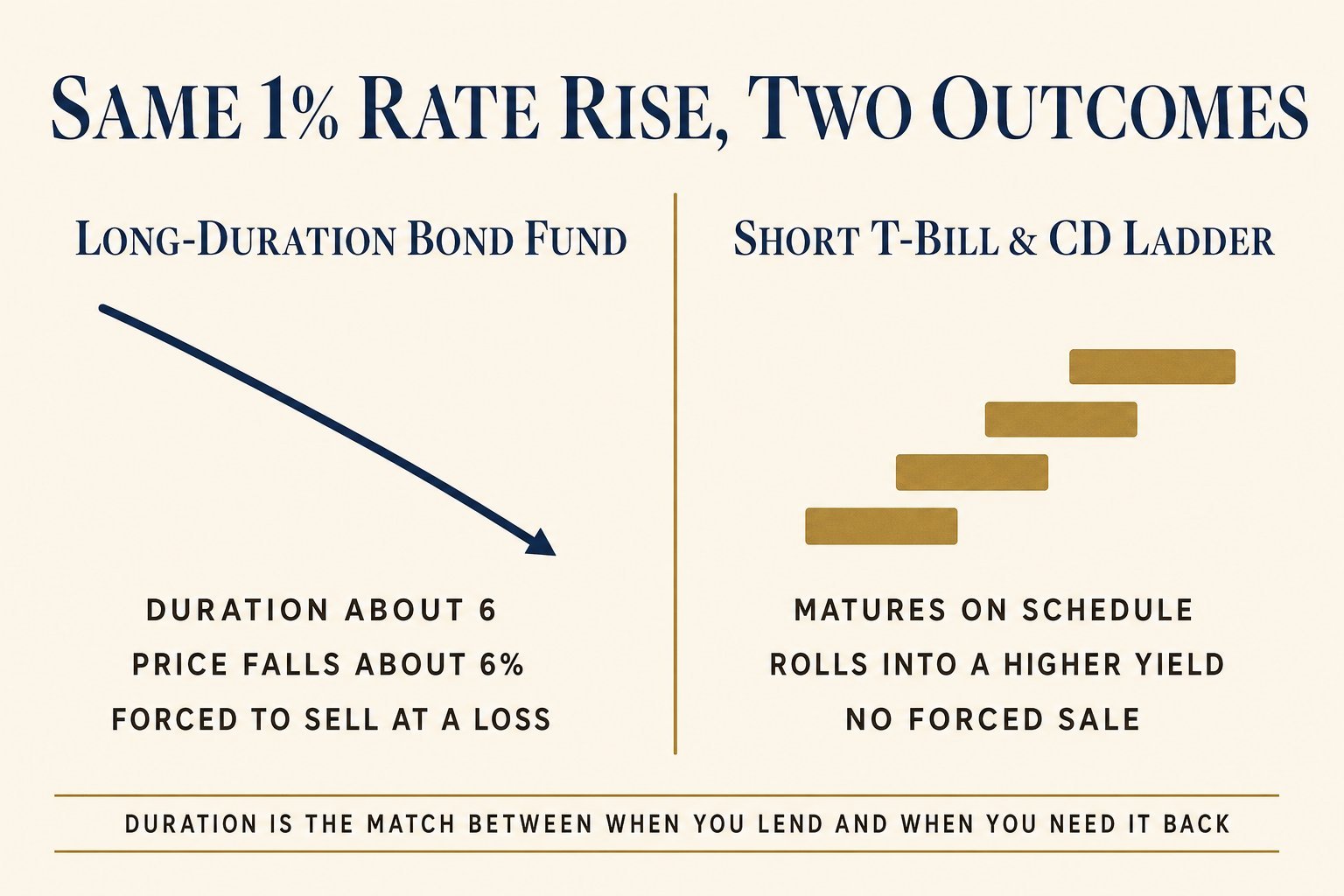
A fund with a duration of 6 will lose roughly 6% of its value if interest rates rise one percentage point — and gain roughly 6% if rates fall one point. A duration of 2? Roughly 2% either way. The higher the duration, the harder the seesaw tips. FINRA lays this out plainly for anyone who wants the longer version.
Now go back to 2022. A typical “total bond market” fund carried a duration somewhere around 6. When the Federal Reserve raised rates faster than it had in four decades, that duration-6 math played out in real accounts, and a fund people treated like a savings account dropped double digits. It wasn’t a defective product. It did exactly what a duration-6 fund is built to do when rates jump.
Pro Tip: Before you buy any bond fund, find its average duration on the fact sheet — it’s usually listed under “Portfolio Data” or “Key Facts” on the fund company’s site. Multiply that number by one. That’s roughly what you’d lose if rates rose a point, and roughly what you’d gain if they fell one. If that figure makes you wince, the fund is longer than your stomach.
A bond fund is not the same thing as a bond
This is the distinction most articles skip, and it changes everything.
If you buy an individual bond and hold it to maturity, you get your principal back on the maturity date no matter what rates did in between (barring a default). The price swing along the way is real, but it’s temporary — it disappears the day the bond matures and pays you back at face value. You have an escape hatch: just wait.
A bond fund never matures. It holds a rolling basket of hundreds of bonds and is constantly buying new ones and selling old ones. There is no date when the fund “comes back to par.” So a paper loss from a rate spike becomes a very real loss the moment you have to sell shares to raise cash — the same forced-selling trap I’ve written about with stocks and sequence-of-returns risk. Sell into the dip and you’ve turned a temporary swing into a permanent haircut.
Neither tool is wrong. An individual bond or CD held to a date you chose has a built-in “hold to maturity” exit. A bond fund gives you diversification and convenience but no maturity date to hide behind. The trouble starts when you use one as if it were the other.
Higher for longer — the good news hiding in the bad
Here’s where the 2026 backdrop matters. The Fed has held its policy rate at 3.50%–3.75% through every meeting this year under Chair Kevin Warsh, with a distinctly hawkish tilt — some officials are openly floating another hike, and the next meeting lands July 28–29. The 10-year Treasury has been sitting around 4.5%. You can check the current numbers yourself on the Fed’s H.15 release.
Duration cuts both ways, and this is the part the “bonds are scary now” crowd leaves out: higher rates bruised the bonds you already owned, but they mean every new dollar you put into bonds earns more than it has in fifteen years. A retiree buying bonds today is finally being paid a real yield to lend money — something that simply wasn’t true for most of the last decade.
Thomas’ Take: For most of the 2010s, bonds paid next to nothing, so to squeeze out yield people reached into longer maturities and shakier credit. That was the actual risk — not the bond, the reach. Today you can earn a genuine yield without stretching. The same environment that punished bond holders in 2022 is the one paying bond buyers in 2026. The instrument didn’t get more dangerous; the price of admission changed.
Match the duration to the job
The fix isn’t to swear off bonds. It’s to stop owning the wrong duration in the wrong place. This is where my Now, Soon, and Later bucket framework does the heavy lifting, because each bucket wants a different duration.
The Now bucket holds money you’ll spend in the next one to three years, and it wants short duration only: Treasury bills, short CDs, money market funds. A rate move can’t force a loss here, because each holding matures before the swing matters. This is exactly why I’ve argued that cash finally pays — the Now bucket’s job is safety and liquidity, not reaching for yield.
The Soon bucket, your guaranteed income floor, isn’t a bond fund’s job at all. That floor comes from Social Security, a pension, and, where it fits, an income-focused annuity. Guaranteed income is a contract with a defined payment; it doesn’t reprice when the Fed moves. Don’t ask a bond fund to be your income floor. It can’t sign that contract.
The Later bucket, money you won’t touch for a decade or more, is where longer-duration bonds can legitimately live as ballast against your stocks. Because you’re not selling them next year, the interim price swing is noise, not damage. You have the one thing the seesaw requires: time to let it settle — the same reason the Later bucket can carry real risk at all.
The whole rule reduces to one sentence: lend for only as long as you can afford to wait for the money back. Duration should match your time horizon — not your yield target.
Same bonds, two very different retirements
Consider a hypothetical case. Nadia, 66, just retired outside Charlotte with $700,000 saved and a paid-off house. She figures she needs about $30,000 a year from her portfolio on top of Social Security.
In version one, a well-meaning tip tells her to “get conservative — just put it all in a total bond fund.” That fund has a duration of about 6. Rates rise a single point during her first year of retirement. Her “safe” money is now down roughly 6%, about $42,000, precisely as she needs to start drawing $30,000. To pay herself, she sells fund shares at a loss. The fund didn’t malfunction. A duration-6 fund did what a duration-6 fund does.
In version two, she matches the same $700,000 to the job. About $90,000 (three years of the gap between her income and her spending) goes into the Now bucket in T-bills and short CDs laddered across staggered maturities. The rest stays in a diversified Later bucket she has no reason to sell this year. When that same rate hike hits, her Now bucket doesn’t care: each rung matures on schedule and she rolls the next into a higher yield. Same interest-rate move — one version forces a sale at a loss, the other collects a raise.
The difference wasn’t the market, and it wasn’t luck. It was whether the duration of her money matched the day she needed it.
What to actually do this week
You don’t need to become a bond trader. You need to do four things:
- Find the duration of every bond fund you own. It’s on the fact sheet, under “Portfolio Data” or “Key Facts.” Thirty seconds tells you how much a 1% rate move would swing your “safe” money.
- Keep short money short. For anything you’ll spend in the next few years, favor short duration — or own individual T-bills and CDs with maturity dates you choose, so you always have the hold-to-maturity exit.
- Let long money be long. For money a decade or more out, a longer duration is fine. You have time to let the seesaw settle, and you’re being paid more to wait than you have been in years.
- Stop treating “bond” as a synonym for “safe.” Safe is a match between how long you’re lending and when you need the money back — nothing more.
If you want to see how a rate move would actually land on your plan, and how much of your money belongs short versus long, that’s exactly the kind of thing a modeling tool like ProjectionLab lets you test before you commit a dollar. You can map your buckets, run different rate scenarios, and watch what happens to each one.
Disclosure: The ProjectionLab link above is an affiliate link. If you subscribe through it, Confluence Media Group may earn a commission at no additional cost to you. I only point readers toward tools I think are genuinely worth their time.
A bond isn’t safe because it’s a bond. It’s safe when the day you get your money back lines up with the day you need it. Get those two dates to agree, and interest rates stop being something that happens to you — and start being something you’re paid for.
Frequently asked questions
Should I sell my bond fund because rates might rise again?
Reacting to a forecast is its own risk — nobody reliably knows the Fed’s next move. The better question is whether the fund’s duration matches when you’ll need that money. If it’s short money in a long-duration fund, that’s a mismatch worth fixing regardless of what rates do next. If it’s long-horizon money, the swings are noise you have time to ride out.
Are individual bonds safer than bond funds?
Not safer — different. An individual bond gives you a maturity date and a hold-to-maturity exit, which matters a lot for money you need on a schedule. A bond fund gives you diversification and convenience but no maturity date. For a Now-bucket ladder, the individual-bond structure is often the better fit; for long-term ballast, a fund is perfectly reasonable.
This article is published by Confluence Media Group LLC, an independent publisher of educational financial content. Thomas Clark is a Series 65 Investment Advisor Representative. The information provided is for educational and informational purposes only and is not personalized financial, tax, or legal advice. Past performance does not guarantee future results. All investing involves risk, including potential loss of principal. Consult a qualified professional before making financial decisions.
Confluence Media Group LLC is a separate entity from Confluence Capital Management, the investment advisory practice through which Thomas Clark provides advisory services. Advisory services are not offered through this publishing platform.
About Thomas Clark
Thomas Clark is the founder of Confluence Media Group LLC and a Series 65 Investment Advisor Representative. He has spent nearly two decades working with families on retirement planning, with a focus on Social Security optimization, retirement income coordination, and the bucket planning approach to building a guaranteed income floor.
Thomas writes and publishes at thomasclarkadvisor.com and is the author of The Just in Case Binder — a 148-page printable family financial organizer for households who want to make sure the people they love know where everything is.
He lives in North Carolina with his family.
Subscribe to the weekly newsletter · Get the Just in Case Binder

Thomas Clark is a Series 65 licensed investment advisor and experienced trader. He specializes in investing, retirement planning, and market analysis, helping individuals build wealth and make informed financial decisions.
