
Delaying Social Security? Don’t Trip at the Finish Line
Delaying Social Security to 70 earns a guaranteed 8% raise every year, but two lesser-known SSA rules at the finish line can quietly shrink the bigger check. Here is how to protect it when you file.

You did the hard part. You looked at the numbers, decided to wait, and left Social Security alone while your benefit grew. Every month past your full retirement age added to the check you’ll collect for the rest of your life.
Then you reach the finish line — the day you actually file — and the rules shift under you. The Social Security Administration will offer you things that sound like gifts. A few of them quietly hand back a piece of the raise you spent years earning.
Delaying is simple. Filing is where people trip. Here are the three things to get right at the finish line, so the bigger check you waited for is the one you actually keep.
The raise you’re actually earning by waiting
Between full retirement age and 70, Social Security grows your benefit by two-thirds of one percent for every month you wait. That works out to 8% a year, and it isn’t a market return or a projection — it’s written into the law as a delayed retirement credit. For anyone born in 1960 or later, full retirement age is 67, so waiting all the way to 70 raises your monthly benefit by 24%.
Then every cost-of-living adjustment compounds on that larger number. A 24% bigger base means every future COLA is 24% bigger too, for life. There is no other place in a retirement plan where you can buy a guaranteed, inflation-adjusted raise like that. That’s why, when there’s no health or income reason to claim early, delaying is usually the most powerful lever a retiree has — and why the break-even age is the wrong question to obsess over.
This is also why the finish line matters so much. You’re not protecting a number on a statement. You’re protecting the size of your Soon-bucket income floor — the guaranteed money that covers your essential bills no matter what the market does. If you want the mechanics of how that base benefit is built in the first place, I walked through it in how your benefit is actually calculated.
Trap #1 — The “free” six-month check that isn’t free
When you finally apply after full retirement age, the SSA may offer you a lump sum: up to six months of back payments, paid all at once. On a $3,000 benefit, that’s around $18,000 landing in your account. It feels like a bonus for being patient.
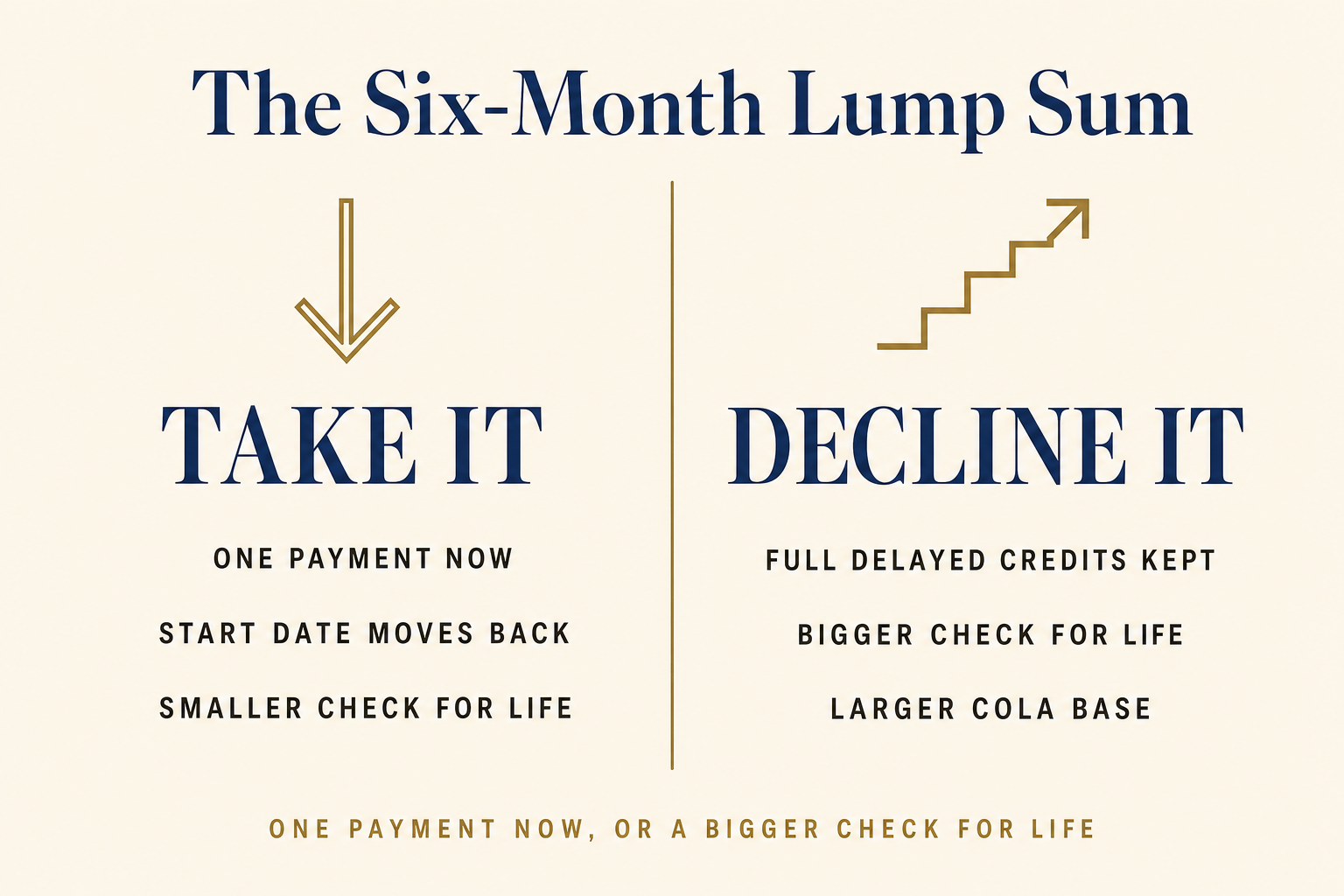
It isn’t. Social Security can only pay retroactive benefits back as far as your full retirement age, and taking that lump sum resets your official start date backward by up to six months. Those months stop counting as “delayed.” You forfeit the credits you earned in that window — roughly 4% of your monthly benefit — permanently. Every check for the rest of your life is smaller, and so is every future COLA built on it.
So the real trade is this: you take one lump sum today in exchange for a smaller check every month for as long as you live. For most people who deliberately waited, that’s exactly backwards. You spent years buying a bigger guaranteed raise; the lump sum sells a chunk of it back at a discount. If you delayed on purpose, the answer is usually to decline the retroactive offer and start your benefit as of the month you actually file.
There’s a narrow exception. If a health change or a cash crunch means you now wish you’d claimed earlier, the lump sum is a reasonable way to capture some of that. But that’s a reversal of your original plan, not a bonus stacked on top of it.
Thomas’s Take: The SSA isn’t doing anything sneaky here — the lump sum is a legitimate option, and for someone who changed their mind it’s genuinely useful. But it’s presented like a reward, and it reads like one. Anyone who delayed on purpose should treat that offer as a question, not a gift: do I want a permanently smaller guaranteed check in exchange for one payment now? Usually the answer is no.
Trap #2 — Why your first checks may look too small
Here’s the one that sends people into a panic, and sometimes into claiming too early the next time around. If you start your benefit before 70, some of the delayed retirement credits you earned aren’t applied right away. The credits for the months you delayed during the year you file generally aren’t posted until the following January.
In plain terms: your first several checks can come in lower than the number you were promised. Then, the next January, the SSA recalculates, trues it up, and in many cases pays the difference back to your start date.
Nothing is actually lost. It’s a timing quirk in how the agency posts the credits, not a cut to your benefit. But if you don’t know it’s coming, a first check that looks 4% or 5% light can feel like a mistake or a broken promise. Don’t let it rattle you, and don’t assume the smaller number is permanent. If your benefit still looks wrong after that first January, that’s the moment to call the SSA — not before.
Trap #3 — Waiting past 70 earns you nothing
Delayed retirement credits stop the month you turn 70. There is no bonus for 71, none for 72. Every month you leave your benefit unclaimed after 70 is a month of guaranteed income you simply gave up and will never get back.
People miss this for understandable reasons. They’ve gotten comfortable living without the check, they’re still working and don’t feel they need it, or they’re vaguely worried about the taxes a larger check might trigger. None of that changes the math: past 70, the raise is over, and waiting only costs you.
The clean rule is to claim your benefit effective the month you turn 70. Because 70 is well past your full retirement age, you can even file a little late and still collect back to your 70th birthday without penalty. What you should not do is treat 70 as a soft deadline and drift past it. Put it on the calendar the same way you’d mark a required minimum distribution.
A hypothetical at the finish line
Consider a hypothetical case: Margaret, 68, retired two years ago and has been living on her Now bucket while her Social Security grew. Her benefit at full retirement age would have been about $2,600 a month; by waiting to 68, it has grown to roughly $2,810.
She files, and the representative offers her six months of retroactive benefits — around $16,000 in a single payment. On paper it’s tempting. But taking it would push her start date back toward age 67 and a half, erasing much of the credit she waited for. Her monthly benefit would slip back toward $2,700 and stay there for life, and every COLA afterward would build on the smaller number.
Margaret declines the lump sum, starts her benefit as of the month she files, and makes a note to expect her first few checks to run a little light until the following January. She waited on purpose. At the finish line, she protected what the waiting bought.
These figures are hypothetical and rounded for illustration.
The finish line is a bucket decision
Delaying Social Security was never really about beating a break-even age. It’s about buying the largest guaranteed, inflation-adjusted income stream available to you — the anchor of your Soon bucket, the money that pays your essential bills for life. That’s the whole point of the Now, Soon, Later framework, and it’s why sizing that income floor matters more than almost any other number in your plan. Everything above the floor is what your Later bucket is for.
So the day you file deserves as much attention as the decision to wait. The credits, the lump-sum question, the January timing, the hard stop at 70 — these are the mechanics that decide how big your floor actually ends up. Get the finish line right, and the check you spent years growing is the check you get to keep.
Key takeaways
- Waiting past full retirement age earns 8% a year. From 67 to 70, that’s a 24% larger benefit for life, and every future COLA compounds on the bigger base.
- The six-month retroactive lump sum usually isn’t a bonus. It resets your start date backward and permanently shrinks your monthly check. If you delayed on purpose, it’s usually right to decline it.
- Your first checks may look small — that’s a timing quirk, not a cut. Delayed credits earned in your filing year are applied the following January, then trued up.
- Delayed credits stop at 70. Waiting longer earns nothing; claim effective the month you turn 70.
- The bigger check is your income floor. Protecting it at the finish line protects the guaranteed money that covers your essential expenses.
Frequently asked questions
Should I ever take the six-month lump sum?
It makes sense mainly if your circumstances changed and you now wish you’d claimed earlier — a health issue, or a genuine need for cash. As a “reward” for someone who deliberately delayed, it works against you: you trade a permanently smaller check for one payment today.
My first Social Security check was lower than my statement said. Did I make a mistake?
Probably not. If you filed before 70, some delayed credits aren’t posted until the January after you start. The agency typically recalculates then and pays the difference back to your start date. If it still looks wrong after that January, contact the SSA directly.
Is there any reason to wait past 70?
No. Delayed retirement credits end at 70. Claim your benefit effective the month you turn 70 — waiting longer only forfeits guaranteed income you can’t recover.
Before you file, it’s worth seeing the actual numbers for your own situation — what your benefit looks like at 67, at 70, and what a reset start date would cost you. You can model different claiming ages with the free Social Security calculator and walk into that SSA appointment knowing exactly what to say yes and no to.
This article is published by Confluence Media Group LLC, an independent publisher of educational financial content. Thomas Clark is a Series 65 Investment Advisor Representative. The information provided is for educational and informational purposes only and is not personalized financial, tax, or legal advice. Past performance does not guarantee future results. All investing involves risk, including potential loss of principal. Consult a qualified professional before making financial decisions.
Confluence Media Group LLC is a separate entity from Confluence Capital Management, the investment advisory practice through which Thomas Clark provides advisory services. Advisory services are not offered through this publishing platform.
About Thomas Clark
Thomas Clark is the founder of Confluence Media Group LLC and a Series 65 Investment Advisor Representative. He has spent nearly two decades working with families on retirement planning, with a focus on Social Security optimization, retirement income coordination, and the bucket planning approach to building a guaranteed income floor.
Thomas writes and publishes at thomasclarkadvisor.com and is the author of The Just in Case Binder — a 148-page printable family financial organizer for households who want to make sure the people they love know where everything is.
He lives in North Carolina with his family.
Subscribe to the weekly newsletter · Get the Just in Case Binder

Thomas Clark is a Series 65 licensed investment advisor and experienced trader. He specializes in investing, retirement planning, and market analysis, helping individuals build wealth and make informed financial decisions.
