
Dollar-Cost Averaging vs. Lump-Sum Investing: What the Data Says
Easing a windfall into the market feels safer than investing it all at once. Here's what nearly a century of data actually says — and the one case where the answer flips.

You just came into a large sum of money. Maybe it’s an inheritance, the proceeds from selling a house, or a 401(k) rolling over into an IRA the week you retire. It’s sitting in cash, and you know it shouldn’t stay there. So you run into the oldest question in investing: do you put it all in now, or feed it in slowly to be safe?
Most people’s instinct is to ease in. It feels prudent. It feels like the responsible middle path between doing nothing and being reckless. And most of the time, that instinct quietly costs you money.
That’s not my opinion — it’s what nearly a century of market data shows. But “most of the time” is doing a lot of work in that sentence, and the exception matters far more for someone standing at the edge of retirement than for a 30-year-old. Let’s separate what the data says from what your gut says, and then figure out which one should win for you.
The two strategies, defined plainly
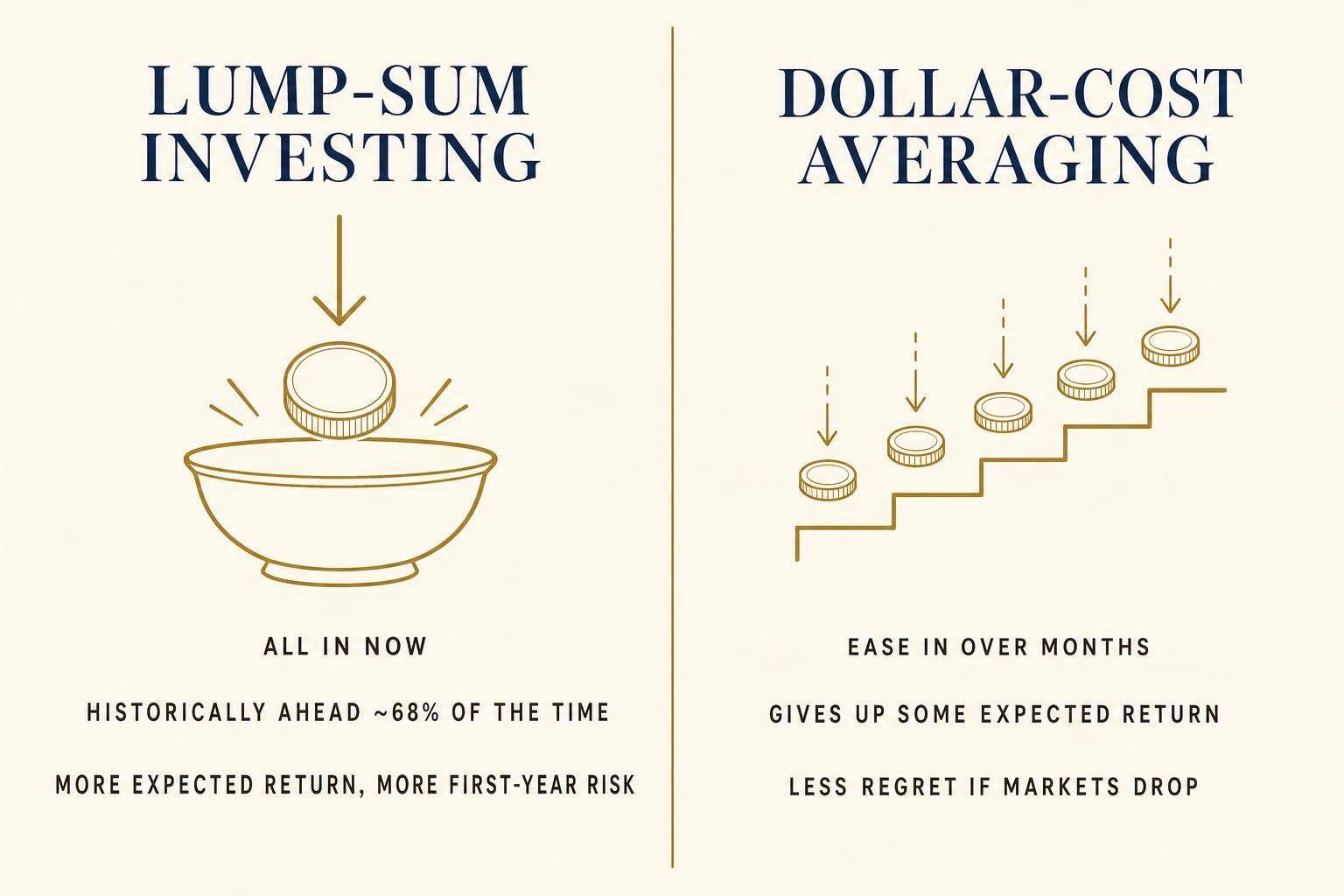
Lump-sum investing means putting the entire amount to work at once. You have $250,000, you invest $250,000 today, and you own your target mix of stocks and bonds by this afternoon.
Dollar-cost averaging (DCA) means splitting that same amount into equal pieces and investing them on a schedule — say, $25,000 a month for ten months — regardless of what the market is doing on any given day. If prices fall while you’re deploying, your later purchases buy more shares, which lowers your average cost per share — the SEC’s investor-education site lays out the basic mechanics if you want the textbook version.
Here’s the distinction that trips almost everyone up: automatically investing part of every paycheck into your 401(k) is not the dollar-cost-averaging decision we’re talking about. That’s simply investing money as you earn it — you never had a lump sum to deploy, so there was never an “all at once” alternative. Real DCA is a choice about money you already hold in cash right now. Keep those two straight, because the right answer for each is completely different.
What the data actually says
Vanguard studied this across the U.S., U.K., and Australian markets over the stretch from 1976 to 2022. Investing a lump sum immediately beat dollar-cost averaging roughly 68% of the time in the U.S., and somewhere between about 62% and 74% of the time depending on the market and the window. On average, the lump-sum investor came out ahead by around 2.3% over the following year for a balanced portfolio. You can read Vanguard’s research on it here.
Why does the “riskier” approach usually win? For one boring, powerful reason: markets go up more often than they go down. Since 1926, U.S. stocks have posted a positive return in roughly three of every four calendar years. When you hold money back to feed it in slowly, you are choosing to sit in cash during months the market is statistically likely to rise. You’re not avoiding risk so much as postponing it — and giving up expected return while you wait. Over long horizons, that lost time compounds, the same way it compounds when it’s working for you.
There’s a sharper way to put it, and Vanguard’s own researchers have: dollar-cost averaging is a strategy for taking risk later. Every dollar you haven’t invested yet is a dollar earning cash returns instead of market returns, during a period when the market usually wins.
Thomas’ Take: “Easing in to be safe” is really a bet that the market will fall while you deploy. Sometimes it does. But you’re making a market-timing call without admitting that’s what it is — and consistent market timing is a game almost nobody wins.
So why does anyone dollar-cost average?
Because we are not spreadsheets. The math describes the average outcome across thousands of periods. You only get to live through one, and the one that terrifies people is the same one that makes headlines: you invest $250,000 on Monday and the market drops 20% by Friday.
The odds of that are low. The regret if it happens is enormous — enough that some people, having lived it, swear off stocks entirely at exactly the wrong moment. Dollar-cost averaging exists to manage that emotion, not to beat the market. And if easing in is the only thing that gets you to invest at all — instead of leaving the money in a savings account for three years “until things calm down” — then DCA wins in a landslide, because the worst strategy of all is the one where the money never goes to work.
Behavioral risk is real risk. Loss aversion — the well-documented tendency to feel a loss about twice as intensely as an equivalent gain — is why the theoretically inferior strategy can be the right one for a particular human being. Just be honest about the trade you’re making: you’re paying a little expected return in exchange for a lot of peace of mind. Sometimes that’s a fair price.
The one situation where the answer flips
Everything above assumes a long time horizon — money that can ride out a bad first year because it has decades to recover. Change that assumption and the conclusion changes with it.
Picture someone deploying a large 401(k) rollover into an IRA the same month they retire. This is the most fragile moment in a portfolio’s life — what I’ve called the retirement red zone — because a steep loss in the first year or two of drawing down does damage that the same loss twenty years earlier never could. That’s sequence-of-returns risk, and it’s the one place where “invest it all at once” genuinely deserves a second look.
But notice what the question has quietly become. It’s no longer “lump sum or DCA?” It’s “how much of this money do I actually need in the next few years, and how much can stay invested for the long haul?” That’s a bucket-planning question. The money you’ll spend soon belongs in your Now and Soon buckets — cash and guaranteed income — where the lump-sum-versus-DCA debate is irrelevant, because that money isn’t going into stocks at all. The money you won’t touch for a decade or more belongs in the Later bucket, and for that slice, the lump-sum math applies exactly as it always did.
Framed that way, “ease in slowly to be safe” usually turns out to be a clumsy stand-in for a decision you should be making on purpose: how much stays out of the market for the near term, not how slowly the long-term money goes in.
Two hypotheticals, clearly labeled
Consider a hypothetical case. Priya, 46, inherits $200,000 and won’t need it until her own retirement, 20 years out. Her honest answer to “would a 20% drop next month make you sell?” is no — she’d see it as a discount. For Priya, the data is clear: invest it, sensibly allocated, and let two decades of compounding do the work. Spreading it over a year would most likely just cost her return.
Now consider a hypothetical retiree. Walt, 65, is rolling a $600,000 401(k) into an IRA the month he stops working. Walt doesn’t have a lump-sum problem — he has a bucket problem. Two to three years of spending goes into cash and short-term instruments (his Now bucket), a guaranteed income layer from Social Security and a pension covers his essentials (his Soon bucket), and the remainder — the money with a 10-plus-year horizon — goes into his Later bucket, where investing it promptly is the historically favored move. Same $600,000, but the useful question was never the one he started with. This is also why deploying into a market sitting near record highs unsettles people far more than it should.
How to actually decide
Strip away the noise and it comes down to four honest questions:
- Is this a sum I already hold in cash, or money I’m earning over time? Only the first is a real lump-sum-versus-DCA decision. The second is just: invest as you go.
- What’s the time horizon? Ten-plus years favors investing promptly. A few years means most of it shouldn’t be in stocks at all.
- Will regret make me bail? If a bad first month would send you to cash for good, easing in — or holding some back — is cheap insurance against a very expensive mistake.
- Am I near retirement? If so, stop asking “how fast do I invest?” and start asking “how much of this stays out of the market for the near term?”
If you’d rather see the trade-off in your own numbers than in the abstract, this is exactly the kind of thing worth modeling. I use and recommend ProjectionLab for testing how deploying a lump sum — all at once versus over time, and across your Now, Soon, and Later buckets — plays out before you commit to it. You can try it here. (Disclosure: that’s an affiliate link. If you subscribe through it, Confluence Media Group may earn a commission at no extra cost to you. I only point people to tools I actually think earn their keep.)
The honest bottom line: for long-horizon money and a steady stomach, the data says invest it and get on with your life. For money you’ll need soon, the lump-sum debate is a distraction from the real decision. And for the nervous investor with a big sum and a long horizon, easing in isn’t wrong — it’s insurance, and you deserve to know that’s what you’re paying for.
Key takeaways
- Historically, investing a lump sum all at once has beaten easing in about two-thirds of the time, mostly because markets rise more often than they fall.
- Dollar-cost averaging a sum you already hold is really a decision to take risk later — you trade some expected return for emotional comfort.
- Automatic 401(k) contributions are not the same decision; that’s just investing as you earn.
- Near retirement, the question isn’t lump sum versus DCA at all — it’s how much of the money belongs in your Now and Soon buckets versus your Later bucket.
Frequently asked questions
Isn’t dollar-cost averaging always the “safe” choice?
It feels safer because it limits regret if the market drops right after you invest. But it doesn’t reduce long-term risk so much as delay it, and historically it has given up some return. Whether it’s “safe” depends on whether you mean emotional comfort or expected outcome.
If I do decide to ease in, how long should it take?
The research suggests shorter windows lose less to the market’s upward drift, so averaging in over a handful of months costs less than stretching it across several years (FINRA has a plain-English primer on averaging in). But the deeper question is usually how much of the money should be invested at all versus held for near-term needs.
Does this change if the market is at an all-time high?
Less than your gut insists. Markets spend a great deal of their time near record highs — precisely because they rise over the long run — so waiting for a “better” entry is its own form of market timing.
This article is published by Confluence Media Group LLC, an independent publisher of educational financial content. Thomas Clark is a Series 65 Investment Advisor Representative. The information provided is for educational and informational purposes only and is not personalized financial, tax, or legal advice. Past performance does not guarantee future results. All investing involves risk, including potential loss of principal. Consult a qualified professional before making financial decisions.
Confluence Media Group LLC is a separate entity from Confluence Capital Management, the investment advisory practice through which Thomas Clark provides advisory services. Advisory services are not offered through this publishing platform.
About Thomas Clark
Thomas Clark is the founder of Confluence Media Group LLC and a Series 65 Investment Advisor Representative. He has spent nearly two decades working with families on retirement planning, with a focus on Social Security optimization, retirement income coordination, and the bucket planning approach to building a guaranteed income floor.
Thomas writes and publishes at thomasclarkadvisor.com and is the author of The Just in Case Binder — a 148-page printable family financial organizer for households who want to make sure the people they love know where everything is.
He lives in North Carolina with his family.
Subscribe to the weekly newsletter · Get the Just in Case Binder

Thomas Clark is a Series 65 licensed investment advisor and experienced trader. He specializes in investing, retirement planning, and market analysis, helping individuals build wealth and make informed financial decisions.
