
Record Highs and the Retiree: What to Actually Do
A market at an all-time high feels like a warning to anyone living off their savings. Here is what record highs actually mean for a retirement plan, and the three disciplined moves that beat reacting to the headline.

The market keeps printing new record highs, and for a lot of retirees that is not a relief — it is a reason to get nervous. The higher the number climbs, the louder a small voice gets: this cannot last, and I am the one standing closest to the edge.
I understand the instinct. When you are no longer earning a paycheck, a portfolio at an all-time high can feel less like a gift and more like a setup. But the discomfort of record highs is almost entirely psychological, not structural — and acting on that discomfort is one of the more expensive mistakes a retiree can make. Let me walk through what new highs actually mean, what they do not, and what a retirement plan should do when the market refuses to stop setting records.
New highs are the market’s normal state, not a warning
Record highs feel rare and ominous. They are neither. A rising market spends much of its life at or near its peak, because every dollar of long-term gain was, at some point, a fresh all-time high. Vanguard found that U.S. equities set new all-time highs on roughly one out of every three trading days in a recent quarter. New highs arrive in clusters and streaks, because a streak of new highs is simply what an uptrend looks like from the inside.
2026 has been one of those years. The S&P 500 has notched more than two dozen new closing highs and pushed above 7,600 for the first time in early June. Said out loud, that sounds like a market stretched to its absolute limit. It is also just what the later innings of a long expansion look like — and you only ever find out which one it was in hindsight.
That is the trap. People treat “all-time high” as a synonym for “top.” But a top is only visible after the fact. In the moment, a record high on the way to higher ground and a record high right before a correction look exactly the same. That is precisely why you cannot trade on the feeling.
The valuation worry is real — but it is not a timing signal
Let me be honest about the thing underneath the unease, because there is a legitimate concern in there. By some measures the S&P 500 is trading at a valuation it has reached only once before in roughly seven decades, and a handful of giant technology names are carrying an outsized share of the whole index. The Federal Reserve has stopped cutting — it has held its target range at 3.50% to 3.75% across every meeting this year, and its own projections now show officials split on whether the next move is a cut or a hike. None of that is nothing.
But here is the part that actually governs what you do tomorrow: valuation is a statement about the next decade, not the next month. High starting valuations have historically been a headwind on long-run returns. They tell you almost nothing about whether the market is higher or lower a year from now. The two questions get blurred together constantly, and the blur is where bad decisions live.
There is a real difference between a market that is genuinely in new structural territory and one that just feels that way because the number is big. I wrote about how to tell them apart in when “this time is different” is actually true. Most “the market is simply too high” arguments turn out to be the story, not the structural change.
What the history of buying at highs actually says
Here is the part almost nobody internalizes, because it runs against the gut. Buying into a record-high market has, historically, been a perfectly ordinary thing to do. RBC Global Asset Management found that after the S&P 500 set a new all-time high, the index was positive one year later in more than 90% of cases. Across nearly a century, forward returns measured from a new high have come in roughly in line with — and sometimes a touch better than — returns measured from any random day. Past performance never guarantees what comes next, and a single bad year can sit anywhere in that record. But the data does not support the idea that a new high is a uniquely dangerous moment to own stocks.
Thomas’s Take: All-time highs are not a reason to sell. They are the receipt for staying invested. The investor who bailed out of the last twenty “too high” markets missed every one of the gains that made those markets feel too high in the first place.
I will give the bears their due on one point, because being straight about it matters. Over very long holding periods, starting from a stretched valuation has historically meant somewhat lower returns than starting from a cheap one. That is a reason to keep your return expectations sober, and maybe to be a little more deliberate about how much you are adding. It is not a reason to sit in cash waiting for a green light that never actually rings a bell.
Why a bucket plan already answers the question
The reason record highs rattle retirees specifically is that their income and their market exposure feel like the same pile of money. If the market falls, the grocery money falls with it. That single fused fear is what makes a big number on the screen feel like a threat instead of a milestone.
Bucket planning exists to break that link. In the Now, Soon, and Later framework, your Now bucket holds near-term spending in cash and short-term instruments, untouched by where the market closed today. Your Soon bucket is the guaranteed income floor — Social Security, a pension, and where it fits, a fixed index annuity with an income rider — sized to cover your essential bills no matter what stocks do. The Later bucket is the part that is sitting at an all-time high, and it is also the part you do not need to touch for years.
When essentials are covered by guaranteed income, a record high in the Later bucket is just a number you are not required to react to. That is the entire point of building the floor. The real danger in retirement was never a high market — it is being forced to sell into a low one, which is the failure mode I walked through in sequence of returns risk and in the retirement red zone. A solid floor removes the force. Once the force is gone, the market’s level is news, not an emergency.
What to actually do when the market keeps setting records
So the answer is not “move everything to cash and wait.” Hoarding cash because the market feels high is market timing wearing a cardigan, and it carries its own quiet, compounding cost — the one I laid out in the hidden cost of holding too much cash. There are three things worth doing instead, and all three are disciplined rather than reactive.
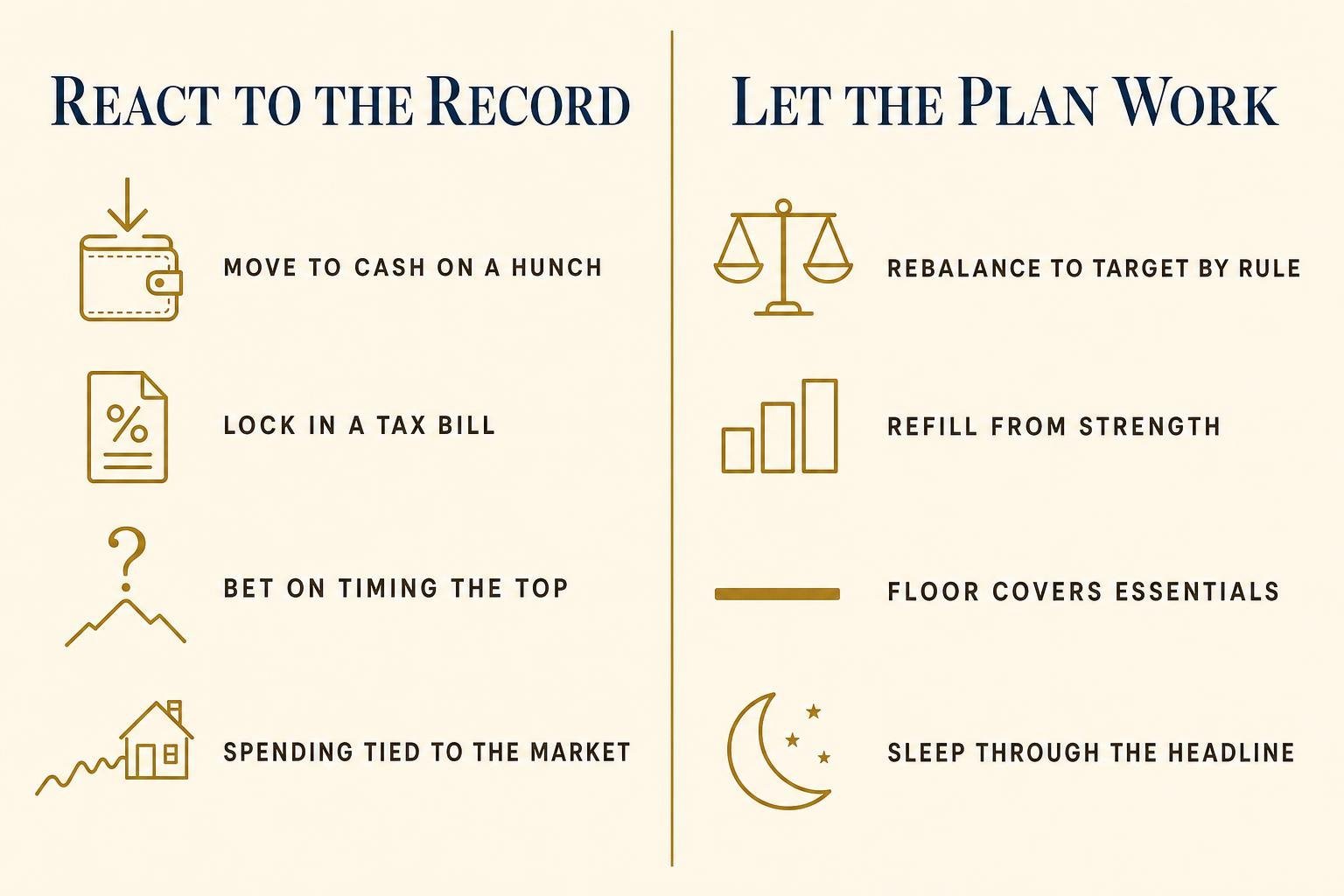
First, rebalance by policy, not by mood. If your Later bucket has run well past its target allocation in the rally, trim it back to plan. That sells some of the high — on purpose, by rule, without a forecast attached. Second, top off your Now bucket from strength. A record-high market is exactly the right time to refill near-term cash, the mirror image of refusing to sell into a downturn. Third, pressure-test the floor: confirm your Soon bucket still covers essentials and your Now bucket is genuinely two to three years deep, not eighteen months.
Consider a hypothetical case: Frank, 66, retired last year just outside Denver. He has $850,000 in his IRA, a paid-off house, and about $4,800 a month in essential expenses already covered by Social Security and a small pension. His IRA — his Later bucket — is at an all-time high, and the headlines have him convinced a crash is overdue. His instinct is to move the whole $850,000 to cash and wait for the dust to settle.
Here is what his own plan tells him instead. His essentials are covered by guaranteed income, so a market drop does not touch his grocery money. His Now bucket holds two years of discretionary spending in cash, so he is not a forced seller of anything. His IRA has drifted to about 75% stocks against a 65% target, so the disciplined move is not to sell everything — it is to trim that 10% back to plan, bank the gain, and top off his Now bucket while prices are high. He sells a slice of the record, by rule, and goes back to his weekend. Moving $850,000 to cash would have locked in a tax bill and a guess about timing. Rebalancing locked in a little of the gain and none of the guess.
If you want to see how a record-high market followed by a sharp drop a couple of years later plays out against your own numbers — before you are living through either — modeling tools like ProjectionLab let you stress-test a stretched market against a guaranteed income floor and a disciplined rebalance. (ProjectionLab is an affiliate partner; if you subscribe through that link, Confluence Media Group may earn a commission at no additional cost to you. I only point readers toward tools I would actually use.)
The bottom line
A market at an all-time high asks every retiree the same quiet question: do you trust your plan, or do you trust your nerves? The whole reason to build a guaranteed income floor and a real cash cushion is so the answer never has to depend on where the index closed today. New highs are not the moment the plan is in danger. They are the moment the plan is doing exactly what it was built to do, and the discipline is to let it.
The retirees who struggle at record highs are the ones whose spending rides on the market’s level. The ones who sleep are the ones who made that impossible on purpose. So check that your floor is solid, that your cash is deep enough, and that your rules are written down. Then close the laptop and go enjoy the day the market handed you.
Key takeaways
- New highs are normal, not a warning. A rising market spends much of its life near its peak; equities have historically set fresh highs on roughly one trading day in three during strong stretches.
- Valuation governs the decade, not the month. A rich starting valuation has historically dragged on long-run returns, but it tells you almost nothing about where the market is a year from now.
- Buying at highs has been ordinary, not reckless. Historically the index was positive a year after a new high in more than 90% of cases — though past performance never guarantees future results.
- A bucket plan disarms the fear. When essentials are covered by a guaranteed income floor, a record high in your growth bucket is a number you are not required to react to.
- Act by rule, not by hunch. Rebalance to your target, refill the Now bucket from strength, and pressure-test the floor — rather than moving everything to cash on a feeling.
Frequently asked questions
Should I wait for a pullback before putting new money to work?
Waiting for a pullback assumes you will know one when you see it and will actually buy when it feels worst — two things most people get wrong in both directions. If you have a lump sum and the wait would keep you up at night, spreading it in over several months is a reasonable middle path. What rarely pays off is sitting in cash indefinitely because the market “feels high.”
Doesn’t a record high mean a crash is more likely?
No. The market does not keep a memory of its previous high and decide it is “due” for a fall. A correction can start from a record high or from the middle of a slump; the level itself is not the trigger. What protects you is not predicting the drop — it is being structured so a drop does not force you to sell.
If the market is this expensive, should retirees hold more cash?
Hold the cash your plan calls for — generally two to three years of near-term spending in the Now bucket — not an extra pile parked on the sidelines out of nervousness. Excess cash feels safe but quietly loses ground to inflation and to the returns it is not earning, which is a real cost over a long retirement.
This article is published by Confluence Media Group LLC, an independent publisher of educational financial content. Thomas Clark is a Series 65 Investment Advisor Representative. The information provided is for educational and informational purposes only and is not personalized financial, tax, or legal advice. Past performance does not guarantee future results. All investing involves risk, including potential loss of principal. Consult a qualified professional before making financial decisions.
Confluence Media Group LLC is a separate entity from Confluence Capital Management, the investment advisory practice through which Thomas Clark provides advisory services. Advisory services are not offered through this publishing platform.
About Thomas Clark
Thomas Clark is the founder of Confluence Media Group LLC and a Series 65 Investment Advisor Representative. He has spent nearly two decades working with families on retirement planning, with a focus on Social Security optimization, retirement income coordination, and the bucket planning approach to building a guaranteed income floor.
Thomas writes and publishes at thomasclarkadvisor.com and is the author of The Just in Case Binder — a 148-page printable family financial organizer for households who want to make sure the people they love know where everything is.
He lives in North Carolina with his family.
Subscribe to the weekly newsletter · Get the Just in Case Binder

Thomas Clark is a Series 65 licensed investment advisor and experienced trader. He specializes in investing, retirement planning, and market analysis, helping individuals build wealth and make informed financial decisions.
