
How Social Security Is Taxed in 2026 (and What Changed)
The 2025 law didn't make Social Security tax-free — it added a temporary senior deduction. Here's how benefits are actually taxed in 2026, the tax torpedo to watch, and how to plan around it.

In the summer of 2025, a lot of retirees got a message that sounded like very good news. The Social Security Administration itself said the new tax law “eliminates federal income taxes on Social Security benefits for most beneficiaries.” Headlines ran with “No Tax on Social Security.” Ever since, plenty of people I’ve talked with have assumed their benefits are now untouchable by the IRS.
They’re mostly not. The 2025 law didn’t repeal the tax on Social Security. It added a temporary deduction that softens the blow for some people and does nothing for others. If you’re building a retirement income plan around the idea that your Social Security check is now tax-free, you’re planning on a misunderstanding.
So let’s clear it up. Here’s how Social Security actually gets taxed in 2026, what the 2025 law really changed, and the quiet “tax torpedo” that catches middle-income retirees who never see it coming.
How Social Security actually gets taxed
Whether your benefits are taxed comes down to a single number the IRS calls your combined income, and most planners call your provisional income. The formula is straightforward: your adjusted gross income, plus any tax-exempt interest, plus half of your annual Social Security benefits.
Run that number, then compare it to two thresholds. For a single filer, provisional income under $25,000 means none of your benefits are taxed. Between $25,000 and $34,000, up to half of your benefits become taxable. Above $34,000, up to 85% can be. For a married couple filing jointly, the same steps sit at $32,000 and $44,000.
One point trips up almost everyone: “up to 85%” is not a tax rate. It means up to 85 cents of every benefit dollar gets pulled into your taxable income. That amount is then taxed at your ordinary rate, whatever bracket you land in. Nobody pays an 85% tax on their Social Security.
Here’s the detail that turns this from trivia into a planning problem: those thresholds have never been adjusted for inflation. The $25,000 line dates to 1984, when benefits first became taxable. Congress added the 85% tier in 1993 and froze both numbers in place. Meanwhile, every annual cost-of-living raise nudges more retirees over lines that never move. A rule written to tax “higher-income” retirees four decades ago now reaches squarely into the middle class. According to the Social Security Administration, roughly half of beneficiaries now owe some tax on their benefits.
What the 2025 law actually did
The One Big Beautiful Bill Act, signed in 2025, created a new senior deduction: up to $6,000 per person age 65 or older, for tax years 2025 through 2028. A married couple where both spouses are 65 or older can claim up to $12,000. You can take it whether or not you itemize, and it stacks on top of the extra standard deduction seniors already get. The details are spelled out by the IRS.
That’s real money, and for lower-income retirees it can erase the tax on their benefits entirely. But look closely at what it is and isn’t.
It’s a deduction against your total income, not a repeal of the rule that makes benefits taxable. The provisional-income math above still runs exactly as before. Up to 85% of your benefits can still land in your taxable income. The deduction simply lowers the tax you owe on your income overall.
It also phases out. Once your modified adjusted gross income passes $75,000 single or $150,000 joint, the deduction shrinks by 6 cents for every dollar over the line, and it disappears completely at $175,000 single or $250,000 joint. The retirees most likely to owe tax on 85% of their benefits are often the ones who receive little or none of this deduction.
And it expires. Under current law, the senior deduction is gone after 2028. The taxation of benefits is not. Build a plan around a four-year deduction and you’ve built a plan with an expiration date.
The tax torpedo almost nobody explains
This is where the real damage happens, and it’s the part the headlines skip. Because your benefits become taxable in steps tied to your other income, there’s a stretch where each extra dollar you pull from a traditional IRA does double duty. The dollar is taxable itself, and it drags more of your Social Security into taxable income right behind it.
The result is a marginal tax rate higher than your bracket suggests. A retiree who believes they’re in the 12% bracket can face an effective rate above 22% on the next dollar withdrawn — because that dollar also makes 85 cents of Social Security taxable. Planners call it the “tax torpedo,” and it strikes in the middle-income range, not at the top. It’s why a modest year-end IRA withdrawal, or a poorly timed Roth conversion, can cost far more than the sticker rate implies.
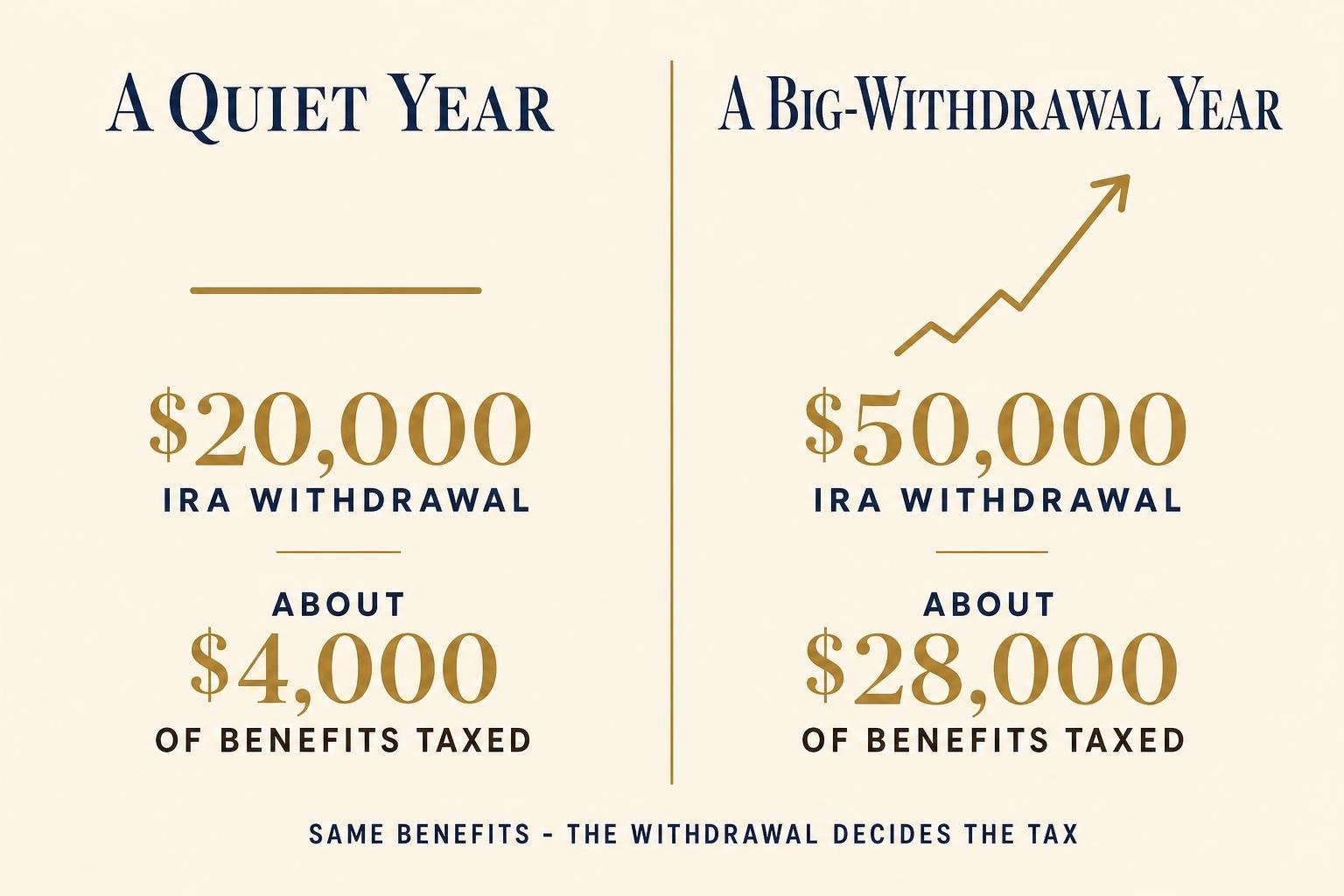
The same $30,000, two very different tax bills
Consider a hypothetical couple. Miguel and Rosa, both 67, retired last year outside Charlotte. Between them they collect $40,000 a year in Social Security. They also hold a $600,000 traditional IRA and a paid-off house.
In a quiet year, they take $20,000 from the IRA. Their provisional income — the $20,000 withdrawal plus half of their $40,000 in benefits — comes to about $40,000. That lands in the middle tier, so only around $4,000 of their benefits is taxable. Between their standard deduction and the new senior deductions, they owe little or nothing.
Now picture a year with a new roof and a replacement car, so they pull $50,000 from the IRA instead. Provisional income jumps to about $70,000, well past the 85% line. Suddenly close to $28,000 of their benefits is taxable — seven times more than the quiet year.
Read that again, because it’s the whole point. Taking an extra $30,000 from the IRA didn’t just add $30,000 to their taxable income. It pulled roughly another $24,000 of their Social Security into the tax base alongside it — close to $54,000 of taxable income created by a $30,000 withdrawal. Same benefits, same house, wildly different tax bill, decided entirely by how they sequenced one withdrawal.
What you can actually do about it
You can’t change the thresholds. But you can influence your provisional income year to year, which means you can often control how much of your benefit gets taxed. Four levers do most of the work.
Use the low-income years as a planning window. The stretch between retirement and the start of Social Security and required minimum distributions is often when your provisional income is at its lowest. That’s the window to do Roth conversions on purpose — filling the low brackets now and shrinking the traditional IRA that would otherwise force large taxable withdrawals later.
Lean on Roth dollars for the big stuff. Money from a Roth IRA isn’t in your AGI, so it isn’t in your provisional income either. A pool of Roth savings is the cleanest way to cover a new roof or a car without setting off the torpedo. It’s also why draining the Roth first is usually backwards — the whole logic behind tax-aware bucketing.
Use qualified charitable distributions if you give. Once you’re 70½ or older, a qualified charitable distribution sends money straight from your IRA to a charity, satisfies your required minimum distribution, and never touches your AGI. That keeps provisional income down, which keeps both your benefit taxation and your Medicare IRMAA surcharge down at the same time.
Sequence the large expenses. A new roof, a car, a gift to the kids — where that money comes from, and which tax year it falls in, decides whether it trips the 85% tier. Splitting a large withdrawal across two years, or funding it from taxable savings or a Roth, can save real money.
None of this is about a single account or a single year. It’s the same idea behind the Now, Soon, and Later framework: decide which dollars fund which year’s spending before the year locks in.
Because benefit taxation depends on how your withdrawals, conversions, and claiming age interact across several years, it’s genuinely hard to eyeball. A planning tool like ProjectionLab lets you model a Roth conversion against the provisional-income thresholds and see how much of your benefit becomes taxable before you pull the trigger, instead of finding out next April.
Disclosure: the ProjectionLab link above is an affiliate link. If you subscribe through it, Confluence Media Group may earn a commission at no additional cost to you. I only point readers to tools I’d use myself.
The takeaway
The 2025 headline wasn’t exactly a lie. It was a slogan built on a temporary deduction. The rule underneath it hasn’t moved since 1993, and the frozen thresholds mean more retirees drift into it every year. The people who pay the least tax on their Social Security aren’t the ones with the lowest income. They’re the ones who decided, on purpose and ahead of time, where each year’s money would come from.
Frequently asked questions
Did the 2025 law make Social Security tax-free?
No. It created a temporary $6,000-per-person deduction for people 65 and older, in effect for 2025 through 2028, that can reduce or eliminate the tax for some retirees. The underlying rule that makes up to 85% of benefits taxable is unchanged.
How do I know whether my benefits are taxable?
Add your adjusted gross income, any tax-exempt interest, and half of your annual benefits. If that provisional income is above $25,000 (single) or $32,000 (married filing jointly), at least some of your benefits are taxable. The IRS worksheet in Publication 915 walks through the exact figure.
Does my state tax Social Security too?
Most states don’t, and the number that do keeps shrinking. But a handful still tax benefits under their own rules, so it’s worth checking your state specifically rather than assuming.
This article is published by Confluence Media Group LLC, an independent publisher of educational financial content. Thomas Clark is a Series 65 Investment Advisor Representative. The information provided is for educational and informational purposes only and is not personalized financial, tax, or legal advice. Past performance does not guarantee future results. All investing involves risk, including potential loss of principal. Consult a qualified professional before making financial decisions.
Confluence Media Group LLC is a separate entity from Confluence Capital Management, the investment advisory practice through which Thomas Clark provides advisory services. Advisory services are not offered through this publishing platform.
About Thomas Clark
Thomas Clark is the founder of Confluence Media Group LLC and a Series 65 Investment Advisor Representative. He has spent nearly two decades working with families on retirement planning, with a focus on Social Security optimization, retirement income coordination, and the bucket planning approach to building a guaranteed income floor.
Thomas writes and publishes at thomasclarkadvisor.com and is the author of The Just in Case Binder — a 148-page printable family financial organizer for households who want to make sure the people they love know where everything is.
He lives in North Carolina with his family.
Subscribe to the weekly newsletter · Get the Just in Case Binder

Thomas Clark is a Series 65 licensed investment advisor and experienced trader. He specializes in investing, retirement planning, and market analysis, helping individuals build wealth and make informed financial decisions.
