
Long-Term Rates Just Hit a 19-Year High. Now What?
The Fed controls short-term rates, and everyone expected cuts. But long-term rates just hit a 19-year high, and for retirement income that is more window than warning.

The Federal Reserve spent most of this year signaling that rate cuts were coming, and for months the market believed it. Then something strange happened: the interest rates that matter most to your retirement started going up anyway.
In the third week of August, the 30-year Treasury yield touched roughly 5.3%, its highest level in about 19 years — back to territory we last saw in 2007. The 10-year Treasury climbed near 4.7%. Meanwhile, the odds of a Fed rate cut at the September meeting fell to roughly one in three on the CME FedWatch tool, after briefly looking like a near-certainty just weeks earlier.
If that sounds contradictory, it isn’t. It’s the clearest lesson in years about how interest rates actually work — and for anyone building retirement income, rising long-term interest rates are not the warning the headlines make them out to be. In one specific way, they’re a window.
Two ends of the same curve, moving in opposite directions
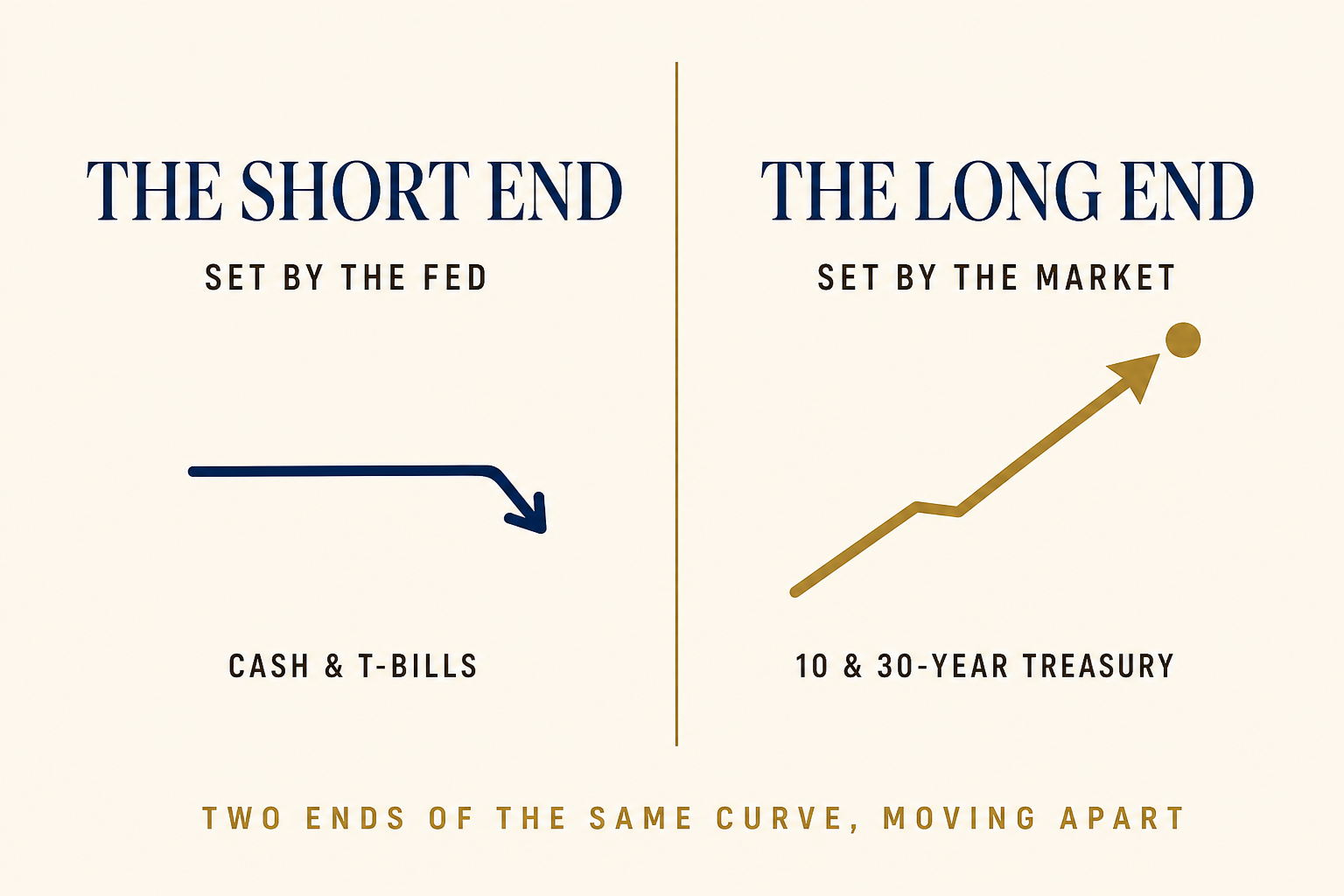
Here’s the piece most coverage skips. There is no single “interest rate.” There’s a whole curve of them, running from overnight cash out to 30-year bonds, and the two ends are controlled by two very different forces.
The short end — the federal funds rate, and by extension what you earn on cash, money market funds, and Treasury bills — is set by the Federal Reserve. That’s the rate everyone watches on Fed day. When people say “the Fed is cutting,” this is what they mean, and I wrote a few days ago about what falling short rates do to the cash in your Now bucket.
The long end — the 10-year and 30-year Treasury yields — is different. The Fed influences it, but it doesn’t set it. The bond market does, through millions of buyers and sellers deciding what they’ll accept to lend money to the government for a decade or three. And right now, those buyers are demanding more.
So we have the unusual picture of the Fed leaning toward easing on the short end while the long end climbs to a 19-year high. Same yield curve, two ends walking away from each other.
Why the long end is climbing
Long-term rates reflect what investors expect over many years, and a few forces are pushing them higher at the same time.
The first is supply. The federal deficit is on track to exceed last year’s, which means the Treasury has to sell an enormous volume of new bonds. On top of that, corporations have been issuing debt heavily, and the buildout of artificial-intelligence infrastructure is soaking up capital at a scale that competes with everything else. When the supply of bonds rises faster than the demand, prices fall and yields rise. That’s just the market clearing.
The second is inflation that won’t fully sit down. It has moderated from its peak, but it’s been stuck above the Fed’s 2% target, and a recent move up in oil prices doesn’t help. Lenders who expect higher inflation over the next 20 years demand a higher yield to compensate. That’s rational, not panic.
Put simply: the bond market is pricing in more borrowing and stickier inflation than it was a year ago. The Fed can nudge the overnight rate lower, but it cannot force a 30-year lender to accept less. That’s why the long end is doing its own thing.
The pain side: what higher long rates do to a bond portfolio
Let me be honest about the uncomfortable part first, because it’s real.
Bond prices and bond yields move in opposite directions. When yields rise, the price of bonds you already own falls — and the longer the bond’s maturity, the harder it falls. That sensitivity has a name: duration. A bond fund with a duration of 15 years will lose roughly 15% of its price if its yield jumps by one percentage point. That’s why long-term bond funds have been the quiet casualty of this move, and why some retirees who thought of bonds as “the safe part” have been unpleasantly surprised.
This matters most for your Later bucket — the growth-oriented, longer-horizon money. If you’re holding a long-duration bond fund there and watching the balance drop, you’re feeling the mark-to-market sting of rising rates in real time.
But — and this is the whole point of this article — that price drop is only half the story. It’s what happens to money you’re holding. The other half is what happens to money you’re about to put to work.
The opportunity side: income is on sale
Higher long-term rates mean higher yields on new income. And for anyone building the guaranteed income floor at the center of bucket planning — the Soon bucket — this is the best environment in about two decades.
New Treasury bonds and a bond ladder are paying yields we simply have not seen since before the 2008 financial crisis. Multi-year guaranteed annuities — the plain-vanilla kind that lock a stated interest rate for a set term, the way a CD does — have been quoting rates around 6% as of this writing. And the income riders on income-focused Fixed Index Annuities, which promise a contractually defined guaranteed income amount, price off these same long-term rates. When the long end rises, the guaranteed number the insurer can offer rises with it.
This is the calibration I want you to hold onto: a Fixed Index Annuity’s job in the Soon bucket is income, not growth. It is not a stock substitute and it never was. But its whole purpose — turning a lump sum into a floor of guaranteed income you cannot outlive — gets meaningfully cheaper to build when long-term rates are high. Higher rates mean the insurer can guarantee more income per dollar you commit. (For the same reason, this is not the environment to reach for a variable annuity — piling market risk and high fees on top of an income goal defeats the purpose when a plain guaranteed rate is finally paying well.)
Thomas’ Take: The financial media treats a spike in long-term rates as a threat, and for a leveraged trader or a long bond fund, it is. But if you are a pre-retiree trying to lock in a paycheck for life, high long-term rates are a sale on the one thing you actually need to buy. Don’t just read the red on the screen. Ask which side of the trade you’re on.
Duration risk versus locking a rate — the distinction that decides everything
The reason the same headline can be bad news and good news is that “rising rates” describes two completely different actions.
Owning duration means holding a long bond or bond fund whose price moves against you when yields rise. You’re exposed to the swing. That’s the pain side.
Locking a rate means using today’s higher yield to buy a fixed stream of income — a bond held to maturity, a rung on a ladder, a multi-year guaranteed annuity, an income rider. You capture the high rate and the day-to-day price swings stop mattering, because you’re holding for the income, not trading the price.
Same rate environment. Opposite experience. The question isn’t “are rates up or down” — it’s “am I holding duration I don’t want, or am I locking in income I do?”
Consider a hypothetical couple, Ray and Linda, both 63 and two years from retirement. Ray opens the brokerage app and sees their long-term bond fund down for the year, and his stomach drops. Linda, looking at the same screen, sees something different: the exact same rate move that dinged the bond fund just made the guaranteed-income quotes for their Soon bucket the richest they’ve been in their adult lives. Neither of them is wrong about the number. They’re looking at opposite sides of one coin. The couple’s actual job is to decide which bucket each dollar belongs in — and to stop letting the Later bucket’s price swings scare them out of the Soon bucket’s opportunity.
Before you move money based on any of this, though, run your own numbers rather than acting on a headline — mine included. A planning tool like ProjectionLab lets you model what filling more of your income floor at today’s higher rates actually does to the odds your money lasts, instead of guessing. (ProjectionLab is a paid tool; the link is an affiliate link, which means I may earn a small commission at no extra cost to you. I only recommend tools I’d use myself.)
What this means before the September Fed meeting
The Fed’s September decision will dominate the financial news, and it matters for the short end — for your cash, your money market yield, the “when does the Fed finally cut” parlor game. But the long end has already told you something more useful, and it didn’t wait for a press conference.
For the first time in nearly 20 years, the market is offering retirees a genuinely high rate to lock in guaranteed income. That won’t necessarily last; annuity and bond rates are expected to drift lower as the cycle turns, even if gradually. A window that’s open now can be narrower next year. The point isn’t to rush — it’s to recognize which bucket this environment favors, and to stop reading a Soon-bucket opportunity as a Later-bucket emergency.
Key takeaways
- The Fed controls short-term rates (cash, T-bills); the bond market controls long-term rates (the 10- and 30-year Treasury). Right now they’re moving in opposite directions.
- The 30-year Treasury yield recently hit about 5.3% — a 19-year high — driven by heavy government and corporate borrowing and inflation stuck above 2%.
- Rising long rates hurt the price of bonds you already own (duration risk), which stings the Later bucket.
- The same rise makes new guaranteed income cheaper to buy — better yields on bond ladders, multi-year guaranteed annuities near 6%, and higher FIA income-rider payouts for the Soon bucket.
- The deciding question isn’t up-or-down. It’s whether you’re holding duration you don’t want or locking in income you do.
Frequently asked questions
Should I sell my bond fund now that rates are rising?
Selling locks in the price loss and doesn’t address why you owned the fund. A bond fund and a bond held to maturity behave differently: the fund reprices daily; an individual bond or ladder rung pays its stated interest and returns principal at maturity regardless of the price along the way. The real question is whether that money belongs in the Later bucket at all, or whether it’s Soon-bucket money that would be better off in a held-to-maturity structure.
Are these higher annuity rates guaranteed, or could they change?
A multi-year guaranteed annuity locks its stated rate for the full term by contract, and a Fixed Index Annuity’s income rider guarantees the income amount defined in the contract — those specific figures are contractual. What isn’t guaranteed is that new offers will stay this high. Available rates move with the market, and they’re expected to ease as the rate cycle turns.
Why would long-term rates rise if the Fed is cutting?
Because the Fed only sets the overnight rate. Long-term yields reflect the market’s view of future inflation and the sheer supply of bonds being issued. When investors expect more borrowing and stickier inflation, they demand higher long-term yields — even as the Fed lowers the short end.
This article is published by Confluence Media Group LLC, an independent publisher of educational financial content. Thomas Clark is a Series 65 Investment Advisor Representative. The information provided is for educational and informational purposes only and is not personalized financial, tax, or legal advice. Past performance does not guarantee future results. All investing involves risk, including potential loss of principal. Consult a qualified professional before making financial decisions.
Confluence Media Group LLC is a separate entity from Confluence Capital Management, the investment advisory practice through which Thomas Clark provides advisory services. Advisory services are not offered through this publishing platform.
About Thomas Clark
Thomas Clark is the founder of Confluence Media Group LLC and a Series 65 Investment Advisor Representative. He has spent nearly two decades working with families on retirement planning, with a focus on Social Security optimization, retirement income coordination, and the bucket planning approach to building a guaranteed income floor.
Thomas writes and publishes at thomasclarkadvisor.com and is the author of The Just in Case Binder — a 148-page printable family financial organizer for households who want to make sure the people they love know where everything is.
He lives in North Carolina with his family.
Subscribe to the weekly newsletter · Get the Just in Case Binder

Thomas Clark is a Series 65 licensed investment advisor and experienced trader. He specializes in investing, retirement planning, and market analysis, helping individuals build wealth and make informed financial decisions.
