
The Fed Is About to Change the Deal on Your Cash
For about two years, the safest money in your retirement plan has quietly paid around 4%. If the Fed starts cutting rates, that yield falls almost immediately — and unlike most Fed news, it's worth acting on.

For about two years, the safest money in your retirement plan has been quietly doing something it hadn’t done in a long time: paying you. The cash in your money-market fund, your Treasury bills, your short-term CDs — all of it has been earning somewhere in the neighborhood of 4%, with essentially no risk to principal. That was a gift. And gifts like that don’t last.
The Federal Reserve has held its benchmark rate in a target range of 3.50% to 3.75% for a while now. But the market’s attention is already shifting to what comes next. Fed officials gather in Wyoming for the Kansas City Fed’s annual Jackson Hole Economic Symposium on August 27–29, and the Fed’s next scheduled policy meeting follows in mid-September. Investors have spent the summer increasingly betting that the era of falling rates is about to begin.
I’m not going to tell you whether they’re right. I don’t forecast the Fed, and neither should your plan. But if the direction of rates does turn, it changes the deal on one specific part of your money — and unlike most Fed news, this is a change worth doing something about.
Why I usually tell you to ignore the Fed — and why this is different
Regular readers know my standard advice when a Fed meeting rolls around: watch it if you find it interesting, then go do something else. I wrote a whole post arguing that a well-built retirement plan shouldn’t flinch when the Fed meets. The stock side of your portfolio has already priced in whatever everyone expects — that’s the whole point of the market cheering weak economic data lately, because weak data pulls rate cuts forward. Trying to trade around the Fed is a losing game for a retiree.
Cash is the exception. When rates fall, the yield on cash and short-term instruments falls almost immediately and mechanically. There’s no “priced-in” cushion, no diversification to smooth it out. The money-market fund paying 4% today could be paying noticeably less within a few months of the first cut. This isn’t a market forecast — it’s just how the plumbing works. The rate on your safest money tracks the Fed’s rate closely, so a lower Fed rate means a lower paycheck from your cash.
That’s why this particular piece of Fed news deserves your attention when most of it doesn’t.
The risk has a name: reinvestment risk
The thing you’re actually facing is called reinvestment risk, and it’s one of the least-understood risks in retirement. Most people worry about their investments losing value. Reinvestment risk is the opposite problem: your safe money is fine, but when it matures, you have to reinvest it at whatever rate exists then — not the rate you were happily earning.
Here’s the trap. A 12-month CD paying 4.5% feels great today. But when it matures next summer, you don’t get to renew at 4.5%. You renew at whatever the going rate is at that moment. If rates have drifted down in the meantime, you’ve quietly taken a pay cut, and you didn’t do anything wrong to earn it. The shorter the maturity of your safe holdings, the more often you’re exposed to this — because you’re constantly rolling money over into the current rate.
This is the mirror image of the duration lesson I covered when rates were rising. Back then, short duration protected you — you weren’t locked into low yields while new bonds paid more. When rates are poised to fall, the calculus flips. Staying entirely short means you re-price your income downward every few months. Locking in a longer maturity means you keep today’s yield for longer.
What a disciplined response looks like (and what it doesn’t)
Let me be clear about what I am not suggesting. I am not telling you to dump your cash into the stock market because “cash won’t pay anymore.” That’s exactly the wrong reflex — it takes money you’re holding because you need it to be safe and puts it somewhere it can drop 20% in a bad year. The job of your Now bucket is to be there when you need it. Yield is a bonus, never the mission. If a lower yield tempts you to make your emergency money risky, the falling rate has cost you far more than a few tenths of a percent.
The disciplined move is simpler and more boring: match the maturity of your safe money to when you’ll actually need it, and use a rate environment like this one to lock in longer where you can.
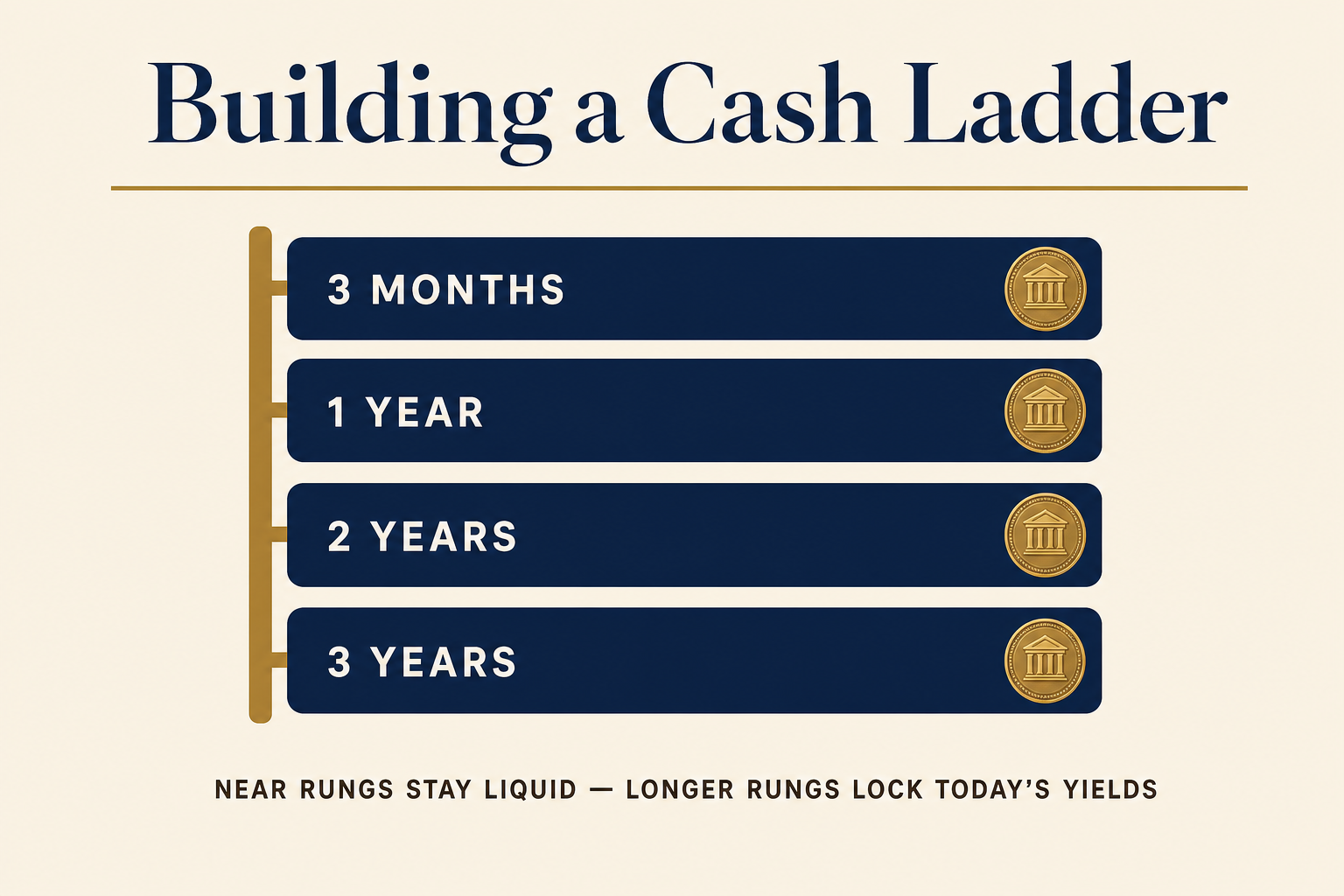
In practice, that usually means building a ladder. Instead of holding everything in a money-market fund that re-prices daily, or piling into one long CD, you spread your safe money across staggered maturities — some coming due in three months, some in a year, some in two or three years. The near-term rungs keep you liquid. The longer rungs let you hold on to today’s yields even if new rates come down. As each rung matures, you reinvest it at the far end of the ladder. You’re never guessing where rates are headed; the ladder handles it either way. (If you want to build one with government-backed instruments, TreasuryDirect lets you buy Treasury bills and notes directly.)
There’s a deeper version of this move, too. If part of your plan is to build a guaranteed income floor — the Soon bucket in my framework — a period when longer-term rates are still elevated is a reasonable time to lock some of that floor in. Multi-year guaranteed instruments and the income riders on fixed index annuities are priced off prevailing rates. The guaranteed payout available to you when rates are higher is generally more attractive than what’s on offer after a cutting cycle has run its course. Remember what that bucket is for: income, not growth. This isn’t about chasing return. It’s about recognizing that guaranteed income is a product you buy, and its price moves with rates.
Thomas’ Take: The single most common mistake I see when rates start falling isn’t moving too slowly. It’s the panic-reach for yield — cash flooding into junk bonds, leveraged funds, or “high-yield” products that hide real risk behind an attractive number. A 4% pay cut on truly safe money is annoying. A 40% loss on money you thought was safe is a retirement-altering event. Don’t solve a small problem by creating a large one.
A hypothetical to make it concrete
Consider a hypothetical case: Margaret, 64, retired last year from a career in hospital administration outside Columbus. She has about $250,000 sitting in a money-market fund earning roughly 4%, which she’s been treating as both her cash cushion and a place to park money she doesn’t need for a few years. She likes seeing the interest show up every month, and she’s heard rates might be coming down.
Margaret doesn’t need to predict the Fed to act sensibly. She figures she wants roughly two years of spending — call it $60,000 — kept fully liquid; that stays in the money-market fund, where daily access matters more than squeezing out the last bit of yield. The remaining $190,000 isn’t emergency money; it’s money she won’t touch for two to five years. So she ladders it: portions maturing at one, two, and three years, using CDs and Treasuries. If rates fall, she’s glad she locked in today’s yields on the longer rungs. If they don’t, she’s given up almost nothing, because the ladder keeps maturing and reinvesting on its own. Either way, she’s stopped leaving the decision entirely to next summer’s interest rate.
Notice what Margaret didn’t do. She didn’t move her safe money into stocks. She didn’t buy something exotic to keep her yield at 4%. She simply matched her money to her timeline and used the current environment to her advantage. That’s the entire play.
The point isn’t to outguess the Fed
Almost everything the Fed does is noise for a retiree with a real plan. This is one of the few exceptions, and even here, the goal isn’t to be a better forecaster than the professionals in Jackson Hole. It’s to recognize that the interest your cash pays is the one number in your plan that moves directly with the Fed — and that a moment when rates are still elevated, but widely expected to fall, is a rational time to lock in duration on the money whose whole purpose is stability.
Do that, and it won’t much matter what Powell says in Wyoming or what the Fed decides in September. Your safe money will keep doing its job at a rate you chose on purpose — instead of one the calendar chose for you.
Key takeaways
- The yield on cash and short-term instruments tracks the Fed’s rate closely, so if rates fall, your safe money takes an almost immediate pay cut — with no “priced-in” cushion the way stocks have.
- The specific risk is reinvestment risk: when a short CD or T-bill matures, you reinvest at the then-current rate, not the one you were enjoying.
- The disciplined response is a maturity ladder — keep near-term money liquid, lock longer maturities to hold today’s yields — not shifting safe money into stocks or reaching for risky “high-yield” products.
- If you’re building a guaranteed income floor, a period of still-elevated rates can be a reasonable time to lock some of it in, because guaranteed income is priced off prevailing rates. Income, not growth.
This article is published by Confluence Media Group LLC, an independent publisher of educational financial content. Thomas Clark is a Series 65 Investment Advisor Representative. The information provided is for educational and informational purposes only and is not personalized financial, tax, or legal advice. Past performance does not guarantee future results. All investing involves risk, including potential loss of principal. Consult a qualified professional before making financial decisions.
Confluence Media Group LLC is a separate entity from Confluence Capital Management, the investment advisory practice through which Thomas Clark provides advisory services. Advisory services are not offered through this publishing platform.
About Thomas Clark
Thomas Clark is the founder of Confluence Media Group LLC and a Series 65 Investment Advisor Representative. He has spent nearly two decades working with families on retirement planning, with a focus on Social Security optimization, retirement income coordination, and the bucket planning approach to building a guaranteed income floor.
Thomas writes and publishes at thomasclarkadvisor.com and is the author of The Just in Case Binder — a 148-page printable family financial organizer for households who want to make sure the people they love know where everything is.
He lives in North Carolina with his family.
Subscribe to the weekly newsletter · Get the Just in Case Binder

Thomas Clark is a Series 65 licensed investment advisor and experienced trader. He specializes in investing, retirement planning, and market analysis, helping individuals build wealth and make informed financial decisions.
