
Bad News Is Good News: Why the Market Cheered Job Losses
The July jobs report was bad — the economy lost 23,000 jobs — yet the S&P 500 closed at a record. Here's why “bad news is good news” rules this market, and why your retirement plan shouldn't care.

Friday’s jobs report was genuinely bad. The economy lost 23,000 jobs in July — the first outright decline in years, against forecasts for a gain of around 83,000. The two months before it were revised down by more than 100,000 jobs combined. And the stock market’s response? The S&P 500 closed at an all-time high of 7,757.64 and booked its strongest week since April.
If that seems backwards, you’re paying attention. A shrinking job market is bad news for the economy, and the market threw a party. This is the “bad news is good news” reflex, and right now it’s running the show. Understanding why it happens — and why it has almost nothing to do with your retirement plan — is one of the more useful things you can do with a Monday morning.
What actually happened Friday
Start with the numbers, because they matter. The Bureau of Labor Statistics reported that nonfarm payrolls fell by 23,000 in July, driven by a loss of about 53,000 government jobs plus softness in retail and leisure and hospitality. Economists had penciled in roughly +83,000. On top of the miss, May was revised down by 66,000 and June by 37,000 — the kind of revision that quietly tells you the labor market was weaker than anyone thought all along.
The headline unemployment rate actually fell, to 4.1% from 4.2%. But read the fine print: it dropped because people left the labor force, not because they found work. The labor force participation rate slid to 61.4%, a level not seen in over five years. Wages barely moved — average hourly earnings rose just 0.1% for the month and 3.2% over the year, which is below the rate of inflation. In plain terms, fewer jobs, and the paychecks that remain are losing ground to prices.
By almost any honest reading, that is a soft report. And the market loved it.
Why the market read a job loss as a buy signal
Here’s the mechanism, because it’s not magic. A stock price is a bet on the future — specifically, on future profits and on the interest rate those future profits get measured against. That second part, the interest rate, is where the Federal Reserve lives. When money is cheaper, the same future earnings are worth more today, and asset prices rise. When money gets more expensive, the reverse.
Now recall where the Fed has been this cycle. Inflation ran hot into the summer, and at its July 29 meeting the Fed held its policy rate at 3.50–3.75% with three officials dissenting because they wanted to raise rates. The fear hanging over this market hasn’t been “when do we get a cut” — it’s been “are we about to get another hike.” That’s an unusual place to be.
A weak jobs report changes that math in an instant. A cooling labor market gives the Fed room to sit still, or even to cut, instead of tightening into a slowdown. After Friday’s number, market-implied odds of a September rate hike collapsed — futures pricing flipped to favor the Fed holding steady, and traders quietly took the hike scenario off the table. Less pressure on rates means a higher present value for stocks. So the market looked past the actual news — fewer jobs, weaker wages — and priced the thing it cares about most right now: an easier Fed.
That’s the whole trick. In a market fixated on the central bank, weak economic data becomes “good news” because it points to easier money. Strong data becomes “bad news” because it points to tightening. The economy you live in and the economy the market is trading can drift in opposite directions for a surprisingly long time.
The tell most people miss
I spent years trading, and if there’s one instinct that background leaves you with, it’s a nose for when a move is built on fundamentals versus when it’s built on liquidity. A market that rallies to a record on a report showing the country lost jobs is, almost by definition, trading on liquidity — on what the Fed will do — not on the health of the underlying economy.
That’s not a reason to panic, and it’s certainly not a sell signal. But it’s worth naming honestly: “bad news is good news” is a regime, and regimes flip. The same easy-money logic that lifts stocks on a weak jobs print can reverse the moment inflation data comes in hot — and the July Consumer Price Index lands this week. (It’s the same reason your plan shouldn’t flinch at a Fed meeting in the first place.) If that number is high, the market may suddenly decide the Fed can’t ease after all, and the exact same “bad” economic backdrop stops being bullish. When the market is trading the Fed instead of the economy, the ground under a record high is less solid than the number on the screen suggests.
Thomas’ Take: A record high built on a job loss isn’t a green light — it’s a reminder of what the market is actually reacting to. When applause follows bad news, the market is telling you it’s trading on the Fed’s next move, not on how many people found work. That’s useful information. It is not a signal to change how you invest the money you’ll spend in retirement.
What the report actually means for your plan
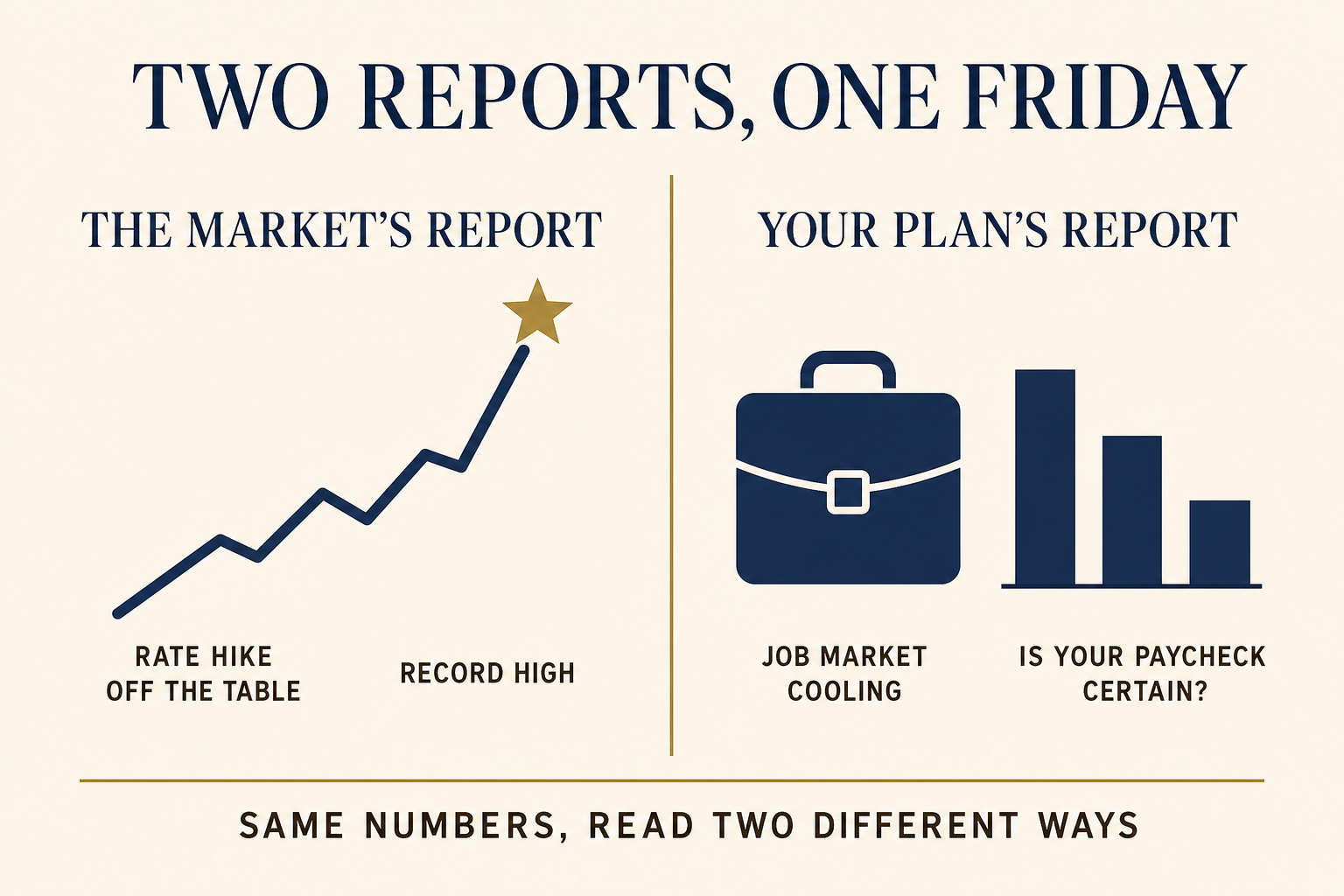
Here’s where I want to separate two things that Friday jammed together: the market’s reaction and your plan’s reality. They are reading two different reports off the same page.
If you’re retired and living off your portfolio, a record high driven by rate-cut hopes does not change what you can safely spend. Your withdrawal rate is set by your plan, not by whichever way the market chose to interpret the morning’s data. Chasing a rally — spending more because the statement looks great this week — is exactly the behavior that sequence-of-returns risk punishes when the mood turns.
If you’re still working and within a few years of retirement, the relevant part of Friday’s report isn’t the record close at all — it’s the cooling labor market underneath it. The whole reason the market rallied is a signal that jobs are getting harder to come by. If your plan quietly assumes you’ll keep earning until 65 or 67 to bridge to a larger Social Security benefit, a softening job market is the line item that actually deserves your attention. The market’s celebration and your plan’s real risk were pointing in opposite directions on the same Friday.
This is exactly what the Now, Soon, Later bucket framework is built to absorb. Your Soon bucket — the guaranteed income floor from Social Security, any pension, and income-focused annuities — pays the same whether the market cheered the jobs number or jeered it. Your Now bucket covers near-term spending so you’re never forced to sell into whatever the next “good news is bad news” whipsaw brings. A guaranteed income floor is the thing that lets you read a bad-news rally with genuine indifference, because your bills don’t depend on decoding it.
A tale of two reports (hypothetical)
Consider a hypothetical couple, Marcus and Renee, both 62, near Charlotte. Marcus still works; Renee retired last year. When their brokerage statement pinged a record high on Friday, they felt a jolt of “maybe we’re further ahead than we thought — maybe Marcus can hang it up early too.”
But look at what the same report says about their actual plan. Their strategy is for Marcus to keep working until 67 so they can delay his Social Security to a larger benefit and give Renee a bigger survivor benefit down the road — the highest-leverage move on their table. The part of Friday’s report that touches that plan isn’t the S&P’s record. It’s the 23,000 lost jobs and the five-year low in participation, because those speak to how dependable Marcus’s paycheck-to-67 really is. The disciplined read isn’t “the market says we’re ahead, let’s spend.” It’s “the market cheered a soft job market — is our bridge income as solid as we’re assuming?” Same report, opposite lessons, depending on whether you’re the market or the household.
If Marcus and Renee want to pressure-test that bridge instead of guessing at it, the move isn’t to react to a headline — it’s to model it. A tool like ProjectionLab lets you run your own plan against a scenario where the working years get cut short, and see how much your “will this hold” risk actually moves — often less than a dramatic Friday makes it feel. (ProjectionLab is an affiliate partner; if you subscribe through that link, Confluence Media Group may earn a commission at no additional cost to you. I only point readers toward tools I’d actually use.)
The bottom line
The market and your retirement were reading two different reports on Friday. The market read “the Fed might finally ease” and hit a record. Your plan should read “the job market is cooling” and ask a quieter question: does anything I’m counting on depend on a paycheck that’s getting less certain? A record high built on bad news is neither a reason to celebrate nor a reason to hide. It’s a reminder that the market’s mood and your plan’s math are two different things — and the whole point of a guaranteed income floor is that you get to stop needing them to agree.
Key takeaways
- “Bad news is good news” is about the Fed, not the economy. Stocks rallied to a record on a weak jobs report because the softness took a September rate hike off the table — cheaper money lifts asset prices even as the real economy cools.
- The unemployment “improvement” was a mirage. The rate fell to 4.1% only because people left the labor force; participation hit a five-year low and wage growth (3.2%) is trailing inflation.
- Regimes flip. The same easy-money logic that lifted stocks can reverse the instant inflation data (this week’s CPI) runs hot — a record built on Fed hopes rests on shakier ground than the number suggests.
- The market’s reaction isn’t your plan’s signal. If you’re retired, a rate-cut rally doesn’t change your safe spending; if you’re still working, the cooling job market — not the record close — is the part of the report that touches your plan.
- A guaranteed income floor makes the whole debate optional. When your Soon bucket covers the bills, you don’t need to know whether today’s bad news is good news.
Frequently asked questions
Why does the stock market go up on bad economic news?
Because a stock price reflects expected future earnings measured against interest rates. When weak data makes the Federal Reserve more likely to hold or cut rates, the present value of those future earnings rises — so prices can climb even as the economy weakens. It’s a sign the market is trading on Fed policy rather than fundamentals.
Does a record high mean it’s safe to spend more in retirement?
No. Your safe spending is a function of your plan — your income floor, your withdrawal rate, and your time horizon — not of this week’s market mood. Raising your spending because the statement looks good is precisely the behavior that gets punished when the mood turns.
Should I change my investments based on the jobs report?
For most retirement savers, no. A single data point rarely justifies a portfolio change, and market timing is notoriously hard to get right twice — you have to be correct on both the exit and the re-entry. If the report reveals something specific to your plan — like a labor market that makes “work until 67” less certain — that’s worth modeling, but it’s a planning question, not a trading one.
This article is published by Confluence Media Group LLC, an independent publisher of educational financial content. Thomas Clark is a Series 65 Investment Advisor Representative. The information provided is for educational and informational purposes only and is not personalized financial, tax, or legal advice. Past performance does not guarantee future results. All investing involves risk, including potential loss of principal. Consult a qualified professional before making financial decisions.
Confluence Media Group LLC is a separate entity from Confluence Capital Management, the investment advisory practice through which Thomas Clark provides advisory services. Advisory services are not offered through this publishing platform.
About Thomas Clark
Thomas Clark is the founder of Confluence Media Group LLC and a Series 65 Investment Advisor Representative. He has spent nearly two decades working with families on retirement planning, with a focus on Social Security optimization, retirement income coordination, and the bucket planning approach to building a guaranteed income floor.
Thomas writes and publishes at thomasclarkadvisor.com and is the author of The Just in Case Binder — a 148-page printable family financial organizer for households who want to make sure the people they love know where everything is.
He lives in North Carolina with his family.
Subscribe to the weekly newsletter · Get the Just in Case Binder

Thomas Clark is a Series 65 licensed investment advisor and experienced trader. He specializes in investing, retirement planning, and market analysis, helping individuals build wealth and make informed financial decisions.
