
The Fed Meets This Week. Your Plan Shouldn’t Flinch.
The Fed meets July 28-29, and under Chair Warsh it won't signal its next move. Here's why a retiree with a guaranteed income floor can watch the meeting and calmly do nothing.

The Federal Reserve meets on Tuesday and Wednesday this week, and on Wednesday afternoon it will tell us whether it’s moving interest rates. Between now and then, financial television will run a countdown clock, and a small army of analysts will spend the week combing every scrap of Fed commentary for a hint about what comes next.
If you’re living on your retirement savings, here’s my honest take on the whole spectacle: watch it the way you’d watch a weather forecast for a city you don’t live in. Mildly interesting. Not something you act on.
That isn’t complacency. It’s the entire point of building a retirement income plan that doesn’t depend on guessing what the Fed does next. And this year there’s an added reason the guessing is pointless — the Fed, under its new chair, has largely stopped dropping the hints everyone is straining to hear. Let me walk through what’s actually happening this week, and why a well-built plan barely notices.
What’s actually on the table this week
Start with the facts, because they’re calmer than the coverage. Economists and interest-rate markets broadly expect the Fed to leave its benchmark rate right where it is — a target range of 3.50% to 3.75% — which would make this the fifth straight meeting with no change. The decision comes Wednesday afternoon, July 29.
What’s unusual in 2026 isn’t the likely hold. It’s the direction of the argument. For most of the past two years the debate was some version of “when do the cuts start.” Right now, with inflation still running around 3.5% — above the Fed’s 2% goal — the live question is closer to the opposite: whether the next move, whenever it comes, is another hike rather than a cut. After the June meeting, market pricing put roughly a one-in-four chance on a hike at this very meeting. That’s a different world from the one where everyone assumes rates only go down from here. If you want the fuller picture on why one cool inflation report didn’t settle that debate, I covered it in why one good inflation report isn’t the all-clear.
The twist nobody’s pricing in: a Fed that won’t tip its hand
Here’s the part that makes this week genuinely different, and it has nothing to do with the rate itself.
For years, the Fed practiced what it called forward guidance — deliberately telegraphing its likely future moves so markets wouldn’t be caught off guard. The projections, the carefully worded statement, the chair’s choreographed press conference: much of it existed so you could read the tea leaves and see the next move coming. An entire cottage industry grew up around interpreting those signals.
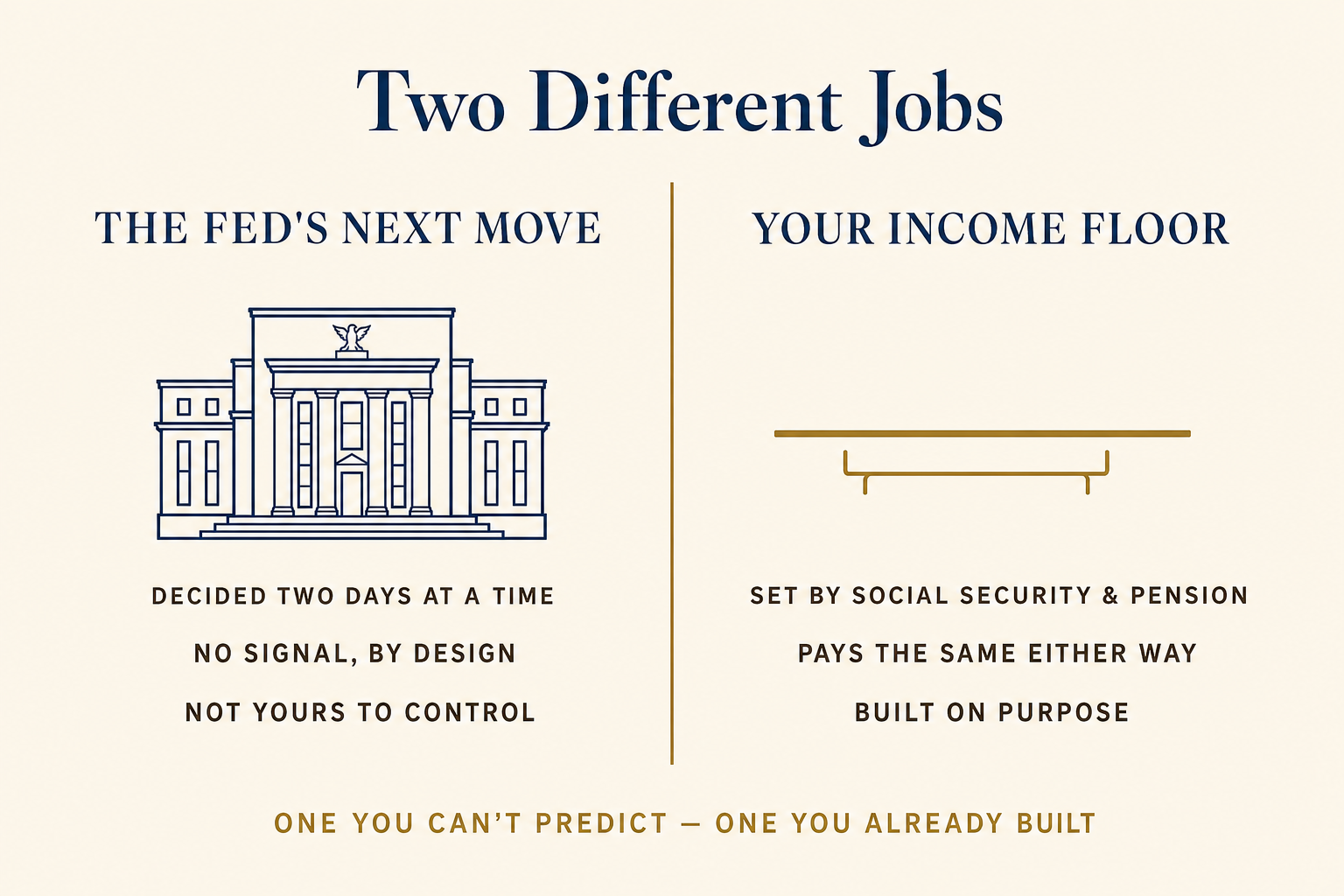
Chair Kevin Warsh, who took over the Fed this spring, has made a point of stepping back from that approach. In his testimony to Congress and in his first meetings running the committee, he has said plainly that the Fed will lean away from handing markets a roadmap of where rates are heading. The reasoning is that a central bank shouldn’t pre-commit to a path; it should respond to the data as it actually arrives.
You can debate whether that’s good policy. But the practical consequence for you is simple, and a little freeing: there is no signal to trade. The whole ritual of repositioning a portfolio around what the Fed hinted at collapses when the Fed stops hinting. You cannot front-run a decision the Fed itself says it hasn’t made yet.
Why a rate decision barely touches a retirement income plan
Set the meeting aside for a moment and look at where your money actually lives. If you run your retirement on a Now, Soon, and Later bucket structure, a single rate decision touches each bucket far less than the headlines imply.
Your Soon bucket — the guaranteed income floor built from Social Security, any pension, and income-focused annuity payments — is the part that pays your essential bills, and it does not move when the Fed does. Social Security is set by its own formula and annual cost-of-living adjustment. A pension check is a pension check. Annuity income you’ve already turned on is fixed by the contract. Whatever the Fed announces Wednesday, the money that covers your groceries and your mortgage lands in your account exactly the same. That is the whole reason I lean so hard on sizing the income floor carefully in the first place.
Your Now bucket — the cash and short-term reserves — has actually been a quiet beneficiary of the Fed holding rates higher for longer. As I wrote when cash finally started paying again, short-term savings, Treasury bills, and CDs are yielding more than they have in years precisely because the Fed hasn’t cut. A continued hold is good news for that bucket, not bad.
Your Later bucket — the growth money — is invested for a decade or more. It is the last thing that should be traded around a two-day meeting. One rate decision is noise on a fifteen-year chart.
What actually deserves a few minutes of your attention
None of this means you should be a total bystander. There are a couple of genuinely useful things to review this week — calmly, and none of them involve reacting to the announcement itself.
First, if higher-for-longer holds, the strong short-term yields in your Now bucket are likely to stick around a while — a good moment to make sure that cash is actually earning it, and to think about laddering Treasury bills or CDs so you’re not forced to reinvest everything at once if rates eventually turn. Second, the flip side of the same coin: if you own long-term bond funds, a Fed that might hike rather than cut is exactly the interest-rate risk I laid out in why rising rates hurt bond funds — worth knowing what duration you’re holding before rates move, not after.
Neither of these is a “buy or sell today” call. They’re maintenance you can do with a cup of coffee, on your own schedule, whether or not the Fed touches anything Wednesday. The difference between maintenance and market timing is that maintenance doesn’t care what day it is.
Thomas’ Take: The old game was to guess the Fed’s next move before the crowd did. The new Fed just told you it isn’t playing that game. That’s not a problem to solve — it’s permission to stop trying. Build an income floor that pays you no matter what the committee decides, and Fed week goes from a stress test to a non-event.
The trade not to make
Consider a hypothetical couple: Walt and Carol, both 67, retired last year near Sarasota. About $4,800 of their monthly essentials is covered by Social Security plus Walt’s small pension — their Soon-bucket floor. They keep roughly two years of spending in the Now bucket and about $700,000 in a diversified Later bucket they haven’t started drawing on.
Reading that the Fed might hike this week, Walt gets an itch. His logic runs like this: if rates go up, stocks usually take it on the chin, so why not move a big slice of the Later bucket to cash now and buy back in after the dust settles? It sounds prudent. It’s market timing in a cardigan.
Walk it through their actual plan and the itch fades. Their essentials are already covered by guaranteed income, so nothing the Fed does Wednesday changes their cash flow this month or next. The Later bucket has a fifteen-year job; selling it to dodge a maybe-hike means guessing the decision, then guessing the market’s reaction to it, then guessing when to climb back in — three coin flips in a row, with real money and a real tax bill riding on each. If Walt is genuinely tempted, the disciplined move isn’t to trade on a hunch — it’s to model it first. A tool like ProjectionLab lets you run your own plan against different rate and market paths and watch how much your “will I run out” risk actually moves — usually far less than a nervous week makes it feel. (ProjectionLab is an affiliate partner; if you subscribe through that link, Confluence Media Group may earn a commission at no additional cost to you. I only point readers toward tools I’d actually use.)
Walt and Carol looked, saw that a hold or a hike barely nudged their plan, and did the hard, boring, correct thing: nothing to the floor, a quick check that the cash was earning its keep, and the Later bucket left alone. The plan had already answered the question the Fed was about to raise.
Key takeaways
- A hold is the widely expected outcome. Economists and markets broadly look for the Fed to stay at 3.50–3.75% this week — its fifth straight pause — with the live debate being hold-versus-hike, not when cuts begin.
- There’s no roadmap to trade. Under Chair Warsh, the Fed has stepped back from forward guidance, so the signal-reading ritual has nothing left to read.
- A rate decision barely touches a bucket plan. Your guaranteed income floor doesn’t move, higher-for-longer actually helps your cash, and your growth money is invested for years, not days.
- The useful work this week is quiet maintenance — check that your cash is earning, know the duration of any bond funds — not reacting to the announcement.
- The most expensive move is repositioning your portfolio to front-run a decision the Fed itself hasn’t made.
Frequently asked questions
Will the Fed raise or cut rates this week?
Most economists and market pricing point to no change — a continued hold in the 3.50–3.75% range. The more honest answer is that no one knows for certain, and the Fed has deliberately stepped back from signaling its next move in advance. Treat any confident prediction, in either direction, with skepticism.
If rates might rise, should I move out of stocks before the meeting?
Selling a long-term growth allocation to dodge a possible rate move requires being right three times: about the decision, about the market’s reaction, and about when to buy back in. A plan that separates guaranteed income from growth is built precisely so you don’t have to win those bets. If a single meeting would change your allocation, the issue is the plan’s design, not the meeting.
Does a Fed hold help or hurt retirees?
For anyone holding cash, higher-for-longer rates mean short-term savings, Treasury bills, and CDs keep paying more than they did for most of the last decade — a genuine plus for your Now bucket. The trade-off is that borrowing stays expensive, which matters more if you’re carrying variable-rate debt than if you’re living off a paid-for plan.
A Fed meeting is a big deal for the economy and a small deal for a well-built retirement. The Fed’s job is to steer the whole ship; your job is much narrower — to build a plan that doesn’t lurch every time the captain adjusts course. This week, under a chair who’s decided to stop announcing his next turn in advance, the reward for having done that work is simple: you get to read Wednesday’s headline, nod, and go back to your afternoon. The plan already knew what to do.
This article is published by Confluence Media Group LLC, an independent publisher of educational financial content. Thomas Clark is a Series 65 Investment Advisor Representative. The information provided is for educational and informational purposes only and is not personalized financial, tax, or legal advice. Past performance does not guarantee future results. All investing involves risk, including potential loss of principal. Consult a qualified professional before making financial decisions.
Confluence Media Group LLC is a separate entity from Confluence Capital Management, the investment advisory practice through which Thomas Clark provides advisory services. Advisory services are not offered through this publishing platform.
About Thomas Clark
Thomas Clark is the founder of Confluence Media Group LLC and a Series 65 Investment Advisor Representative. He has spent nearly two decades working with families on retirement planning, with a focus on Social Security optimization, retirement income coordination, and the bucket planning approach to building a guaranteed income floor.
Thomas writes and publishes at thomasclarkadvisor.com and is the author of The Just in Case Binder — a 148-page printable family financial organizer for households who want to make sure the people they love know where everything is.
He lives in North Carolina with his family.
Subscribe to the weekly newsletter · Get the Just in Case Binder

Thomas Clark is a Series 65 licensed investment advisor and experienced trader. He specializes in investing, retirement planning, and market analysis, helping individuals build wealth and make informed financial decisions.
