
One Good Inflation Report Isn’t the All-Clear
June inflation cooled to 3.5%, and the headlines called it a turning point. Here's what one good CPI report actually changes for a retirement income plan — and why the answer is: very little.

The June inflation report landed last week, and the number was better than almost anyone expected. Consumer prices fell 0.4% for the month, pulling the annual rate down to 3.5% from 4.2% in May — a full step below the 3.8% economists had penciled in. The financial press did what it usually does with a surprise like that. It called a turning point.
I’d be careful with that.
One cool report is not a trend, and a single month of relief doesn’t change how you should be running a retirement income plan. If anything, the way this number got reported is a more useful lesson than the number itself: markets and headlines swing hard on one data point, and a plan built to swing with them is a plan that will wear you out. Here’s what the June report actually said, what it didn’t, and why your retirement income shouldn’t move much in either direction.
What the June report actually said
The headline was genuinely encouraging. According to the Bureau of Labor Statistics, the Consumer Price Index dropped 0.4% in June, its first monthly decline in a while, and the 12-month rate eased to 3.5%. That’s the first real cooldown since inflation re-accelerated above 4% earlier this year.
But look one layer down and the picture gets more honest. Almost all of the improvement came from energy, which fell 5.7% on the month — its biggest one-month drop since April 2020 — as gas prices came down. Strip out food and energy, and “core” inflation was flat for the month, leaving the annual core rate at 2.6%. Shelter rose just 0.1% and transportation services actually slipped. Good news, all of it. But energy is the single most volatile line in the whole index, and a month led by falling gas prices is not the same thing as inflation being solved.
Why one month isn’t the all-clear
You don’t have to take my word that a single report doesn’t settle anything. The Federal Reserve said so itself. It left its policy rate at 3.50–3.75% and, in the days after the report, Governor Christopher Waller was explicit that it would take several months of readings like this to convince him inflation is genuinely heading back to the 2% target. The market’s own expectation is still that the Fed’s next move could be a hike in September, not a cut — and the next Fed meeting is July 28–29.
That’s the part the “inflation is beaten” headlines skip. The same energy swing that pulled June’s number down can reverse just as quickly the next time oil moves. Core inflation — the part that actually tells you where the trend is heading — didn’t fall at all. One data point in the right direction is a reason for cautious relief. It is not a reason to rebuild a plan around.
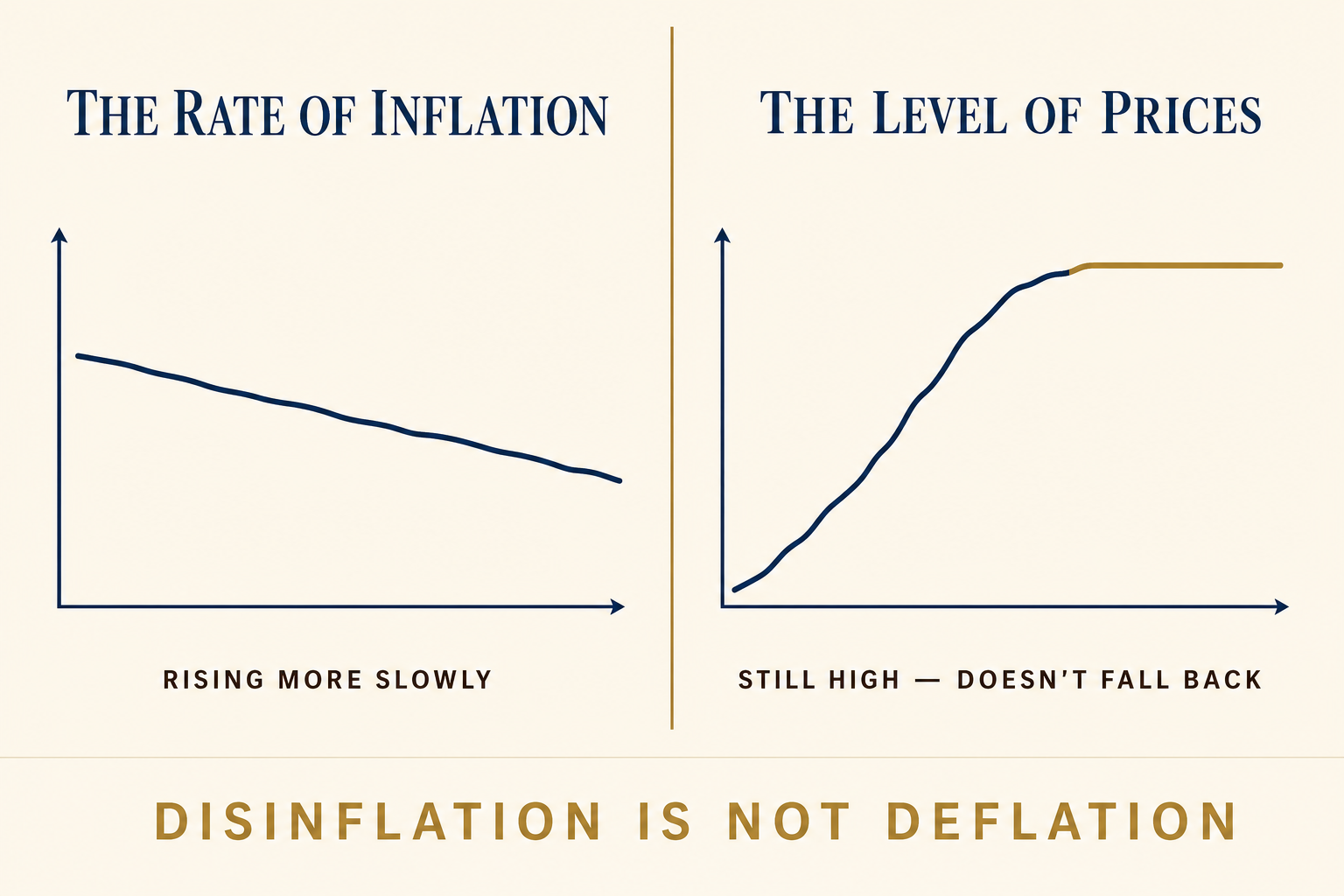
Disinflation is not deflation
Here’s the distinction that matters most for anyone living on their money, and it’s the one the reporting almost never makes clearly. A falling rate of inflation does not mean falling prices. It means prices are still rising — just more slowly. The cumulative jump of the past few years is already baked into what you pay at the register today, and it does not come back down.
Cooler inflation is a smaller raise on next year’s grocery bill, not a refund on this year’s. If you retired three years ago, your fixed costs have quietly reset to a permanently higher level, and a good CPI print doesn’t undo that. It only slows how fast the number climbs from here. I wrote more about that erosion in what inflation actually erodes in retirement — the short version is that the danger isn’t a single scary month, it’s the slow compounding of “normal” inflation across a 25- or 30-year retirement.
Thomas’ Take: Celebrating a cooler inflation rate is like celebrating that your car is now speeding up more slowly. You’re still going faster than you were. The prices didn’t fall — the acceleration did. Build your plan for the level, not the headline.
What it means for your income plan
If you run your retirement on a Now, Soon, and Later bucket structure, the June report changes almost nothing, because the plan already answers the inflation question in three places rather than reacting to one number.
The only income source that automatically keeps pace with inflation is Social Security, through its annual cost-of-living adjustment. Pensions and basic annuity income are usually fixed for life, which means inflation slowly erodes them — one reason I lean on sizing the guaranteed income floor carefully and treating the growth-oriented Later bucket as the real long-run inflation hedge. Your defense against rising prices was decided when you built the plan, not when the CPI came out.
There’s a wrinkle worth knowing, too. The same cooling that eases your grocery bill also means a smaller Social Security raise next year, because the annual COLA is calculated from summer inflation data. Lower summer inflation, smaller COLA. The relief on your spending and the shrinkage of your raise partly offset each other — which is exactly why a single print is nothing to either celebrate or mourn. If you want the fuller version of why the inflation you feel rarely matches the headline number, I laid it out in the gap between headline inflation and your grocery bill.
The trade not to make
The real risk after a report like this isn’t the inflation. It’s the temptation to do something about it. The story practically writes itself: inflation is cooling, rate cuts must be coming, so move money back into long-term bonds and rate-sensitive positions before everyone else does. That is trading a headline, and the Fed just told you it isn’t there yet.
Repositioning a whole retirement plan on one CPI print is market timing wearing a more respectable coat. The Fed’s rate decisions matter for how you build guaranteed income over time, but they are not a signal to jump in and out of the market — and as I noted in the first-half market recap, the retirees who did best this year were the ones who did the least. If you are genuinely tempted to shift your allocation on the news, the honest move is to model it before you touch anything. A tool like ProjectionLab lets you run your own plan against different inflation paths, withdrawal orders, and rate scenarios and watch how the “will I run out” risk actually moves — usually far less than a single day’s headline suggests. (ProjectionLab is an affiliate partner; if you subscribe through that link, Confluence Media Group may earn a commission at no additional cost to you. I only point readers toward tools I’d actually use.)
A hypothetical that shows the difference
Consider a hypothetical couple: Gene and Paula, both 68, retired outside Charlotte. Their roughly $5,200 in monthly essentials is fully covered by Social Security plus a small pension — their Soon-bucket income floor. They keep about two years of spending in the Now bucket and roughly $650,000 in a diversified Later bucket they aren’t drawing on yet.
When the June report hit, Paula read three articles saying rate cuts were on the way and floated moving a big slice of the Later bucket into long-term bonds “to lock in before the Fed turns.” It’s a reasonable-sounding instinct. But walk it through their actual plan and it falls apart: their essentials are already covered by guaranteed, COLA-protected income, so a cooler CPI doesn’t threaten their cash flow this year, and a smaller COLA next year is a rounding error against a floor that’s already built. The Later bucket exists to grow over a decade-plus horizon, not to be repositioned every time the Fed’s path looks a little clearer. They did nothing — and “nothing” was the correct, deliberate answer, because the plan had already pre-answered the question the headline was asking.
Key takeaways
- One report is not a trend. June’s 3.5% reading was real and encouraging, but core inflation was flat and most of the drop was volatile energy prices.
- The Fed isn’t declaring victory, and neither should you. Officials want several months of good data, and the next move may still be a hike rather than a cut.
- Disinflation is not deflation. A falling inflation rate slows how fast prices rise — it doesn’t lower the prices you already pay.
- Your plan already handles this. A COLA-protected income floor plus a growth-oriented Later bucket is the inflation defense — not a reaction to any single print.
- Don’t trade the headline. Repositioning your allocation on one CPI report is market timing with better PR.
Frequently asked questions
Does a cooler inflation report mean the Fed will cut rates soon?
Not on the strength of one month. The Fed has signaled it wants to see several consecutive readings before it’s convinced inflation is headed sustainably to 2%, and market expectations still lean toward a possible hike this year rather than a cut. Treat any confident prediction of the Fed’s next move — in either direction — with skepticism.
Should I change my retirement plan after a good CPI report?
As a rule, no. A well-built plan is designed to hold up across a range of inflation and interest-rate environments, which is the entire point of separating guaranteed income from growth. If a single data point would change your allocation, the issue is the plan’s design, not the data.
A cooler CPI means a smaller Social Security COLA. Is that bad?
It’s a trade-off, not a loss. The COLA is meant to track the cost of living, so a smaller raise generally comes alongside slower price increases. The two move together by design. What you don’t want is a large COLA driven by high inflation — that “raise” is just your check trying to catch up to a more expensive world.
The discipline that gets tested on a day like this isn’t complicated. It’s the willingness to read a good headline, nod, and change nothing. A retirement plan isn’t supposed to react to the news — it’s supposed to make the news optional. If June’s report left you reaching for the phone to call your custodian, that’s worth noticing. The plan that works is the one that already knew what to do before the number came out.
This article is published by Confluence Media Group LLC, an independent publisher of educational financial content. Thomas Clark is a Series 65 Investment Advisor Representative. The information provided is for educational and informational purposes only and is not personalized financial, tax, or legal advice. Past performance does not guarantee future results. All investing involves risk, including potential loss of principal. Consult a qualified professional before making financial decisions.
Confluence Media Group LLC is a separate entity from Confluence Capital Management, the investment advisory practice through which Thomas Clark provides advisory services. Advisory services are not offered through this publishing platform.
About Thomas Clark
Thomas Clark is the founder of Confluence Media Group LLC and a Series 65 Investment Advisor Representative. He has spent nearly two decades working with families on retirement planning, with a focus on Social Security optimization, retirement income coordination, and the bucket planning approach to building a guaranteed income floor.
Thomas writes and publishes at thomasclarkadvisor.com and is the author of The Just in Case Binder — a 148-page printable family financial organizer for households who want to make sure the people they love know where everything is.
He lives in North Carolina with his family.
Subscribe to the weekly newsletter · Get the Just in Case Binder

Thomas Clark is a Series 65 licensed investment advisor and experienced trader. He specializes in investing, retirement planning, and market analysis, helping individuals build wealth and make informed financial decisions.
