
The First Half of 2026: A Market Recap for Retirees
The S&P 500 closed its best first half in five years — and inflation climbed back above 4% for the first time in three years. Here's what the first half of 2026 actually means for a retirement plan, and why structure beat luck.

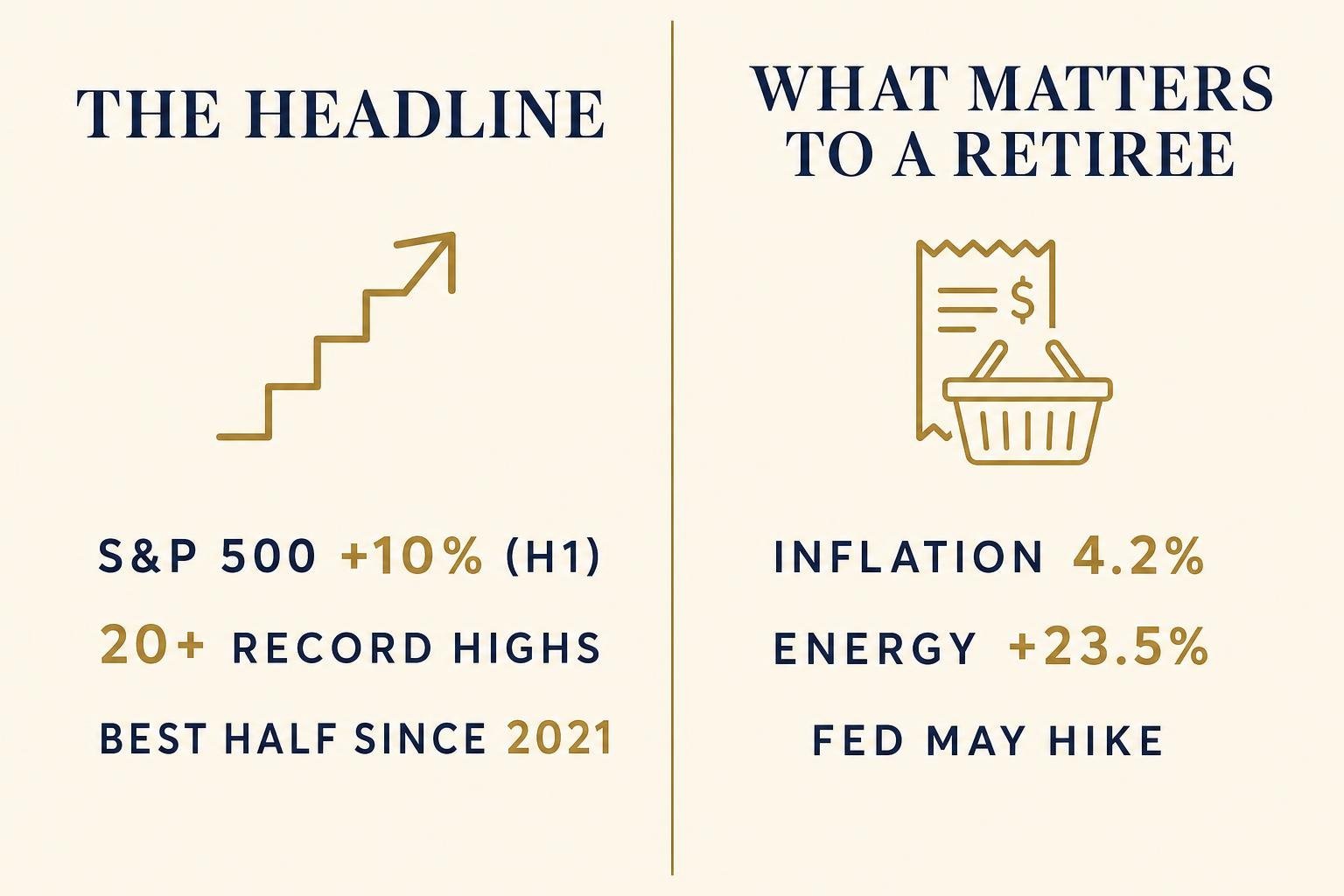
The S&P 500 just closed its best first half in five years. Inflation just climbed back above 4% for the first time in three years. Both of those things are true, and only one of them shows up on your account statement.
That gap is the whole story of the first half of 2026. If you looked only at your portfolio balance on June 30, you had a very good six months. If you looked only at your grocery bill, your utility statement, or the price at the pump, you had a rough one. A retirement plan has to account for both numbers — and most of the mid-year recaps you’ll read this month only mention the first one.
So here’s the first half of 2026 as it actually matters to someone who is living on their money rather than just watching it grow. Four storylines, and what each one means for the way you’ve structured your retirement.
The headline: a record-setting first half, powered by a very narrow engine
The top-line number was genuinely strong. The S&P 500 finished the first half of 2026 up roughly 10%, its best first half since 2021, and the second quarter was the strongest three-month stretch for U.S. stocks since 2020. The index crossed 7,600 for the first time in early June and set more than 20 record closing highs along the way.
Read that fast and it sounds like a broad boom. It wasn’t. Almost the entire move came from one place: the artificial-intelligence and semiconductor trade. Chip stocks now make up around 20% of the S&P 500 — the highest share on record, and roughly four times what it was in 2020. When a single slice of the market gets that large, the index stops telling you how “the market” did and starts telling you how a handful of very big companies did.
That matters for a retiree in a specific way. A record-high index built on narrow leadership is more fragile than the number suggests, because the same concentration that drove it up on the way in can drive it down on the way out. We got a preview in early-to-mid June, when the AI trade cracked and the Nasdaq fell 4% in a single session — its worst day in more than a year — before recovering. Records and air pockets, in the same quarter, from the same source. (If the record highs themselves have you wondering what to do, I wrote a whole piece on what a retiree should actually do when the market keeps setting records.)
None of that is a reason to sell anything. It’s a reason to know what your growth money is actually resting on, which is the entire point of keeping it in a clearly defined Later bucket rather than treating your whole balance as one undifferentiated pile.
The number under the number: inflation came back
Here’s the line that didn’t make most of the celebratory headlines. Consumer prices rose 4.2% over the year through May 2026 — up from 3.8% in April, and the first reading above 4% in three years. The Federal Reserve’s preferred measure, core PCE, hit 3.4%, its highest since late 2023. This wasn’t a blip; it was the third straight month of acceleration.
The driver was energy. A supply shock tied to the conflict with Iran pushed energy prices up roughly 23.5% over the year, and that fed straight into the headline number. (This is the rare case where a geopolitical event actually reaches your budget — I drew that line in an earlier piece on when geopolitics actually matters to your portfolio.) Energy is exactly the kind of expense that hits a retiree’s budget without asking permission — you can defer a vacation, but you can’t defer heating the house or filling the tank.
This is the number I’d circle if you only circled one. A 10% gain in your Later bucket is pleasant, but you weren’t going to spend that money this year anyway. A 4.2% rise in the cost of the things you buy every week is a direct tax on your standard of living, and it compounds. I wrote earlier this year about what inflation actually erodes in retirement — the short version is that it doesn’t hit every line of your budget equally, and the lines it hits hardest are often the ones you can’t cut.
The Fed changed its posture — and its chair
The first half also brought a genuine shift in monetary policy, and not the one most people expected coming into the year. At its June meeting — the first led by new chair Kevin Warsh — the Federal Reserve held its benchmark rate steady at a range of 3.50% to 3.75% and, more tellingly, stripped out the language that had signaled a bias toward future cuts. The Committee’s own median projection for where rates end 2026 moved up to 3.8%, from 3.4% earlier in the year. In plain terms: the Fed spent the start of the year expected to cut, and left the first half hinting it might hike.
That’s a meaningful reversal, and it flows directly from the inflation story above. A central bank watching prices re-accelerate does not cut rates into the pressure. For anyone who wants to understand why each of these decisions ripples through your income, I broke down the Fed’s dual mandate in an earlier piece.
The bond market took the hint. The 10-year Treasury yield spent the first half hovering in the 4.3% to 4.5% range and sat near 4.5% as July opened. For a retiree, higher-for-longer rates cut both ways: they’re uncomfortable for the growth side of a portfolio, but they’re a gift for the guaranteed-income side. When rates are elevated, the instruments that build a Soon-bucket income floor — Treasury ladders, and the income-focused Fixed Index Annuities I use for guaranteed income rather than growth — are priced more generously than they were two years ago. A period like this is a buying window for income, not a reason to wait.
What a retiree should actually take from the first half
Put the four storylines together and you get a market that is expensive and narrow at the top, an inflation rate that is quietly eating purchasing power at the bottom, and a Fed that has stopped promising relief. That combination is exactly the environment bucket planning was built for, and it’s worth walking through why.
Consider a hypothetical case. Raj and Meera, both 67, are retired outside Charlotte. Their essential expenses run about $5,400 a month. That entire number is covered by Social Security plus a small pension plus an income rider — their Soon bucket. They keep about two years of spending in cash and short-term bonds — their Now bucket. The rest, a little over $700,000, sits in a diversified Later bucket that had a strong first half riding the same market everyone else did.
Now run the first half of 2026 through their plan. The record highs? Nice, but irrelevant to this year’s cash flow — that money isn’t being touched. The 4.2% inflation print? It raises their grocery and energy costs, but their guaranteed floor is doing its job, and Social Security’s annual cost-of-living adjustment is designed to track inflation over time (you can see how that works at the SSA’s COLA page). The Fed maybe hiking? It stings their bond holdings a little and helps the next tranche of income they buy. At no point in that first half were they forced to sell a growth asset to pay a bill. That’s the whole game. This isn’t a lucky outcome — it’s an engineered one, and it’s the same defense I described in the piece on sequence-of-returns risk.
Contrast that with the retiree who runs their whole balance as one pool and draws from it monthly. For that person, a record-high, narrowly-led market plus re-accelerating inflation is a genuine problem: every withdrawal in a shaky quarter is a forced sale, and every month of 4%+ inflation quietly raises the amount they have to pull. Same market, same six months, completely different experience — because of structure, not luck.
Thomas’ Take: The record highs were the least important number in the first half of 2026. The 4.2% inflation print was the most important one. If your plan reacts loudly to the first and shrugs off the second, you’ve got the two backwards.
Heading into the second half
I won’t tell you what the market does next — nobody knows, and anyone who says otherwise is selling something. What I’ll tell you is that the second half of 2026 starts with stocks priced for a lot of good news, inflation still above the Fed’s target, and a central bank that has removed its safety net. That’s not a forecast of trouble; it’s a description of a plan that needs to hold whether the next six months are calm or not.
The mid-year mark is a good moment to stress-test that plan against the numbers we actually have, rather than the ones you hope for. This is the kind of thing worth modeling instead of eyeballing. I use and recommend ProjectionLab for exactly this — it lets you run your plan against a higher-inflation, higher-for-longer-rates scenario and see whether your income floor still covers your essentials before you need it to. (Disclosure: that’s an affiliate link. If you subscribe through it, Confluence Media Group may earn a commission at no extra cost to you. I only recommend tools I actually use.)
The first half of 2026 was, for most portfolios, a good six months. It was also a warning about purchasing power that arrived wrapped in celebration. A well-built retirement plan lets you hold both of those truths at once — collect the gains without leaning on them, and absorb the inflation without panicking over it. That’s not caution for its own sake. That’s the difference between watching the market and living off it.
Key takeaways
- Stocks had their best first half since 2021 (+~10%), but the gains were narrow — chip stocks are now a record ~20% of the S&P 500, which makes a record-high index more fragile than it looks.
- Inflation returned, hitting 4.2% in May — its highest in three years, driven by a roughly 23.5% jump in energy costs. For a retiree, this number matters far more than the index.
- The Fed pivoted from expected cuts toward a possible hike, holding at 3.50%–3.75% and lifting its year-end rate projection to 3.8%. Elevated rates are a buying window for guaranteed income.
- Structure beat luck. A retiree with a funded Soon-bucket income floor experienced this half completely differently from one drawing from a single undifferentiated pool.
This article is published by Confluence Media Group LLC, an independent publisher of educational financial content. Thomas Clark is a Series 65 Investment Advisor Representative. The information provided is for educational and informational purposes only and is not personalized financial, tax, or legal advice. Past performance does not guarantee future results. All investing involves risk, including potential loss of principal. Consult a qualified professional before making financial decisions.
Confluence Media Group LLC is a separate entity from Confluence Capital Management, the investment advisory practice through which Thomas Clark provides advisory services. Advisory services are not offered through this publishing platform.
About Thomas Clark
Thomas Clark is the founder of Confluence Media Group LLC and a Series 65 Investment Advisor Representative. He has spent nearly two decades working with families on retirement planning, with a focus on Social Security optimization, retirement income coordination, and the bucket planning approach to building a guaranteed income floor.
Thomas writes and publishes at thomasclarkadvisor.com and is the author of The Just in Case Binder — a 148-page printable family financial organizer for households who want to make sure the people they love know where everything is.
He lives in North Carolina with his family.
Subscribe to the weekly newsletter · Get the Just in Case Binder

Thomas Clark is a Series 65 licensed investment advisor and experienced trader. He specializes in investing, retirement planning, and market analysis, helping individuals build wealth and make informed financial decisions.
