
You Got a Windfall. Which Bucket Does It Go In?
A sudden windfall — an inheritance, a home sale, a severance — isn't an investing question first. It's a bucket question. Here's how to slot it into Now, Soon, or Later.

A check clears. An inheritance settles. A house sells, or a severance package lands, or a business you spent thirty years building finally has a buyer. However it arrives, a large sum of money has a way of making people do one of two things — and both are usually wrong.
The first is to rush it into the market, because sitting in cash feels like waste. The second is to freeze, leave it in a savings account, and quietly let inflation chip away at it for two years while you “figure it out.” I’ve watched both play out, and the reason each goes sideways is the same: the person started with the wrong question.
The right first question isn’t “How should I invest this?” It’s “What job does this money need to do?” And in the Now/Soon/Later framework, that question has a structured answer.
Start with the job, not the investment
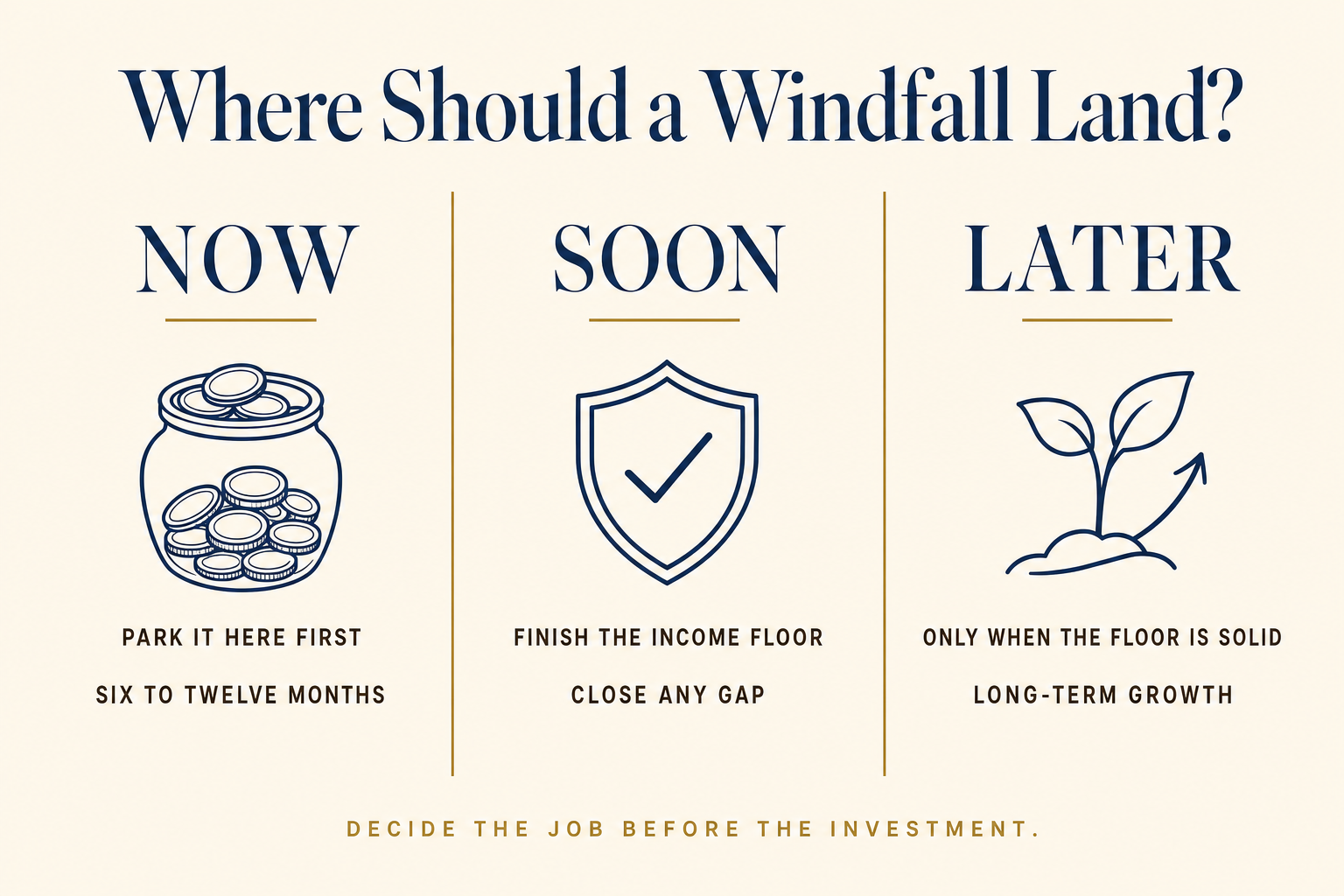
If you’ve read much of what I write, you know I organize retirement money into three buckets. The Now bucket holds current living expenses in cash and short-term instruments. The Soon bucket builds a guaranteed income floor from Social Security, pensions, and income-focused annuities. The Later bucket is long-term growth — market exposure aligned with your risk tolerance and your legacy goals.
Every bucket does a different job. The Now bucket buys groceries this year. The Soon bucket pays the bills you can’t afford to gamble on. The Later bucket grows money you won’t touch for a decade or more.
A windfall is not an asset class. It’s a pile of dollars looking for a job. So before you think about index funds or CDs or annuities, you decide which of those three jobs this money should take on. The investment choice comes second, and it flows naturally from the bucket you pick.
First, park it in the Now bucket — on purpose
Here’s the move almost nobody makes, and the one I’d make first: put the whole thing in the Now bucket temporarily. A high-yield savings account, a money market fund, a short T-bill. Then don’t touch it for six to twelve months.
This isn’t indecision. It’s a deliberate cooling-off period, and there’s a reason financial planners have a name for the mistakes people make right after a windfall — “sudden money” errors. Grief, in the case of an inheritance. Euphoria, in the case of a business sale. Pressure from a relative, a broker, or your own guilt about “doing something” with the money. None of those are good conditions for an irreversible decision involving six figures.
Parking the money costs you almost nothing. With cash still paying a real yield in 2026, a windfall sitting in a money market fund for a year isn’t dead weight — it’s earning while you think. The downside of waiting is small. The downside of a rushed, wrong, permanent decision is not.
So the first bucket a windfall goes in is almost always the Now bucket. The real question is where it goes next.
Then find where your plan actually has a gap
Once the dust settles, run one diagnostic before anything else: is your Soon bucket finished?
By finished, I mean this — do your guaranteed income sources (Social Security, any pension, any income annuity) cover your essential expenses? Rent or mortgage, utilities, food, insurance, the bills that show up whether or not the market cooperates. If guaranteed income covers those, your floor is built. If there’s a gap between your essential bills and your guaranteed income, that gap is the most important thing a windfall can fix.
This is where I part ways with the standard advice, which almost always steers a windfall toward growth — “put it in the market, you’ve got time.” For someone whose income floor already covers the essentials, that’s fine. But for someone with a gap, using a windfall to complete the income floor is worth more than a few points of expected return, because it changes how you experience every single day of retirement. A covered floor is the difference between watching a market drop with curiosity and watching it with dread.
When the windfall belongs in the Later bucket
If your income floor is already solid — essentials covered by guaranteed sources, a healthy Now bucket — then the windfall’s job is growth, and it belongs in the Later bucket. This is the “you’ve got time, invest it” scenario, and here that advice is actually right.
The only real question left is how to put it to work: all at once, or gradually? That’s a genuine debate with data on both sides, and I’ve covered the lump-sum-versus-dollar-cost-averaging question in its own post. The short version: investing it all at once tends to win on average, but easing in over several months can be the right call for your nerves — and staying invested matters more than the entry schedule. Either way, that’s a Later-bucket deployment decision, and it only comes up after you’ve confirmed the money isn’t needed to shore up the floor.
The tax tail that decides more than you’d think
One more layer, because a windfall’s tax character often decides which bucket it can efficiently serve. Not every dollar you receive is the same kind of dollar.
An inherited IRA arrives with strings. Under the SECURE Act, most non-spouse heirs must empty an inherited IRA within 10 years, and if the original owner had already started required minimum distributions, annual withdrawals are required during that window too — rules the IRS finalized and began enforcing in 2025. Every dollar you pull out is taxed as ordinary income. That changes the plan: an inherited IRA isn’t a lump you park, it’s a decade-long faucet you have to drain thoughtfully, ideally in your lower-income years.
Inherited taxable assets are the opposite story. A brokerage account or a house you inherit generally gets a “step-up” in cost basis to its value on the date of death, so decades of built-in gains can vanish for tax purposes — you can often sell an inherited stock or home with little or no capital gains tax (IRS Topic 409). And if you’re selling your own long-time home as the windfall, the home-sale exclusion can shield up to $250,000 of gain for a single filer or $500,000 for a married couple.
The point isn’t the mechanics — it’s that which account a windfall lives in changes how freely it can move between buckets. This is the same logic behind tax-aware bucketing: match the tax character of the dollar to the job you’re asking it to do.
A hypothetical to tie it together
Consider a hypothetical case. Ellen, 64, recently retired from a career in hospital administration outside Charlotte. Her mother passes away and leaves her $280,000 — roughly $180,000 in a traditional IRA and $100,000 in a taxable brokerage account. Ellen’s first instinct, echoed by a well-meaning brother-in-law, is to “just put it all in the market.”
Instead, she parks all of it in a money market fund and waits. Six months later, with a clearer head, she runs the diagnostic. Her Social Security (which she’s delaying to 67) plus a small pension will eventually cover most of her essentials — but not until she claims. Right now there’s a three-year gap.
So her buckets sort themselves out. The $100,000 taxable account — which stepped up in basis, so she can reposition it with little tax cost — becomes part of her Now-and-Soon plan, funding the bridge to her Social Security claim. The $180,000 inherited IRA becomes a 10-year drawdown she’ll spread across her lower-income years to avoid a tax spike, with whatever she doesn’t need for living expenses flowing into her Later bucket. Same $280,000. Completely different plan than “put it in the market” — because she started with the job, not the investment.
(Ellen is a hypothetical, and her numbers are illustrations, not a recommendation. Your own situation will differ.)
If you want to see how a windfall actually changes your plan — whether it’s better used to finish your income floor or to grow in the Later bucket — this is worth modeling rather than guessing at. A planning tool like ProjectionLab lets you drop a lump sum into different roles and see what each choice does to the odds your money lasts. (ProjectionLab is a paid tool; the link is an affiliate link, which means I may earn a small commission at no extra cost to you. I only recommend tools I’d use myself.)
Key takeaways
- A windfall isn’t an investing question first — it’s a bucket question. Decide the job before the investment.
- Park it in the Now bucket for six to twelve months on purpose. “Sudden money” decisions made fast are usually the ones people regret.
- Run one diagnostic: is your income floor finished? If guaranteed income doesn’t yet cover your essentials, closing that gap is the windfall’s highest use.
- Only send it to the Later bucket for growth once the floor is solid. Then the lump-sum-versus-ease-in question is the last decision, not the first.
- Check the tax character. An inherited IRA is a taxed 10-year faucet; inherited taxable assets usually step up in basis and move more freely.
Frequently asked questions
Should I pay off my mortgage with a windfall? It’s a reasonable option, and it’s really a Soon-bucket decision in disguise — eliminating a required payment lowers the essential expenses your income floor has to cover. Whether it beats investing depends on your mortgage rate and your temperament, but framing it as “does this shrink my floor’s job?” is more useful than a pure rate-versus-return calculation.
Isn’t leaving a windfall in cash for a year a mistake? A permanent home in cash, yes. A deliberate six-to-twelve-month holding pattern while you make a good decision, no — especially while cash still earns a real yield. The cost of waiting is small; the cost of a rushed, irreversible move is not.
What if the windfall is smaller — say $20,000? The same order applies, just faster. Top off the Now bucket to a comfortable cushion, close any small gap in the floor, and send the rest to the Later bucket. The framework scales down as cleanly as it scales up.
A windfall feels like a financial event. It’s really a planning event. The dollars are the easy part — the decision is figuring out which job they should do, and the buckets already told you how to ask.
This article is published by Confluence Media Group LLC, an independent publisher of educational financial content. Thomas Clark is a Series 65 Investment Advisor Representative. The information provided is for educational and informational purposes only and is not personalized financial, tax, or legal advice. Past performance does not guarantee future results. All investing involves risk, including potential loss of principal. Consult a qualified professional before making financial decisions.
Confluence Media Group LLC is a separate entity from Confluence Capital Management, the investment advisory practice through which Thomas Clark provides advisory services. Advisory services are not offered through this publishing platform.
About Thomas Clark
Thomas Clark is the founder of Confluence Media Group LLC and a Series 65 Investment Advisor Representative. He has spent nearly two decades working with families on retirement planning, with a focus on Social Security optimization, retirement income coordination, and the bucket planning approach to building a guaranteed income floor.
Thomas writes and publishes at thomasclarkadvisor.com and is the author of The Just in Case Binder — a 148-page printable family financial organizer for households who want to make sure the people they love know where everything is.
He lives in North Carolina with his family.
Subscribe to the weekly newsletter · Get the Just in Case Binder

Thomas Clark is a Series 65 licensed investment advisor and experienced trader. He specializes in investing, retirement planning, and market analysis, helping individuals build wealth and make informed financial decisions.
