
Medicare Open Enrollment: The Review Most Retirees Skip
Doing nothing during Medicare Open Enrollment isn't staying put — your plan changes every year whether you look or not. Here's the 20-minute annual review that keeps your drug plan from quietly overcharging you.

Sometime in September, a thick envelope from your Medicare plan landed in your mailbox. It’s called the Annual Notice of Change, and most people give it about four seconds before it joins the recycling. That’s the single most expensive four seconds in a lot of retirement budgets.
Here’s the part nobody tells you clearly: doing nothing during Medicare Open Enrollment is not “staying put.” Your plan changes every year whether you look or not. The drugs it covers change. The pharmacies in its network change. The premium changes. When you skip the review, you’re not keeping last year’s plan — you’re accepting whatever next year’s version of it turns out to be, sight unseen.
Open Enrollment runs from October 15 to December 7, and the changes you make take effect January 1. It’s a narrow window, and it’s the one stretch of the year when almost everyone on Medicare can fix a plan that’s quietly drifted away from what they actually need. This is how to use it in about 20 minutes.
What You Can Actually Change (and When)
Open Enrollment is the annual do-over for the parts of Medicare you choose. During the window you can switch from Original Medicare to a Medicare Advantage plan or back the other way, change from one Medicare Advantage plan to another, join a standalone Part D drug plan, switch Part D plans, or drop drug coverage entirely. Whatever you pick by December 7 starts January 1 and generally locks in for the year. The dates come straight from Medicare.gov, and they don’t move. If you’re choosing a plan for the first time rather than reviewing one, our companion guide on how to choose the right plan each year walks through the ground floor.
What Open Enrollment does not do is let you buy or change a Medigap (Medicare Supplement) policy with guaranteed acceptance. That’s a separate world with its own timing and, in most states, medical underwriting after your initial window closes. Worth knowing so you don’t assume October is the moment to shop supplements — it usually isn’t.
Your Plan Changes Every Year — Even If You Don’t
This is the piece that surprises people. A Part D or Medicare Advantage plan is a one-year contract, and the insurer rewrites it every fall. The Annual Notice of Change is where they tell you what’s different for January, and the changes are rarely in your favor by accident.
The three that bite hardest: the formulary (which drugs are covered and on which cost tier), the pharmacy network (whether your regular pharmacy is still “preferred,” “standard,” or out entirely), and the premium and deductible. A medication that sat on a cheap tier this year can jump two tiers next year, or fall off the formulary completely, and the plan is under no obligation to flag it in a way you’ll notice.
Premiums are a live issue heading into 2027 specifically. The federal government has been paying temporary subsidies to standalone Part D plans to hold premiums down, and that support is winding down. For some plans that means a meaningful premium jump. Whether yours is one of them is exactly the kind of thing buried in an envelope you were about to throw away.
There’s good news mixed in, and it’s real. The Part D redesign that started in 2025 eliminated the old “donut hole” coverage gap and put a hard cap on what you pay out of pocket for covered drugs in a year. That cap is $2,100 in 2026 and rises to $2,400 in 2027, per Medicare.gov. Once your covered drug spending hits it, you pay nothing more for the rest of the year. If you take expensive medications, that ceiling changes the math on which plan is cheapest overall — which is the whole point of looking.
The 20-Minute Review That Actually Matters
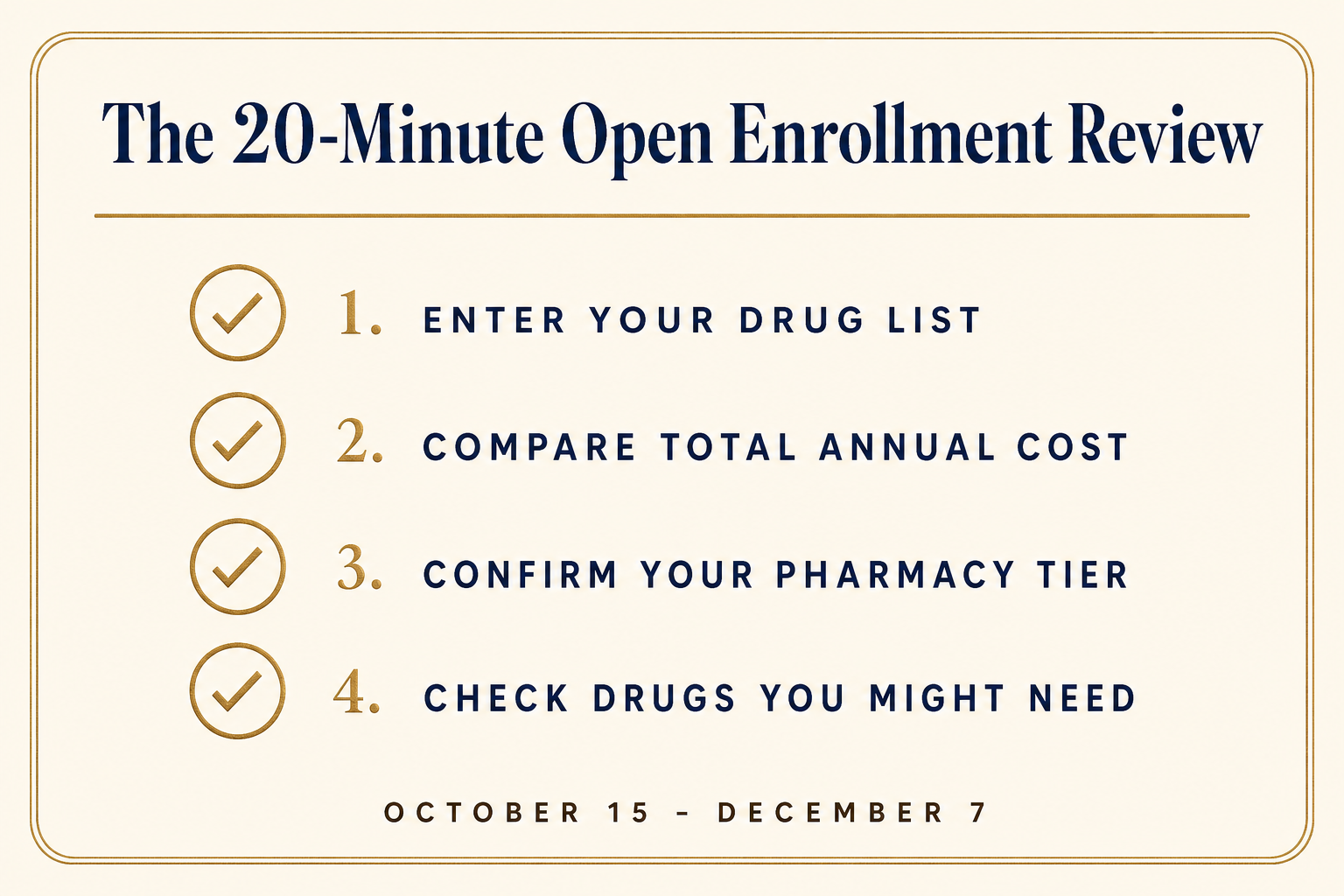
You don’t need to become a Medicare expert. You need to run one honest comparison, and the free Plan Finder tool at Medicare.gov does the heavy lifting. Work it in this order:
- Enter your actual drug list. Type in every prescription, the dose, and how often you fill it. This is the step people skip, and it’s the step that makes the whole comparison meaningful. The tool prices each plan against your drugs, not a generic average.
- Compare total annual cost, not the premium. The cheapest premium routinely hides the most expensive plan once you add deductibles, copays, and drug tiers. Plan Finder shows an estimated yearly total — that’s the number that matters.
- Confirm your pharmacy is still preferred. The same plan can charge wildly different prices depending on whether you fill at a “preferred” pharmacy or a “standard” one. Check that your pharmacy — or a mail-order option you’d actually use — is in the good tier.
- Check the drugs you might need, not just the ones you take. If a medication is on your horizon, see how each plan treats it before you’re locked in for the year.
Twenty minutes, once a year. There is almost no other move in retirement that pays that well per minute of effort.
Thomas’ Take: Auto-renewal is not a convenience the plan is offering you. It’s the plan betting you won’t look. Most years, for most people, that bet pays off — for the insurer. The fix costs you one evening in November.
A Hypothetical: Margaret’s Part D Surprise
Consider a hypothetical retiree named Margaret, 71, in suburban Ohio. She’s been on the same standalone Part D plan for three years and has never re-shopped it — it worked, so why touch it? Her Annual Notice of Change this fall says her monthly premium is rising from about $18 to roughly $40, and one of her three regular medications is moving from a $10 tier to a $47 tier.
If Margaret does nothing, she absorbs both increases automatically on January 1 — call it a few hundred dollars over the year she never agreed to. If she spends 20 minutes in Plan Finder with her three drugs entered, she may well find a different plan in her area that covers the same medications at lower tiers, even if its premium looks a dollar or two higher on the sticker. The comparison is the only way to know. These figures are illustrative, but the pattern is not — premium creep and tier shuffling are the normal way these plans evolve.
If You’re in Medicare Advantage, You Have Two Windows
Medicare Advantage plans change the same way, plus an extra layer: their provider networks and extra benefits (dental, vision, the fitness perk you signed up for) can shift year to year, and a doctor who was in-network can quietly drop out. The Annual Notice of Change covers this too.
Medicare Advantage enrollees get a second, narrower window that standalone Part D members don’t: the Medicare Advantage Open Enrollment Period, January 1 to March 31. During those months you can switch to a different Advantage plan or drop back to Original Medicare. It’s a useful safety valve if January makes it obvious the new plan year isn’t working — but it’s a backstop, not a substitute for looking in the fall.
I’m not going to tell you Medicare Advantage is right or wrong for you — that genuinely depends on your health, your doctors, your medications, and how much predictability you want. What I will say is that the choice deserves a real look each year, and if it feels complicated, you don’t have to do it alone. Every state runs a free, unbiased counseling program (the State Health Insurance Assistance Program, or SHIP) with no product to sell you. That’s the help I’d use before I’d trust a commission-based sales call.
Where This Fits in a Bucket Plan
In the Now, Soon, Later framework, healthcare is a Now-bucket cost — it’s a bill you pay every month out of current income, not a growth asset for later. And Now-bucket costs are the ones that quietly erode a plan when nobody’s watching, because they don’t feel like investment decisions. A $250 unnecessary Part D increase doesn’t announce itself the way a market drop does, but it comes out of the same place: the income you’re living on. Premiums aren’t the only Medicare cost that moves with your income, either — the IRMAA surcharge can add to your Part B and Part D premiums based on your tax return from two years back, which is its own reason to keep an eye on the whole picture.
The reason a guaranteed income floor matters so much is that it makes your essential expenses predictable. Letting an avoidable premium increase ride cuts against that on purpose. Controlling the controllable costs — and your drug plan is one of the most controllable there is — is how you protect the floor you worked to build. It’s the same discipline that makes people re-shop healthcare costs in retirement generally, and it’s why Medicare timing deserves the same attention as Social Security timing.
Key Takeaways
- Open Enrollment is October 15 to December 7, and changes take effect January 1. It’s the main annual window to switch Part D or Medicare Advantage plans.
- Your plan changes every year. Formularies, pharmacy tiers, and premiums all reset each January — the Annual Notice of Change is where they’re disclosed.
- Compare total annual cost, not premium. Enter your real drug list into Medicare’s Plan Finder; the lowest premium is often the most expensive plan overall.
- The Part D out-of-pocket cap is $2,100 in 2026 and $2,400 in 2027. If you take costly drugs, that ceiling reshapes which plan wins.
- Medicare Advantage members get a second window (January 1 to March 31) to change course — but the fall review still comes first.
Frequently Asked Questions
Do I have to do anything during Open Enrollment if I like my plan?
No action is required, and your plan will renew automatically. But “like my plan” should mean the version taking effect in January, not the one from last year. Read the Annual Notice of Change first, then decide. Liking a plan you haven’t re-checked is just a guess.
What if I miss the December 7 deadline?
For most people the choice is locked until the next Open Enrollment. Medicare Advantage members have the January 1 to March 31 window as a partial backstop, and a few special circumstances (moving, losing other coverage) open a Special Enrollment Period. But the clean, guaranteed chance to change is the fall window — treat December 7 as firm.
Where can I get unbiased help?
Start at Medicare.gov’s Plan Finder for the comparison, and use your state’s SHIP program for free one-on-one counseling. Neither has a plan to sell you, which is exactly why I’d start there rather than with a phone number from a mailer.
The envelope in your recycling bin is asking you a question every year: is this still the right plan? Open Enrollment is the two-month window where you get to answer it. Block 30 minutes on the calendar before Thanksgiving, pull up Plan Finder, and give the honest answer. It’s the cheapest raise available in retirement — you just have to look.
This article is published by Confluence Media Group LLC, an independent publisher of educational financial content. Thomas Clark is a Series 65 Investment Advisor Representative. The information provided is for educational and informational purposes only and is not personalized financial, tax, or legal advice. Past performance does not guarantee future results. All investing involves risk, including potential loss of principal. Consult a qualified professional before making financial decisions.
Confluence Media Group LLC is a separate entity from Confluence Capital Management, the investment advisory practice through which Thomas Clark provides advisory services. Advisory services are not offered through this publishing platform.
About Thomas Clark
Thomas Clark is the founder of Confluence Media Group LLC and a Series 65 Investment Advisor Representative. He has spent nearly two decades working with families on retirement planning, with a focus on Social Security optimization, retirement income coordination, and the bucket planning approach to building a guaranteed income floor.
Thomas writes and publishes at thomasclarkadvisor.com and is the author of The Just in Case Binder — a 148-page printable family financial organizer for households who want to make sure the people they love know where everything is.
He lives in North Carolina with his family.
Subscribe to the weekly newsletter · Get the Just in Case Binder

Thomas Clark is a Series 65 licensed investment advisor and experienced trader. He specializes in investing, retirement planning, and market analysis, helping individuals build wealth and make informed financial decisions.
