
IRMAA: The Medicare Surcharge That Ambushes Retirees
Your Medicare premium in retirement is priced off a tax return you filed two years ago. Here's how the IRMAA surcharge works, and how to plan around its income cliffs.

Somewhere around the start of retirement, a lot of people get a letter from Social Security that ruins their week. It says their Medicare premium is going up — sometimes by a couple hundred dollars a month, per spouse — because of how much money they made. The confusing part is the year it points to. Not last year. Not this year. A tax return they filed two years ago, back when they were still working and earning a full paycheck.
That surcharge has a name almost nobody hears until it hits them: IRMAA, the Income-Related Monthly Adjustment Amount. It is one of the most avoidable costs in retirement, and one of the most commonly walked into, because it runs on a two-year delay and it works like a trip-wire instead of a dial. This is what it is, why new retirees are the ones who get caught, and the handful of moves that keep you on the right side of the line.
What IRMAA Actually Is
Medicare is not one flat price for everyone. In 2026, most people pay the standard Part B premium of $202.90 a month, up from $185 in 2025 (you can confirm the current figure at Medicare.gov). But above certain income levels, you pay that base premium plus a surcharge on both Part B (your doctor and outpatient coverage) and Part D (your drug plan). That surcharge is IRMAA.
For 2026, the surcharge kicks in once your income crosses $109,000 as a single filer or $218,000 for a married couple filing jointly. From there it climbs across five tiers, and at the top — $500,000 single, $750,000 joint — the all-in Part B premium reaches $689.90 a month. Part D adds its own surcharge on top, ranging from roughly $14.50 to $91 a month depending on the tier. The Social Security Administration is the agency that actually makes the determination and sends the letter; its rules for higher-income beneficiaries are laid out on SSA.gov.
For a couple both on Medicare, crossing into even the first tier can mean well over a thousand dollars a year in extra premiums between the two of them. It is a real number, and it is driven entirely by a figure most retirees have never been taught to watch.
The Two-Year Lookback Nobody Warns You About
Here is the mechanic that catches people. Your Medicare premium in any given year is based on your income from two years earlier. Your 2026 premium is priced off your 2024 tax return. Your 2027 premium will be priced off 2025.
Think about who that hurts most. Someone retiring at 65 in 2026 was very likely still working in 2024 — earning a full salary, maybe selling company stock, maybe taking a final bonus. That high-earning year is exactly the year Medicare reaches back to. So the first Medicare bill of your retirement can be priced as if you never retired at all. You changed your life; the surcharge is still looking at the old one.
The income figure Medicare uses is your modified adjusted gross income, or MAGI. For IRMAA, that is essentially your adjusted gross income (line 11 of the Form 1040) plus any tax-exempt interest. That last piece surprises people: the interest from municipal bonds you bought because it is tax-free still counts toward the income that sets your Medicare premium. Tax-free for income taxes is not tax-free for IRMAA.
IRMAA Is a Cliff, Not a Ramp
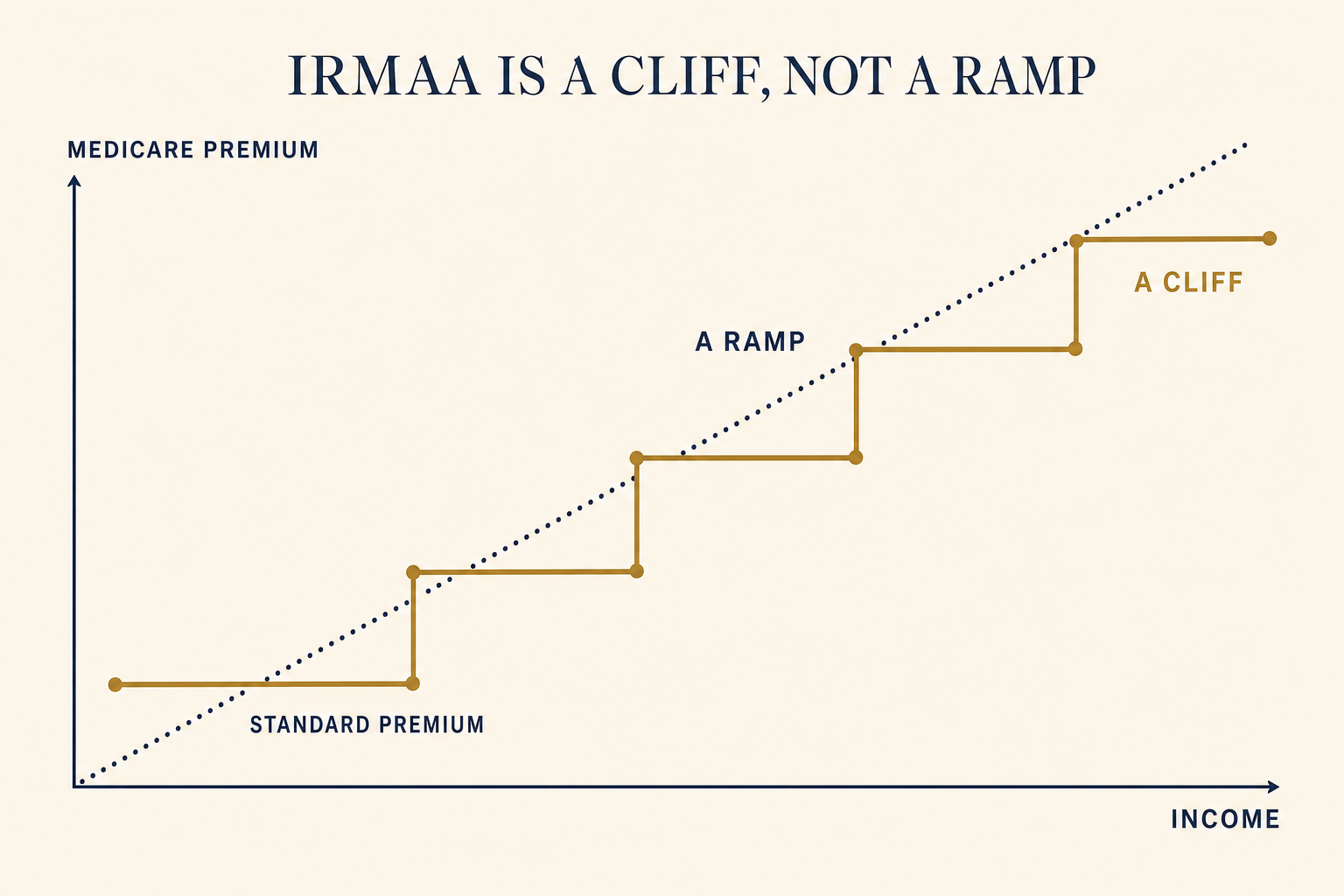
The federal income tax system is a series of ramps. Earn one dollar into a higher bracket and only that one dollar is taxed at the higher rate. Most people assume Medicare works the same way. It does not.
IRMAA is a cliff. Cross a threshold by a single dollar and you owe the entire surcharge for that tier — not a sliver of it, all of it. One dollar of extra income can cost you hundreds of dollars a year in higher premiums. That is what makes IRMAA planning different from ordinary tax planning: the goal is not just to keep income generally low, it is to know precisely where the lines sit and to avoid stepping one dollar over them.
Thomas’ Take: Most people treat Medicare as a fixed cost of getting older — a bill that is whatever it is. For a large share of retirees, it is not fixed at all. It is a semi-variable cost you have real control over, as long as you are managing the right number two years ahead of when it matters. The retirees who get ambushed are not the ones with too much money. They are the ones nobody warned about the lookback.
The Events That Trip the Wire — Often Just Once
What pushes a normally moderate-income retiree over a line is rarely their everyday spending money. It is usually a one-time spike, and retirement is full of them.
Selling a house or a rental property can throw a large capital gain onto a single year’s return. A Roth conversion, which is a genuinely smart move in the right years, adds directly to MAGI in the year you do it and can lift you into an IRMAA tier if you convert too much at once. The first year of required minimum distributions forces income out of your traditional accounts whether you need it or not. A large realized gain from rebalancing, an inheritance that gets invested and sold, or a lump-sum pension payout can each spike a single year on its own.
And then there is the quietest one. When a spouse dies, the survivor eventually files as a single taxpayer, where the IRMAA thresholds are roughly half what a couple’s are. The same household income that sat comfortably under the joint line can land the survivor in a surcharge tier — on top of the drop from two Social Security checks to one. It is one more reason the financial side of losing a spouse deserves planning long before it happens, which I wrote about in what happens to your bucket plan when a spouse dies.
How to Plan Around It
The good news is that IRMAA rewards exactly the kind of planning that good retirement income design is built on: knowing where your income comes from and choosing which sources you tap in which years.
This is where the bucket structure earns its keep. Money you pull from the Now bucket — cash and short-term reserves — and withdrawals from a Roth do not add to MAGI. Guaranteed income from Social Security counts, but only partially for some households. Distributions from traditional IRAs and 401(k)s, realized capital gains, and that municipal-bond interest all count in full. When you know a big income event is coming, you can often control its timing: do a partial Roth conversion this year instead of a large one, spread a property sale’s impact where possible, or lean on already-taxed money in a year you are close to a line. Retirees managing capital gains should also know about the 0% capital gains bracket, which interacts with all of this.
The other half is the appeal most people never file. If your income dropped because of a specific life-changing event — you stopped working, you got married or divorced, your spouse died, you lost a pension — you can ask Social Security to use your current income instead of the two-year-old figure. The form is SSA-44, and “I retired” is a valid reason. The retiree who got the ambush letter because 2024 was a working year is often exactly the person who should file it. Note that a one-time Roth conversion or a home sale does not qualify as a life-changing event — those you plan around, you do not appeal.
None of this is guesswork you should be doing on the back of an envelope, because the moves interact — a Roth conversion that saves taxes for decades might cost you one year of IRMAA, and whether that trade is worth it depends on numbers specific to you. This is a good moment to run your own scenario rather than react to a letter. A planning tool like ProjectionLab lets you model a Roth conversion or a big withdrawal against your income lines and see whether it quietly bumps you into an IRMAA tier before you commit to it. (ProjectionLab is a paid tool; the link is an affiliate link, which means I may earn a small commission at no extra cost to you. I only recommend tools I’d use myself.)
A Hypothetical to Make It Concrete
Consider a hypothetical couple: Ray and Diane, both 66, retired last year in a small town outside Charlotte. Their steady retirement income — Social Security plus modest IRA withdrawals — runs around $150,000, comfortably under the 2026 joint threshold. In 2024, though, they sold a rental property they had owned for twenty years and booked a $90,000 gain. That one sale pushed their 2024 MAGI well over $218,000.
Two years later, in 2026, both of their Medicare premiums carry an IRMAA surcharge — for a gain they took once and will not repeat. Because the rental sale is not a life-changing event, they cannot appeal it away. But they can see it coming, brace for a single year of higher premiums, and make sure they do not stack another income spike — like a large Roth conversion — into the same year and knock themselves up yet another tier. The surcharge is annual, not permanent: once their 2026 income (their normal $150,000) becomes the lookback year in 2028, their premiums fall back to standard. Knowing that turns a nasty surprise into a manageable, one-year line item.
Key Takeaways
- IRMAA is an income-based surcharge on Medicare Part B and Part D that stacks on top of the standard premium once your income crosses a threshold ($109,000 single / $218,000 joint in 2026).
- Your premium is based on your income from two years earlier, so new retirees often get priced off a final high-earning working year.
- It is a cliff, not a ramp — one dollar over a line triggers the full surcharge for that tier.
- Most trip-ups are one-time events: home sales, Roth conversions, first-year RMDs, or a surviving spouse moving to single-filer thresholds.
- You control the timing of most income events, and you can appeal a surcharge caused by a genuine life-changing event using Form SSA-44.
Frequently Asked Questions
Is IRMAA permanent once I’m in it?
No. Social Security recalculates it every year against your income from two years prior. A one-time spike raises your premium for a single year, then it falls back once a normal income year rolls into the lookback window.
Does my tax-free municipal bond interest really count?
Yes. IRMAA’s MAGI adds tax-exempt interest back in. Muni interest that escapes income tax still counts toward the income that sets your Medicare premium.
Can I appeal if I just retired?
Yes — work stoppage is one of the qualifying life-changing events on Form SSA-44. If your income fell because you retired, you can ask Social Security to use your current income instead of the two-year-old figure. A one-time capital gain, though, is not an appealable event.
The lesson underneath all of this is the same one that runs through most of retirement income planning: the expensive surprises are the ones nobody told you to watch for. IRMAA is not a tax on being wealthy. It is a tax on not knowing the rules two years before they bite. Once you know the lines are there and roughly where they sit, the surcharge stops being an ambush and becomes just another number you plan around — which is exactly where you want it.
This article is published by Confluence Media Group LLC, an independent publisher of educational financial content. Thomas Clark is a Series 65 Investment Advisor Representative. The information provided is for educational and informational purposes only and is not personalized financial, tax, or legal advice. Past performance does not guarantee future results. All investing involves risk, including potential loss of principal. Consult a qualified professional before making financial decisions.
Confluence Media Group LLC is a separate entity from Confluence Capital Management, the investment advisory practice through which Thomas Clark provides advisory services. Advisory services are not offered through this publishing platform.
About Thomas Clark
Thomas Clark is the founder of Confluence Media Group LLC and a Series 65 Investment Advisor Representative. He has spent nearly two decades working with families on retirement planning, with a focus on Social Security optimization, retirement income coordination, and the bucket planning approach to building a guaranteed income floor.
Thomas writes and publishes at thomasclarkadvisor.com and is the author of The Just in Case Binder — a 148-page printable family financial organizer for households who want to make sure the people they love know where everything is.
He lives in North Carolina with his family.
Subscribe to the weekly newsletter · Get the Just in Case Binder

Thomas Clark is a Series 65 licensed investment advisor and experienced trader. He specializes in investing, retirement planning, and market analysis, helping individuals build wealth and make informed financial decisions.
