
Required Minimum Distributions: Avoid the First-Year Trap
Required minimum distributions start at 73, and the math is the easy part. The costly mistakes hide in the calendar, the aggregation rules, and the tax bill — here is how to take yours right.

Required minimum distributions have a reputation for being complicated. They aren’t. The math fits on an index card, and your IRA custodian will even calculate the number for you. The rules that actually cost retirees money aren’t the math — they’re the calendar and the coordination.
An RMD is the age at which the government stops letting your tax-deferred savings grow untouched and starts requiring you to pull some out each year so it can finally collect the taxes it deferred for decades. Miss the timing, misread which accounts can be combined, or take the money without thinking about where it lands on your tax return, and a routine withdrawal turns into an expensive one. Let’s walk through where those mistakes happen and how to take yours the right way.
What an RMD actually is — and when yours starts
A required minimum distribution is the smallest amount you must withdraw each year from your tax-deferred retirement accounts once you reach a certain age. It applies to traditional IRAs, SEP and SIMPLE IRAs, and most workplace plans like 401(k)s and 403(b)s. It does not apply to Roth IRAs during your lifetime, and — as of 2024 — it no longer applies to Roth 401(k)s either. Money you already paid tax on stays where it is.
Under current law, RMDs begin at age 73 for anyone born between 1951 and 1959. If you were born in 1960 or later, your starting age is 75. That age floor moved twice in recent years under the SECURE 2.0 Act, which is exactly why so many people are unsure when their clock starts. The IRS keeps the current rules in its required minimum distribution FAQs.
The calculation itself is straightforward. You take your account balance as of December 31 of the prior year and divide it by a life-expectancy factor from the IRS Uniform Lifetime Table. At 73, that factor is about 26.5. So a $530,000 IRA produces a first RMD of roughly $20,000 — a little under 4% of the balance. Each year the factor shrinks, so the required percentage slowly climbs as you age.
The first-year trap that costs the most
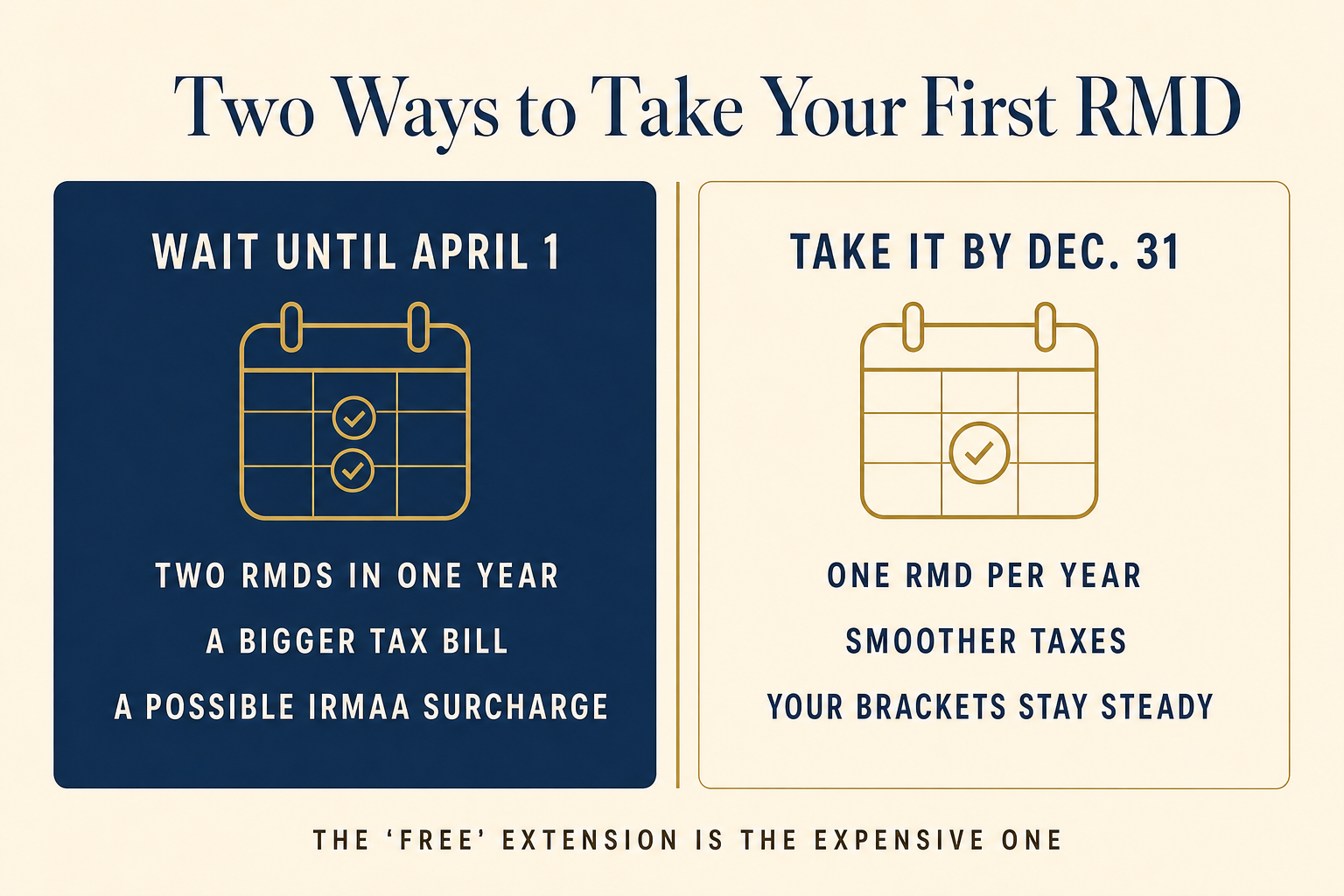
Here is the rule that catches people, and it hides inside a piece of apparent generosity. Your first RMD isn’t due by December 31 of the year you turn 73. You get an extension: you have until April 1 of the following year — what the IRS calls your Required Beginning Date.
Sounds like a nice grace period. It’s a tax trap. Every RMD after the first is due by December 31. So if you push your first distribution into the following April, you take two RMDs in the same calendar year — the delayed first one plus that year’s regular one. Both land on the same tax return, stacked on top of each other.
That doubling can shove you into a higher tax bracket, trigger more of your Social Security to be taxed, and — for many retirees — quietly push your income across a Medicare IRMAA threshold, adding a surcharge to your Part B and Part D premiums two years later. A “free” extension can cost more than the tax on the distribution itself.
Thomas’ Take: The April 1 deadline is the most expensive convenience in the tax code. For most people, the right move is to take your very first RMD by December 31 of the year you turn 73 — not to use the extension. Spread the income across two tax years instead of bunching it into one. The only time delaying makes sense is if you know that first year will be unusually low-income for a specific reason. Otherwise, take it on the normal schedule and keep your brackets smooth.
The aggregation rule almost everyone gets wrong
If you have more than one retirement account, you need to know a rule that is easy to misremember — and misremembering it is a common way people accidentally under-withdraw and trigger a penalty.
You must calculate an RMD separately for every account you own. But when it comes to actually taking the money, the accounts don’t all follow the same rule:
IRAs can be pooled. If you have three traditional IRAs, you add up the three separate RMD amounts and can pull the entire total from just one of them if you like. The IRS only cares that the combined dollar figure comes out.
Workplace plans cannot. Each 401(k) or 403(b) stands alone. You must take that plan’s RMD from that specific plan. You can’t cover a 401(k)’s RMD by pulling extra from an IRA, and you can’t satisfy one 401(k) with a withdrawal from another.
The classic mistake: someone with two old 401(k)s from former employers assumes they work like IRAs, takes the whole required amount from one, and comes up short on the other. This is one of the underappreciated arguments for consolidating old workplace plans into a single IRA before RMDs begin — one account, one number, one withdrawal, far less to track.
The penalty — and how forgiving it now is
Miss an RMD, or take out too little, and the IRS levies an excise tax on the shortfall. It used to be a brutal 50%. SECURE 2.0 cut it to 25%, and — importantly — to just 10% if you catch the mistake and take the missed amount within two years, then file Form 5329 to report it.
Better still, the IRS has a long history of waiving the penalty entirely for a reasonable, promptly corrected error. You attach a short statement explaining what happened and that you’ve since withdrawn the shortfall. The takeaway isn’t “the penalty is scary” — it’s that an honest RMD mistake is fixable if you act. Don’t panic, don’t hide it. Correct it and document it.
Turning a required withdrawal into a planning tool
Most retirees are already spending their RMD to live on, so the withdrawal isn’t the problem — the tax bill is. Three levers give you real control over that bill.
1. Give it straight to charity. If you’re charitably inclined, a Qualified Charitable Distribution (QCD) lets you send money directly from your IRA to a qualified charity — up to $111,000 in 2026 — and it counts toward your RMD while staying off your taxable income entirely. For a retiree who takes the standard deduction and gets no benefit from itemizing donations, a QCD is often the single most tax-efficient way to give. You can start QCDs at 70½, even before RMDs begin.
2. Shrink the problem before it starts. The best RMD planning happens in the years before age 73 — the low-income window many people have between when they stop working and when RMDs and Social Security fully kick in. Those years are prime territory for partial Roth conversions and for harvesting gains inside the 0% capital-gains bracket. Every dollar you move out of a traditional IRA at a low rate today is a dollar that never has to come out as a taxed RMD later.
3. Mind where the money lands. An RMD is, in bucket-planning terms, a forced distribution out of your Later bucket — your growth money. If you don’t need it for this year’s expenses, you don’t have to spend it; you just have to withdraw it. It can be reinvested in a taxable brokerage account and keep working. The requirement is about where the money is taxed, not about forcing you to consume it.
This is exactly the kind of decision worth modeling against your real numbers before you lock it in. A tool like ProjectionLab lets you run your own version — different conversion amounts, claiming ages, and withdrawal orders — and watch how your lifetime tax bill and “will I run out” risk actually move as you change the inputs. (ProjectionLab is an affiliate partner; if you subscribe through that link, Confluence Media Group may earn a commission at no additional cost to you.)
A hypothetical, start to finish
Consider a hypothetical couple, Ray and Linda, both 73 this year. Ray has $530,000 spread across two traditional IRAs and one 401(k) still sitting with a former employer. Using round figures for illustration, his combined RMD works out to about $20,000.
Because his IRAs can be aggregated, Ray takes the IRA portion — say $14,000 — from whichever IRA he prefers. But the 401(k)’s share, about $6,000, has to come out of the 401(k) itself. He takes both by December 31, ignoring the tempting April 1 extension, so he never bunches two years of income together.
Ray and Linda already give $8,000 a year to their church. So Ray routes that $8,000 as a QCD directly from an IRA. It counts toward his RMD but never appears in their taxable income — which keeps them a comfortable margin below the first IRMAA threshold. Same withdrawal, same giving, materially lower tax. That’s the whole game: the RMD was never optional, but nearly every dollar of tax around it was negotiable.
Key takeaways
- RMDs start at 73 (or 75 if you were born in 1960 or later) and apply to traditional IRAs and most workplace plans — never to Roth accounts during your lifetime.
- Take your first RMD by December 31, not the April 1 extension, to avoid stacking two years of income onto one tax return.
- IRA RMDs can be combined and taken from one account; each 401(k) or 403(b) must be satisfied on its own.
- The missed-RMD penalty is now 25% — or 10% if corrected within two years — and is often waivable for a promptly fixed error.
- QCDs, pre-73 Roth conversions, and thoughtful account ordering turn a required withdrawal into a tax-planning opportunity.
Frequently asked questions
Do I have to take an RMD if I’m still working? For your current employer’s 401(k), you may be able to delay RMDs until you actually retire, if the plan allows it and you don’t own 5% or more of the company. This “still-working exception” never applies to IRAs or to plans from former employers.
Can my spouse and I combine our RMDs? No. RMDs are strictly individual. Each spouse calculates and takes their own from their own accounts, even on a joint tax return.
How is the RMD actually taxed? A traditional-account RMD is ordinary income in the year you take it. Many custodians let you have taxes withheld directly from the distribution, which can be a clean way to stay current with the IRS without quarterly estimates.
The bottom line
The required minimum distribution itself is just arithmetic — a number your custodian will hand you. What separates a smooth retirement tax picture from a jagged one isn’t the withdrawal; it’s the decisions clustered around it. Take the first one on time, respect the aggregation rules, use the QCD if you give, and do your heaviest lifting in the low-tax years before 73 ever arrives. Handled that way, the RMD stops being a deadline you dread and becomes just one more line item in a plan you already control.
This article is published by Confluence Media Group LLC, an independent publisher of educational financial content. Thomas Clark is a Series 65 Investment Advisor Representative. The information provided is for educational and informational purposes only and is not personalized financial, tax, or legal advice. Past performance does not guarantee future results. All investing involves risk, including potential loss of principal. Consult a qualified professional before making financial decisions.
Confluence Media Group LLC is a separate entity from Confluence Capital Management, the investment advisory practice through which Thomas Clark provides advisory services. Advisory services are not offered through this publishing platform.
About Thomas Clark
Thomas Clark is the founder of Confluence Media Group LLC and a Series 65 Investment Advisor Representative. He has spent nearly two decades working with families on retirement planning, with a focus on Social Security optimization, retirement income coordination, and the bucket planning approach to building a guaranteed income floor.
Thomas writes and publishes at thomasclarkadvisor.com and is the author of The Just in Case Binder — a 148-page printable family financial organizer for households who want to make sure the people they love know where everything is.
He lives in North Carolina with his family.
Subscribe to the weekly newsletter · Get the Just in Case Binder

Thomas Clark is a Series 65 licensed investment advisor and experienced trader. He specializes in investing, retirement planning, and market analysis, helping individuals build wealth and make informed financial decisions.
