
How to Pay Taxes in Retirement Without a Penalty
When you retire, the automatic tax withholding from your paychecks disappears — but the IRS still expects to be paid throughout the year. Here's how the safe harbor and one simple withholding move keep you penalty-free without the quarterly-payment hassle.

For most of your working life, taxes were somebody else’s problem to manage. Every payday, your employer quietly calculated the withholding, sent it to the IRS, and handed you the rest. You never wrote a check to the government during the year — if anything, one came back to you in the spring. That machine ran in the background for forty years.
The first year you retire, it shuts off. The paychecks stop, but the tax bill doesn’t — it just moves from your employer’s payroll department onto your own desk. And here’s the part that catches people off guard: the IRS still expects to be paid as the year goes, not in one lump at the end. Miss that, and you can owe a penalty on top of your tax, even if you pay every dollar by April 15. It’s one of the least-discussed transitions in retirement, and it’s entirely avoidable once you see how the system actually works.
Retirement quietly breaks the tax system you’re used to
The United States runs a “pay-as-you-go” tax system. The government wants its share throughout the year, in roughly even installments, as the income is earned. While you were working, payroll withholding handled that automatically — you never had to think about it. In retirement, your income arrives from a scatter of new sources: Social Security, a pension, IRA and 401(k) withdrawals, dividends, interest, maybe a capital gain. And most of them withhold nothing unless you specifically tell them to.
That’s the trap. A $40,000 IRA withdrawal doesn’t arrive with taxes already taken out the way a paycheck did. Social Security withholds nothing unless you file a form. Dividends and interest land in your account gross. So a newly retired household can go a whole year feeling like it’s paying taxes — because the money is clearly taxable — while the IRS’s running tally shows nothing coming in. Then the bill, plus a penalty, shows up the following spring.
The IRS gives you two tools to stay current: estimated tax payments and withholding. Most retirees are told to use the first. The quiet truth is that the second is usually simpler and, used well, can make the whole problem disappear. We’ll get there.
The safe harbor: the number that makes a penalty impossible
Before the mechanics, understand the finish line. The IRS charges an underpayment penalty when you don’t pay in enough during the year — but it also tells you exactly how much counts as “enough.” Reach one of these safe-harbor targets and you cannot be penalized, no matter how large your final bill turns out to be:
- Pay at least 90% of this year’s total tax, or
- Pay at least 100% of last year’s total tax — whichever is the smaller number.
There’s one wrinkle for higher earners: if your prior-year adjusted gross income was over $150,000 ($75,000 if you’re married filing separately), that second target rises to 110% of last year’s tax. The prior-year safe harbor is the one most retirees lean on, because you already know last year’s number — no forecasting required. Cover it, and you can owe a genuinely large check in April with zero penalty attached to it.
Miss it, and the penalty is really just interest on what you underpaid, charged from each installment date you fell short. And it isn’t a rounding error anymore. For 2026, that rate runs 7% in the first and third quarters (6% in the second), compounded daily — roughly double the near-zero rates of a few years ago. The IRS figures it on Form 2210. The safe harbor is simply the line that keeps you on the right side of it.
The withholding move most retirees never hear about
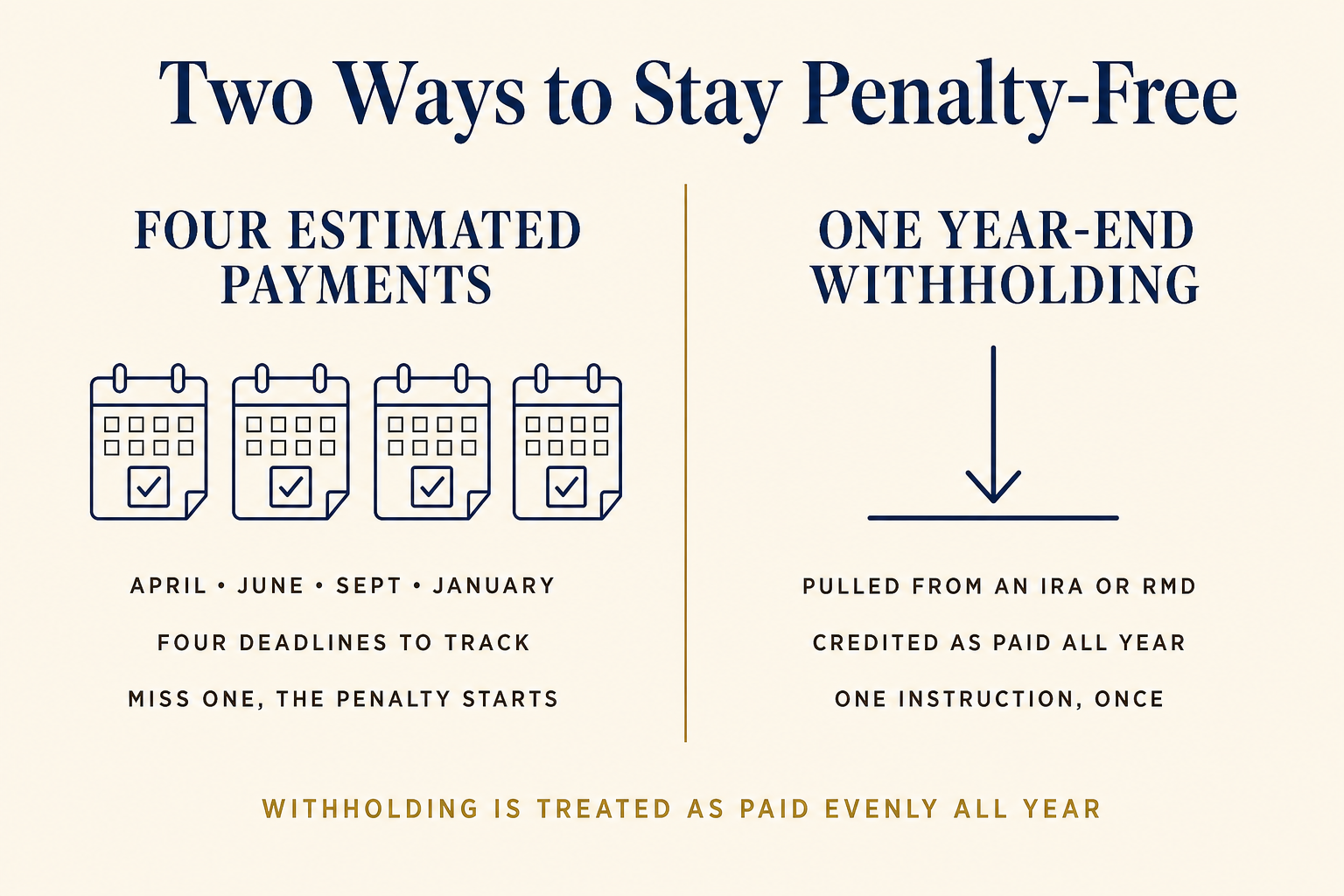
Here’s the piece that changes everything, and almost nobody outside a tax office brings it up. The IRS treats tax that’s withheld as if it were paid evenly across the whole year — regardless of when it actually came out. Estimated payments get credited on the date you send them. Withholding gets credited as though it trickled in all year long, even if the entire amount came out in December (IRS Publication 505 spells this out).
That quirk is a gift. It means you can skip the four-times-a-year estimated-payment schedule entirely and instead have your full-year tax withheld from a single retirement-account distribution late in the year — and the IRS treats you as if you’d paid on time all along. One well-sized December withdrawal can rescue a year you’d otherwise underpaid.
You have three withholding levers to work with:
- Social Security. File Form W-4V to have a flat 7%, 10%, 12%, or 22% held from every benefit check.
- Pension and IRA withdrawals. Use Form W-4R to set a withholding percentage on the money you pull from those accounts.
- Your year-end RMD. Once you’re taking required minimum distributions at 73, this is the cleanest tool of all — tell the custodian to withhold enough from that mandatory withdrawal to cover the entire year’s tax.
Thomas’ Take: If I could hand every new retiree one piece of tax plumbing, it would be this: stop mailing quarterly estimates and let a single late-year withholding do the job. The quarterly calendar is stressful and easy to forget — miss one deadline and the penalty clock starts running. Withholding from a December distribution is one instruction, once a year, and the IRS backdates the credit for you. It’s the rare move that’s both easier and safer.
What this looks like in practice
Consider a hypothetical couple, Roger and Diane, both 68, in suburban Charlotte. Social Security and a small pension cover their essential bills. On top of that, they withdraw about $45,000 a year from a traditional IRA for travel and extras, plus a few thousand in dividends from a taxable account. When they filed last spring, their total federal tax for the year came to roughly $9,000.
Their prior-year safe harbor is straightforward: pay in $9,000 this year — 100% of last year’s tax, since their income sits under the $150,000 line — and no penalty can apply, even if this year’s bill lands a little higher. They have two clean ways to get there. The first is to send the IRS four estimated payments of about $2,250 apiece, due in April, June, September, and January, each one a separate thing to remember. The second is to do nothing until late in the year, then have their IRA custodian withhold $9,000 from a December distribution. Both satisfy the safe harbor. Only one of them requires four trips to the mailbox and a calendar full of reminders.
Diane handles their money, and she picks the withholding route. In late November she instructs the custodian to send $9,000 of their IRA withdrawal straight to the IRS as withholding. Because withholding counts as paid evenly all year, the couple is fully covered for every quarter — including the ones that already passed — and they never wrote a single estimated-tax check. That’s the entire strategy: one instruction, once, and the penalty risk is gone.
Decide it inside your bucket plan, before the year locks
Taxes aren’t a once-a-year event; they’re a recurring expense that belongs in your Now bucket, right next to housing and groceries. The mistake is treating the tax bill as a surprise instead of a planned line item. Each year, early enough to still act on it, you want to answer two questions: roughly how much will I owe, and which account is going to pay it?
That second question is where retirement taxes and withdrawal sequencing meet. The amount you draw from a traditional IRA drives your taxable income — and, as I’ve covered in how Social Security actually gets taxed, an extra withdrawal can quietly pull more of your benefits into the tax base right behind it. Settling your withdrawals, and the withholding on them, before December is the same discipline behind all good mid-year tax planning: the moves that are easy in October become impossible on December 31.
If you want to pin down your number before the year closes, this is worth modeling rather than guessing at. A planning tool like ProjectionLab lets you map your income sources, project your full-year taxable income, and see what a given IRA withdrawal does to your tax bill — so you know exactly how much to withhold before you ever pull the money. (ProjectionLab is a paid tool; the link is an affiliate link, which means I may earn a small commission at no extra cost to you. I only recommend tools I’d use myself.)
Key takeaways
- In retirement, nobody withholds your taxes automatically, but the IRS still expects payment throughout the year — miss that and you can owe a penalty even after paying in full by April.
- The safe harbor makes a penalty impossible: pay the smaller of 90% of this year’s tax or 100% of last year’s (110% if your prior-year AGI topped $150,000).
- The 2026 underpayment penalty runs 7% in the first and third quarters, compounded daily — no longer a trivial cost.
- Tax that’s withheld counts as paid evenly all year, so a single late-year withholding from an IRA, pension, or RMD can cover the whole year with no quarterly estimates at all.
- Treat taxes as a Now-bucket line item: estimate the bill and decide which account pays it before year-end, not in April.
Frequently asked questions
Do I really have to pay taxes four times a year in retirement?
Not necessarily. Quarterly estimated payments are one option, but they aren’t the only one. If you receive Social Security, a pension, or IRA withdrawals, you can have taxes withheld from those instead — and because withholding counts as paid evenly across the year, a single well-sized withholding can replace the entire quarterly schedule.
What’s the penalty if I get it wrong?
It’s essentially interest on the amount you underpaid, charged from each missed deadline until you catch up. For 2026 that rate is 7% in the first and third quarters, compounded daily, and it’s calculated on IRS Form 2210. Hitting a safe harbor avoids it completely.
Should I have taxes withheld from Social Security?
Many retirees find it the simplest path. Filing Form W-4V lets you hold back a flat 7%, 10%, 12%, or 22% of each payment, chipping away at your bill automatically. Whether that’s the right lever — versus withholding from an IRA — depends on your particular mix of income, so it’s worth mapping out or running past your tax preparer.
When are 2026 estimated payments due?
If you do use estimates, the dates are April 15, 2026; June 15, 2026; September 15, 2026; and January 15, 2027. Mark them on the calendar — or sidestep the calendar entirely with the withholding approach.
The tax code doesn’t get harder in retirement, but it does get quieter. The withholding that used to happen on its own now waits for you to set it up, and the penalty for missing it is real money. The good news is that staying penalty-free takes one decision a year, not twelve. Work out your safe-harbor number, choose how you’ll cover it, and let a single withholding do the job your old payroll department used to. Then you can go back to not thinking about it — which, after forty years of never having to, is exactly how it should feel.
This article is published by Confluence Media Group LLC, an independent publisher of educational financial content. Thomas Clark is a Series 65 Investment Advisor Representative. The information provided is for educational and informational purposes only and is not personalized financial, tax, or legal advice. Past performance does not guarantee future results. All investing involves risk, including potential loss of principal. Consult a qualified professional before making financial decisions.
Confluence Media Group LLC is a separate entity from Confluence Capital Management, the investment advisory practice through which Thomas Clark provides advisory services. Advisory services are not offered through this publishing platform.
About Thomas Clark
Thomas Clark is the founder of Confluence Media Group LLC and a Series 65 Investment Advisor Representative. He has spent nearly two decades working with families on retirement planning, with a focus on Social Security optimization, retirement income coordination, and the bucket planning approach to building a guaranteed income floor.
Thomas writes and publishes at thomasclarkadvisor.com and is the author of The Just in Case Binder — a 148-page printable family financial organizer for households who want to make sure the people they love know where everything is.
He lives in North Carolina with his family.
Subscribe to the weekly newsletter · Get the Just in Case Binder

Thomas Clark is a Series 65 licensed investment advisor and experienced trader. He specializes in investing, retirement planning, and market analysis, helping individuals build wealth and make informed financial decisions.
