
The 0% Capital Gains Bracket Most Retirees Walk Past
Everyone knows tax-loss harvesting. Its opposite — selling appreciated stock at a 0% federal rate — is the move most retirees walk past. Here is how the 0% capital gains bracket works in 2026 and how to use it in the bridge years.

Everyone who has spent five minutes reading about retirement taxes has heard of tax-loss harvesting: selling an investment that’s down to book the loss and shave a little off your tax bill. Almost nobody talks about its mirror image: selling an investment that’s up and paying nothing on the gain.
It sounds like a typo. It isn’t. In 2026, a married couple can sell a long-held stock or fund, pocket a long-term capital gain, and owe exactly zero federal tax on it, as long as their taxable income stays at or below $98,900. That’s not a loophole or a gray area. It’s printed right on the IRS’s own rate tables.
The retirees who benefit most are in the quiet stretch between the last paycheck and the first Social Security check, and most let the window close without ever using it. Here’s how the 0% bracket works, who it fits, and the one move that turns it into real money.
The tax bracket almost nobody mentions
Long-term capital gains (the profit on an investment you’ve held longer than a year) have their own set of tax rates, separate from the rates on your paycheck or your IRA withdrawals. There are three of them: 0%, 15%, and 20%.
For 2026, a married couple filing jointly pays 0% on long-term gains as long as total taxable income lands at or below $98,900. From there up to $613,700 the rate is 15%, and only above that does it reach 20%. Single filers get roughly half those thresholds; the 0% band runs up to about $49,450. You can see the current brackets on the IRS’s own page, Topic No. 409, Capital Gains and Losses.
The word doing all the heavy lifting there is taxable. The 0% ceiling isn’t a cap on your gross income, and it isn’t a cap on the size of the gain. It’s a cap on taxable income — what’s left after your deductions come out. Hold onto that distinction, because it’s the whole game.
One more mechanic you need: capital gains stack on top of your ordinary income. Picture your income as water filling a glass. Ordinary income (a pension, IRA withdrawals, a part-time paycheck) pours in first. Your long-term gains pour in on top. Whatever portion of the gains sits below that $98,900 line is taxed at 0%. Whatever spills over is taxed at 15%. So the less ordinary income you have, the more room there is underneath for gains to land tax-free.
Why the “bridge years” are the opening
There’s a specific window in most retirement plans where ordinary income falls close to zero: the years after you’ve stopped working but before you’ve claimed Social Security and before required minimum distributions begin. I’ve called these the bridge years: the stretch you fund from cash and taxable savings while you let a delayed Social Security benefit grow (the delayed retirement credits add roughly 8% a year up to age 70, per the SSA). Much of what funds those years, cash or the return of principal from selling investments, isn’t taxable income at all, so your income on paper can fall startlingly low. That low floor of ordinary income is exactly what opens up room beneath the 0% ceiling.
The 2026 standard deduction widens that room further. A married couple filing jointly starts with a $32,200 standard deduction, adds $1,650 each once both spouses are 65 or older, and through 2028 can claim a temporary “senior bonus” deduction from the 2025 tax law worth up to another $6,000 per qualifying spouse under the income phase-out. Stacked together, that can shelter well north of $40,000 before a dollar of income is counted.
Because the ceiling is on taxable income, those deductions effectively raise how much gross gain you can realize tax-free. Wipe out the first $40,000-plus with deductions, leave $98,900 of taxable room above it, and a couple with little other income can book six figures of long-term gains and still owe zero federal tax.
Tax-gain harvesting: the actual move
Knowing the bracket exists is one thing. Using it is another. The strategy has a name, tax-gain harvesting, and the mechanics are almost embarrassingly simple.
You sell appreciated shares in your taxable brokerage account, deliberately, to realize a long-term gain while it’s taxed at 0%. Then, if you still want to own the investment, you buy it right back. You end the day owning the same portfolio you started with, except your cost basis (the number your future gain is measured against) has been reset higher. You’ve booked the gain, paid nothing, and shrunk the taxable gain your future self, or your heirs, will ever have to report.
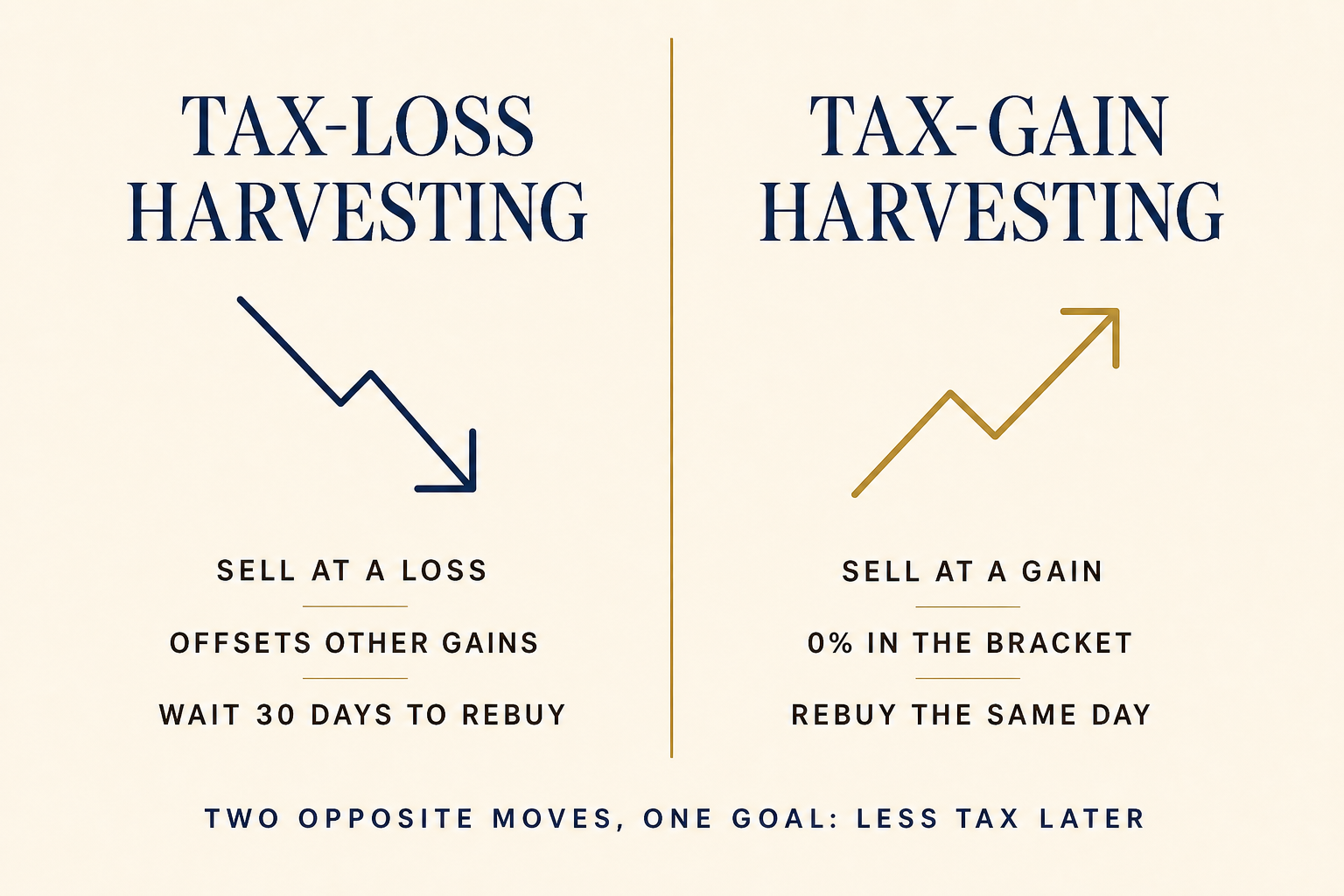
And here’s the detail that makes it work: the wash-sale rule doesn’t apply to gains. That rule, the one that blocks you from claiming a loss if you rebuy within 30 days, exists only to stop people from manufacturing losses. It says nothing about gains. You can sell an appreciated fund and repurchase it the same afternoon with no waiting period at all. (The IRS spells this out in Publication 550.)
It’s the mirror image of tax-loss harvesting: one books a loss to offset today’s taxes, the other books a gain precisely because today’s tax on it is nothing. The same idea, controlling the timing of your taxes instead of letting the calendar control them, pointed in opposite directions.
A hypothetical worth walking through
Consider a hypothetical couple, Ken and Diane, both 66, who retired two years ago in suburban Columbus. They’re living on cash savings while they delay Social Security to 70, so their ordinary taxable income this year is close to nothing. In their taxable brokerage account sits an index fund they bought years ago: worth $260,000 today, with about $90,000 of that being unrealized long-term gain.
Left alone, that $90,000 gain is a tax bill waiting to happen, one that lands the day they finally need to sell, most likely in their 70s when Social Security and RMDs have pushed their income (and their capital-gains rate) up to 15%. At 15%, that gain would cost them roughly $13,500 in federal tax.
Instead, this year, they sell the whole position and immediately rebuy it. Their standard deduction erases the first chunk of income, and the $90,000 of gain lands entirely under the $98,900 taxable-income ceiling. Federal tax on the harvest: zero. They now own the same fund, at the same market value, with a cost basis reset $90,000 higher. The future tax bill they were carrying just evaporated: legally, quietly, on purpose.
The exact numbers are illustrative, and yours will look different; this is a hypothetical, not a recommendation. But the shape of the opportunity is real, and it repeats every year the bridge stays open.
The catch — read this before you sell anything
A move this clean always has edges, and this one has four worth respecting.
It competes with Roth conversions for the same room. Those low-income bridge years are also the best time to do Roth conversions, moving money from a traditional IRA to a Roth while your tax bracket is low. But a conversion is ordinary income, and it fills the glass from the bottom, pushing your gains up toward the 15% line. You generally can’t max out both in the same year. Choosing between them is the real planning question.
The gain raises your MAGI. A harvest still counts as income for other tests, even when the tax on it is zero. It can shrink an ACA marketplace subsidy before 65, feed the two-year lookback that sets your Medicare IRMAA surcharges, and make more of your Social Security taxable in the years you’re claiming it. That’s one more reason the pre-claiming window is the sweet spot.
A big harvest can spill into the 15% bracket. Because the gain itself counts toward the $98,900 ceiling, harvesting too much in one year pushes the excess into the 15% rate. The skill is filling the 0% band to the brim without overflowing it, which takes a real look at your numbers, not a guess.
State tax may still apply. The 0% rate is a federal rate. Most states tax capital gains as ordinary income, so depending on where you live, a “free” federal harvest may still carry a state bill. It’s usually still worth doing; just go in with your eyes open.
Thomas’ Take: Paying tax on purpose feels wrong, even when the tax is zero, so most people don’t do it. That instinct is exactly why this bracket goes unused. The retirees who come out ahead are the ones who treat the bridge years as a tax project, not just a waiting room, and decide on purpose each year whether the smarter move is a Roth conversion, a gain harvest, or a measured split of both.
Where this fits your bucket plan
If you’ve read much of what I write, you know I organize retirement money into a Now, Soon, and Later framework: cash for near-term spending, a guaranteed income floor for the essentials, and market growth for the long haul. Tax-gain harvesting lives in the Later bucket, and it only works there. Gains inside an IRA or 401(k) don’t get capital-gains treatment at all, so your taxable brokerage account is the one place the 0% rate applies.
That’s part of the larger logic behind which accounts to draw from first and keeping the right account types in the right buckets. The bridge years are when every lever (delayed Social Security, Roth conversions, and gain harvesting) is available at once, and they’re the years most retirees spend doing nothing with their tax bill.
This is worth modeling rather than guessing at. A planning tool like ProjectionLab lets you test the trade-off directly — a year of gain harvesting versus a year of Roth conversions versus a split — and see what each choice does to your lifetime tax bill and the odds your money lasts, instead of running it on a napkin. (ProjectionLab is a paid tool; the link is an affiliate link, which means I may earn a small commission at no extra cost to you. I only recommend tools I’d use myself.)
Key takeaways
- Long-term capital gains have their own 0%, 15%, and 20% rates. In 2026, married couples pay 0% on gains while taxable income stays at or below $98,900 (about $49,450 for single filers).
- The ceiling is on taxable income, so your standard deduction effectively raises how much gain you can realize tax-free, often into six figures for a couple with little other income.
- Tax-gain harvesting means selling appreciated shares at 0%, then rebuying to reset your cost basis higher. The wash-sale rule applies only to losses, so there’s no waiting period.
- The bridge years (retired, not yet claiming Social Security, before RMDs) are when ordinary income is lowest and the 0% room is widest.
- Weigh it against Roth conversions, watch the MAGI ripple to IRMAA and Social Security taxes, mind the stacking limit, and check your state’s rules before you sell.
Frequently asked questions
Do I really have to wait 30 days to buy the investment back?
No. The 30-day wash-sale rule exists only to stop people from claiming artificial losses. It has nothing to say about gains. When you harvest a gain, you can repurchase the same investment immediately, and that’s what lets you reset your cost basis without changing what you own.
Does the gain count against the 0% limit itself?
Yes, and this trips people up. The gain is part of your taxable income, so it counts toward the $98,900 ceiling. Harvest a modest amount and it all lands at 0%; harvest too much and the excess spills into the 15% bracket. The goal is to fill the 0% band without overflowing it.
Isn’t a Roth conversion the better use of those low-income years?
Sometimes; it depends on your plan. A Roth conversion trades a small tax bill now for tax-free growth and no future RMDs; a gain harvest resets basis at no cost today. They compete for the same low-bracket room, so the right answer often isn’t one or the other but a deliberate split, sized to your numbers each year.
The bridge years feel like a holding pattern: you’re retired, but the big income sources haven’t switched on yet. Treat them that way and they pass quietly. Treat them as the most flexible tax years you’ll ever have, and a few deliberate moves can hand your future self a permanently smaller tax bill. The 0% bracket is sitting right there on the IRS’s own table. The only question is whether you use it before the window closes.
This article is published by Confluence Media Group LLC, an independent publisher of educational financial content. Thomas Clark is a Series 65 Investment Advisor Representative. The information provided is for educational and informational purposes only and is not personalized financial, tax, or legal advice. Past performance does not guarantee future results. All investing involves risk, including potential loss of principal. Consult a qualified professional before making financial decisions.
Confluence Media Group LLC is a separate entity from Confluence Capital Management, the investment advisory practice through which Thomas Clark provides advisory services. Advisory services are not offered through this publishing platform.
About Thomas Clark
Thomas Clark is the founder of Confluence Media Group LLC and a Series 65 Investment Advisor Representative. He has spent nearly two decades working with families on retirement planning, with a focus on Social Security optimization, retirement income coordination, and the bucket planning approach to building a guaranteed income floor.
Thomas writes and publishes at thomasclarkadvisor.com and is the author of The Just in Case Binder — a 148-page printable family financial organizer for households who want to make sure the people they love know where everything is.
He lives in North Carolina with his family.
Subscribe to the weekly newsletter · Get the Just in Case Binder

Thomas Clark is a Series 65 licensed investment advisor and experienced trader. He specializes in investing, retirement planning, and market analysis, helping individuals build wealth and make informed financial decisions.
