
What Happens to Your Bucket Plan When a Spouse Dies
A retirement plan built for two can quietly fail the moment it becomes a plan for one. Here is how to design your Now, Soon, and Later buckets so the income floor survives the first death.

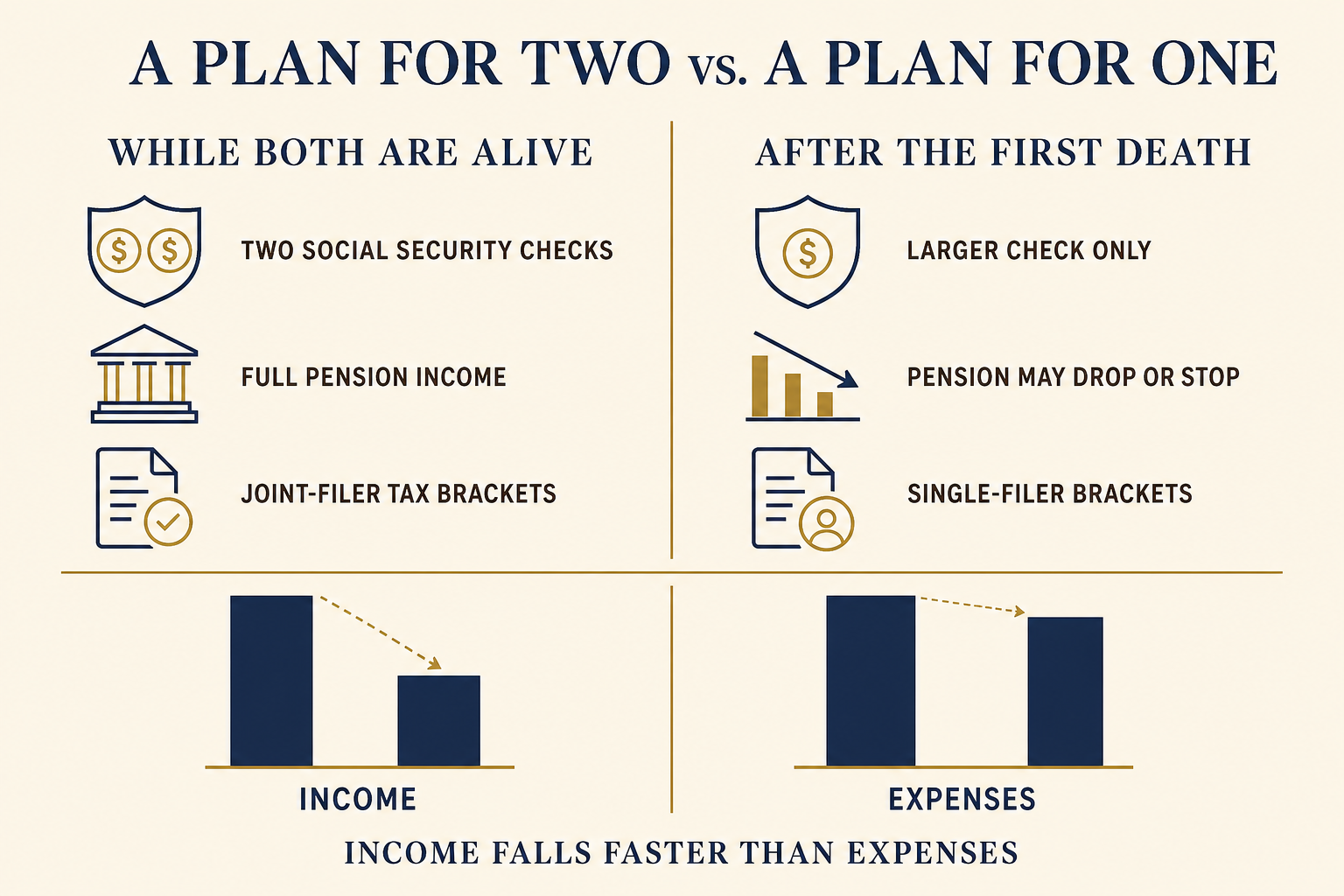
A retirement plan built for two people can quietly fail the moment it becomes a plan for one. Not because of grief, and not because of funeral costs. It fails because household income falls fast when the first spouse dies, and household expenses barely move.
Most couples never pressure-test their plan for this. They size their retirement income against the bills they pay together, while both Social Security checks and any pension are flowing. Then one of them dies first — statistically, one of them always does — and the survivor is left running a two-person house on something much closer to one person’s income. The Now, Soon, and Later bucket framework is built to make retirement income durable. But durable has to mean durable for the survivor, not just for the couple.
The floor you built for two has to hold for one
The heart of bucket planning is the Soon bucket — the guaranteed income floor made of Social Security, any pension, and, for some households, an income-focused Fixed Index Annuity. The job of that floor is to cover your essential expenses with money that does not depend on the stock market. When you size the Soon bucket, you are answering one question: how much guaranteed income do we need to keep the lights on no matter what markets do?
The mistake is answering that question only for the couple. The floor a household needs while both spouses are alive is not the floor the survivor needs. Property taxes, homeowner’s insurance, the utility bills, the car, most of the fixed cost of a life — none of that gets cut in half when one person is gone. Groceries and some discretionary spending drop, but the rest of the bills keep arriving at close to full price. A common planning assumption is that a survivor needs roughly 70–80% of the couple’s spending — on something closer to 55–65% of the couple’s income.
Two things happen the day the second check stops
The income side of that squeeze comes from two places, and both are decided years before anyone dies.
First, one Social Security check disappears. When a spouse dies, the survivor keeps the larger of the two benefits and the smaller one stops — the household does not keep both. This is the part people get wrong most often: it is not a 50% cut, it is the loss of the smaller check. Consider a couple collecting $2,600 and $1,700 a month. The survivor keeps the $2,600 and loses the $1,700 — a 40% cut to Social Security income overnight. I walked through how survivor benefits are calculated and timed in this piece on survivor benefit timing, and it is worth reading alongside this one.
Second, the pension election you made at retirement suddenly matters enormously. If the higher earner took a single-life pension for the bigger monthly payment, that income can stop entirely at death. If they elected a joint-and-survivor payout, a defined percentage continues. That choice, often made quickly at retirement to capture a larger check, is really a decision about the survivor’s floor. Read it that way when you make it.
The tax code treats the survivor like a stranger
Here is the part that catches people completely off guard. The year after a spouse dies, the survivor usually files as a single taxpayer. For a couple who spent decades filing jointly, the single brackets are a different world: the standard deduction is roughly half, and the tax brackets are roughly half as wide, so the same income gets pushed into higher rates. The Medicare income-related surcharge thresholds — IRMAA — are also far lower for a single filer, which means a survivor can drift into Medicare surcharges on an income that never triggered them as a couple.
So the survivor often faces the cruel arithmetic of less income taxed at higher rates. This is the survivor’s penalty, and it is severe enough that I gave it its own full article. It matters here because it changes how you should build the Later bucket while both spouses are alive.
Designing buckets that survive the first death
The good news is that every part of this is something you can build for in advance. Bucket planning is not just an allocation — it is a set of decisions, and three of them do most of the work.
Size the Soon bucket for the survivor, not the couple. This is the single most important change, and it reframes one of the biggest decisions in retirement. Delaying the higher earner’s Social Security to age 70 is often described as a bet on longevity. It is really survivor insurance. The higher earner’s benefit becomes the survivor benefit, so every dollar you add by delaying is a dollar that protects whichever spouse lives longer — for the rest of their life. When the guaranteed floor needs to hold for one person on a single income, the delayed benefit is doing exactly the job the Soon bucket exists to do.
Build the Later bucket with the survivor’s tax bracket in mind. The years when both spouses are alive and filing jointly are the widest tax brackets this household will ever see. That is the window to move money out of tax-deferred accounts and into Roth through deliberate conversions, so the survivor is not forced to pull every dollar of income through the narrow single brackets later. This is the same logic behind matching the right account types to each bucket: Roth money is ideal Later-bucket money precisely because it comes out tax-free when the survivor needs it most.
Keep the Now bucket funded through the transition. When someone dies, accounts do not retitle overnight. There is a lag while beneficiary claims are processed and joint accounts become individual ones. A survivor should never be forced to sell investments in a down market to cover living expenses during that lag. This is also where beneficiary designations quietly matter more than the will — an account with a named beneficiary passes directly and fast, keeping the Now bucket liquid when the survivor needs it.
Thomas’ Take: Most couples size their income floor for two people and never stress-test it for one. Flip it. Ask what the survivor’s guaranteed income and tax picture look like, and build the buckets to pass that test. If the floor holds for one, it more than holds for two.
A hypothetical that shows the whole picture
Consider a hypothetical couple: Ray and Margaret, both 72, living in a paid-off house outside Charlotte. Their essential expenses run about $5,000 a month. Ray, the higher earner, delayed his Social Security to 70 and collects $3,100; Margaret collects $1,600. Together with a small joint-and-survivor pension of $700, their guaranteed floor is $5,400 — comfortably above their essentials. Their Later bucket sits partly in a Roth, because they ran conversions in their late 60s.
Ray dies at 74. Margaret keeps his $3,100 benefit and loses her $1,600. The pension continues at 60% of its value, dropping to $420. Her guaranteed floor falls from $5,400 to about $3,520 — a real cut, but still close to her essential expenses, largely because Ray delayed. Her spending drops only to about $4,000, so she has a modest gap to fill. She fills it from the Roth in her Later bucket, which does not add to her taxable income in a year she is already newly filing as a single taxpayer. The plan bends. It does not break.
Now run the same story where Ray claimed at 62 for roughly $1,800, took the single-life pension for a bigger check, and left everything in a traditional IRA. Margaret’s floor would collapse to just her survivor benefit, the pension would vanish, and every dollar she pulled to cover the gap would land in the compressed single brackets. Same couple, same savings — a completely different retirement for the person left behind. The difference was entirely in the design.
The part that isn’t about money
There is a final piece that no bucket can hold, and it is the one survivors mention most. In the weeks after a death, the surviving spouse has to actually find everything — the account logins, the insurance policies, the pension paperwork, the list of what is owned and where. When that information lives only in the head of the person who died, a hard season gets harder.
This is exactly why I built The Just in Case Binder — a printable organizer that puts every account, beneficiary, policy, and password in one place your family can find. It is not a financial product and it is not advice; it is the paperwork side of the same idea. A bucket plan that survives the first death only works if the survivor can actually reach the buckets.
Key takeaways
- When the first spouse dies, income falls faster than expenses — plan for the survivor to need roughly 70–80% of the couple’s spending on a much smaller income.
- The survivor keeps the larger Social Security benefit and loses the smaller one; the pension survivor election made at retirement decides whether that income continues.
- Filing as a single taxpayer the following year means a smaller standard deduction, narrower brackets, and lower IRMAA thresholds — less income, often taxed at higher rates.
- Delaying the higher earner’s Social Security to 70 is survivor insurance; Roth conversions in the joint-filing years pre-position tax-free income for the survivor.
- Keep the Now bucket liquid through the transition, and keep beneficiary designations current so accounts pass quickly.
Frequently asked questions
Does the bigger or the smaller Social Security check stop when a spouse dies?
The smaller one stops. The survivor keeps whichever benefit is larger, so a household’s Social Security income drops by the amount of the lower check, not by half.
When does the higher single-filer tax actually hit?
Generally the tax year after the year of death. The year the spouse dies, a joint return is usually still allowed; after that, most survivors without a dependent file as single, which is where the narrower brackets and lower IRMAA thresholds apply.
Should the higher earner always delay Social Security to protect the survivor?
Not always — health, the need for income before 70, and the size of the gap between the two benefits all matter. But because the higher earner’s benefit becomes the survivor benefit, delaying it does double duty as longevity protection and survivor protection, which tips the decision toward waiting more often than people assume.
This article is published by Confluence Media Group LLC, an independent publisher of educational financial content. Thomas Clark is a Series 65 Investment Advisor Representative. The information provided is for educational and informational purposes only and is not personalized financial, tax, or legal advice. Past performance does not guarantee future results. All investing involves risk, including potential loss of principal. Consult a qualified professional before making financial decisions.
Confluence Media Group LLC is a separate entity from Confluence Capital Management, the investment advisory practice through which Thomas Clark provides advisory services. Advisory services are not offered through this publishing platform.
About Thomas Clark
Thomas Clark is the founder of Confluence Media Group LLC and a Series 65 Investment Advisor Representative. He has spent nearly two decades working with families on retirement planning, with a focus on Social Security optimization, retirement income coordination, and the bucket planning approach to building a guaranteed income floor.
Thomas writes and publishes at thomasclarkadvisor.com and is the author of The Just in Case Binder — a 148-page printable family financial organizer for households who want to make sure the people they love know where everything is.
He lives in North Carolina with his family.
Subscribe to the weekly newsletter · Get the Just in Case Binder

Thomas Clark is a Series 65 licensed investment advisor and experienced trader. He specializes in investing, retirement planning, and market analysis, helping individuals build wealth and make informed financial decisions.
