
The Roth Conversion Window Hiding in Your Gap Years
The 2025 tax law removed the year-end Roth conversion deadline — but not the reason to convert. Your low-income gap years before RMDs are still the cheapest tax years you'll ever have.

For two years, the retirement world braced for a deadline. The lower tax rates from the 2017 tax law were scheduled to expire at the end of 2025, and anyone sitting on a large traditional IRA heard the same drumbeat: convert to a Roth before the clock runs out, because rates are about to jump. Then the One Big Beautiful Bill made those rates permanent, and the deadline simply evaporated.
A lot of people exhaled and quietly crossed “Roth conversion” off the list. That’s the mistake. The deadline that actually mattered was never the one written into the tax code. It was the one on your own calendar, and it’s still ticking.
The deadline that disappeared
Here’s what changed. The 2017 Tax Cuts and Jobs Act set seven brackets — 10%, 12%, 22%, 24%, 32%, 35%, and 37% — but it built in an expiration date. Left alone, those rates would have snapped back to higher pre-2017 levels in 2026. That looming reversal is what drove the “convert now” urgency you heard everywhere.
The One Big Beautiful Bill Act, signed in July 2025, took the expiration out. Those seven brackets are now permanent law with no sunset, and the near-doubled standard deduction came along with them. The IRS has already published the 2026 inflation-adjusted figures under the new law.
So the pressure is off, right? Only if you misread why the window was valuable in the first place.
The window that actually matters: your gap years
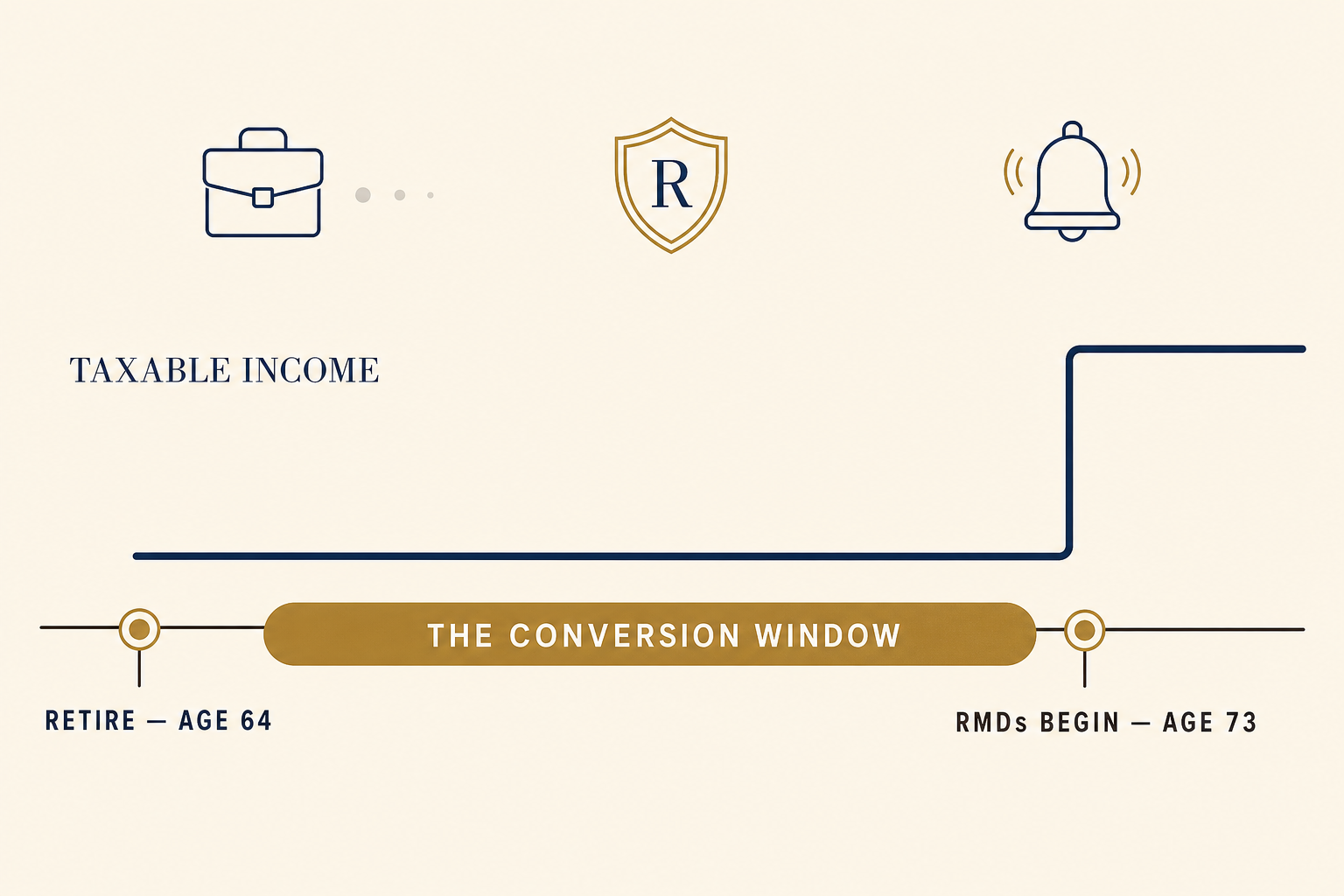
The real Roth conversion window has nothing to do with Congress. It’s the stretch of years between the day your paycheck stops and the day Required Minimum Distributions begin.
A Required Minimum Distribution, or RMD, is the amount the IRS forces you to pull out of your tax-deferred accounts each year once you hit the trigger age — 73 for anyone born between 1951 and 1959, and 75 for those born in 1960 or later. You don’t get to choose whether to take it. The IRS sets the amount, and it lands as ordinary income on top of everything else you’re already reporting.
Now look at the years just before that trigger. If you retire at 63 or 64, there’s often a stretch — sometimes eight or nine years — where three things are true at once. Your wages are gone. Social Security may not have started yet, especially if you’re delaying to 70 for the larger benefit. And RMDs haven’t kicked in. For that window, your taxable income can be the lowest it will be for the rest of your life.
That’s the opening. It has no headline, no act of Congress, and no notice in the mail. It opens the year you stop working and it closes the year RMDs start.
Why those years are the cheapest you’ll ever see
Start with the deductions. For 2026, the standard deduction for a married couple filing jointly is $32,200, and the temporary senior deduction created by the same 2025 law stacks on top of that for people 65 and older. That first slice of income comes off before a dollar is taxed. (I walked through how that senior deduction works in what the new Social Security law really does.)
Then look at the brackets themselves. For a married couple in 2026, the 12% bracket runs up to roughly $100,000 of taxable income, and the 22% bracket extends to about $211,000. During your gap years, much of that low-rate space sits empty. A Roth conversion lets you deliberately fill it — moving money out of a traditional IRA and paying tax on it now, at 12% or 22%, instead of watching those same dollars come out later at a higher rate, stacked on top of Social Security and forced RMDs. These same low-income years are when other tax breaks come within reach too, like the 0% capital gains bracket most retirees walk past — so a conversion has to be planned alongside them, not in isolation.
Consider the alternative. Do nothing, and at 73 the RMD arrives whether you need the money or not. A $1.5 million traditional balance throws off a first-year RMD of roughly $56,600 — income you didn’t ask for, taxed at your highest bracket. That extra income can drag more of your Social Security into taxation and can push you into higher Medicare premium tiers. The gap years are your chance to shrink that future forced withdrawal before it ever hits. This is the same forced-income problem I covered in the RMD first-year trap, viewed from the other end of the telescope.
Where this fits in the buckets
If you’ve read much of what I write, you know I organize retirement money into three buckets: a Now bucket for near-term spending, a Soon bucket built for guaranteed income, and a Later bucket for growth. Your traditional IRA and 401(k) usually live in that Later bucket, and they carry a quiet passenger: a tax bill you haven’t paid yet.
A Roth conversion is how you settle part of that bill on your own terms. You’re moving Later-bucket dollars out of an account the government taxes on its schedule and into a Roth, where qualified growth and withdrawals are never taxed again — and where there are no RMDs at all during your lifetime. If you’re still building the structure, start with how to actually set up your retirement buckets first; conversions come after the buckets exist.
Consider a hypothetical case, using round numbers for illustration and not a projection. Richard and Diane, both 64, just retired. They have $900,000 in traditional IRAs, a paid-off house, and enough cash in the Now bucket to cover two years of spending. They plan to delay Social Security until 70. That gives them roughly six years — 64 to 70, and really out to 73 before RMDs — with almost no reportable income. If they convert a measured amount each year, filling up the 12% bracket and reaching into the 22%, they can move a meaningful share of that $900,000 into a Roth at rates they may never see again. Left untouched, that same balance keeps compounding into a much larger RMD when Diane and Richard are 73 and least able to control the tax on it.
The two ceilings that decide how much to convert
Converting isn’t a “more is better” exercise. Two ceilings tell you when to stop in any given year.
The first is the top of a bracket you’re willing to pay. For most people in the gap years, that means filling the 12% bracket and, depending on the size of the traditional balance, reaching into the 22%. Converting a dollar that pushes you into the 24% bracket usually defeats the purpose, unless your future RMD-driven rate would clearly be higher.
The second ceiling is quieter and catches people off guard: IRMAA and the Social Security tax torpedo. IRMAA — the Income-Related Monthly Adjustment Amount — is a surcharge Medicare adds to your Part B and Part D premiums once your income crosses certain lines. For a married couple, the first threshold sits at $212,000 and is frozen there through 2027, per Medicare’s cost rules. A large one-year conversion can trip that surcharge two years later, and it can pull more of your Social Security into taxation at the same time. That’s why I favor converting a steady amount across several gap years rather than one aggressive move that blows through a Medicare tier.
This is the moment to run your own numbers instead of eyeballing it. A planning tool like ProjectionLab lets you model a multi-year conversion plan and watch what it does to your brackets, your future RMDs, and your Medicare premiums before you pull the trigger. (ProjectionLab is a paid tool; the link is an affiliate link, which means I may earn a small commission at no extra cost to you. I only recommend tools I’d use myself.) Seeing the whole runway at once is far more useful than converting blind and finding the surcharge on a statement two years later.
What most people get wrong
Two errors show up again and again. The first is treating the vanished sunset as a reason to do nothing. The 2025 law removed the artificial deadline, but the real clock — your gap years — is still running, and every year you don’t use it is a year of low-bracket room you can’t get back.
The second is converting on autopilot in the other direction: dumping a huge amount in a single year to “get it over with,” and tripping IRMAA and the tax torpedo in the process. The skill is pacing. You have a runway of several years; use all of it.
And here’s the part nobody tells you plainly. No letter arrives when this window closes. It doesn’t close with a headline or a tax-law change. It closes quietly, on an ordinary birthday, the year your first RMD lands and mandatory income crowds out the low-bracket space you used to have. The Big Beautiful Bill changed a great many things about the tax code. The one thing it left completely untouched is the window that matters most — and the fact that it belongs to you, not to Congress.
Key Takeaways
- The 2025 One Big Beautiful Bill made the lower tax brackets permanent, removing the year-end-2025 conversion deadline — but not the reason to convert.
- The real Roth conversion window is your “gap years”: the low-income stretch between retiring and the start of RMDs at 73 (or 75).
- In those years you can convert traditional-IRA dollars at 12% or 22% instead of paying higher rates later when RMDs and Social Security stack up.
- Watch two ceilings — the top of your target bracket, and the IRMAA/Social-Security-taxation thresholds — and convert steadily rather than all at once.
Frequently Asked Questions
If rates are permanent now, does a Roth conversion still make sense?
For many retirees, yes. Permanence removed the “beat the sunset” urgency, but it froze rates at historically low levels. The case for converting during your gap years rests on the gap between your low-income early-retirement years and the higher-income RMD years — and that gap didn’t change.
How much should I convert in a single year?
Enough to fill a bracket you’re comfortable paying — often the 12% and part of the 22% — without crossing an IRMAA threshold or pulling more Social Security into tax. The right number depends on your other income that year, which is exactly why a multi-year model beats a rule of thumb.
RMDs are years away for me. Why start now?
Because the low-bracket room in each gap year doesn’t roll over. A dollar of 12%-bracket space you don’t use at 64 is gone at 65. Spreading conversions across the whole runway is what keeps any single year from tripping a Medicare surcharge or a higher bracket.
This article is published by Confluence Media Group LLC, an independent publisher of educational financial content. Thomas Clark is a Series 65 Investment Advisor Representative. The information provided is for educational and informational purposes only and is not personalized financial, tax, or legal advice. Past performance does not guarantee future results. All investing involves risk, including potential loss of principal. Consult a qualified professional before making financial decisions.
Confluence Media Group LLC is a separate entity from Confluence Capital Management, the investment advisory practice through which Thomas Clark provides advisory services. Advisory services are not offered through this publishing platform.
About Thomas Clark
Thomas Clark is the founder of Confluence Media Group LLC and a Series 65 Investment Advisor Representative. He has spent nearly two decades working with families on retirement planning, with a focus on Social Security optimization, retirement income coordination, and the bucket planning approach to building a guaranteed income floor.
Thomas writes and publishes at thomasclarkadvisor.com and is the author of The Just in Case Binder — a 148-page printable family financial organizer for households who want to make sure the people they love know where everything is.
He lives in North Carolina with his family.
Subscribe to the weekly newsletter · Get the Just in Case Binder

Thomas Clark is a Series 65 licensed investment advisor and experienced trader. He specializes in investing, retirement planning, and market analysis, helping individuals build wealth and make informed financial decisions.
