
No Tax on Social Security? What the New Law Really Does
The 2025 tax law didn't stop taxing Social Security. It added a temporary senior deduction with age limits and income phase-outs, while the benefit-taxation math underneath stayed exactly the same.

If you heard that Social Security is now tax-free, you didn’t imagine it — but you didn’t hear the whole thing either. The 2025 tax law that got sold under the “no tax on Social Security” banner is real, and it does put money back in a lot of retirees’ pockets. What it actually does, though, is narrower, more temporary, and more conditional than the slogan. And the space between the slogan and the fine print is exactly where retirement plans get tripped up.
Here’s the plain version: the way your Social Security benefits are taxed did not change at all. What changed is a separate deduction, aimed at people 65 and older, that phases out as income rises and disappears entirely in a few years. If you plan around the headline instead of the mechanics, you can make a genuinely expensive mistake — claiming early expecting a tax break that won’t apply to you yet, or assuming a tax problem has been solved when it’s only been paused.
What the headline was actually about
The One Big Beautiful Bill Act, signed in July 2025, created a new “senior deduction”. If you’re 65 or older, you can deduct up to $6,000 — up to $12,000 for a married couple where both spouses are 65 or older. It stacks on top of the extra standard deduction seniors already get, and you can take it whether you itemize or use the standard deduction. It runs for tax years 2025 through 2028.
There are income strings attached. The deduction starts shrinking once your modified adjusted gross income passes $75,000 for a single filer or $150,000 for a married couple filing jointly, and it phases out completely above roughly $175,000 and $250,000 respectively. So it’s built for lower- and middle-income retirees, not high earners.
The White House’s own Council of Economic Advisers estimated that with this deduction in place, about 88% of seniors receiving Social Security will owe no federal tax on their benefits. That sounds enormous until you notice the baseline: roughly 64% already owed nothing. So the change moves the needle from about two-thirds to about seven-eighths. That’s a real expansion — it just isn’t the wholesale repeal the branding implies.
The key thing to hold onto: this is a deduction against your total taxable income. It is not a carve-out that makes Social Security dollars specifically tax-free. That distinction is the whole ballgame, and it’s why the next section matters more than the headline.
What the law did not touch
The formula that decides how much of your benefit is taxable is exactly what it was a year ago. It runs on a number the IRS and SSA call combined income — most people know it as provisional income. You calculate it by taking your adjusted gross income (not counting Social Security), adding any tax-exempt interest, and then adding half of your annual Social Security benefits.
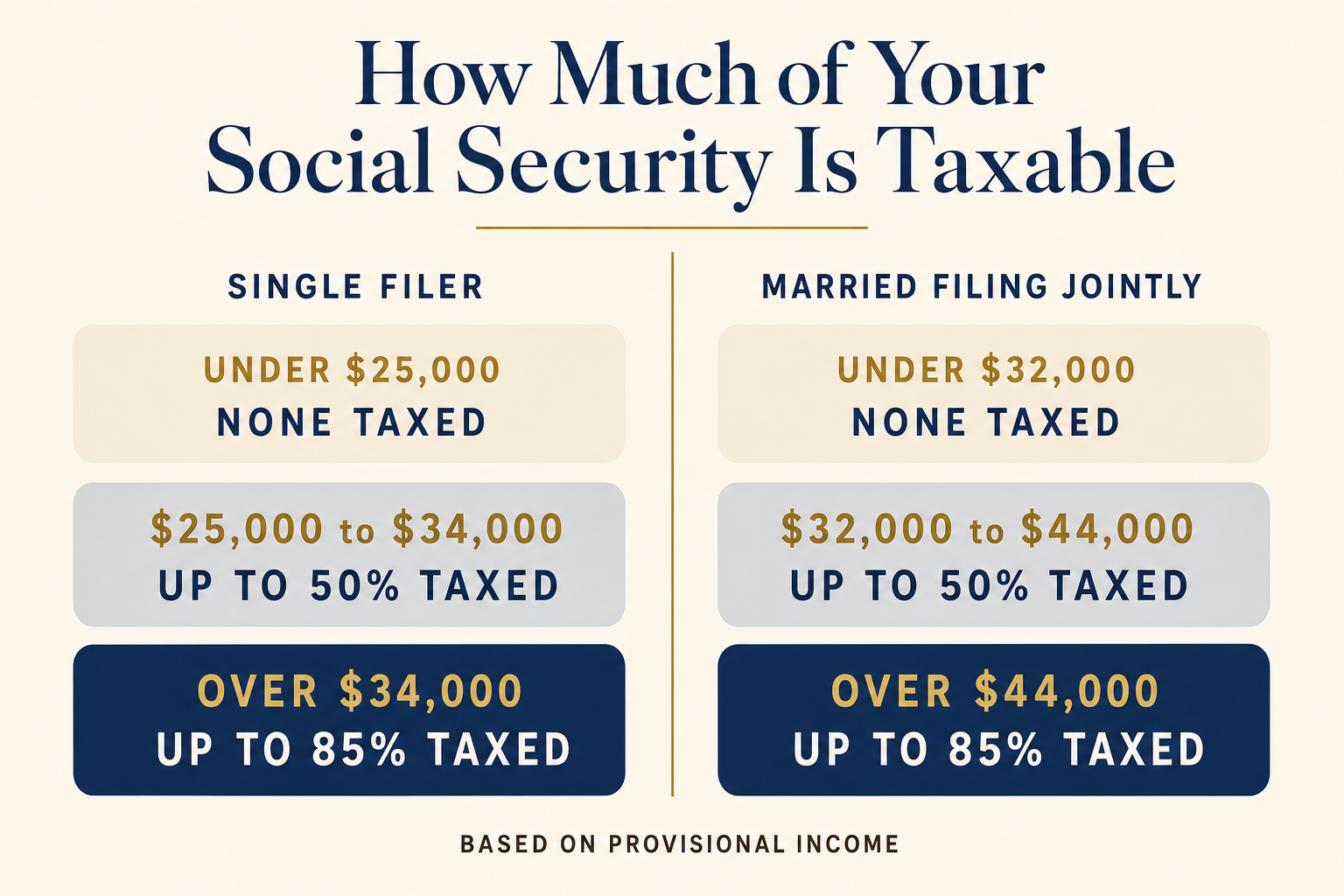
That provisional income number drops you into one of three tiers. For a single filer: under $25,000, none of your benefit is taxable; between $25,000 and $34,000, up to 50% can be taxed; above $34,000, up to 85% can be taxed. For a married couple filing jointly, the breakpoints are $32,000 and $44,000. The “up to 50%” and “up to 85%” are ceilings on how much of the benefit gets pulled into your taxable income — not tax rates themselves. (The IRS lays out the arithmetic in its guidance on Social Security income.)
Now the detail almost nobody mentions, and the reason this quietly gets worse every year: those thresholds were written into law in 1983 and expanded in 1993, and they have never been adjusted for inflation. A $25,000 line drawn in 1983 would be more than $80,000 in today’s dollars if it had kept pace. It didn’t. So every year, ordinary cost-of-living raises push more retirees over lines that haven’t moved since Reagan and Clinton were in office. The new senior deduction softens the blow for some people, but it doesn’t touch the machinery underneath, and that machinery keeps grinding in one direction.
Who this helps — and who it quietly leaves out
For a 66-year-old couple living on Social Security plus modest withdrawals, this deduction can be the difference between owing something on their benefits and owing nothing. That’s a real, meaningful win, and it’s worth claiming. But three groups get little or nothing, and they’re easy to miss.
Anyone under 65. The deduction is age-gated, not benefit-gated. If you claim Social Security at 62, you get zero help from this provision until the year you turn 65 — even though your benefits are fully subject to the same taxation rules the whole time. Don’t let “no tax on Social Security” nudge you into claiming early on the assumption the tax is gone. For most people it isn’t, and claiming early has its own steep, permanent cost.
Higher-income retirees. Because of the phase-outs, a couple with income comfortably into six figures may get a reduced deduction or none at all. The people most likely to have 85% of their benefits taxed are frequently the same people the deduction leaves behind.
Everyone, after 2028. This is scheduled to sunset. Unless Congress extends it, the deduction disappears for tax year 2029 and beyond, while the underlying taxation of benefits sails on unchanged. Building a permanent plan around a temporary provision is how you end up surprised.
Consider a hypothetical case. Margaret and Ray are both 66 and file jointly. Between them they collect about $46,000 a year in Social Security and pull roughly $20,000 from a traditional IRA. Their provisional income is the $20,000, plus half the Social Security ($23,000), which lands them around $43,000 — comfortably into the tier where a chunk of their benefits is taxable. The new $12,000 senior deduction reduces their taxable income enough that their federal tax on those benefits may effectively drop to nothing for now. Helpful — as long as they remember that if either their withdrawals climb or the deduction expires, the tax comes back, because the tier math never left.
The lever you actually control
Here’s the part that turns this from trivia into planning. Provisional income isn’t fixed — it’s partly a dial you turn, and the dial is which bucket you draw from.
Withdrawals from traditional IRAs and 401(k)s count toward provisional income. So do required minimum distributions once they kick in, which is why an RMD can push benefits into a higher taxation tier whether you need the money or not. Tax-exempt municipal bond interest counts too, an unwelcome surprise for people who assumed “tax-free” meant invisible to the IRS here. Qualified withdrawals from a Roth, by contrast, don’t count at all. That’s what makes a Roth conversion strategy so useful for managing Social Security taxation — dollars moved to a Roth in a low-income year come back out later without inflating the provisional income number that decides your benefit’s tax fate.
This is the same logic that runs through the whole bucket-planning approach: the Now bucket for near-term spending, the Soon bucket for a guaranteed income floor, and the Later bucket for growth. Coordinating which account you tap in which year is one of the highest-leverage moves available in retirement, and it’s the same instinct behind other quiet tax wins, from the 0% capital gains bracket to simply paying your retirement taxes without triggering a penalty. The window between retirement and the start of RMDs — and now, the window before this deduction sunsets in 2028 — is where a lot of that work gets done.
This is worth modeling rather than eyeballing. A planning tool like ProjectionLab lets you run your own numbers — test a year of Roth conversions against a year of larger IRA withdrawals and see what each one does to your provisional income, your benefit taxation, and your lifetime tax bill, instead of guessing. (ProjectionLab is a paid tool; the link is an affiliate link, which means I may earn a small commission at no extra cost to you. I only recommend tools I’d use myself.)
Thomas’ Take: A tax break you have to be 65 to use, that shrinks if you earn too much and vanishes in 2028, is not “no tax on Social Security.” It’s a helpful, temporary deduction — take it if you qualify. But build your plan on the math that isn’t going anywhere: the provisional-income tiers that decide how much of your benefit is taxed, and the fact that you can steer that number by choosing which bucket you draw from.
Key takeaways
- The 2025 law did not stop taxing Social Security benefits. The provisional-income formula and the up-to-85% taxation tiers are unchanged.
- What’s new is a senior deduction: up to $6,000 per person ($12,000 per couple) for filers 65 and older, for tax years 2025–2028.
- It phases out above $75,000 (single) / $150,000 (joint) in income and disappears entirely for high earners — and for everyone if it’s not extended past 2028.
- It does nothing for people under 65, so don’t let the headline talk you into claiming Social Security early.
- Provisional income is partly under your control. Which account you draw from — traditional, Roth, taxable — changes how much of your benefit gets taxed.
Frequently asked questions
Do I have to itemize to get the senior deduction?
No. It’s available whether you take the standard deduction or itemize, as long as you’re 65 or older by the end of the tax year and your income is under the phase-out limits.
Does the deduction lower the amount of my benefit that counts as taxable?
No — and this trips people up. It reduces your overall taxable income, which can lower or erase the tax you’d otherwise owe. But it doesn’t change the provisional-income calculation that determines how much of your benefit is pulled into taxable income in the first place.
Will this make my Social Security tax-free permanently?
Not on its own. The deduction is scheduled to expire after tax year 2028. Unless Congress extends it, the tax treatment of your benefits in 2029 reverts to the same rules that applied before — which never actually went away.
The cleanest way to think about all of this: a headline changed, and a temporary deduction got added. The system that taxes your benefits did not move. That’s not a reason to ignore the deduction — claim every dollar of it you’re entitled to. It’s a reason to keep planning around the part that’s permanent, because that’s the part that’s still quietly deciding how much of your Social Security you actually get to keep.
This article is published by Confluence Media Group LLC, an independent publisher of educational financial content. Thomas Clark is a Series 65 Investment Advisor Representative. The information provided is for educational and informational purposes only and is not personalized financial, tax, or legal advice. Past performance does not guarantee future results. All investing involves risk, including potential loss of principal. Consult a qualified professional before making financial decisions.
Confluence Media Group LLC is a separate entity from Confluence Capital Management, the investment advisory practice through which Thomas Clark provides advisory services. Advisory services are not offered through this publishing platform.
About Thomas Clark
Thomas Clark is the founder of Confluence Media Group LLC and a Series 65 Investment Advisor Representative. He has spent nearly two decades working with families on retirement planning, with a focus on Social Security optimization, retirement income coordination, and the bucket planning approach to building a guaranteed income floor.
Thomas writes and publishes at thomasclarkadvisor.com and is the author of The Just in Case Binder — a 148-page printable family financial organizer for households who want to make sure the people they love know where everything is.
He lives in North Carolina with his family.
Subscribe to the weekly newsletter · Get the Just in Case Binder

Thomas Clark is a Series 65 licensed investment advisor and experienced trader. He specializes in investing, retirement planning, and market analysis, helping individuals build wealth and make informed financial decisions.
