
Medicare’s $2,400 Part D Cap and Your December 7 Deadline
Medicare's Part D out-of-pocket cap rises to $2,400 in 2027, and a new payment plan can spread the cost across the year. Here's what to check before open enrollment ends December 7.

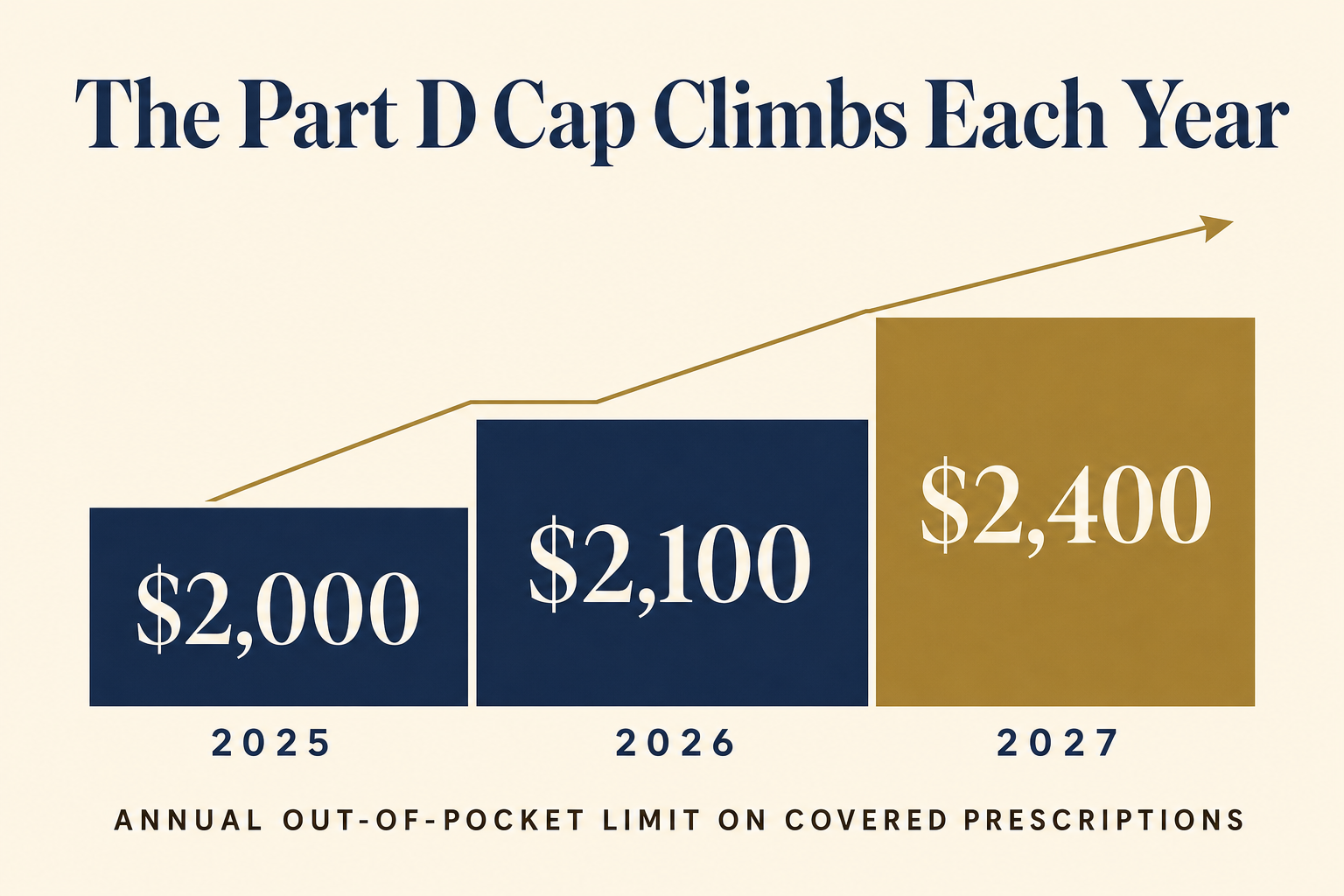
Something quietly changed in your Medicare drug coverage, and most people never noticed — because it only matters once your pharmacy bill gets big enough. Starting in 2025, Medicare put a hard ceiling on what you pay out of pocket for covered prescriptions. In 2025 that ceiling was $2,000. In 2026 it’s $2,100. For the 2027 plan year, it rises to $2,400.
If you’ve never come close to spending that much on medications, the cap is a safety net you hope you never need. But if you — or your spouse — take even one expensive brand-name or specialty drug, this is quietly the most important number in your coverage. And there’s a second change riding alongside it that almost nobody has used: an option to spread that cost across the year instead of absorbing it all at once.
Both of these should shape a decision you have to make before Medicare’s open enrollment window closes on December 7. Here’s what actually changed, and what to check before the deadline.
The Part D cap is real now — and it replaced something much worse
For years, Medicare Part D had no ceiling at all. Once you got past the deductible, you moved through a confusing series of phases — including the infamous “donut hole” coverage gap — and if you relied on a high-cost drug, you could spend many thousands of dollars a year with no stopping point.
The 2022 Inflation Reduction Act changed that. The donut hole as people knew it is gone, and there is now a single annual out-of-pocket maximum on covered Part D drugs. Once your spending on those drugs reaches the cap — $2,400 in 2027 — you pay nothing more for them for the rest of the calendar year. You can see the current figures on Medicare’s own page on Part D drug costs.
Who benefits most: anyone taking a brand-name or specialty medication, where a single prescription can carry a serious monthly price tag. Who barely notices: if your prescriptions are inexpensive generics, you may never reach the cap in a given year. That’s fine — it’s there if your health changes.
The cap limits the total — not the timing
Here’s the part people miss: the cap is a ceiling on your total for the year, not a schedule for how you pay it.
Say you take a specialty drug that costs around $800 a month. You could hit the full $2,400 within the first few months of the year — and then pay nothing for covered drugs after that. That’s wonderful for your annual total. It’s hard on your January, February, and March budget, when the bills all land at once.
The cap solved the “how much, total” problem. It didn’t solve the “all at once” problem. That’s where the second change comes in.
The Medicare Prescription Payment Plan — the option almost nobody used
Alongside the cap, Medicare introduced something called the Medicare Prescription Payment Plan. In plain terms: instead of paying the pharmacy at the counter each time you fill a prescription, you can choose to have your drug plan bill you monthly, spreading your out-of-pocket costs evenly across the year.
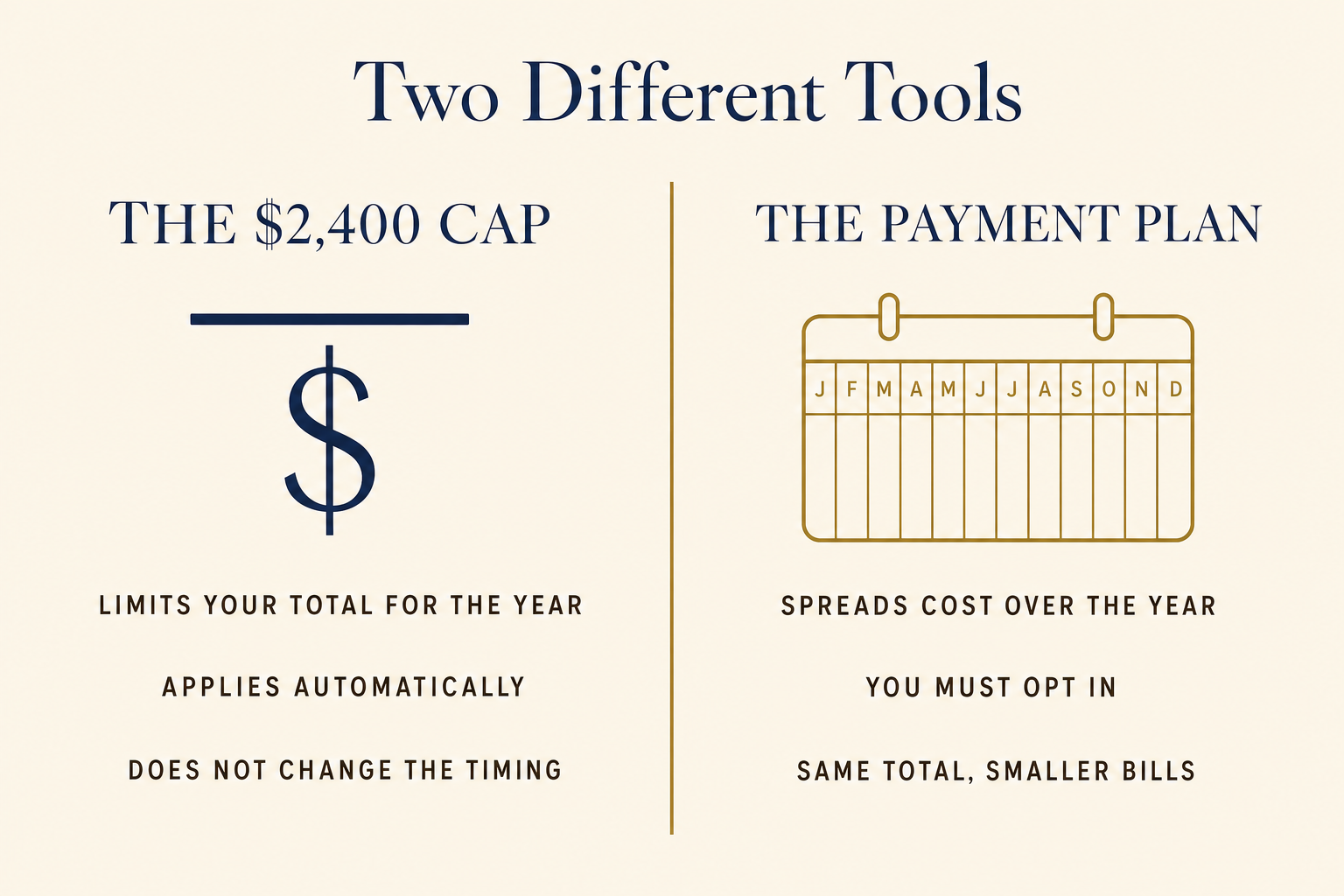
What it does not do: it does not lower your total. You’ll still pay up to the $2,400 cap over the year — you’re just paying it in smoother monthly installments instead of front-loaded lumps. There is no cost to participate. But there are a few things to know before you assume it’s automatic:
- It’s voluntary. Nothing happens unless you opt in with your drug plan. The plan won’t enroll you by default.
- It doesn’t follow you between plans. If you switch to a different plan for 2027, you have to opt in again with the new one.
- Leaving doesn’t erase the balance. If you drop out mid-year, you still owe whatever you’ve accumulated — just back on the normal schedule.
- If you get Extra Help (the low-income subsidy), this generally isn’t aimed at you, because your costs are already held low.
Who it helps: people with high, front-loaded drug costs who would rather budget a steady amount each month than open a large bill in February.
Thomas’ Take: The cap tells you the worst your drug year can cost. The payment plan tells you how you’d prefer to pay for it. Those are two separate decisions — and for once, you get to make both in your favor.
A hypothetical: meet Diane
Consider a hypothetical case: Diane, 68, recently retired from teaching, takes one specialty medication that runs about $600 a month. Under the old Part D rules, a drug like that could have cost her thousands of dollars over a year with no clear ceiling. Under the 2027 rules, her out-of-pocket spending on covered drugs stops at $2,400 — she’d reach that ceiling by spring and pay nothing more for that medication the rest of the year.
If Diane also opts into the payment plan, that $2,400 gets billed as roughly $200 a month across 2027 instead of landing as a few painful bills in the first quarter. Same total. Very different cash flow. (Diane is illustrative — your own numbers depend on your specific drugs and the plan you choose.)
What this changes about your December 7 decision
Here’s where I’ll be direct: don’t auto-renew. The single most common mistake I see people make with Medicare drug plans is treating them as set-and-forget. Plans change their covered-drug lists (their formularies), their pharmacy networks, and their prices every single year. The lowest-premium plan is often not the lowest-total-cost plan for someone who actually takes medication.
The cap changes that math in a specific way. Because every plan now shares the same $2,400 ceiling, what separates one plan from another is the path to that ceiling — which of your drugs are covered, at what tier, at which pharmacy. Two plans can both cap you at $2,400 and still cost very different amounts along the way, depending on whether your specific medications are covered and where you fill them.
So the question for the next few weeks isn’t “is my premium going up?” It’s “what’s my all-in cost for my actual drug list on this plan — and would I want the payment plan on top of it?” This is the same review most people skip when their plan quietly renews, and it’s worth doing properly. (It’s also worth remembering that switching between Medicare Advantage and Medigap isn’t always a two-way door, and that your Part B and Part D premiums can carry an IRMAA surcharge based on your income from two years ago — both reasons to look at the whole picture, not just one line.)
Your one-page check before December 7
You don’t need a spreadsheet. You need about an hour and a short list. Here’s the annual review worth doing before the window closes:
- Pull your plan’s Annual Notice of Change — the letter that arrived in September. It lists exactly what’s changing on your plan for 2027.
- Write down every prescription you take, with the dose. Include the occasional ones.
- Run that list through Medicare’s Plan Finder. It estimates your all-in annual cost on each plan — not just the premium.
- Compare total cost, not premium. Confirm your pharmacy is in-network on the plan you’re considering.
- Decide on the payment plan. If your drug costs are high and front-loaded, ask the plan you choose about opting into the Medicare Prescription Payment Plan for 2027.
- Act before December 7. After that, the window closes until next fall, with only limited exceptions.
For the first time, Medicare can tell you the most your prescriptions can cost you in a year. That’s genuinely good news — the open-ended risk that used to hang over anyone on an expensive drug finally has a number on it. Your job in the next few weeks is to find out what that number looks like on your plan, make sure your actual medications are covered at a pharmacy you use, and decide whether you’d rather pay it in a lump or spread it out.
Do that, and you walk into 2027 knowing your worst case instead of hoping for the best. Let the December 7 deadline slide by without looking, and you’ve quietly let last year’s plan make this year’s decision for you. If you’d like the plain-English version of changes like this every week, that’s exactly what the weekly newsletter is for.
This article is published by Confluence Media Group LLC, an independent publisher of educational financial content. Thomas Clark is a Series 65 Investment Advisor Representative. The information provided is for educational and informational purposes only and is not personalized financial, tax, or legal advice. Past performance does not guarantee future results. All investing involves risk, including potential loss of principal. Consult a qualified professional before making financial decisions.
Confluence Media Group LLC is a separate entity from Confluence Capital Management, the investment advisory practice through which Thomas Clark provides advisory services. Advisory services are not offered through this publishing platform.
About Thomas Clark
Thomas Clark is the founder of Confluence Media Group LLC and a Series 65 Investment Advisor Representative. He has spent nearly two decades working with families on retirement planning, with a focus on Social Security optimization, retirement income coordination, and the bucket planning approach to building a guaranteed income floor.
Thomas writes and publishes at thomasclarkadvisor.com and is the author of The Just in Case Binder — a 148-page printable family financial organizer for households who want to make sure the people they love know where everything is.
He lives in North Carolina with his family.
Subscribe to the weekly newsletter · Get the Just in Case Binder

Thomas Clark is a Series 65 licensed investment advisor and experienced trader. He specializes in investing, retirement planning, and market analysis, helping individuals build wealth and make informed financial decisions.
